

Missing an invasive plant when purchasing a property can prove far more costly than most buyers anticipate. Property devaluation of up to 20% has been recorded where invasive species go undetected, and the financial and legal consequences can follow homeowners for years. The challenge is that detection is rarely as straightforward as spotting an unusual-looking weed in the garden. Invasive plants spread underground through extensive rhizome networks that remain entirely invisible to the naked eye. This guide explains what invasive plant detection involves, what professional surveys include, and why getting it right matters enormously for buyers and remortgagees across England, Wales, and Ireland.
Table of Contents
- What is invasive plant detection?
- Why professional detection matters for property buyers and mortgagees
- Common pitfalls and edge cases in invasive plant detection
- Survey outcomes, management plans, and next steps
- Best practices and tips for successful invasive plant detection
- Why the biggest risk in plant detection is what you don’t see
- Get expert help with your invasive plant survey
- Frequently asked questions
Key Takeaways
| Point | Details |
|---|---|
| Detection protects value | Accurate detection prevents property devaluation, mortgage refusal, and legal headaches. |
| Professional surveys required | Mortgage lenders typically insist on PCA-accredited surveys and formal management plans for at-risk homes. |
| Hidden risks underground | Invisible rhizomes and dormant plants make detection tricky—certified experts are essential. |
| Early action pays off | Prompt expert checks save homeowners time, money, and future disputes. |
What is invasive plant detection?
Invasive plant detection is the systematic process of identifying, recording, and assessing non-native plant species that pose a risk to property, infrastructure, and biodiversity. In a residential context, detection goes well beyond a casual walk around the garden. Invasive plant detection involves systematic visual inspections, GPS mapping, photographic documentation, and identification of key features of species such as Japanese knotweed, Himalayan balsam, and giant hogweed.
The three species most frequently encountered during property surveys are:
- Japanese knotweed: Bamboo-like hollow stems with purple flecks, heart-shaped leaves, and the capacity to push through tarmac and concrete foundations
- Himalayan balsam: Tall pink-flowered annual that spreads aggressively along watercourses and damp ground
- Giant hogweed: Extremely hazardous to human skin, capable of causing severe burns, and a notifiable species under the Wildlife and Countryside Act 1981
One of the most common misconceptions is that detection is purely a visual exercise. In reality, the rhizome network of Japanese knotweed can extend up to 7 metres horizontally and 3 metres deep, meaning the plant’s true footprint is almost always larger than what appears above ground. You can learn more about invasive plant identification to understand the full range of species that may affect your property.
| Detection method | What it reveals | Limitations |
|---|---|---|
| Visual inspection | Above-ground growth, stem and leaf features | Misses dormant or underground spread |
| GPS mapping | Precise location and boundary proximity | Requires trained operator |
| Photographic documentation | Evidence trail for lenders and solicitors | Seasonal variation affects accuracy |
| Rhizome sampling | Underground spread and root health | Invasive; requires specialist equipment |
Statistic: Only 27% of invasive plant identifications made without professional assistance are accurate, underscoring why untrained detection carries significant risk for property transactions.
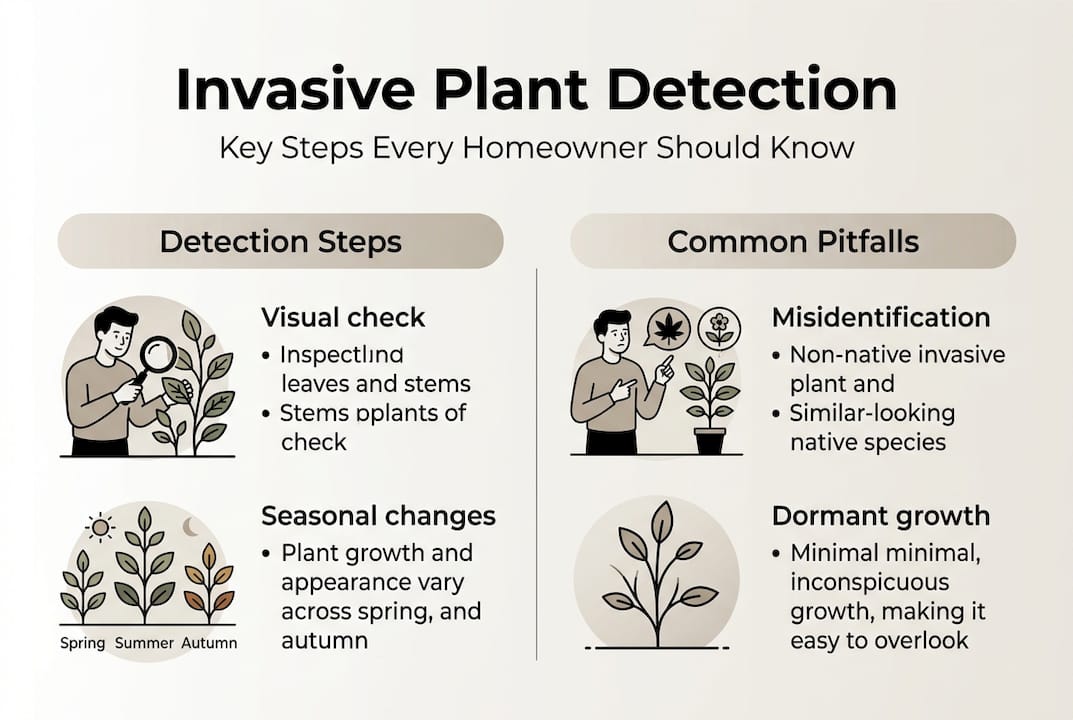
Seasonal variation adds another layer of complexity. Japanese knotweed is easiest to identify between April and October when stems and leaves are visible. Outside this window, dead canes and site history become the primary indicators, and accuracy drops considerably without specialist knowledge.
Why professional detection matters for property buyers and mortgagees
Understanding the technical process is important, but why does professional detection matter so much when buying or remortgaging? The answer lies in lender requirements, legal protection, and the accuracy gap between professional and non-professional assessments.
Professional surveys by PCA-qualified specialists are required by lenders to confirm the absence of invasive species or to provide formal management plans, including mapping, photographs, and risk assessments. Without this documentation, many mortgage applications will stall or be declined entirely.
A PCA-accredited survey typically includes:
- A thorough site inspection by a qualified specialist
- GPS mapping of all identified species and their estimated rhizome extent
- Photographic evidence compiled into a formal report
- A risk assessment graded by proximity to structures and boundaries
- An insurance-backed guarantee where treatment is recommended
The difference between a professional survey and a non-accredited check is significant. Review the professional survey checklist to understand exactly what a compliant report should contain before you commission one.
| Survey type | Lender accepted | Legal cover | Accuracy |
|---|---|---|---|
| PCA-accredited professional | Yes | Yes | High |
| Non-accredited specialist | Rarely | Limited | Variable |
| DIY or phone assessment | No | None | Low |
Misidentification is one of the most significant risks in non-professional assessments. Professionals trained to PCA standards avoid the 73% of errors that occur in untrained identifications by cross-referencing seasonal characteristics, growth patterns, and site history. The impact on property value from a missed or incorrectly assessed invasive species can be severe and long-lasting.

Pro Tip: Always request a copy of the surveyor’s PCA accreditation certificate before instructing a survey. This single document confirms that the report will be accepted by your lender and provides a clear evidence trail for your solicitor.
Common pitfalls and edge cases in invasive plant detection
Even with professionals involved, invasive plant detection can be fraught with complications. The trickiest pitfalls arise from misidentification, seasonal limitations, and the hidden nature of rhizome spread.
Japanese knotweed is consistently mistaken for other species, with only 27% of identifications accurate in recent data. Common lookalikes include bindweed and dogwood, both of which share superficial visual similarities during certain growth stages. Rhizome spread of up to 7 metres horizontally and 3 metres deep remains entirely invisible above ground, making surface-level inspections dangerously incomplete.
The most frequent pitfalls include:
- Winter dormancy: Dead canes can be overlooked or removed before a survey takes place, leaving no visible evidence
- Lookalike species: Bindweed, dogwood, and even some ornamental bamboos are regularly confused with Japanese knotweed by untrained observers
- Boundary spread: Rhizomes frequently extend beneath fences and walls from neighbouring properties, making the source difficult to trace
- Fragment regrowth: Rhizome fragments as small as 0.7 grams can regenerate into a full plant, meaning disturbed soil carries its own risk
Review the data on knotweed misidentification rates to understand how frequently errors occur and what the consequences look like in practice.
Pro Tip: Photograph any suspected invasive growth throughout the year, including in winter when dead canes are still present. A dated photographic record is invaluable to surveyors and can significantly improve detection accuracy.
“Success in invasive plant management is defined as two consecutive growing seasons with no regrowth. Anything short of this standard does not constitute eradication.” — PCA industry guidance
For guidance on your obligations once a plant is identified, visit reporting knotweed to understand the legal steps required under current legislation.
Survey outcomes, management plans, and next steps
After challenges are identified or a plant is confirmed, homeowners must decide what to do next. Understanding what your survey results mean and which steps follow is essential for protecting your investment.
Following a positive identification, you will typically receive:
- A formal risk assessment document grading the severity and proximity to structures
- A species map showing the estimated extent of above and below-ground growth
- A management plan outlining recommended treatment options and timescales
- Documentation suitable for submission to your lender and solicitor
The choice of treatment has a direct bearing on both success rates and lender acceptance. Property devaluation of 5 to 20% is common where invasive plants are present, but treatment success rates vary considerably by method. Herbicide-based programmes achieve 85 to 95% success over 3 to 5 years, while thermo-electric treatment reaches 90 to 98% success over 2 to 4 years.
| Treatment method | Success rate | Typical timescale | Chemical use |
|---|---|---|---|
| Herbicide programme | 85–95% | 3–5 years | Yes |
| Thermo-electric treatment | 90–98% | 2–4 years | No |
| Excavation and removal | High (site-dependent) | Weeks to months | No |
| Root barrier installation | Preventative | Immediate | No |
The RHS recommends non-chemical cultural methods such as digging and barriers as a first preference, acknowledging herbicides for severe or persistent cases. For homeowners seeking a fully chemical-free solution, thermo-electric treatment and root barrier installation offer credible, lender-accepted alternatives.
Review the full invasive weed assessment steps to understand the complete process from initial survey through to treatment sign-off and lender notification.
Best practices and tips for successful invasive plant detection
Now that you know what is involved and expected, here is how to ensure your plant detection process is accurate, efficient, and accepted by lenders and estate agents.
Choosing the right surveyor is the single most important decision you will make. Look for the following:
- PCA accreditation: Confirms the surveyor meets the Property Care Association’s professional standards
- Insurance-backed guarantees: Essential for lender compliance and long-term legal protection
- Documented site history: A thorough surveyor will review historical records, not just current growth
- Seasonal awareness: Ask whether the surveyor adjusts their methodology for winter surveys
- Written report format: Confirm the report format is accepted by your specific lender before instructing the survey
PCA-accredited surveys are the recognised standard for lender acceptance, with early professional intervention preventing both devaluation and potential legal issues under the Wildlife and Countryside Act 1981.
Pro Tip: Never rely on an over-the-phone assessment or a brief visual check from a non-specialist. These are almost universally rejected by lenders and provide no legal protection if invasive plants are later discovered.
Liaising with your solicitor early is equally important. Ensure all survey documentation is passed to your legal team promptly, as delays in submitting management plans can hold up exchange of contracts. Follow the assessment workflow guide to keep your transaction on track from survey to completion.
Why the biggest risk in plant detection is what you don’t see
Most guides focus on the visible: stem colour, leaf shape, growth rate. What they rarely address is the far greater risk that exists entirely below the surface. Standard inspections that concentrate on above-ground growth are, in our view, fundamentally incomplete.
Rhizome spread of up to 7 metres horizontally and 3 metres deep is invisible above ground, yet it represents the true extent of the problem. A property that appears clear of invasive plants at the surface may have an extensive rhizome network already undermining foundations or encroaching on neighbouring land.
Dormant plants and invisible spread account for the majority of failed remediation cases we encounter. Homeowners who accept a quick visual check as sufficient are taking a risk that no insurance policy or management plan can fully reverse after the fact. Insist on full GPS mapping, rhizome assessment, and a PCA-backed report. Anything less is not a survey; it is a glance. Explore free survey insights to understand what a thorough assessment should deliver before you commit to any property purchase.
Get expert help with your invasive plant survey
Armed with the right knowledge, it is time to secure your investment and peace of mind with professionals who understand the risks at every level, above and below ground.

Japanese Knotweed Agency carries out PCA-accredited invasive plant surveys across England, Wales, and Ireland, providing the formal documentation your lender and solicitor require. Whether you are facing a straightforward survey or dealing with dormant knotweed issues that are harder to detect, our specialists are equipped to assess and advise with authority. We also offer fully chemical-free knotweed solutions using thermo-electric treatment, root barrier installation, and excavation. For answers to the questions buyers and remortgagees ask most, visit our common survey questions page and take the first step towards a protected, compliant property transaction.
Frequently asked questions
What are the signs of Japanese knotweed on a property?
Look for bamboo-like stems with purple flecks, heart-shaped leaves, and rapid clumping growth, particularly near property boundaries and along drainage lines.
How important is a PCA-accredited survey for mortgage approval?
Most lenders require a PCA-accredited invasive plant survey and a formal management plan before approving a mortgage on a property where invasive species are present or suspected.
Can dormant invasive plants be detected in winter?
Yes, experienced surveyors can identify dormant knotweed via dead canes and site history, though identification is more challenging and requires specialist knowledge outside the main growing season.
What happens if invasive plants are discovered during a house survey?
You will need a formal management plan and, in most cases, a treatment programme, both of which are required for mortgage approval and compliance with current environmental legislation.
How successful are professional treatment options?
Herbicide treatments succeed 85 to 95% of the time over 3 to 5 years, while thermo-electric methods achieve 90 to 98% success within 2 to 4 years, making them the faster and chemical-free alternative.