
TL;DR:
- Industry-standard invasive weed surveys involve formal species identification, detailed mapping, and risk assessment by qualified specialists.
- Proper surveys must include documented chemical risk assessments and waste disposal plans to meet legal and lender requirements.
- Using accredited contractors ensures compliant reports, reducing transaction risks and legal liabilities in property sales involving invasive weeds.
Many homeowners assume that any garden inspection or general building survey will flag invasive weeds before a property sale completes. This assumption is, unfortunately, incorrect, and it costs buyers and sellers dearly. Property transactions regularly stall or fall through because weed survey evidence does not meet the standard conveyancers and mortgage lenders require. This guide explains precisely what an industry-standard invasive weed survey must include, which professional bodies set the benchmark, what documentation to request, and how to protect yourself legally when Japanese knotweed is involved in a property transaction across England, Wales, and Ireland.
Table of Contents
- What makes a weed survey ‘industry standard’?
- Essential steps and documentation for compliant surveys
- Japanese knotweed and legal obligations for homeowners
- Choosing the right contractor: accreditation and red flags
- Why overconfidence about weed surveys puts property sales at risk
- Next steps: professional support for standard-compliant surveys
- Frequently asked questions
Key Takeaways
| Point | Details |
|---|---|
| Standard matters | Only industry-standard weed surveys are accepted for legal disclosure and protect against future disputes. |
| Get proper documentation | Request full reports, risk assessments, and disposal records to meet compliance. |
| Choose accredited experts | Select contractors registered with PCA or INNSA for greater trust and quality assurance. |
| Legal impact | Disclosure of Japanese knotweed is mandatory on property paperwork and can affect sales. |
| Prevention beats cure | Addressing weed issues upfront with evidence-backed surveys reduces transaction risks later. |
What makes a weed survey ‘industry standard’?
With the importance of recognised standards clear from the outset, it is worth examining in detail what a compliant survey actually involves and why it differs so fundamentally from a general inspection.
An industry-standard invasive weed survey is a structured, evidence-based assessment carried out by a qualified specialist. It goes far beyond walking a garden and noting what plants are present. It involves formal species identification using recognised botanical criteria, systematic infestation mapping, photographic documentation, risk evaluation relative to structures and boundaries, and a written report formatted to meet requirements set by established trade bodies.
Two organisations define the benchmark in the United Kingdom. The Property Care Association (PCA) provides technical guidance linking survey methodology and reporting to safe, compliant herbicide practices, ensuring that any chemical management recommendations within a report are grounded in current safety frameworks. The Invasive Non-Native Specialists Association (INNSA) publishes a Code of Practice for managing Japanese knotweed, setting out the inspection, identification, and reporting standards that member contractors must follow.
Understanding the survey process for invasive weeds before engaging a contractor helps you ask the right questions and evaluate responses with confidence.
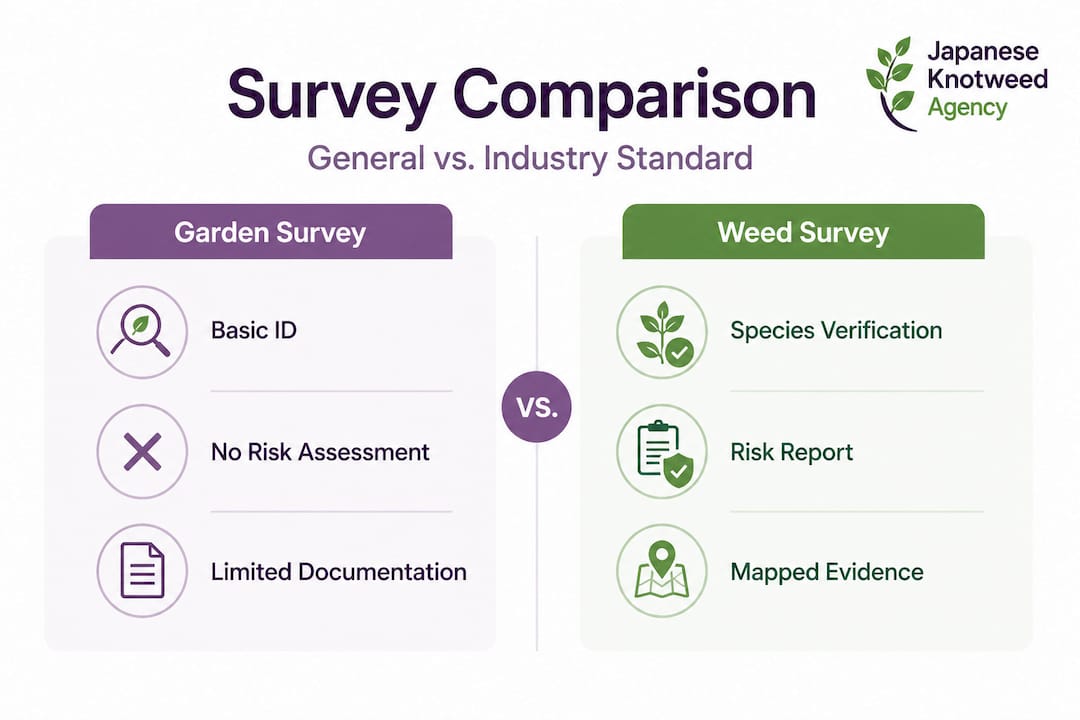
| Feature | Standard garden survey | Industry-standard invasive weed survey |
|---|---|---|
| Species identification | General observation | Formal botanical assessment |
| Infestation mapping | Not included | Detailed site plan with extent recorded |
| Risk evaluation | None | Structural, boundary, and neighbour risk assessed |
| Written report format | Variable | Aligned to PCA or INNSA codes |
| Treatment recommendations | Rarely provided | Included with options and timescales |
| Legal/lender suitability | Not applicable | Accepted by conveyancers and mortgage lenders |
| COSHH assessment | Not included | Required if herbicides are recommended |
Pro Tip: Before commissioning any survey, ask the contractor directly whether they hold active PCA or INNSA membership. A reputable specialist will confirm this without hesitation and should be able to provide a membership number you can verify independently through the relevant trade body’s online register.
Key features that distinguish an industry-standard survey include:
- Formal written identification of all invasive species present, including those beyond knotweed such as Himalayan balsam, giant hogweed, and invasive bamboo
- Georeferenced or scaled mapping of the infestation extent
- Assessment of proximity to structures, drainage, and neighbouring land
- Clear management options with timeframes and likely costs
- Documentation suited to mortgage lender requirements and conveyancing disclosure forms
Essential steps and documentation for compliant surveys
Once you know what makes a survey industry-standard, understanding the core procedural steps and the evidence trail you should expect helps protect your investment at every stage of a transaction.
A compliant survey follows a clear sequence. The surveyor begins with a desk-based review, examining any existing records, aerial imagery, and historical land use data to understand site context before attending in person. On site, the specialist conducts a systematic walk-over assessment, recording all invasive species by their accepted scientific names and noting growth stage, canopy spread, and evidence of rhizome disturbance.

Mapping follows identification. The infestation is plotted against a scaled site plan, with distances to buildings, drainage features, boundary walls, and neighbouring properties clearly recorded. This spatial data is fundamental; without it, a report cannot demonstrate whether the infestation poses a structural risk or falls under the seven-metre guidance zone that many mortgage lenders reference.
COSHH (Control of Substances Hazardous to Health) assessments are a non-negotiable component whenever herbicide treatment is proposed. These assessments must be tailored individually to the specific herbicide, the site conditions, and the precise task being undertaken. They cannot be generic template documents. Waste disposal must also be formally documented, as knotweed plant material is classified as controlled waste under UK legislation, and its movement and disposal must be recorded at each stage.
The following steps reflect what a compliant survey process should involve:
- Pre-visit desk-based assessment of the site and any historical records
- Formal on-site species identification using recognised botanical criteria
- Scaled infestation mapping with distances to key features recorded
- Structural and boundary risk evaluation
- COSHH assessment completed for any recommended herbicide programme
- Waste disposal plan documented in line with current legislation
- Written report issued in a format recognised by conveyancers and lenders
- Treatment plan provided with method options, timescales, and cost indications
- Signed documentation confirming contractor qualifications and trade body membership
When reviewing a report on Japanese knotweed from your surveyor, cross-reference it against this process to confirm nothing is missing. You can also use a detailed Japanese knotweed survey checklist to audit what you receive before relying on it in a transaction.
| Compliant survey report: typical contents | Purpose |
|---|---|
| Site address and survey date | Establishes formal record |
| Surveyor qualifications and membership | Confirms competence and accountability |
| Species identified with botanical names | Provides accurate legal identification |
| Scaled infestation map | Demonstrates extent and proximity to structures |
| Risk classification | Supports lender and conveyancer decisions |
| Treatment options with timescales | Enables informed management decisions |
| COSHH assessment reference | Confirms legal compliance for herbicide use |
| Waste management record | Documents controlled waste handling |
| Guarantees and warranty details | Provides long-term reassurance for buyers |
Familiarising yourself with best practices for safe herbicide use is worthwhile even if you are not personally applying any products, as it enables you to assess whether a contractor’s recommendations are proportionate and responsibly framed.
Japanese knotweed and legal obligations for homeowners
Beyond process, the legal framework connecting survey evidence to property disclosure obligations is something no homeowner involved in a transaction should overlook, particularly where knotweed is concerned.
The TA6 Property Information Form is the primary disclosure document in residential conveyancing in England and Wales. Sellers are required to answer directly on the question of Japanese knotweed, selecting Yes, No, or Not known, and TA6 requirements specify that supporting documentary evidence must accompany a positive or known disclosure. A bare verbal assertion carries no legal weight. Without a professional survey report and accompanying management plan, a seller’s disclosure is effectively unsubstantiated, which can cause mortgage applications to stall or fail entirely.
“The TA6 Property Information Form requires sellers to confirm whether Japanese knotweed is present or has previously been present within seven metres of the property boundary, and to provide supporting evidence of any management or treatment undertaken.”
Understanding your Japanese knotweed legal obligations before a sale or purchase is not optional; it is a fundamental part of responsible property ownership. Misrepresentation on a TA6 form can expose a seller to legal claims from buyers after completion, including claims for the costs of treatment and any resulting property devaluation.
For sellers, the must-do actions are:
- Commission a professional survey before listing the property, not after an issue is raised
- Obtain a written management plan and evidence of any treatment already carried out
- Disclose accurately on the TA6 form and attach supporting documentation
- Ensure any treatment provider issues a formal guarantee transferable to the buyer
For buyers, the must-do actions are:
- Do not accept a seller’s verbal assurance that knotweed is absent; request the survey documentation
- If the seller answers ‘Not known’, arrange an independent specialist survey before exchange
- Verify that any management plan cited in the disclosure remains active and the treating contractor is still operational
- Speak to your conveyancer about how selling with Japanese knotweed affects the transaction timeline
Mortgage lenders take knotweed very seriously, and mortgage decisions with knotweed on a property are rarely straightforward without a credible, up-to-date professional survey and an active management agreement in place.
Choosing the right contractor: accreditation and red flags
With compliance requirements in mind, the contractor you select to carry out the survey is just as critical as understanding which standards apply.
INNSA members adhere to a published Code of Practice, which sets out mandatory inspection protocols, reporting requirements, and professional conduct standards. This means that when you choose an INNSA member, you are engaging a specialist whose methods have been assessed against a defined benchmark. Conveyancers and mortgage lenders are increasingly familiar with INNSA-accredited reports, and some lenders specifically reference trade body membership as part of their assessment criteria.
PCA-accredited contractors operate under similarly rigorous requirements, with particular emphasis on the safe and legal management of herbicide-based programmes. Both PCA and INNSA memberships can be verified directly through each organisation’s online member directory.
Warning signs that a contractor falls short of industry standards include:
- Reports that contain generic text without site-specific detail or scaled mapping
- No reference to COSHH assessments in proposals involving herbicide application
- Inability to confirm active trade body membership when asked directly
- Vague treatment guarantees that do not specify duration, coverage, or transferability to new owners
- No evidence of professional indemnity insurance, which is essential for survey work used in property transactions
- Reluctance to provide client references from comparable survey projects
If a surveyor has missed knotweed on a property you have already purchased, the consequences can be significant, both financially and legally. This is precisely why verifying credentials before instructing any contractor is time well spent.
Pro Tip: Ask prospective contractors whether their treatment guarantees are transferable to a future buyer. A written, transferable guarantee backed by an insurance-backed warranty demonstrates a level of professional accountability that generic reports simply cannot provide.
Essential questions to put to any contractor before instructing them:
- Are you an active member of INNSA or PCA, and can you provide your membership number?
- Does your survey report format meet current conveyancing and mortgage lender requirements?
- Will you complete a site-specific COSHH assessment if herbicide treatment is recommended?
- Is your treatment guarantee transferable and backed by an insurance-backed warranty?
- What professional indemnity cover do you hold, and what is the limit?
Why overconfidence about weed surveys puts property sales at risk
In our experience at Japanese Knotweed Agency, the most costly mistakes in property transactions do not arise because homeowners are careless. They arise because homeowners are overconfident. The belief that any professional-looking report constitutes defensible evidence is surprisingly widespread, and it persists because the distinction between a basic inspection and a compliant industry-standard survey is not always immediately obvious from the paperwork.
A report can look thorough. It can contain photographs, site descriptions, and a recommendation for treatment. Yet, if it does not align with PCA or INNSA codes, lacks a scaled infestation map, or omits a COSHH assessment where one is legally required, it carries no real weight with a conveyancer or a lender’s surveyor. We have seen transactions collapse at a late stage precisely because the survey document a seller relied upon was not considered adequate evidence by the buyer’s mortgage provider.
There is also a meaningful difference between a report and defensible evidence. A report tells a story about what was found. Defensible evidence provides a documented, traceable, professionally accountable record that can withstand scrutiny, support an insurance claim, or hold its own in a legal dispute. Most guides on this subject stop short of drawing this distinction, but it is the one that matters most in practice.
The financial implications are real. When a sale falls through late in the process due to inadequate knotweed documentation, both parties bear costs: legal fees, survey fees, removal costs, and in some cases, the loss of an onward purchase. If a buyer discovers undisclosed knotweed after completion, they may pursue the seller for misrepresentation, a route explored in detail in our guidance on knotweed non-disclosure actions.
The straightforward conclusion is this: investing in a genuinely industry-standard survey from an accredited specialist is not a premium option. It is the baseline requirement for a transaction that stands on solid ground.
Next steps: professional support for standard-compliant surveys
Navigating invasive weed surveys and knotweed disclosures is far more manageable when you have access to experienced, accredited professionals who understand what conveyancers and lenders actually require.
Japanese Knotweed Agency carries out professional property surveys for invasive weeds across England, Wales, and Ireland. As pioneers of chemical-free thermo-electric treatment, delivering up to 5,000 volts directly to the rhizome network, we offer an approach that is both highly effective and environmentally responsible. Our survey reports are structured to meet industry standards, and our treatment programmes include root barrier installation and excavation works where required. Whether you are a buyer, seller, or property professional, our team is ready to provide the documented evidence and management plans your transaction demands. Contact us to arrange a survey or explore our full range of invasive weed solutions.
Frequently asked questions
Are industry-standard weed surveys necessary for every home sale?
If there is any suspicion or visible evidence of invasive plants, a recognised industry-standard survey is essential to meet disclosure requirements and support mortgage or insurance needs, as TA6 guidance links knotweed disclosure directly to specialist survey evidence.
What is the difference between a general garden survey and an industry-standard invasive weed survey?
Only the industry-standard survey is carried out to recognised codes, contains a full risk assessment, and provides property transaction-compliant evidence, as PCA and INNSA standards far exceed what a basic garden inspection delivers.
What documents should I ask for after an invasive weed survey?
Request the full survey report, treatment recommendations, a COSHH risk assessment if herbicides are proposed, and evidence of waste disposal, as COSHH documentation is a legal requirement for any compliant programme involving chemical control.
Is INNSA or PCA accreditation mandatory for contractors?
While not strictly required by law, using PCA or INNSA members ensures surveys meet current codes and are trusted by conveyancers and lenders, as INNSA’s Code of Practice is a widely adopted industry benchmark for inspection and reporting quality.
What if my seller claims not to know about knotweed?
A ‘Not known’ answer on the TA6 form typically means a specialist survey should be arranged before exchange, as TA6 guidance advises that ‘Not known’ is appropriate only when no evidence exists, pending independent survey confirmation.