
TL;DR:
- Homes with Japanese Knotweed can lose 5% to 15% of their value even after treatment.
- Legal, survey, and disclosure obligations are strict, impacting mortgage approvals and sale processes.
- Buyer stigma persists, often reducing property offers despite scientific evidence of minimal structural risk.
Homes with a history of Japanese Knotweed can lose between 5% and 15% of their value, and the value drops persist even after professional treatment. Many sellers still underestimate this risk, assuming that once the plant is gone, the problem disappears with it. In reality, buyers, mortgage lenders, and solicitors across England, Wales, and Ireland are increasingly demanding invasive weed surveys, formal management plans, and documented evidence before any sale can proceed. This guide explains precisely what the risks are, what legal and survey obligations you face, and what practical steps you can take to protect your property sale.
Table of Contents
- How invasive weeds threaten home sales: the real risks
- Survey standards and legal requirements: what you must know
- Stigma and price: lasting impact beyond treatment
- Prevention and realistic solutions: what actually works
- Our perspective: cutting through the fear and finding practical solutions
- Practical help for homeowners: take the next step
- Frequently asked questions
Key Takeaways
| Point | Details |
|---|---|
| Disclosure is critical | Sellers must declare invasive weeds and provide supporting documentation to avoid legal issues and delays. |
| Stigma lingers after treatment | Property value and buyer caution can persist for years, regardless of professional remediation. |
| Prevention pays off | Regular inspections and proactive management have the best chance to protect your sale and home value. |
| Follow best practice surveys | Modern RICS guidance requires detailed weed surveys, which directly affect sales and lending decisions. |
How invasive weeds threaten home sales: the real risks
To understand what homeowners really face, let’s break down the tangible effects of invasive weeds on home sales.
Japanese Knotweed is capable of pushing through tarmac, concrete, and building foundations. Its rhizome network, the underground root system that can extend several metres in every direction, is extraordinarily resilient. But beyond the physical damage, the commercial and legal consequences of its presence on or near a property are often what cause the greatest disruption to a sale.
The impact on property values is well documented. Research consistently shows that affected properties lose between 5% and 15% of their market value. What surprises many sellers is that this reduction frequently persists long after treatment has been carried out, because buyer and lender caution does not automatically lift once the plant is no longer visible.
| Risk factor | Potential consequence |
|---|---|
| Knotweed on-site (untreated) | Sale blocked, mortgage refused |
| Knotweed history (treated) | Reduced offers, lender conditions |
| Non-disclosure to buyer | Litigation, compensation claims |
| Adjacent/neighbouring knotweed | Survey flagged, buyer concern |
Mortgage lenders have tightened their approach considerably. Many now refuse to lend on properties where knotweed is identified within a certain distance of the structure, or they impose costly indemnity insurance requirements. Knotweed’s conveyancing impact is now a recognised factor in the conveyancing process, with solicitors routinely asking about invasive species as part of standard property disclosure.
Buyers are also far more informed than they were a decade ago. Common buyer responses to a knotweed disclosure include:
- Requesting an independent invasive weed survey before exchange
- Reducing their offer to account for perceived or actual risk
- Withdrawing from the purchase entirely
- Demanding a fully costed and guaranteed management plan be in place
The legal risk for sellers who fail to disclose is serious. Courts have awarded significant compensation in cases where buyers were not informed about knotweed. You can find practical information on how to effectively manage knotweed problems before and during the sale process, but disclosure must come first.
Important: Concealing a known invasive weed problem does not make it go away. It creates legal exposure that can outlast the sale and result in claims for damages years later.
Survey standards and legal requirements: what you must know
Knowing the risks, it’s crucial to understand surveying standards and legal duties.
The RICS 2022 guidance replaced the older 7-metre proximity rule with a four-category risk classification system. This is now the accepted standard across mortgage lenders, surveyors, and conveyancers in England, Wales, and Ireland.
| Category | Risk level | Recommended action |
|---|---|---|
| A | Highest risk (on-site, causing damage) | Immediate treatment required |
| B | On-site, not causing damage | Treatment recommended |
| C | On-site, managed or contained | Monitor and manage |
| D | Off-site only (neighbouring land) | Record and disclose |
This shift matters enormously. Under the old rules, proximity alone determined lender decisions. Under the 2022 system, surveyors assess actual risk. A Category D finding, where knotweed exists only on adjacent land, may not block a mortgage at all. A Category A finding, however, will typically halt a sale until a management plan is in place.
Your legal disclosure obligations are equally important. When completing the TA6 property information form in England and Wales, you are required to declare any known invasive plants. Failing to do so can constitute misrepresentation. Use this survey checklist to ensure nothing is missed before you instruct a surveyor.
Here is the sequence most sellers should follow before listing a property:
- Commission a professional invasive weed survey from a qualified specialist
- Obtain a written report using the RICS 2022 category system
- Disclose the findings honestly on your property information form
- If treatment is required, secure a management plan with a transferable guarantee
- Share all documentation with your solicitor and the buyer’s conveyancer
Pro Tip: If you are unsure whether to report knotweed on a neighbouring property, err on the side of caution. A proactive approach to disclosure consistently performs better in buyer negotiations than a reactive one.
Understanding knotweed laws is equally essential, particularly the obligations around allowing knotweed to spread to neighbouring land, which can result in enforcement action under the Wildlife and Countryside Act 1981 and the Anti-social Behaviour, Crime and Policing Act 2014.
Stigma and price: lasting impact beyond treatment
Even if you follow every survey and treatment rule, a deeper challenge remains.

Research from the University of Leeds found that Japanese Knotweed poses less structural risk to buildings than was previously assumed. Despite this, the stigma surrounding the plant continues to influence buyer behaviour, lender policy, and market valuations. The gap between actual risk and perceived risk is wide, and sellers bear the consequences.
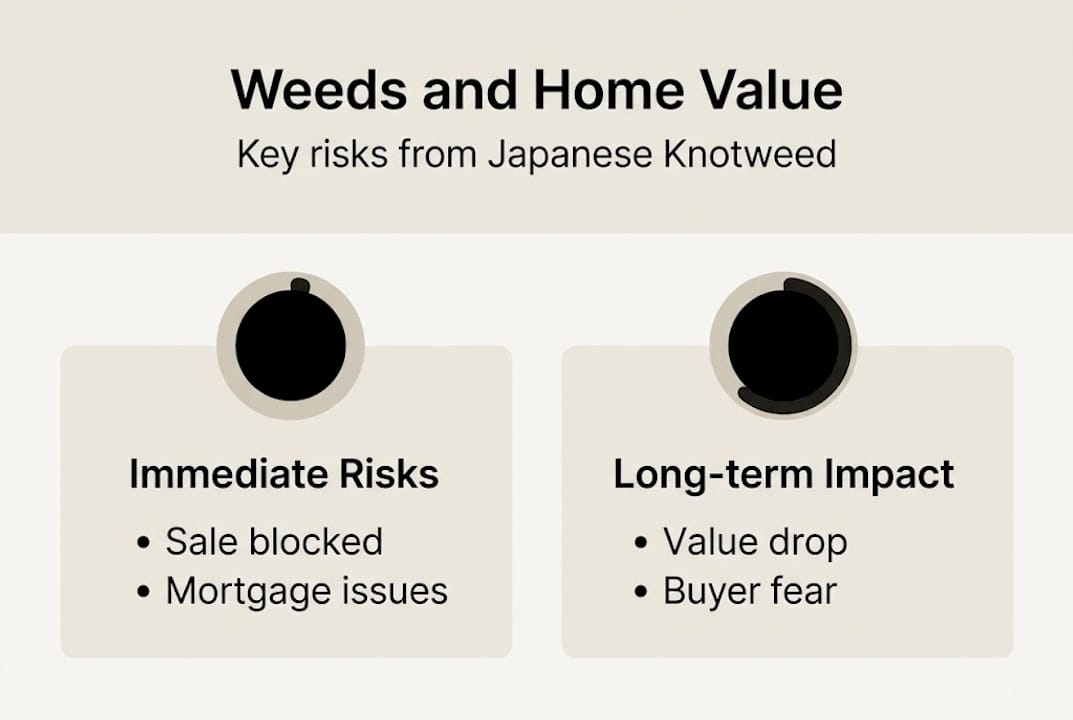
Properties with a disclosed history of knotweed, even fully treated and certified properties, routinely attract lower offers. Buyers factor in the emotional discomfort of having purchased a property with a knotweed history, regardless of what the survey says. This is not irrational on the buyer’s part; it reflects a market reality that sellers need to plan for.
The property industry impacts of this stigma are wide-ranging. Insurers, valuers, and lenders all apply a degree of caution that the underlying science does not always justify. Common ways stigma continues to affect sales post-treatment include:
- Buyers requesting price reductions of 5% to 10% even when treatment is complete
- Lenders imposing retention conditions on mortgage offers
- Valuers noting the knotweed history in their reports, which then affects comparable sales data
- Delays caused by buyers seeking second opinions or independent surveys
Pro Tip: If you are selling with knotweed, prepare a clear, concise information pack for prospective buyers. Include your survey report, treatment records, the management plan, and any transferable warranty. Buyers who feel informed are considerably less likely to withdraw or seek large price reductions.
The most effective approach is to present evidence systematically, not defensively. Buyers who receive thorough documentation at the outset are far better positioned to instruct their mortgage lender and conveyancer quickly, which keeps the sale moving.
Prevention and realistic solutions: what actually works
Despite the persistent challenges, there are smart, proactive ways to protect your sale.
The most damaging scenario for any property sale is the discovery of Japanese Knotweed during the buyer’s survey, with no management plan in place. This creates maximum uncertainty at the worst possible time. Early identification and documented action change the negotiating position entirely.
Here is a practical sequence that consistently yields better outcomes for sellers:
- Carry out a routine site inspection each spring and summer, when knotweed is most visible
- Commission a professional survey if you identify any suspect growth, before marketing the property
- Begin treatment as early as possible; earlier intervention means more treatment cycles completed before sale
- Document every site visit, treatment delivery, and follow-up inspection in writing
- Ensure your management plan includes a transferable guarantee that the buyer can rely on after purchase
Chemical-free treatment options, including thermo-electric treatment methods that deliver direct energy to the rhizome network, are increasingly well regarded by buyers and lenders. They remove the concern about herbicide residue in the soil and appeal to buyers with environmental priorities. Clear documentation of weed management and transparency with buyers are key to restoring trust in the property.
Pro Tip: Review the property survey workflow before instructing a surveyor. Knowing what to expect at each stage helps you prepare your documentation in the correct format and sequence, which speeds up the process considerably.
Preventive work is also worth considering for properties not yet on the market. A clear survey confirming no invasive weed presence can be a positive marketing point, reassuring buyers before they even ask the question.
Our perspective: cutting through the fear and finding practical solutions
Let’s step back and share what many experts and homeowners overlook about invasive weeds and property sales.
Much of the guidance available to homeowners sits at one of two extremes: alarmist content that treats knotweed as an insurmountable obstacle, or dismissive content that underplays genuine legal and financial risk. Neither serves sellers well.
The honest position is this: market practice has changed slowly despite research showing lower structural risk than feared. Stigma is real, lender caution persists, and legal obligations are strict. But sales are achievable. Sellers who approach the situation with evidence, transparency, and a clear managing knotweed impact strategy consistently outperform those who delay or avoid action.
The sellers who struggle most are those who hope the problem will resolve itself or who provide minimal documentation under pressure. Buyers and their solicitors are experienced at identifying gaps. Ethical, evidence-based communication, supported by a professional survey, a credible management plan, and honest disclosure, is what tips the outcome in the seller’s favour. This is not wishful thinking; it is a practical framework that works.
Practical help for homeowners: take the next step
For homeowners ready to act, there are practical steps and trusted support available.
At Japanese Knotweed Agency, we provide professional invasive weed surveys across England, Wales, and Ireland, using the RICS 2022 category framework. Our chemical-free thermo-electric treatment delivers up to 5,000 volts directly to the rhizome network, causing internal cell damage and depleting the plant’s energy reserves without herbicides or soil contamination.
We also offer root barrier installation and excavation works, alongside fully documented management plans that satisfy lender and conveyancer requirements. Whether you need a pre-sale survey, a treatment plan, or clear guidance on your legal position, our eradication plan guide and Knotweed FAQs are a strong starting point. Contact us to discuss your property’s specific situation.
Frequently asked questions
Do I have to declare invasive weeds when selling my home?
Yes, you must declare known invasive weeds, including Japanese Knotweed, on your property disclosure forms. Non-disclosure can lead to litigation and compensation claims long after the sale completes.
Can I sell my house if it has Japanese Knotweed?
Yes, but buyers and lenders often require a management plan and proof of treatment before proceeding. The RICS 2022 categories dictate what lenders and surveyors will require based on the risk classification of the infestation.
Will my home’s value recover after treating invasive weeds?
Property values may remain impacted even after successful treatment, because stigma persists in the minds of buyers and lenders regardless of the scientific evidence.
What survey do I need for invasive weeds in 2026?
RICS 2022 guidance is the accepted standard; look for surveyors who use categories A-D and provide thorough reports. This four-category framework now governs mortgage and conveyancing decisions across England, Wales, and Ireland.