TL;DR:
- Finding Japanese knotweed on your property can pose serious legal, financial, and environmental risks if left unaddressed. Early detection and thorough documentation are essential for effective, chemical-free eradication and for protecting property value, legal interests, and biodiversity. Accurate records including photographs, location, and plant features support coordinated management, reduce costs, and prevent unintentional spread.
Finding Japanese knotweed or another invasive plant on your property may feel like a private matter, but ignoring it carries serious legal, financial, and environmental consequences. Many homeowners assume that concealing the find or adopting a wait-and-see approach is the safest course, yet this instinct frequently makes situations far worse. Early detection and rapid response are widely recognised as the most effective tools for preventing invasive species from establishing permanently. This guide explains precisely what to document, why the records matter, and how a clear account of your find lays the groundwork for lawful, chemical-free eradication.
Table of Contents
- Understanding the risks of invasive species on your property
- Why documenting finds is critical: legal, environmental and practical reasons
- What to document and how: a practical homeowner checklist
- How reporting unlocks chemical-free solutions and coordinated action
- What most homeowners miss about documenting invasive species
- Take control: next steps for homeowners dealing with invasive species
- Frequently asked questions
Key Takeaways
| Point | Details |
|---|---|
| Early documentation is vital | Recording invasive species early protects your home and enables rapid, effective action. |
| Follow legal and expert advice | Reporting is sometimes a legal duty and always improves chances of successful, chemical-free eradication. |
| Collect accurate evidence | Clear photos, location, and dates ensure your report supports control measures and expert response. |
| Reporting prevents costly mistakes | Accurate documentation helps avoid accidental spread and long-term expenses. |
Understanding the risks of invasive species on your property
Japanese knotweed is arguably the most damaging invasive plant affecting homes across England, Wales, and Ireland, but it is not alone. Himalayan balsam, giant hogweed, and rhododendron also cause significant ecological and structural harm. Understanding what you are dealing with is the necessary starting point before any documentation or management can begin.
Japanese knotweed is uniquely aggressive because its rhizome network, the underground root system, can extend three metres deep and seven metres outward from visible stems. A fragment as small as a fingernail is enough to establish an entirely new colony. This is why how Japanese knotweed spreads through gardens, watercourses, and construction sites is so alarming: accidental disturbance, including strimming or mowing, can turn a contained stand into a neighbourhood-wide infestation within a single growing season.
The practical consequences for homeowners are substantial:
- Property value: Mortgage lenders frequently refuse applications on properties where Japanese knotweed is present or within seven metres of a building. This can stall sales and force significant remediation costs before a transaction can proceed.
- Legal liability: Allowing knotweed to spread onto a neighbouring property or public land can constitute a private nuisance under civil law, exposing you to costly litigation.
- Structural damage: The plant’s hollow canes and rhizomes can push through tarmac, concrete foundations, drainage systems, and cavity walls, particularly in older properties.
- Environmental harm: Invasive plants reduce native biodiversity by outcompeting established species and altering soil chemistry, with effects that persist long after the visible plant is removed.
“Japanese knotweed can spread via fragments and after cutting (e.g., strimming/mowing), so verified records help prevent accidental spread.”
Understanding JKW containment explained helps clarify why recording a find before any physical work begins is so important. Containment requires an accurate baseline, and that baseline starts the moment you first identify the plant.
Pro Tip: If you suspect Japanese knotweed on your land, do not cut, strim, or disturb any growth before documenting it thoroughly. Disturbance is the leading cause of unintentional spread to new areas.
With the risks clear, it is important to tackle why documentation is the essential next step.
Why documenting finds is critical: legal, environmental and practical reasons
Documentation is not merely good practice. In certain circumstances it is a legal requirement, and in others it is a practical safeguard that protects you against future disputes, unexpected costs, and regulatory scrutiny.
When reporting is legally required
For invasive non-native animals in England and Wales, government guidance is explicit: there is a duty to report certain sightings of non-widely spread species to the non-native species secretariat. Failure to do so can constitute a legal offence. While the position for invasive plants is less prescriptive at the individual homeowner level, the legal context around Japanese knotweed is tightening year on year.
When reporting is strongly advised
Even where there is no formal legal duty, reporting is clearly in a homeowner’s interests. Across Scotland, for instance, homeowners are asked to report Japanese knotweed via the Scottish Invasive Species Initiative, supporting coordinated management across entire catchments. Similar voluntary frameworks operate in England, Wales, and Ireland, guided by local authorities and specialist agencies.
Key reasons to document and report, regardless of geography, include:
- Audit trail: A dated, evidenced record establishes when you first identified the plant, protecting you if a neighbour later claims the infestation originated from your land.
- Insurance: Some insurers require evidence of prompt identification and response when processing knotweed-related claims for structural damage.
- Resale disclosure: Sellers are expected to disclose known invasive species on a property. A well-documented management history demonstrates responsible stewardship and can actually reassure buyers rather than deter them.
- Coordinated management: Councils and specialist agencies can only coordinate catchment-wide control when they know where infestations exist. Your record contributes to neighbourhood and regional responses that benefit everyone.
“Failure to record early sightings means infestations grow unchecked, often increasing treatment complexity and future costs by a significant margin.”
Understanding your legal obligations on knotweed is a sensible first step before contacting any authority, as the relevant duties vary across England, Wales, and Ireland. Once you know where you stand legally, you can submit reports to how to report Japanese knotweed through the appropriate channels with confidence.
Given the strong justification for documentation, what exactly should you record to ensure an effective and accurate process?
What to document and how: a practical homeowner checklist
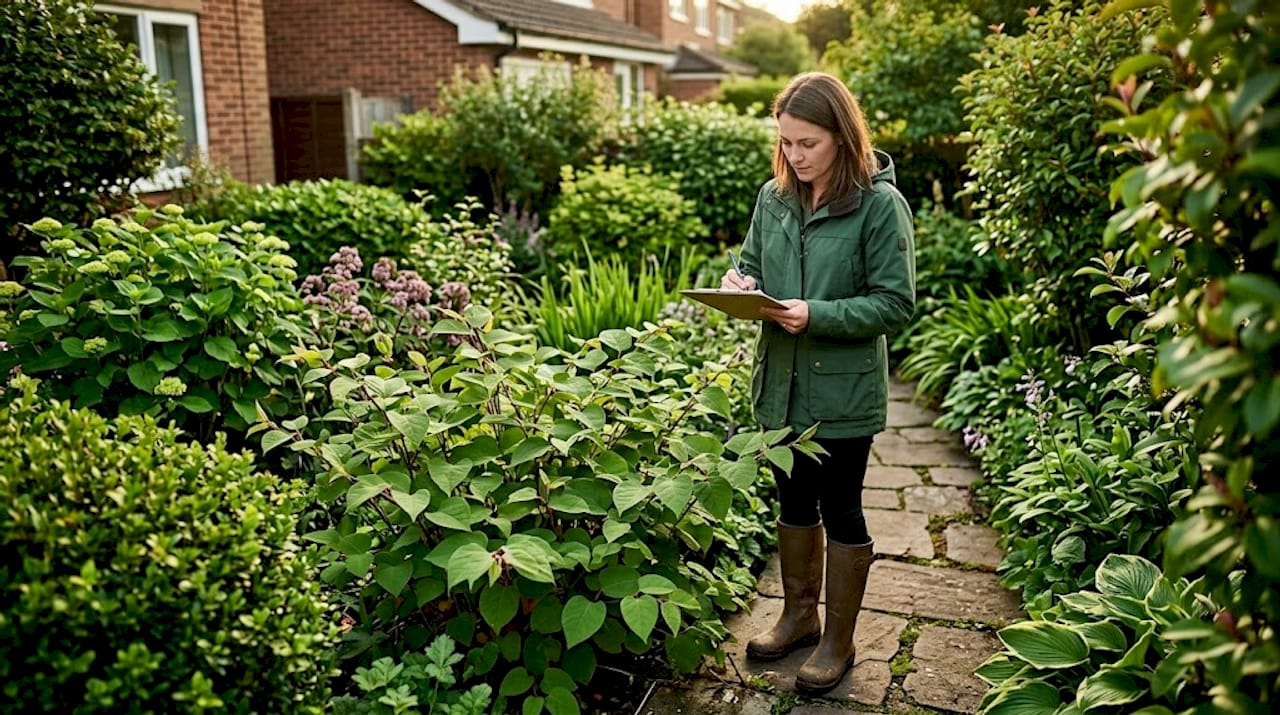
Accurate documentation does not require specialist equipment. A smartphone and methodical approach produce records that are genuinely useful for authorities, surveyors, and treatment specialists. Creating an auditable baseline for decision-making and onward management coordination is the core purpose of your records.
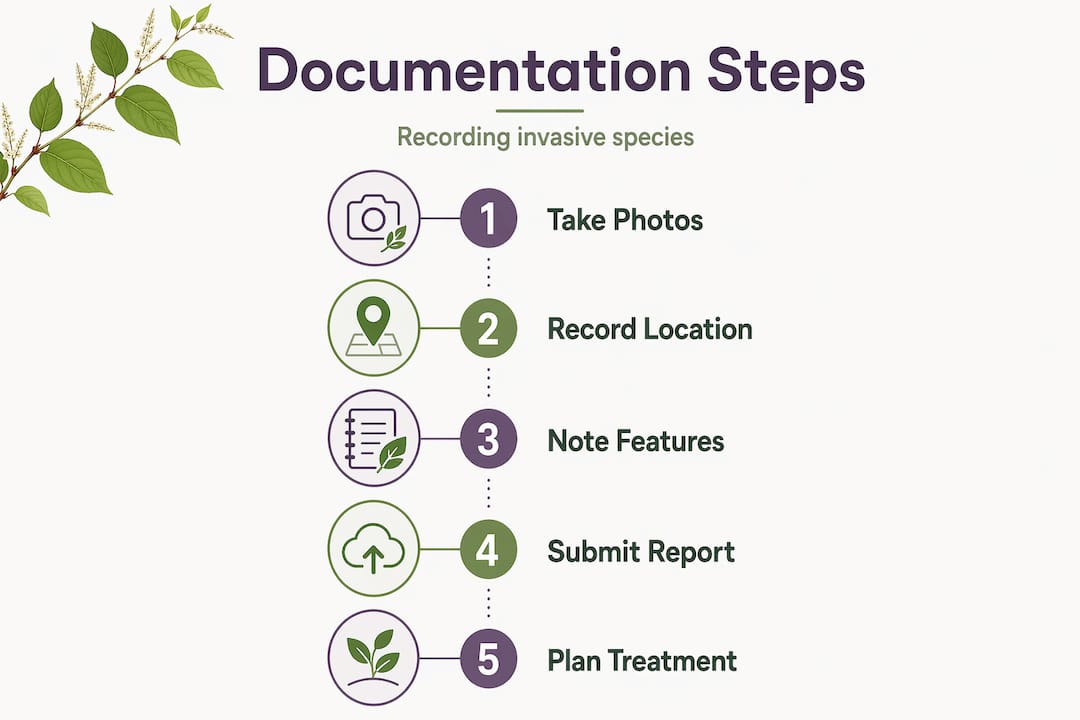
Follow these steps in order:
- Observe without disturbing. Before touching or cutting anything, spend time assessing the visible extent of the growth. Japanese knotweed stems are hollow, bamboo-like, and show distinctive red or purple speckles. Leaves are shield-shaped with a flat base.
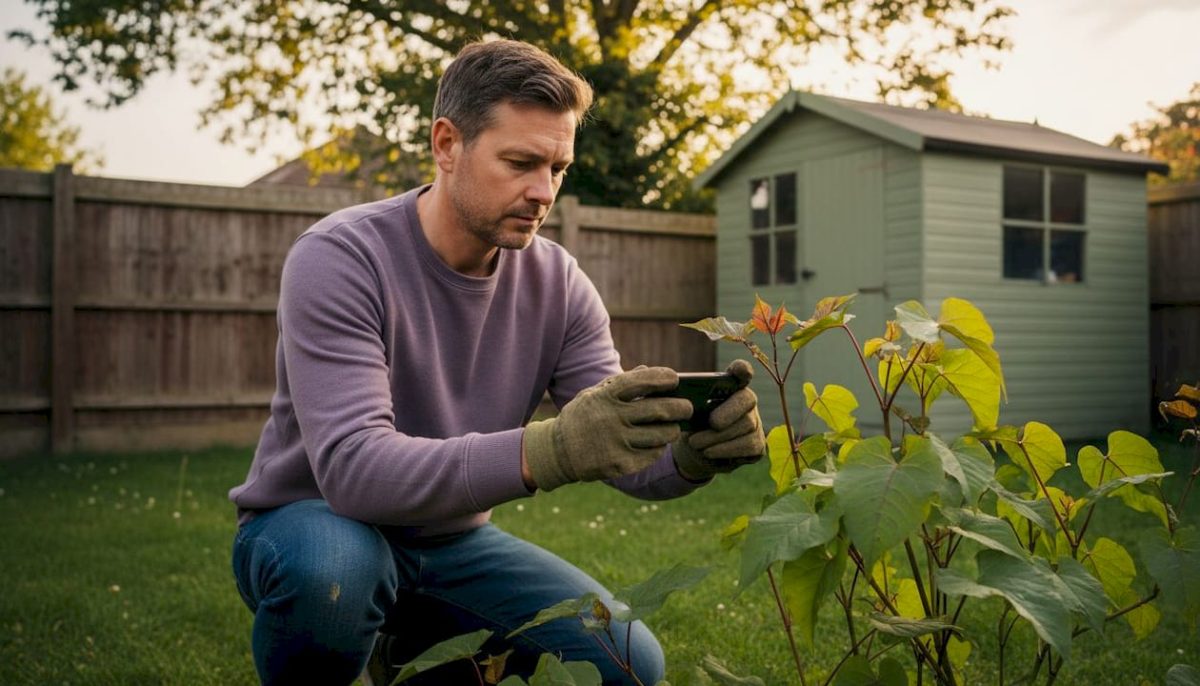
- Photograph comprehensively. Take wide-angle shots showing the full extent of the stand, mid-range images showing stem and leaf detail, and close-ups of distinctive features such as the zigzag stem pattern and leaf nodes.
- Record the precise location. Use your smartphone’s GPS function or note the address, grid reference, and which part of the plot is affected (e.g., north boundary, adjacent to drainage run).
- Note the date and season. Invasive plants look markedly different across seasons. Spring growth is red and asparagus-like; summer growth is full and leafy; winter reveals dead, tan-coloured cane networks. Recording the season aids accurate identification.
- Describe the extent and context. Note approximate dimensions of the visible stand, proximity to buildings, watercourses, or boundary fences, and any recent disturbance such as building work or vegetation clearance.
- Avoid cutting before a specialist assessment. Even collecting a small stem sample for identification purposes should be done with gloves and sealed in a bag, following removal best practices to prevent fragment dispersal.
- Submit to appropriate registers and authorities. Submit records to your local council, the relevant invasive species portal for your nation, and the national knotweed register to ensure the find is logged centrally.
The following table compares documentation quality and its downstream impact:
| Documentation quality | Audit trail strength | Reporting completeness | Treatment planning accuracy |
|---|---|---|---|
| Photos only, no location | Weak | Incomplete | Limited |
| Photos with GPS and date | Moderate | Useful | Good |
| Full checklist completed | Strong | Complete | Excellent |
| Professional survey report | Definitive | Comprehensive | Site-specific and precise |
Pro Tip: Most mobile phones now embed GPS coordinates directly into photo metadata. Enable location tagging in your camera settings before photographing any invasive plant find. This creates an automatic, verifiable record of exactly where and when each image was captured.
Now the evidence is ready, let us see how reporting supports the next steps towards effective eradication and ongoing protection.
How reporting unlocks chemical-free solutions and coordinated action
Documented finds do not simply disappear into a reporting database. They directly enable specialists to design and implement targeted treatment programmes, and they are particularly important for sites where chemical-free methods are the preferred or required approach.
Once a location is known and verified through recorded data, site-specific treatment plans and follow-up surveys can be coordinated by authorities and specialist teams. This matters enormously for chemical-free control because every treatment decision, including the positioning of energy delivery equipment, the scheduling of repeat treatments, and the assessment of rhizome response, depends on knowing the precise footprint of the infestation.
The following data illustrates how reporting phase accuracy affects treatment outcomes:
| Reporting stage | Treatment method options | Average number of treatments needed | Long-term success rate |
|---|---|---|---|
| Early, accurate report | Chemical-free, barrier, excavation | 2 to 3 | High |
| Delayed report, partial data | Chemical-free with additional follow-up | 4 to 6 | Moderate |
| No report, undocumented spread | Reactive, often chemical | 6 or more | Lower without ongoing monitoring |
The key benefits of pairing early reporting with chemical-free control include:
- Precision targeting: Knowing the exact boundaries of the rhizome network allows energy-based treatment, such as thermo-electric delivery, to be applied directly to the affected zone without unnecessary intervention in surrounding areas.
- Reduced collateral impact: Chemical-free approaches protect soil biology, water quality, and neighbouring plant species. Accurate data ensures these benefits are not undermined by treating areas that do not require intervention.
- Coordinated neighbour and authority engagement: When a record exists, councils and agencies can contact neighbouring landowners, coordinate boundary treatments, and avoid the fragmented, property-by-property approach that leaves gaps in coverage.
- Long-term monitoring: A documented starting point allows surveyors to measure progress objectively across treatment seasons, confirming whether the rhizome network is genuinely depleting or whether further intervention is required.
Our chemical-free control guide outlines in detail how data-led planning underpins every stage of responsible eradication. For homeowners seeking to prevent knotweed spread naturally, an accurate report is the essential first action, not an optional extra.
Understanding this process shows why thorough reporting is at the heart of smart, responsible invasive species control. But what nuanced lessons are often missed by the average homeowner?
What most homeowners miss about documenting invasive species
In our experience working with homeowners across England, Wales, and Ireland, the most common mistake is not careless documentation. It is the decision to delay documentation in the hope that the problem will resolve itself or remain unnoticed. This instinct is understandable, but it misunderstands how Japanese knotweed actually behaves.
Fragmentation and underground spread are largely invisible during the first growing season. A stand that appears contained in spring may have extended its rhizome network by several metres before summer ends, crossing boundary fences or reaching drainage runs without any surface indication. By the time the spread becomes visible, the infestation has already expanded significantly, and so has the cost and complexity of eradication.
There is also a less-discussed dimension to documentation that most homeowners only encounter when selling their property. A well-maintained record of identification, professional surveying, and ongoing treatment demonstrates due diligence. Far from being a deterrent to buyers or mortgage lenders, this kind of evidence shows that the infestation was handled responsibly. Conversely, a vendor who cannot demonstrate any documented history leaves the buyer’s surveyor to draw their own conclusions, typically the most cautious and costly ones.
Neighbour disputes are another area where documentation provides critical protection. If a neighbour claims that knotweed spread to their land from yours, a dated record showing the original extent of the infestation, combined with evidence of prompt remedial action through reporting Japanese knotweed, can be the difference between a manageable conversation and prolonged legal proceedings.
The long-term value of a documented management history extends beyond property transactions. Insurance claims for structural damage caused by invasive plant roots are increasingly common, and insurers expect evidence that the homeowner was aware of the risk and took reasonable steps to manage it. An undocumented infestation is not a neutral position. It is frequently interpreted as neglect, with the associated financial consequences.
The most effective posture is straightforward: document immediately, report appropriately, and engage a specialist. The records you create today form the foundation for every decision that follows.
Take control: next steps for homeowners dealing with invasive species
If you have identified Japanese knotweed or any other invasive plant on your property, acting now rather than later is the most protective course of action for your home, your neighbours, and the wider environment.
Japanese Knotweed Agency carries out specialist property surveys for invasive weeds across England, Wales, and Ireland, providing the kind of authoritative, documented assessments that support both management planning and legal peace of mind. You can add a knotweed record directly through our platform to begin the documentation process immediately. Our pioneering chemical-free knotweed solutions deliver up to 5,000 volts of direct energy on site, causing internal cell damage and systematically depleting the rhizome network without the use of herbicides. For answers to the most common questions about identification, legal responsibilities, and treatment options, our Japanese knotweed FAQs are a practical starting point before you book a survey.
Frequently asked questions
Do I have to report Japanese knotweed if I find it in my garden?
There is no blanket legal duty for private homeowners to report Japanese knotweed, but reporting is strongly encouraged by local authorities and specialist agencies to ensure coordinated, effective management and to protect you from future legal and financial liability.
What should I include in my documentation of an invasive plant?
You should record clear photographs, the precise GPS-tagged location, the date, and distinctive plant features without disturbing or cutting the growth, as thorough records create an auditable baseline that supports accurate treatment planning and management coordination.
How does reporting invasive species help with chemical-free control?
Reporting provides the precise location and extent data that specialists need to design targeted, chemical-free treatment plans, and it enables follow-up surveys to be coordinated systematically, reducing the risk of accidental spread through incomplete or untargeted interventions.
Who can I notify if I find an unusual invasive animal in England or Wales?
You should report non-widely spread invasive alien animals to the non-native species secretariat, as government guidance sets out an explicit duty to report such sightings, and failure to do so may constitute a legal offence.