


TL;DR:
- Site-specific weed risk evaluates the threat invasive plants pose to an individual property based on local conditions and land use. It guides tailored management strategies, including survey, treatment, and monitoring, to effectively control Japanese knotweed. Recognizing underground rhizome extent and boundary influences is crucial for successful eradication and property protection.
If you’ve discovered Japanese knotweed on or near your property, you may have encountered the term “site-specific weed risk” without a clear explanation of what it actually means for you. Understanding what is site-specific weed risk is not an academic exercise. It determines whether your mortgage is approved, how urgently you need to act, and which eradication method is appropriate for your land. Two neighbouring properties can face entirely different levels of risk from the same invasive species, and knowing why is the foundation of any effective management decision.
Table of Contents
- What is site-specific weed risk and why does it matter?
- How site-specific risk impacts Japanese knotweed management on your property
- Nuances and limitations of site-specific weed risk assessments
- How to apply site-specific weed risk understanding to protect your property and investment
- Why focusing solely on visible plant presence misses the true site-specific risk
- Professional survey and chemical-free solutions from Japanese Knotweed Agency
- Frequently asked questions
Key Takeaways
| Point | Details |
|---|---|
| Site-specific risk defined | Weed risk varies by property based on local factors like infestation size and site disruption. |
| Japanese knotweed treatment duration | Eradication usually requires multi-year plans because dormant rhizomes can regrow after disturbance. |
| Cross-boundary contamination risk | Knotweed rhizomes spread across property boundaries requiring neighbour cooperation and inspections. |
| Assessment limitations | Risk assessments support decisions but cannot guarantee zero future infestation due to uncertainty. |
| Professional survey importance | Qualified surveys and reports are essential for effective management, legal compliance, and mortgage approval. |
What is site-specific weed risk and why does it matter?
Weed risk is not a single, universal number. When surveyors and ecologists refer to weed risk assessment, they are typically evaluating the potential harm a plant species poses in general terms. Site-specific weed risk goes further. It means evaluating the risk that an invasive plant poses on your particular property, accounting for local conditions, infestation characteristics, and surrounding land use.
The RICS professional standard for Japanese knotweed and residential property makes this distinction clear: site-specific weed risk means evaluating invasive plant risk based on local property factors, not a blanket approach. This matters because a knotweed infestation 10 metres from a boundary wall carries a very different risk profile to one growing directly against your property’s foundations.
Several property-level factors determine the site-specific risk:
- Infestation size and density — Larger, denser stands with an established rhizome (underground root) network present a higher risk of structural damage and re-growth after treatment.
- Proximity to structures — Knotweed growing within 7 metres of a habitable building or within 4 metres of an underground structure is categorised at a higher risk level under RICS guidance.
- Neighbouring land — Infestation originating on an adjacent property can migrate underground, meaning your risk is partly determined by what is happening next door.
- Soil disturbance history — Previous construction, landscaping, or excavation can spread rhizome fragments, elevating recolonisation risk across the site.
- Water features and drainage routes — Knotweed fragments spread readily via watercourses, making riverside or flood-prone properties more vulnerable to new incursions.
Understanding what Japanese knotweed is and how it behaves underground is the starting point for appreciating why these local factors change everything. What looks like a minor, contained clump above ground may represent an extensive rhizome system extending several metres in every direction beneath the surface.
Now that we understand what site-specific weed risk means, let us explore how it applies particularly to Japanese knotweed on UK and Irish properties.
How site-specific risk impacts Japanese knotweed management on your property
Once the site-specific risk level is established, it directly informs the management strategy required. This is where assessment translates into practical action, and where getting it right has real financial consequences.

Mapping the infestation against structural and boundary features is the first step. Risk categories range from low (infestation far from structures, small area, no evidence of spread) through to high (infestation adjacent to foundations, large rhizome mass, evidence of cross-boundary migration). These risk levels link to management approach decisions, supporting professional and lender confidence throughout the process.
Here is how site-specific risk translates into a management plan:
- Commission a professional site-specific weed assessment — A qualified surveyor maps the infestation, its proximity to structures, and any pathways for spread.
- Categorise the risk level — Using RICS categories, the infestation is rated to guide treatment intensity and monitoring frequency.
- Select the appropriate treatment method — Higher risk sites may require physical excavation or thermo-electric treatment alongside root barriers.
- Establish a multi-year monitoring programme — Due to dormant rhizomes, a treatment programme of 3 to 5 years is typically required, with follow-up monitoring to confirm eradication.
- Communicate with neighbours — Where cross-boundary risk is confirmed, coordinated management across both properties significantly improves outcomes.
- Retain documentation — Treatment records and surveyor reports are essential for mortgage applications and future property sales.
You can review the JKWA national register to understand how professional knotweed management is tracked and documented. The impact on property values is considerable, and a well-documented management plan is often the only way to reassure lenders and prospective buyers.
Legal obligations are also shaped by site-specific risk. On construction sites, Japanese knotweed must not be disturbed without proper management controls in place. Any excavated material containing rhizome is classified as controlled waste under UK law and must be disposed of at licensed facilities.
Pro Tip: If you are purchasing a property and Japanese knotweed is declared on the TA6 form, request the full site-specific risk assessment report and existing management plan before exchange. The presence of knotweed alone does not necessarily mean a failed mortgage, but the absence of a credible management plan usually does.
Understanding these management factors leads naturally to a broader perspective on how site-specific risk fits in with wider invasive species principles and challenges.
Nuances and limitations of site-specific weed risk assessments
Site-specific weed risk assessments are valuable, but they are not infallible. Setting realistic expectations about what they can and cannot tell you is essential for sound decision-making.
The most important limitation is that assessments reflect a point-in-time professional judgement. Weed risk assessment outputs serve as decision support rather than guarantees, and contain inherent uncertainty and bias. Conditions change. A neighbour who begins landscaping work six months after your assessment may inadvertently spread rhizome fragments onto your land, altering your risk profile entirely.
“Examining only your own land can significantly understate the true invasive plant risk to your property. Cross-boundary contamination is one of the most frequently overlooked factors in residential knotweed management.”
Cross-site knotweed contamination is a documented and serious challenge, particularly on densely developed urban and suburban plots where the rhizome network from one garden may already extend beneath several neighbouring boundaries.
Additional complexity arises from the following:
- Soil movement during renovation or landscaping — Even a small rhizome fragment, as little as 1 centimetre in length, can establish a new infestation if left undisturbed in suitable conditions.
- Watercourse proximity — Properties near streams, rivers, or drainage channels face a higher and ongoing risk of fresh knotweed introductions from upstream land.
- Historic disturbance records — Properties where knotweed was treated but not formally documented present uncertainty about the extent of the original rhizome mass.
- Seasonal visibility — Assessments conducted during winter, when knotweed is dormant and entirely invisible above ground, require greater reliance on ground investigation to be accurate.
Using a knotweed reporting guide to record observed growth, treatment history, and site changes throughout the year strengthens the accuracy of any formal site-specific assessment carried out subsequently.
These nuances show why practical, professional advice and ongoing vigilance are important for managing invasive species risks effectively.
How to apply site-specific weed risk understanding to protect your property and investment
Knowing the concept is useful. Knowing what to do next is what protects your property and investment.
Step-by-step action plan for homeowners and buyers:
- Book a site-specific survey early — Do not wait for visible symptoms to worsen. Early surveys reduce the scope of treatment required and lower overall costs.
- Complete conveyancing disclosures accurately — On the TA6 property information form, knotweed presence must be declared. Failure to disclose creates significant legal liability after completion.
- Obtain a management plan before exchange — Professional surveys and management plans are typically required by mortgage lenders and help safeguard your ability to borrow against the property.
- Choose treatments matched to your risk category — Higher-risk sites benefit from thermo-electric treatment or physical excavation rather than surface-level methods alone.
- Install root barriers where appropriate — Physical membranes prevent underground rhizome migration between properties and into foundation zones.
- Schedule annual monitoring — Even after apparent eradication, annual site inspections for a minimum of three years confirm that dormant rhizomes have not regrown.
The table below summarises how site-specific risk levels typically correspond to management approaches:
| Risk category | Typical infestation characteristics | Recommended management approach |
|---|---|---|
| Low | Small stand, far from structures, no spread evidence | Monitoring, non-invasive treatment |
| Medium | Moderate stand, within 7m of structures | Thermo-electric treatment, root barriers |
| High | Large stand, adjacent to foundations or boundaries | Excavation, barrier installation, multi-year plan |
| Very high | Cross-boundary spread, structural impact confirmed | Coordinated multi-site management, legal action if required |
Key steps for buyers specifically:
- Request the seller’s knotweed survey report before making an offer
- Confirm whether the infestation originated on or migrated onto the property
- Check whether a specialist invasive weed property survey has been conducted within the past 12 months
- Ensure the management plan is transferable to the new owner
Pro Tip: Where a property straddles a previous development site or shares a boundary with railway embankments, canal towpaths, or open waste land, always commission a dedicated invasive species survey regardless of whether knotweed has been declared. These are among the highest-risk settings in England, Wales, and Ireland.
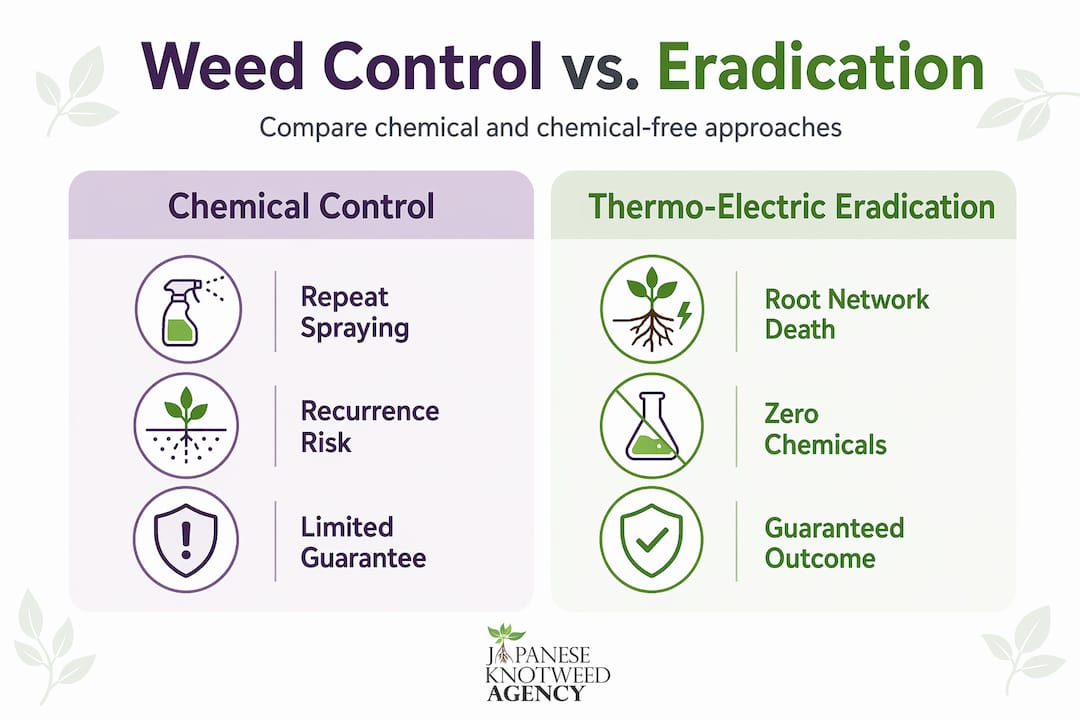
Chemical-free knotweed solutions now achieve results that were previously considered the exclusive domain of herbicide-based programmes, giving environmentally conscious homeowners genuinely effective alternatives. If you are ready to take action, booking a professional survey is the most important first step.
Why focusing solely on visible plant presence misses the true site-specific risk
There is a persistent assumption among homeowners that if knotweed appears to have died back or been treated, the risk has passed. It has not. This is perhaps the most consequential misunderstanding in residential invasive plant management.
Effective site-specific risk assessment must map infestation against disruption points rather than rely only on visible stems. Above-ground knotweed stems are a late indicator of what is already an established underground rhizome network. By the time you can see the plant, the rhizomes may already extend three metres deep and seven metres laterally. Treating the visible stems without addressing the rhizome mass is the equivalent of trimming the top of an iceberg and declaring the sea safe.
Construction disturbance is a particularly underestimated trigger. Dormant rhizomes that have sat undisturbed for years can be reactivated by the vibration and soil movement associated with even minor works. Extensions, damp-proofing, drainage repairs, and landscaping all carry this risk if a previous knotweed presence has not been fully documented and managed.
The role of neighbour collaboration is similarly overlooked. Where one property treats aggressively and a neighbouring property does not, the treated site will almost certainly experience re-infestation within one to two growing seasons. Site-specific risk does not stop at your fence line, and no management plan that ignores adjacent land can be considered truly site-specific.
It is also worth acknowledging that, while chemical-free methods represent the most environmentally responsible approach and are the focus of Japanese Knotweed Agency’s work, integrated management including herbicide use is sometimes recommended for effective control in very high-risk situations. Understanding these trade-offs helps homeowners make genuinely informed decisions rather than selecting an approach based purely on preference. The most effective programme is always the one calibrated to the actual site-specific risk, not a generic template. You can read more about the wider industry impact of knotweed to appreciate why rigorous site-specific assessment is now considered a professional standard, not an optional extra.
Professional survey and chemical-free solutions from Japanese Knotweed Agency
If understanding site-specific weed risk has prompted you to act, Japanese Knotweed Agency is the team to call. As pioneers of chemical-free invasive plant management across England, Wales, and Ireland, the Agency delivers professional property surveys tailored to your specific risk factors, providing detailed reports that satisfy mortgage lender requirements and legal compliance standards.

The Agency’s thermo-electric treatment delivers up to 5,000 volts directly into the rhizome network, causing internal cell damage and depleting energy reserves without glyphosate. Chemical-free solutions achieve up to 95% success rates, making them a credible, environmentally responsible choice for residential and commercial properties alike. Root barrier installation and full excavation works are also available as part of integrated, site-specific management programmes. If you have further questions, the knotweed FAQs resource provides clear guidance on common concerns before you book.
Frequently asked questions
What does site-specific weed risk mean for my property?
It means assessing how likely invasive plants like Japanese knotweed are to establish, spread, and cause harm on your particular land, based on local conditions including infestation size, structural proximity, and neighbouring land use. The RICS professional standard defines this as a property-level evaluation rather than a species-wide assessment.
How long does it take to eradicate Japanese knotweed from my garden?
Control programmes typically last 3 to 5 years due to dormant rhizomes that can regrow after initial treatment. Follow-up monitoring is required throughout to confirm lasting eradication.
Can Japanese knotweed spread from my neighbour’s garden onto mine?
Yes. Its underground rhizomes and small fragments can cross property boundaries, and cross-site contamination is a well-documented cause of reinfestations on treated properties. Coordinated management with your neighbour is often essential.
Do I need a professional survey to understand weed risk on my property?
Yes. Professional surveys provide the accurate, site-specific risk assessments required for effective management and, critically, for satisfying lender requirements when a mortgage is involved.
Is chemical-free knotweed treatment effective?
Chemical-free methods are effective in many cases, particularly when combined with physical controls and professional oversight. Japanese Knotweed Agency reports success rates of up to 95% using thermo-electric treatment without reliance on herbicides.