


TL;DR:
- Professional weed surveys provide critical evidence to prevent mortgage rejections and legal penalties.
- They assess underground rhizome spread using GPS mapping, soil sampling, and risk categorisation.
- Early detection through surveys helps preserve property value, reduce treatment costs, and ensure transaction success.
Japanese Knotweed is one of the most financially damaging invasive plants a homeowner in England, Wales, or Ireland can encounter during a property transaction. Its rhizome network can extend up to three metres deep and seven metres laterally, causing structural damage that lenders take extremely seriously. Professional surveys prevent mortgage rejections by supplying lenders with the documented evidence they require before approving a mortgage on an affected property. Without that evidence, sales collapse, refinancing stalls, and buyers walk away. Understanding what professional weed surveys involve, and why they matter far beyond a standard homebuyer’s report, is essential for anyone navigating the property market today.
Table of Contents
- Why professional weed surveys matter in the UK
- What professional surveys check: methods and features
- Financial and legal protection: cost savings, negotiation and compliance
- Beyond fear: market realities and lasting value
- Our perspective: the overlooked homebuyer advantage
- Get expert help for complete peace of mind
- Frequently asked questions
Key Takeaways
| Point | Details |
|---|---|
| Mortgage approval support | Professional surveys give lenders the required evidence for property sales or refinancing. |
| Financial and legal safeguarding | Early surveys enable negotiation leverage, legal compliance, and avoid hefty fines or future claims. |
| Superior detection methods | Experts use advanced tools to identify hidden or dormant infestations that standard surveys may miss. |
| Market stability through management | Properly managed Knotweed often has minimal long-term effect on property value. |
Why professional weed surveys matter in the UK
The risks that Japanese Knotweed poses to a property transaction are not theoretical. Mortgage lenders across England, Wales, and Ireland routinely flag properties where Knotweed is suspected or confirmed, and many will refuse to lend without a specialist report and a credible management plan in place. A standard RICS homebuyer’s survey notes the presence of Knotweed visually, but it does not assess the extent of the rhizome network, categorise the risk level, or provide the technical evidence that lenders demand.
Professional weed surveys address all of these gaps. They are conducted by qualified surveyors who understand both the biology of invasive species and the legal framework governing their management. The core benefits include:
- Mortgage compliance: Surveys prevent mortgage rejections by providing lenders with the required evidence of absence or a documented management plan.
- Legal protection: Survey results protect against fines under the Wildlife and Countryside Act 1981, which carries serious penalties for allowing Knotweed to spread.
- Property value preservation: Understanding the weed survey and property value relationship helps sellers price accurately and buyers negotiate confidently.
- Insurance and liability clarity: A formal report establishes a baseline that protects both parties if disputes arise after completion.
For buyers, the stakes around mortgages with Japanese Knotweed are particularly acute. Many high-street lenders apply strict criteria, and without a compliant survey, a purchase can fall through at the final stage. That is a costly outcome for everyone involved.
Key fact: Properties with unmanaged Knotweed can see valuations reduced by 5 to 15 per cent, and in severe cases, they become unmortgageable without a treatment plan in place.
Professional surveys also provide peace of mind that no standard check can replicate. They confirm whether Knotweed is absent, identify early-stage growth that would otherwise go undetected, and produce documentation that satisfies lenders, solicitors, and insurers alike.
What professional surveys check: methods and features
But what exactly do these professional weed surveys involve? Here is what sets them apart from general property checks.
A specialist weed survey goes well beyond a visual inspection. Surveyors assess both above-ground growth and the extent of the underground rhizome system, which is where the real risk lies. Knotweed can remain dormant for years, showing no visible signs above ground while its root network continues to spread beneath the surface. Standard surveys often miss dormant Knotweed; specialist surveyors detect it through expert indicators that go far beyond what the eye can see.
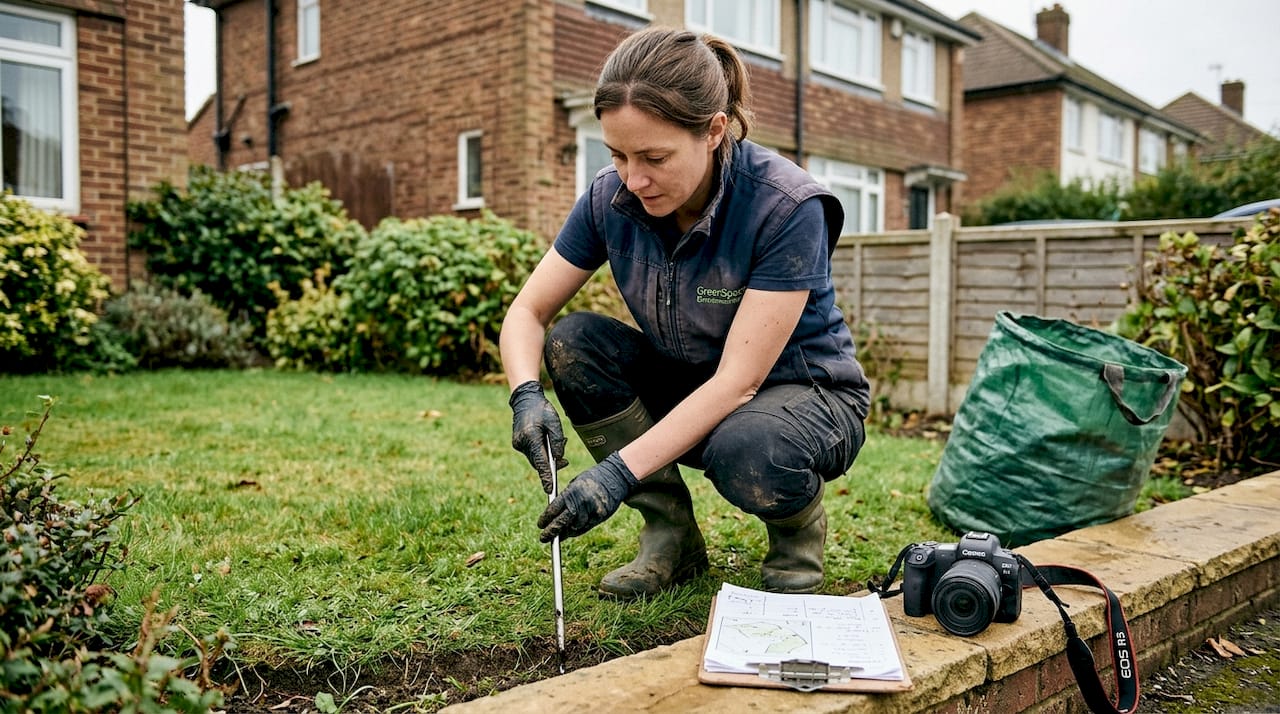
Specialist surveys use RICS risk categories, GPS mapping, and soil sampling to produce accurate, defensible reports. The RICS risk categorisation system classifies infestations from Category 1 (low risk, Knotweed not on or near the property) through to Category 4 (severe infestation with structural implications), giving lenders and buyers a clear, standardised picture.
The key methods used in professional surveys include:
- GPS mapping: Precise location data for all identified growth, enabling accurate monitoring over time.
- Soil sampling: Laboratory analysis to confirm rhizome presence below ground, even where no visible growth exists.
- Seasonal timing: Surveys are timed to growth cycles, with late spring to early autumn offering the most reliable results for active growth detection.
- Photographic evidence: Detailed records that form part of the final report and satisfy lender requirements.
| Feature | Standard RICS survey | Professional weed survey |
|---|---|---|
| Visual inspection | Yes | Yes |
| Rhizome depth assessment | No | Yes |
| GPS mapping | No | Yes |
| RICS risk categorisation | No | Yes |
| Soil sampling | No | Yes |
| Lender-compliant report | No | Yes |
Pro Tip: Always commission a professional weed survey in late spring or summer if possible. Active growth makes identification significantly more reliable, and the resulting report carries more weight with lenders.
The Knotweed survey workflow typically concludes with a written report that includes risk categorisation, photographic evidence, GPS-referenced maps, and recommended next steps. This document becomes a critical asset in any property transaction.
Financial and legal protection: cost savings, negotiation and compliance
Understanding the survey process is vital, but its biggest impact is on your wallet and legal risk.
The financial case for commissioning a professional weed survey is compelling. Surveys enable negotiation leverage saving buyers £12,000 to £20,000 and significantly reduce long-term costs by identifying infestations before they worsen. Early detection means smaller, less established rhizome networks, which translates directly into lower treatment costs.
Here is how the numbers typically compare:
| Scenario | Estimated cost |
|---|---|
| Professional weed survey | £400 to £800 |
| Chemical treatment (moderate infestation) | £2,500 to £8,000 |
| Excavation (severe infestation) | £10,000 to £30,000+ |
| Post-sale legal claim (undisclosed Knotweed) | Up to £50,000 |
| Price reduction negotiated via survey evidence | £12,000 to £20,000 |
For sellers, the legal obligations are equally significant. The TA6 property information form requires sellers to disclose known Knotweed. Surveys provide TA6 form evidence, avoiding £5,000+ fines or post-sale compensation claims reaching up to £50,000. A professional survey completed before listing a property gives sellers documented proof of the situation, whether Knotweed is present or absent, protecting them from future disputes.
The steps for using a survey to your financial and legal advantage are:
- Commission a professional survey before listing or making an offer.
- Use the RICS risk category in the report to inform pricing or negotiation.
- Request seller-funded treatment or a price reduction based on documented findings.
- Retain the survey report as evidence for solicitors and lenders throughout the transaction.
- Ensure any agreed treatment plan is backed by an insurance-backed guarantee.
Pro Tip: If you are selling property with Knotweed, commissioning your own survey before listing gives you control of the narrative. You can present buyers with a management plan rather than leaving them to discover the issue themselves and demand a larger reduction.
Understanding the impact on property values is also important for setting realistic expectations. A survey does not devalue a property; it provides the clarity that allows transactions to proceed.
Beyond fear: market realities and lasting value
With legal and financial angles addressed, it is time to cut through the fear and look at how professional surveys truly affect property value.
Japanese Knotweed carries a disproportionate reputation for destruction. The reality, supported by evidence, is more nuanced. 41% of Knotweed-flagged homes show no market impact if professionally managed; real damage to sale prices is far less common than the headlines suggest. The key variable is not whether Knotweed is present, but whether it is being professionally managed and documented.
Several myths persist around Knotweed and property surveys:
- Myth: Knotweed always kills a sale. Reality: Professionally managed infestations with documented treatment plans regularly proceed to completion.
- Myth: Surveys are only needed when Knotweed is visible. Reality: Dormant rhizomes pose the same legal and structural risk as active growth.
- Myth: A standard homebuyer’s report is sufficient. Reality: Standard surveys lack the technical depth to satisfy lenders or legal obligations.
- Myth: Knotweed means the property is worthless. Reality: Early detection and treatment preserve value and enable sales.
The situations that call for urgent professional survey include:
- Properties adjacent to railway lines, riverbanks, or brownfield sites, where Knotweed colonisation is statistically more likely.
- Any property where a previous survey noted Knotweed within seven metres of the boundary.
- Transactions where the lender has flagged Knotweed as a condition of mortgage approval.
The early Knotweed detection benefits extend well beyond the immediate transaction. A property with a clean survey history, or one with a documented and completed treatment programme, is a stronger asset in any future sale.
“The most costly Knotweed cases we encounter are not the severe infestations. They are the ones where no survey was commissioned, no disclosure was made, and the problem was discovered after completion.”
Our perspective: the overlooked homebuyer advantage
Conventional wisdom frames professional weed surveys as an added cost, a line item to be questioned or deferred when budgets are tight. In our experience, this view consistently costs homeowners more than the survey itself.
The buyers who commission specialist surveys before making offers are the ones who negotiate from a position of strength. They either confirm the property is clear and proceed with confidence, or they use documented findings to secure meaningful price reductions or seller-funded treatment. Either outcome represents a return that far exceeds the survey fee.
For sellers, the calculus is equally clear. A survey completed before listing removes uncertainty, satisfies the TA6 disclosure requirement with documented evidence, and prevents the kind of last-minute renegotiation that collapses transactions. Knotweed certification and mortgage success are directly linked; the certification produced by a professional survey is often the single document that unlocks lender approval.
The homeowners who struggle most are those who treat the survey as optional. Acting early, before a transaction is under offer and time pressure is acute, is the approach that consistently produces the best outcomes.
Get expert help for complete peace of mind
Professional weed surveys are not reserved for crisis situations. They are a proactive tool for anyone buying, selling, or managing a property where invasive species risk is a factor.

At Japanese Knotweed Agency, we carry out specialist property surveys for invasive weeds across England, Wales, and Ireland, delivering accurate, lender-compliant reports that support every stage of a transaction. Our expert Japanese Knotweed FAQs cover the most common concerns homeowners face, and our team can advise on identifying dormant Knotweed before it becomes a costly problem. Where treatment is required, our pioneering chemical-free Knotweed treatment delivers up to 5,000 volts directly to the rhizome network, causing internal cell damage without the use of herbicides. Contact us to arrange a survey and take control of your property transaction today.
Frequently asked questions
Do mortgage lenders require specialist weed surveys for Japanese Knotweed?
Most lenders in England, Wales, and Ireland demand documented surveys and a treatment plan before approving mortgages on Knotweed-affected properties. Surveys provide lenders with required evidence of absence or a credible management plan before funds are released.
How much does a professional Knotweed survey cost?
Professional surveys typically cost between £400 and £800, with early detection saving significantly larger costs if treatment is subsequently required. Survey costs of £400 to £800 compare favourably against treatment programmes ranging from £2,500 to £15,000 or more depending on severity.
What legal risks do home sellers face if Japanese Knotweed is not declared?
Failure to disclose Knotweed on the TA6 form can result in fines exceeding £5,000 and post-sale compensation claims of up to £50,000. Surveys provide TA6 form evidence that protects sellers against both regulatory penalties and civil claims.
Can standard homebuyer surveys spot Japanese Knotweed issues?
Regular surveys rarely identify dormant or subterranean Knotweed, as they rely on visual inspection alone. Standard RICS surveys miss dormant Knotweed; specialist surveyors detect it through expert indicators and technical assessment methods that go well beyond a standard check.