
TL;DR:
- Local policies shape the legal obligations and enforcement methods for managing invasive plants within jurisdictions. They increasingly restrict herbicide use in sensitive areas and promote sustainable, chemical-free weed control strategies. Effective compliance relies on clear procedures, community engagement, and integrated management approaches aligned with ecological and policy goals.
Local policies in weed control are defined as the regulatory frameworks through which local authorities establish, enforce, and monitor the management of invasive and nuisance plant species within their jurisdictions. These policies directly shape how landowners, developers, and public bodies respond to weed infestations, from Japanese Knotweed pushing through tarmac to overgrown vegetation declared a fire hazard. The role of local policies in weed control extends beyond simple enforcement. It determines which treatment methods are permitted, how quickly action must be taken, and whether communities adopt sustainable, chemical-free approaches. For policymakers and local officials, understanding this regulatory architecture is the foundation of effective invasive plant management.
How local regulations establish frameworks for weed control
Local weed abatement programmes are the primary mechanism through which authorities translate policy into action. They define what constitutes a nuisance, set compliance timelines, and specify the consequences of inaction. Without this framework, enforcement is inconsistent and landowners lack clear obligations.
The practical structure of most local weed regulations includes the following components:
- Nuisance declarations: Overgrown vegetation is formally classified as a public nuisance or fire hazard requiring clearance, triggering mandatory compliance. This classification gives authorities the legal standing to act.
- Notice periods: Authorities typically issue written notices allowing property owners 10–30 days to comply before enforcement begins. This window balances the landowner’s right to respond with the authority’s need to act promptly.
- Forced abatement: Where owners fail to comply, local authorities commission contractor clearance and recover costs directly. Administrative fees of 25%–35% are added to the clearance cost, creating a financial deterrent against non-compliance.
- Tax liens: Unpaid abatement costs are placed on the property’s tax roll, giving authorities a reliable revenue recovery mechanism without requiring court action.
- Defensible space requirements: Some programmes mandate that vegetation is cleared within a specified distance of structures, typically 30 feet, to reduce fire risk.
The legal robustness of these programmes depends heavily on procedural accuracy. Failure to provide adequate notice before forced abatement exposes local authorities to legal challenge and increases administrative costs. Proper documentation at every stage is not optional. It is the difference between a defensible enforcement action and a costly dispute.
Pro Tip: When designing or reviewing a local weed abatement programme, build in a formal record of every notice issued, including the date, method of delivery, and officer responsible. This single step reduces legal exposure significantly.
How do local policies influence herbicide use and sustainable practices?
Local policy decisions are the most direct driver of how herbicides are used, restricted, or replaced in weed management programmes. The shift towards Integrated Weed Management (IWM) across many UK and international jurisdictions reflects a policy-led transition, not simply a market one.

Integrated Weed Management combines mechanical, thermal, and limited chemical treatments to reduce ecological harm. Research confirms that IWM reduces aquatic ecotoxicity to 28% of herbicide-only levels. That figure represents a substantial reduction in harm to aquatic ecosystems, which is particularly relevant for authorities managing land near watercourses.
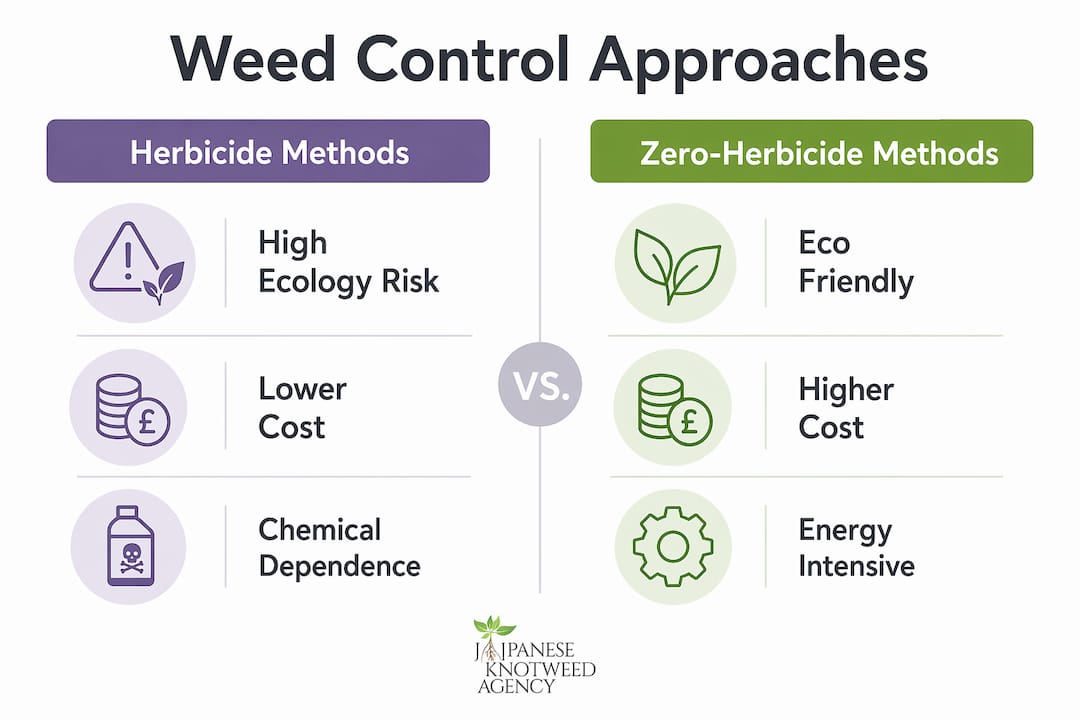
The trade-offs, however, are real and must be factored into policy design. The table below summarises the key environmental differences between herbicide-only and zero-herbicide approaches.
| Factor | Herbicide-only methods | Zero-herbicide methods |
|---|---|---|
| Aquatic ecotoxicity | High, due to glyphosate metabolites | Significantly lower |
| Greenhouse gas emissions | Lower | Higher |
| Fossil fuel consumption | Lower | Up to 6.2 times higher |
| Suitability near water | Restricted or prohibited | Preferred |
| Policy alignment | Declining in sensitive areas | Growing regulatory support |
Some jurisdictions have moved beyond guidance and banned herbicide use entirely in sensitive locations including parks, schools, and hospitals. This policy direction reflects growing public concern about chemical exposure in spaces used by children and vulnerable people. For local authorities, it also creates a procurement obligation: contracts must specify non-chemical methods in these zones.
Japaneseknotweedagency’s thermo-electric treatment delivers up to 5,000 volts directly to the plant, causing internal cell damage and depleting energy reserves within the rhizome network. This approach aligns precisely with the policy direction towards chemical-free weed control in sensitive public spaces.
Pro Tip: When specifying weed management contracts for schools or hospitals, include a clause requiring written confirmation that no Schedule 1 herbicides will be applied within the site boundary. This protects the authority from liability and ensures contractor compliance.
What role does community engagement play in local weed policy?
Community engagement is not a supplementary element of local weed policy. It is a core delivery mechanism. Without informed landowners and active cooperation from developers and residents, even well-designed regulations fail at the point of implementation.
Legislation frequently requires developers and property owners to incorporate weed management plans into property covenants and maintenance agreements. This integration means that obligations travel with the land, not just the current owner. New purchasers inherit the duty to manage, which reduces the risk of infestations being neglected during ownership transitions.
Effective community weed control strategies share several characteristics:
- Early detection monitoring: Authorities that train residents and land managers to identify new infestations at an early stage reduce the cost and complexity of later treatment significantly.
- Educational outreach: Targeted communications explaining legal obligations, identification guides, and available support increase voluntary compliance before enforcement becomes necessary.
- Financial incentives: Economic profitability drives policy adoption more reliably than environmental arguments alone. Grant schemes, subsidised surveys, and service-based delivery models accelerate uptake of sustainable methods.
- Service-based models: Offering landowners access to professional treatment through the local authority, rather than requiring them to source contractors independently, removes a significant barrier to compliance.
The evidence is clear that environmental benefits alone are insufficient to motivate widespread behaviour change. Policymakers who build financial incentives into their programmes consistently achieve higher compliance rates than those who rely on enforcement alone. The most effective local weed management programmes combine clear obligations with genuine support for landowners to meet them.
Comparing enforcement programmes across jurisdictions
Enforcement approaches vary considerably across local authorities, and the differences in outcome are instructive. The most effective programmes share a common structure: seasonal inspection schedules, clear fee structures, and automated cost-recovery mechanisms.
Seasonal enforcement is the norm in most well-run programmes. Inspections are typically scheduled in late spring and summer, when weed growth is most visible and the risk of fire or structural damage is highest. This timing also gives property owners the opportunity to address issues before the inspection window opens, reducing the volume of enforcement actions required.
The table below illustrates how key enforcement variables differ across programme types.
| Variable | Basic programme | Developed programme |
|---|---|---|
| Notice period | 10–14 days | 30 days minimum |
| Administrative fee | 25% of clearance cost | 25%–35% of clearance cost |
| Cost recovery method | Invoice to owner | Tax-roll lien |
| Inspection schedule | Reactive only | Seasonal and reactive |
| Legal challenge risk | Higher | Lower with proper notice |
Programmes that rely solely on reactive enforcement, responding only to complaints rather than conducting scheduled inspections, consistently miss early-stage infestations. By the time a complaint is received, the infestation has often spread beyond the original property boundary. Proactive seasonal inspection is the single most cost-effective change a local authority can make to its enforcement programme.
Proper procedural notices of at least 30 days are critical to reducing legal challenges. Authorities that cut this period to speed up enforcement frequently face appeals that cost more in officer time and legal fees than the original abatement would have.
Key takeaways
Effective local weed control requires regulatory frameworks that combine clear enforcement powers, financial incentives for compliance, and policy-mandated adoption of Integrated Weed Management in ecologically sensitive areas.
| Point | Details |
|---|---|
| Enforcement requires procedure | Notice periods of at least 30 days reduce legal challenges and protect abatement cost recovery. |
| IWM reduces aquatic harm | Integrated Weed Management cuts aquatic ecotoxicity to 28% of herbicide-only levels. |
| Herbicide bans are expanding | Sensitive sites including schools and hospitals now require non-chemical methods in many jurisdictions. |
| Incentives outperform enforcement alone | Financial and service-based models drive sustainable practice adoption more reliably than penalties. |
| Community integration is structural | Embedding weed management in property covenants ensures obligations transfer with land ownership. |
Why I believe local policy is the missing lever in weed management
Working in invasive species management across England, Wales, and Ireland, I have seen the same pattern repeat itself. A local authority has the right intentions, the right species on its radar, and even the right contractors lined up. What it lacks is a policy framework that makes the whole system work together.
The most common failure point is not enforcement. It is communication. Landowners who receive a notice with a 10-day compliance window and no guidance on what treatment is acceptable, who to contact, or what the consequences of inaction are, will often do nothing. Not out of bad faith, but because the system has not made it easy to comply.
The jurisdictions that get this right treat policy as a service design problem, not just a legal one. They ask: what does a landowner need to know, and when do they need to know it? The answer shapes the notice, the outreach, and the support offer.
The shift towards chemical-free methods is also accelerating faster than many local authorities realise. The alternatives to glyphosate are no longer experimental. Thermo-electric treatment, root barriers, and targeted excavation are proven, and they align with where policy is heading. Authorities that build these methods into their specifications now will be ahead of the regulatory curve, not scrambling to catch up.
My recommendation to any policymaker reading this: audit your current weed management contracts against the herbicide restriction direction of travel. If your specifications still default to glyphosate in all areas, you are one policy change away from non-compliance with your own future regulations.
— Alan
How Japaneseknotweedagency supports local weed policy compliance
Local authorities and environmental policymakers need treatment partners who understand both the regulatory framework and the ecological complexity of invasive species management.

Japaneseknotweedagency carries out professional invasive weed surveys across England, Wales, and Ireland, providing the documented evidence base that local authorities need for enforcement decisions and landowner notifications. The agency’s thermo-electric treatment method delivers chemical-free eradication aligned with current and emerging herbicide restrictions in sensitive public spaces. Root barrier installation and excavation services complete the range for sites where containment or full removal is required. To meet your local policy obligations, book a survey and receive a clear, evidence-based assessment of your site’s invasive plant status.
FAQ
What is the role of local policies in weed control?
Local policies establish the legal obligations, enforcement mechanisms, and permitted treatment methods that govern how invasive and nuisance plants are managed within a jurisdiction. They determine compliance timelines, fee structures, and which weed management approaches are acceptable in sensitive areas.
How do local weed laws affect herbicide use?
Local regulations for weed management increasingly restrict or ban herbicide use in sensitive locations such as schools, parks, and hospitals, requiring non-chemical alternatives. This policy direction is driving adoption of Integrated Weed Management and thermo-electric treatment methods.
What are typical enforcement penalties under local weed ordinances?
Local abatement programmes typically add administrative fees of 25%–35% to forced clearance costs and place unpaid amounts as tax liens on the property. Notice periods of at least 30 days are required before enforcement action to reduce legal challenges.
How does Integrated Weed Management align with local policy requirements?
Integrated Weed Management reduces aquatic ecotoxicity to 28% of herbicide-only levels, making it the preferred approach in policy frameworks that prioritise ecological protection near watercourses and sensitive habitats.
Why do some local weed management programmes fail to achieve compliance?
Programmes that rely solely on enforcement without financial incentives or landowner support consistently underperform. Research confirms that economic profitability and service-based delivery models drive sustainable practice adoption more effectively than penalties alone.