

TL;DR:
- Japanese Knotweed is an invasive plant that causes structural damage and is legally protected in the UK. It is identifiable throughout the year by features such as hollow stems, zig-zag leaves, and an orange core in underground rhizomes. Proper identification and documentation, primarily through photographs, are essential to avoid legal and financial risks associated with spreading or mismanaging the plant.
Japanese Knotweed is defined as an invasive perennial plant capable of causing serious structural damage to buildings, drainage systems, and boundary walls. Recognising it correctly is one of the most important steps any homeowner or property buyer can take to protect their investment. The plant is identifiable year-round through its bamboo-like hollow stems, distinctive zig-zag leaf arrangement, and bright orange-centred rhizomes. UK law under Section 14 of the Wildlife and Countryside Act prohibits causing it to grow in the wild, making accurate identification a legal matter as much as a practical one.
What are the identifying features of Japanese Knotweed in each season?
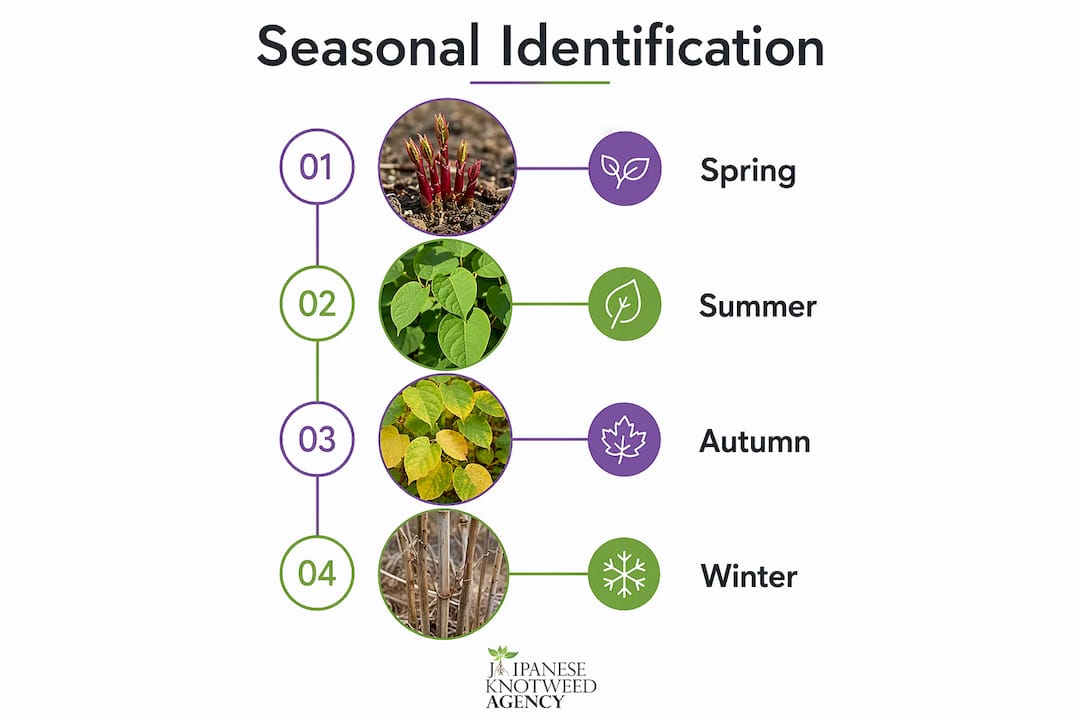
Japanese Knotweed displays distinct characteristics in every season, which means you can spot it reliably throughout the year. The RHS confirms that spring shoots grow 30–60cm within just two weeks. That rate of growth is faster than almost any other plant you will encounter in a UK garden or on a property boundary.
Spring
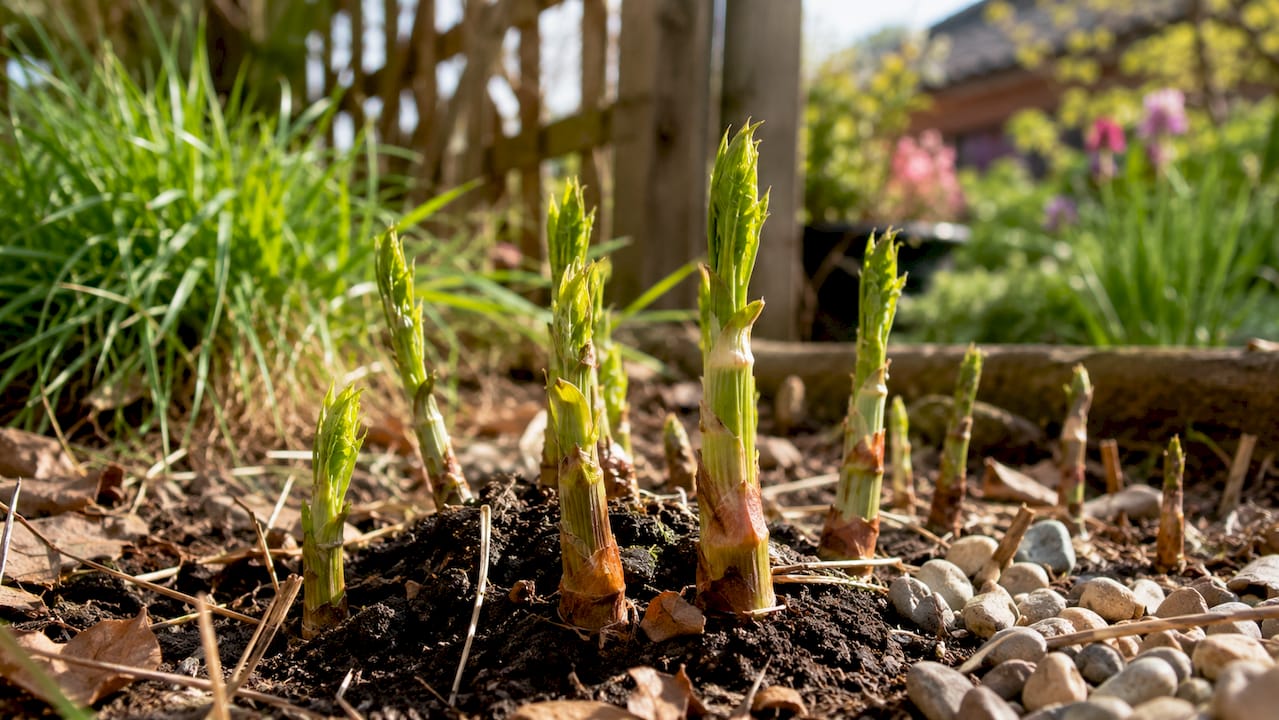
In spring, new shoots emerge from the ground as red or purple, asparagus-like spears. They grow rapidly and have a fleshy, almost succulent appearance at this stage. The shoots are easy to miss if you are not looking for them, particularly along fence lines or near outbuildings.
Summer
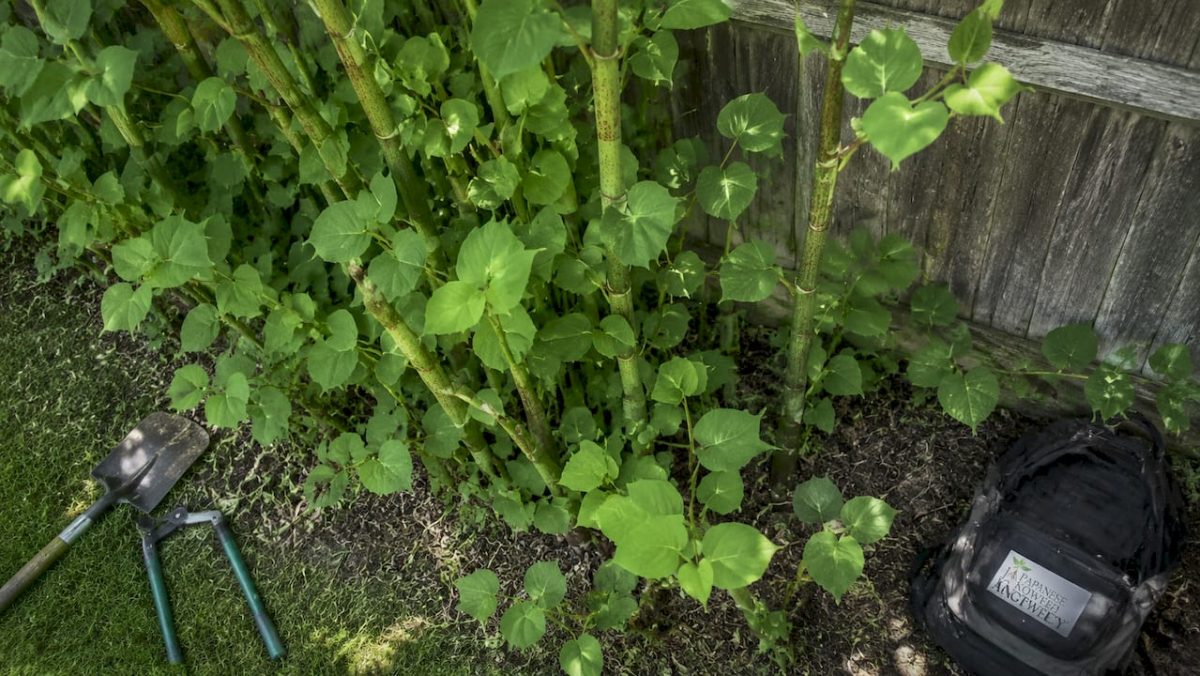
By summer, the plant reaches its full height of 2–3 metres. The hollow bamboo-like stems carry distinctive reddish-purple speckles and clearly visible joints called nodes. Leaves are broadly spade-shaped, up to 14cm in length, and arranged alternately along the stem in a pronounced zig-zag pattern. This zig-zag arrangement is one of the most reliable visual markers for identifying Japanese Knotweed in summer.
Autumn
Clusters of creamy-white flowers appear in late summer and persist into autumn. These small, frothy blooms grow along the upper stems and are attractive enough that the plant was originally introduced to Britain as an ornamental species. By late autumn, the leaves yellow and drop, leaving the stems bare.
Winter
In winter, the above-ground canes die back and turn brittle and brown. They remain standing or collapse near the ground and persist for months. Spotting these dead canes in winter is a reliable sign of infestation, even when no green growth is visible.
Rhizome characteristics
Underground, the rhizome network extends up to 1 metre deep and 7 metres laterally. When cut, the rhizome reveals a bright orange core with a dark outer layer. This orange core is the single most reliable diagnostic feature across all seasons.
Pro Tip: If you suspect knotweed in winter, look for clusters of hollow brown canes with raised nodes. Photograph them from multiple angles and send the images to a specialist rather than disturbing the ground.
| Season | Key visual feature | What to look for |
|---|---|---|
| Spring | Red asparagus-like shoots | Rapid growth from bare ground, fleshy and pointed |
| Summer | Hollow speckled stems, zig-zag leaves | Reddish-purple flecks on stems, spade-shaped leaves |
| Autumn | Creamy-white flower clusters | Small frothy blooms along upper stems |
| Winter | Brown brittle canes | Hollow dead stems with visible nodes remaining upright |
How do you distinguish Japanese Knotweed from similar plants?
Misidentification is common, and it carries real consequences. Treating the wrong plant wastes money. Failing to treat the right one creates legal exposure. The key is knowing which specific features separate Japanese Knotweed from its lookalikes.
Leaves are alternate and broadly oval, unlike the lance-shaped leaves of Himalayan Knotweed. Bamboo, the most common source of confusion, is a grass with solid or partitioned stems. Japanese Knotweed stems are hollow between the nodes. Bindweed and Russian Vine both produce white flowers but lack the zig-zag stem structure entirely.
The comparison below covers the most frequently confused species:
| Plant | Stem | Leaf shape | Key difference |
|---|---|---|---|
| Japanese Knotweed | Hollow, nodes, reddish speckles | Broad, spade-shaped, zig-zag | Orange-cored rhizome underground |
| Bamboo | Hollow or solid, green | Long, narrow, lance-like | Bamboo is a grass, not related to buckwheat |
| Himalayan Knotweed | Slender, reddish | Narrow, lance-shaped | Smaller plant, no zig-zag leaf pattern |
| Russian Vine | Twining, woody | Heart-shaped | Climbing habit, no nodes or speckles |
| Bindweed | Twining, thin | Arrow-shaped | No hollow stem, no nodes |
The rhizome is the definitive test. No lookalike produces the bright orange core that Japanese Knotweed rhizomes display when cut. However, cutting rhizomes carries its own risk, which is covered in the next section.
What steps should property owners take to safely identify and document knotweed?
Safe identification means gathering evidence without disturbing the plant. Fragments as small as 0.7g can regrow into a new infestation. Breaking stems or digging up rhizomes without professional guidance can spread the plant to previously unaffected areas of your property.
Follow these steps to document a suspected infestation safely:
- Photograph the plant from multiple angles. Capture the stem, leaf arrangement, nodes, and any visible flowers or dead canes. Clear photographs allow specialists to confirm identification without any physical contact.
- Record the location precisely. Use your smartphone’s GPS function or note the position relative to fixed structures such as walls, fences, or buildings. Accurate location data is required for any formal survey or management plan.
- Measure the approximate spread. Estimate how far the growth extends along boundaries or across the plot. This helps surveyors assess the likely extent of the underground rhizome network.
- Do not cut, strim, or dig. Physical disturbance risks spreading fragments. The RHS advises that photographic identification sent to specialists is the safest approach for property owners.
- Contact a professional surveyor. A qualified invasive species surveyor can confirm the identification, assess the extent of the infestation, and produce a management plan that satisfies mortgage lender requirements.
Pro Tip: Use a free mapping tool such as Google Maps to drop a pin at the exact location of the suspected plant. Screenshot the map with the pin visible and include it alongside your photographs when contacting a specialist.
Reporting confirmed or suspected sightings to your local council or biodiversity centre supports collaborative mapping efforts. The National Biodiversity Data Centre stresses that sharing infestation data with local authorities is a critical part of controlling spread beyond individual properties.
Once you have documented the site safely, you can report the sighting formally through the appropriate channels to ensure it is recorded and monitored.
What legal and financial risks arise from Japanese Knotweed on your land?
Japanese Knotweed carries legal obligations that property owners cannot ignore. Under Section 14 of the Wildlife and Countryside Act, causing knotweed to grow in the wild is a criminal offence. Penalties range from fines to imprisonment depending on the severity and circumstances.
The financial implications are equally significant. Many UK mortgage lenders require a professional survey and a formal eradication plan before approving a mortgage on an affected property. Untreated infestations reduce market value and can halt property sales entirely. Buyers who discover knotweed after purchase and can demonstrate it was not disclosed may have grounds for legal action against the seller.
Key legal and financial risks include:
- Failure to disclose during a property sale can result in legal claims from the buyer after completion.
- Mortgage refusal is common where lenders identify knotweed on a valuation report without an accompanying management plan.
- Neighbour disputes arise when knotweed spreads from one property to another. The affected neighbour may seek damages through civil action.
- Fly-tipping of knotweed waste is a separate offence. All excavated material must be disposed of at a licensed facility as controlled waste.
- Delayed action increases the cost of treatment significantly. The deeper and wider the rhizome network grows, the more extensive the management programme required.
Early identification is the most effective way to limit all of these risks. A professional plant eradication survey provides the documented evidence that lenders, solicitors, and local authorities require.
Key takeaways
Accurate identification of Japanese Knotweed across all seasons, combined with professional survey confirmation, is the most reliable way to protect your property value and meet your legal obligations.
| Point | Details |
|---|---|
| Seasonal identification | Each season offers distinct visual cues, from red spring shoots to brown winter canes. |
| Rhizome is the definitive marker | The bright orange core of a cut rhizome confirms Japanese Knotweed above all other features. |
| Never disturb the plant | Fragments as small as 0.7g can regrow; photograph and report rather than dig or cut. |
| Legal obligations are strict | Section 14 of the Wildlife and Countryside Act makes uncontrolled spread a criminal offence. |
| Mortgage and sale risks are real | UK lenders require a survey and eradication plan before approving mortgages on affected properties. |
Why getting identification right matters more than most people realise
The most common mistake I see is homeowners acting on a hunch. They pull up a stem, break off a piece of rhizome to check the colour, and in doing so they scatter fragments across the garden. What started as a contained patch becomes a wider problem within a single growing season.
The second most common mistake is assuming that because the plant looks similar to bamboo, it probably is bamboo. The zig-zag leaf arrangement and the hollow, speckled stem are not features bamboo shares. If you look carefully at those two details, you will rarely confuse the two. The problem is that most people do not look carefully enough until they are already in the middle of a property transaction.
What I have found works consistently is the photograph-first approach. Take clear images of the stem, the leaf arrangement, and the base of the plant where it meets the ground. Send those to a qualified specialist before doing anything else. That single step costs nothing and prevents the kind of disturbance that turns a manageable infestation into a controlled-waste disposal problem.
The property industry impact of knotweed is well documented, and it is not going away. Buyers are more informed than they were five years ago, and lenders are more cautious. Getting identification right early, before a sale is agreed or a mortgage is applied for, is the decision that saves the most time, money, and stress.
— Alan
How Japaneseknotweedagency can help you identify and manage knotweed
Japaneseknotweedagency carries out professional property surveys for invasive weeds across England, Wales, and Ireland. If you have spotted something that concerns you, the safest next step is a formal survey conducted by a qualified specialist.

Japaneseknotweedagency offers chemical-free treatment solutions using thermo-electric technology that delivers up to 5,000 volts directly into the rhizome network, causing internal cell damage without the use of herbicides. Root barrier installation and excavation works are also available where the situation requires a more immediate physical solution. To arrange a survey and get a confirmed identification with a management plan, book a survey with the team today.
FAQ
What does Japanese Knotweed look like in summer?
In summer, Japanese Knotweed produces hollow stems up to 3 metres tall with reddish-purple speckles and prominent nodes. Leaves are broadly spade-shaped, up to 14cm long, and arranged in a zig-zag pattern along the stem.
How do I tell Japanese Knotweed apart from bamboo?
Japanese Knotweed stems are hollow between nodes and carry reddish speckles, while bamboo is a grass with green, smooth-jointed canes. The zig-zag leaf arrangement and the orange-cored rhizome are features bamboo does not share.
Is it safe to dig up Japanese Knotweed myself?
Digging is not recommended without professional guidance. Fragments as small as 0.7g can regrow into a new plant, meaning disturbance risks spreading the infestation further across your property.
Does Japanese Knotweed affect my ability to sell my property?
Yes. Many UK mortgage lenders require a professional survey and a formal eradication plan before approving a mortgage on a property where knotweed is present. Undisclosed infestations can also lead to legal claims after a sale completes.
Can Japanese Knotweed be identified in winter?
Yes. In winter, the dead brown canes remain standing or collapsed near the ground and retain their hollow structure and visible nodes. These canes are a reliable sign of infestation even when no green growth is present.