

TL;DR:
- Effective Japanese knotweed eradication requires a professional survey, a multi-year treatment plan, and documented monitoring to protect property value and ensure legal compliance. Chemical and energy-based methods are used over several years, with non-chemical options suited for sensitive sites, while DIY approaches risk worsening infestations and legal penalties. Only accredited professionals can issue guarantees accepted by mortgage lenders, making expert treatment essential for property saleability and legal safety.
Knotweed treatment is the systematic process of controlling and eradicating Japanese Knotweed to protect property value and comply with UK legal obligations. Left untreated, this plant can push through tarmac, damage foundations, and trigger mortgage refusals. Effective eradication is not a single event. It is a planned, multi-year commitment that begins with professional identification and ends with documented proof of control. This guide explains every stage of the process, from survey to final monitoring, covering both herbicide and chemical-free options for homeowners and property buyers across England, Wales, and Ireland.
What professional surveys are essential before starting knotweed treatment?
A professional survey is the mandatory first step before any knotweed control methods begin. Without it, you risk misidentifying the plant, underestimating the extent of the rhizome network, and producing no documentation that satisfies mortgage lenders or insurers. Accredited contractors listed by the Property Care Association (PCA) provide official survey reports that are accepted by lenders and solicitors during property transactions.
A professional survey does three things that a DIY inspection cannot:
- Confirms species identity with certainty, ruling out lookalikes such as bindweed or bamboo
- Maps the infestation zone, including estimated rhizome spread beyond visible growth
- Produces a management plan that specifies which treatment method suits the site, the soil type, and the proximity to watercourses or neighbouring land
The survey report also forms the basis of any insurance-backed guarantee (IBG). Without a valid IBG, most mortgage lenders will not proceed with a sale on an affected property.
Pro Tip: Book a plant eradication survey before listing or purchasing a property. Discovering knotweed mid-transaction causes delays and can collapse sales entirely.
Survey findings shape every subsequent decision. A site near a river requires different treatment constraints than a suburban garden. A shallow infestation responds differently to treatment than one with rhizomes extending three metres below ground. The survey removes guesswork and creates a legally defensible record from day one.
How do approved herbicide treatments work for Japanese Knotweed?
Glyphosate-based herbicides are the industry-standard chemical treatment for Japanese Knotweed when applied correctly by certified professionals. Timing is critical. Late summer and autumn applications are most effective because the plant is actively translocating nutrients down into the rhizome network, carrying the herbicide with them. A spring or early summer application treats only the visible stems and achieves far less.
The realistic treatment timeline follows this pattern:
- Year one, late summer: First herbicide application to actively growing stems. Visible dieback occurs within weeks, but the rhizome system remains largely intact.
- Year two, late summer: Second application targets regrowth from surviving rhizomes. The plant’s energy reserves begin to deplete noticeably.
- Year three, late summer: Third application addresses residual regrowth. Many sites reach a point of control at this stage, though not always full eradication.
- Years four to ten, monitoring: Treatment cycles of 2–3 years are followed by 5–10 years of monitoring to confirm no re-sprouting occurs.
The multi-year commitment reflects the biology of the plant. Eradication is a process of gradual rhizome depletion, not a single knockout treatment. Homeowners who expect results after one season consistently underestimate the depth and spread of the underground system.
Pro Tip: Never apply herbicide near watercourses without checking Environment Agency or Natural Resources Wales guidance first. Glyphosate is restricted near water, and unlicensed application carries significant legal risk.
Legal compliance matters throughout. Causing knotweed to spread in the wild is a criminal offence under UK environmental law. Even well-intentioned herbicide misuse can fragment rhizomes and worsen an infestation rather than control it.
What alternative knotweed treatment methods exist?
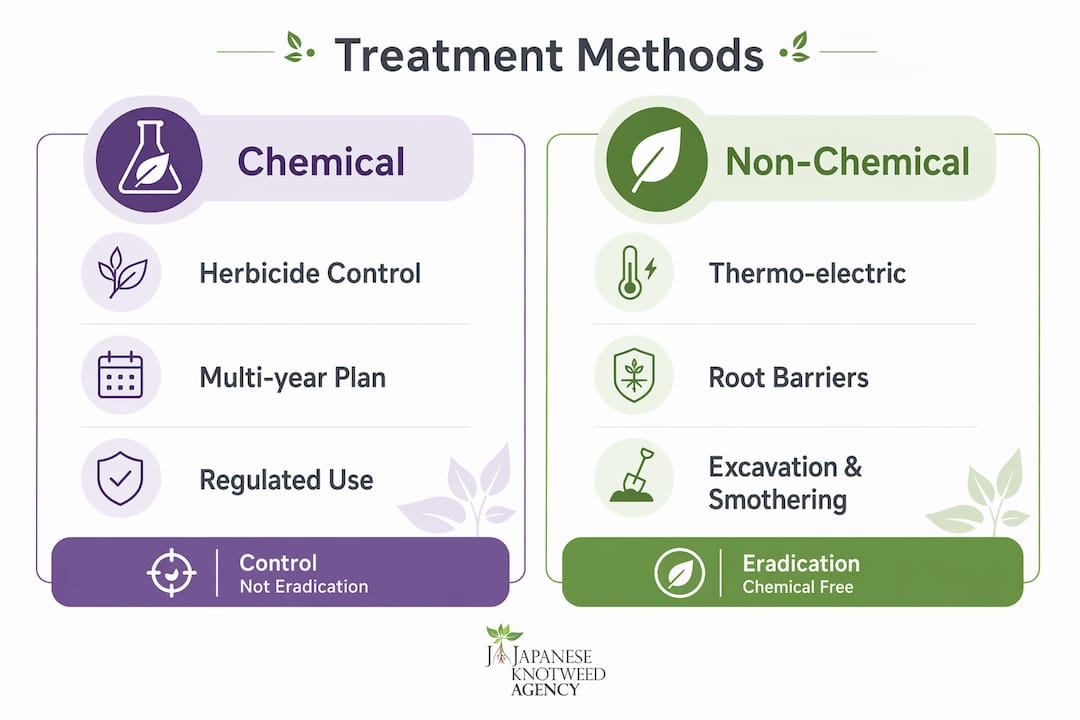
Non-chemical knotweed eradication techniques have advanced considerably, and they suit sites where herbicide use is restricted or where homeowners prefer to avoid chemical applications entirely.
Energy-based thermo-electric treatment
Japaneseknotweedagency pioneered thermo-electric treatment as a chemical-free alternative. The method delivers direct electrical energy up to 5,000 volts into the plant, causing internal cell damage and depleting the energy reserves within the rhizome network with each treatment session. No chemicals enter the soil or surrounding environment. This approach suits properties near watercourses, organic land, or sites where biodiversity protection is a priority. It requires specialist expertise and a clear understanding of treatment timelines, which are comparable to herbicide programmes.
Root barriers and excavation
Root barriers are physical membranes installed in the ground to contain rhizome spread. They do not eradicate the plant but prevent it from crossing into neighbouring land or damaging structures. Japaneseknotweedagency installs root barriers for knotweed control as part of integrated management plans, often combined with treatment to address the existing infestation while preventing lateral spread.
Excavation removes contaminated soil and rhizome material entirely. It is the fastest method but generates significant volumes of controlled waste. Excavated material classified as containing knotweed is treated as controlled waste under UK law and must be disposed of at a licensed facility.
Smothering
Effective smothering requires heavy weighted tarping with a buffer zone of at least three feet beyond the visible infestation. Standard tarps are insufficient. Concrete blocks or timber piles are needed to prevent stalk penetration. Smothering alone rarely achieves eradication on mature stands and works best as a supplementary measure within a wider programme.
The key limitations of non-herbicide methods are:
- Longer treatment timelines on established infestations
- Higher upfront cost for excavation and energy-based methods
- Smothering requires sustained physical management over multiple seasons
- Manual removal methods carry legal risk if fragments are not disposed of correctly
DIY cutting or digging actively worsens infestations. A root fragment as small as one centimetre can generate a new plant. Disturbing the rhizome system without a controlled disposal plan creates multiple new growth points from a single original stand.
How to implement and monitor a knotweed treatment plan over multiple years
A structured treatment plan follows a repeating annual cycle with clear milestones.
- Spring assessment: Inspect for new growth emerging from dormant rhizomes. Record location, density, and any spread beyond the previously mapped zone.
- Late summer treatment: Apply the agreed treatment method, whether herbicide or energy-based, at peak translocation period.
- Autumn review: Document visible dieback and photograph the site for the management record.
- Winter soil check: Assess whether rhizome material is visible at the surface or in disturbed ground.
- Annual report update: Submit updated records to your treatment provider to maintain the IBG and satisfy any lender requirements.
“Knotweed eradication is a process of gradual depletion of rhizomes rather than immediate removal. Patience and persistence are the defining factors in successful long-term control.” — Natural Resources Wales
Insurance-backed guarantees are only available through professional treatment providers. DIY treatment cannot produce an IBG. Mortgage lenders require this document as proof that the infestation is under active, professional management. Without it, a sale on an affected property will not proceed.
Record keeping is the most commonly neglected part of a treatment programme. Gaps in documentation undermine the IBG and create uncertainty for future buyers. Every treatment visit, every site photograph, and every monitoring note should be stored in a single, dated file.

How does knotweed treatment affect property value and mortgage approval?
Untreated Japanese Knotweed has a direct, negative impact on property value and routinely triggers mortgage refusals. Lenders treat it as a structural risk, not a cosmetic issue. Professional treatment, backed by a valid IBG and a PCA-accredited survey report, changes that position entirely.
The legal obligations are equally significant:
- Allowing knotweed to spread onto neighbouring land creates civil liability and potential criminal exposure under the Wildlife and Countryside Act 1981 and associated regulations
- Sellers who fail to disclose a known infestation on property information forms risk misrepresentation claims after completion
- Buyers who proceed without a survey on a suspected affected property inherit both the infestation and the legal liability
Professional treatment converts a liability into a managed, documented condition. A property with a current IBG and a clean monitoring record is mortgageable and saleable. One without that documentation is neither.
Key takeaways
Effective knotweed treatment requires a professional survey, a site-specific multi-year plan, and documented monitoring to protect property value and satisfy mortgage lenders.
| Point | Details |
|---|---|
| Survey first | A PCA-accredited survey is mandatory before treatment begins and essential for mortgage and legal compliance. |
| Multi-year commitment | Chemical and energy-based treatments typically require 2–3 active treatment years followed by 5–10 years of monitoring. |
| Chemical-free options exist | Thermo-electric treatment delivers up to 5,000 volts to deplete rhizomes without chemicals, suiting restricted or sensitive sites. |
| IBG is non-negotiable | Only professional providers can issue insurance-backed guarantees; lenders require them before approving mortgages on affected properties. |
| DIY worsens infestations | A root fragment as small as one centimetre can generate new growth; disturbing rhizomes without controlled disposal spreads the plant. |
Why I believe patience is the most underrated part of knotweed control
After years of working with homeowners across England, Wales, and Ireland, the single most common mistake I see is impatience. Homeowners treat knotweed once, see the stems die back, and assume the job is done. The rhizome network underground can extend three metres deep and seven metres laterally. Surface dieback means almost nothing.
The second mistake is reaching for a spade. I understand the instinct. The plant is visible, it feels controllable, and digging feels productive. But disturbing the rhizome system without a controlled plan creates more growth points, not fewer. I have seen single-plant infestations become multi-stem stands after an owner spent a weekend digging.
What actually works is a planned, professional programme with consistent annual treatment and rigorous record keeping. The thermo-electric approach Japaneseknotweedagency uses is particularly well suited to sensitive sites, and I have seen it achieve strong results where herbicide was not an option. But no method, chemical or otherwise, produces overnight eradication. The biology of this plant demands respect and a long-term view.
Proactive treatment also protects your relationship with neighbours. Knotweed does not stop at a boundary fence. Addressing it early, professionally, and with documentation is the responsible choice for your property and the properties around it.
— Alan
How Japaneseknotweedagency can help you treat knotweed professionally
Japaneseknotweedagency provides accredited property surveys, thermo-electric treatment, herbicide programmes, root barrier installation, and excavation works across England, Wales, and Ireland.
Every treatment programme begins with a professional property survey to map the infestation, confirm species identity, and produce a site-specific management plan. From there, Japaneseknotweedagency’s team applies the most appropriate method for your site, whether that is energy-based eradication delivering up to 5,000 volts directly into the rhizome network, or a professionally managed herbicide programme. All treatment plans are backed by insurance-backed guarantees accepted by mortgage lenders. Contact Japaneseknotweedagency to book your survey and begin a treatment programme that protects your property and your investment.
FAQ
What is knotweed treatment?
Knotweed treatment is a systematic, multi-year programme of herbicide application or energy-based methods designed to deplete and eradicate Japanese Knotweed rhizomes. It must be carried out by accredited professionals to produce valid documentation for mortgage and legal purposes.
Does knotweed treatment actually work?
Professional knotweed treatment works when applied consistently over 2–3 active treatment years, followed by a monitoring period of up to 10 years. No single treatment session achieves full eradication due to the depth and extent of the rhizome network.
How long does Japanese Knotweed removal take?
Treatment cycles typically last 2–3 years, with monitoring recommended for 5–10 years afterwards to confirm no regrowth from dormant rhizomes.
Can I treat Japanese Knotweed myself?
DIY treatment is not recommended and carries legal risk. Even a one-centimetre root fragment can generate new growth, and causing knotweed to spread is a criminal offence under UK law. Only professional treatment produces the insurance-backed guarantee that mortgage lenders require.
What is the best treatment for knotweed near water?
Energy-based thermo-electric treatment is the preferred option near watercourses, as it avoids chemical use entirely. Glyphosate-based herbicides are restricted near water under Environment Agency and Natural Resources Wales guidelines.