TL;DR:
- Invasive species harm freshwater systems by disrupting ecological processes and increasing water turbidity. Prevention and early detection through professional surveys are the most cost-effective ways to protect water quality from invasive species. Managing invasives without chemicals near watercourses is crucial to maintaining ecosystem health and property value.
Invasive species are defined as non-native organisms that establish themselves in a new environment and cause measurable harm to ecosystems, economies, or human health. Their impact on water quality is one of the most serious and least understood consequences of biological invasion. Invasive species cost the US economy over $12 billion annually in environmental and economic damages, with $5.4 billion attributed to non-native freshwater fishes alone. That figure reflects only direct costs. The wider damage to drinking water, fisheries, and recreational water bodies adds considerably more. Understanding these mechanisms is the first step towards protecting the freshwater systems that communities depend on.
How do invasive species alter aquatic ecosystems to degrade water quality?
Invasive species degrade water quality by dismantling the ecological processes that keep freshwater systems clean and functional. The damage is not always visible at the surface, but it accumulates rapidly once an invader establishes itself.
Trophic cascades and vegetation loss
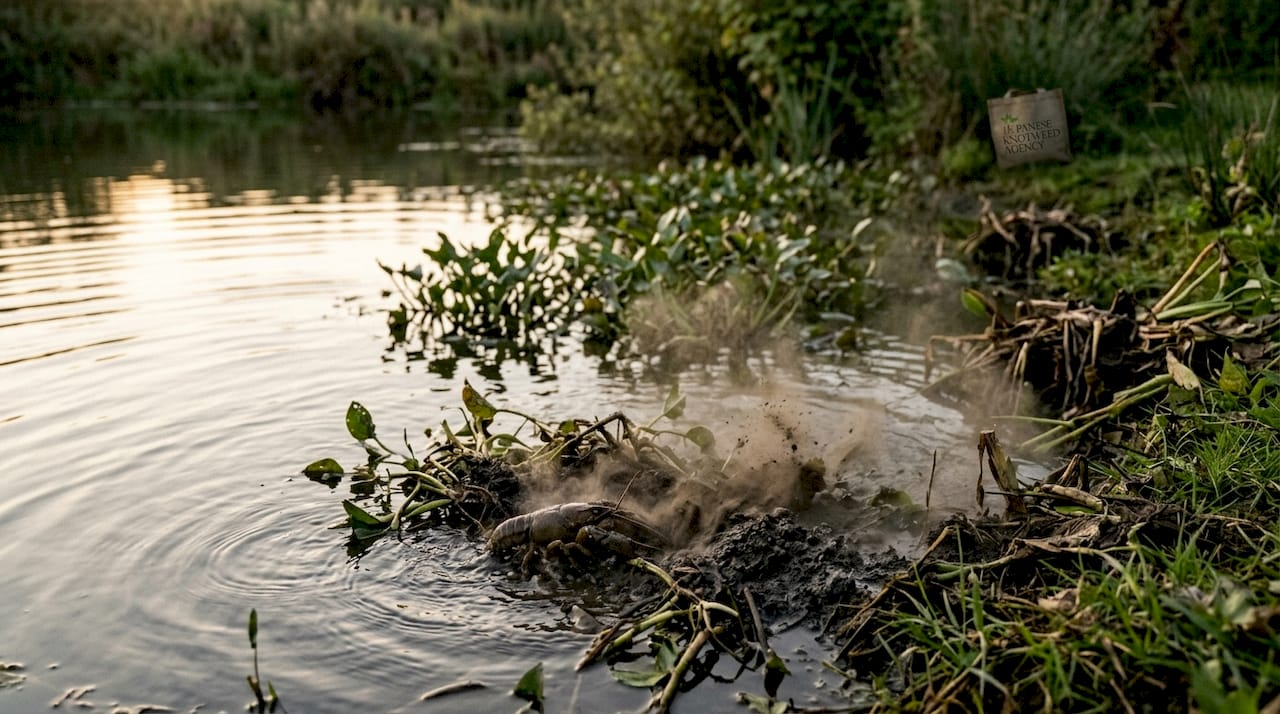
A trophic cascade occurs when a predator or competitor disrupts the food web, causing knock-on effects throughout the ecosystem. Invasive species trigger trophic cascades that reduce native vegetation, destabilise riverbanks, increase turbidity, and impair nitrogen removal and water purification functions. When bank vegetation disappears, soil enters the water unchecked. Turbidity rises, light penetration falls, and aquatic plants that oxygenate the water cannot survive. The result is a degraded system that struggles to support native life.
Invasive crayfish are a well-documented example. They uproot aquatic plants, disturb sediment, and consume the invertebrates that native fish rely on. A single population can transform a clear, plant-rich stream into a turbid, sediment-laden channel within a few seasons.
Nutrient cycling and water purification
Healthy freshwater ecosystems remove excess nitrogen and phosphorus through biological processes involving plants, microbes, and invertebrates. Invasive species disrupt these processes by outcompeting the organisms that perform them. When nitrogen removal fails, algal blooms follow. Algal blooms deplete oxygen, kill fish, and produce toxins that make water unsafe for drinking or recreation.
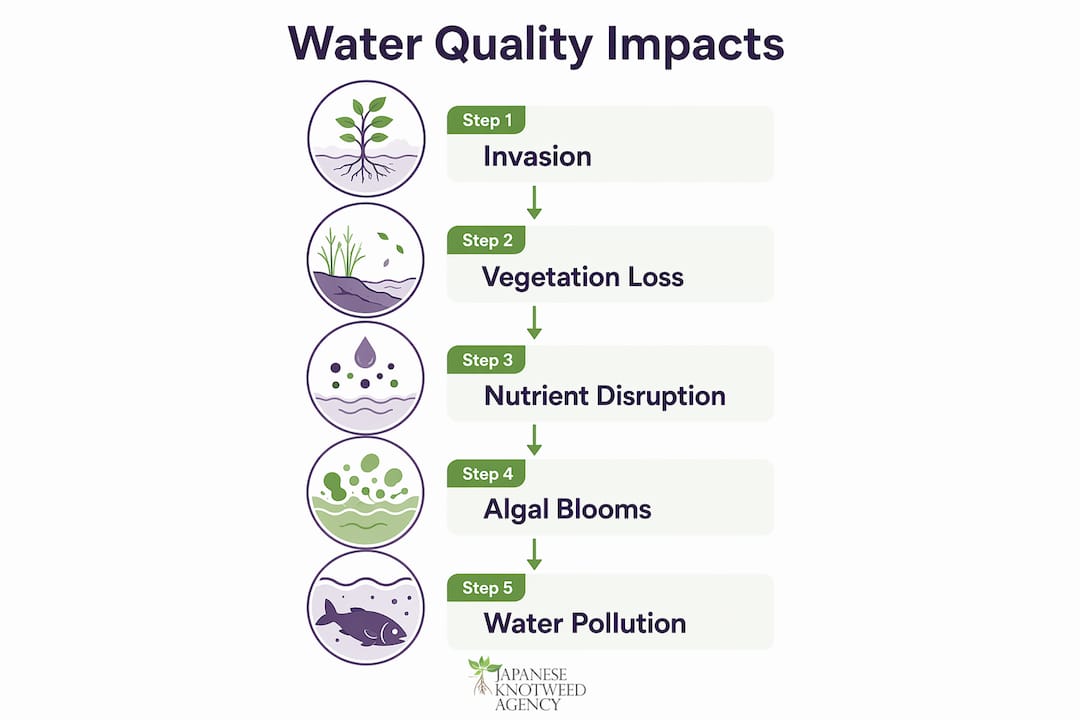
Carbon sequestration is also affected. Native wetland plants store carbon in their root systems and sediment. Invasive plants often have shallower root structures and shorter lifespans, reducing the long-term carbon storage capacity of riparian zones.
Pro Tip: If you notice increased algal growth or murky water near a watercourse on your property, an invasive plant species on the bank may be the underlying cause. A professional survey can identify the source before the problem worsens.
What are the broader environmental and economic consequences?
The impact of invasive species on water quality extends well beyond the immediate ecological damage. Reduced ecosystem service reliability affects drinking water treatment costs, fisheries productivity, and recreational value, leading to significant economic losses that fall on communities and public budgets.
In the Great Lakes, 34% of over 180 aquatic non-native species are classified as invasive. Those species have reduced native insect abundance by 31% and species richness by 26%. Fewer native insects means fewer fish, fewer birds, and a weakened food web that cannot buffer against further disturbance.
“Freshwater ecosystems are threat multipliers where invasive species interact with pollution and climate change to accelerate ecological collapse in ways that are non-linear and difficult to reverse.”
Frontiers in Ecology and Evolution, 2026
The interaction between invasives, pollution, and climate change is particularly concerning. Each stressor weakens the ecosystem’s capacity to absorb the next. A river already stressed by agricultural runoff becomes far more vulnerable when an invasive plant removes its bank vegetation. The combined effect is greater than the sum of its parts.
Biodiversity loss is a direct consequence. On islands, invasive species contribute to around 75% of reptile, bird, amphibian, and mammal extinctions, despite islands covering only 5.3% of Earth’s land area. That statistic illustrates how concentrated and severe the impact of biological invasion can be in contained ecosystems.
| Consequence | Impact |
|---|---|
| Increased turbidity | Reduces light penetration, kills aquatic plants, and harms fish |
| Nitrogen cycle disruption | Triggers algal blooms and oxygen depletion |
| Biodiversity loss | Weakens food webs and reduces ecosystem resilience |
| Economic costs | Damages fisheries, raises water treatment costs, and reduces property values |
| Climate interaction | Amplifies existing stressors, accelerating ecosystem decline |
Which invasive species most affect water quality?
Freshwater systems are particularly vulnerable to invasion because they are physically connected, species-rich, and already under pressure from pollution and abstraction. The threats to freshwater ecosystems are compounded when invasives arrive, as they exploit weakened conditions that native species cannot tolerate.
The following species are among the most impactful on water quality in the UK and internationally:
- Zebra mussels filter vast quantities of water, removing phytoplankton and altering the base of the food web. Their dense colonies block water intake pipes and degrade infrastructure.
- Invasive signal crayfish destabilise riverbanks, increase turbidity, and carry a fungal plague that kills native white-clawed crayfish.
- Japanese Knotweed grows along watercourses, destabilises banks with its extensive rhizome network, and increases erosion and sediment load in rivers.
- Himalayan Balsam colonises riparian zones, crowds out native plants, and leaves banks bare in winter, accelerating erosion and sedimentation.
- Floating pennywort forms dense mats on the water surface, blocking light and oxygen exchange, and causing fish kills.
Invasive aquatic invertebrates deserve particular attention. They act as biological pollutants, reproducing, adapting, and persisting independently of chemical inputs. Unlike a chemical spill, a biological pollutant cannot be neutralised. It self-replicates and adapts to management pressure, making eradication far more difficult than prevention.
Pro Tip: Japanese Knotweed and Himalayan Balsam are both notifiable invasive species under UK legislation. If either is present on land adjacent to a watercourse, you have a legal and environmental responsibility to manage them. A property survey for invasive weeds will confirm the extent of any infestation.
What practical steps can individuals and communities take?
Prevention is the most cost-effective response to invasive species. Managing established invasives is costlier and more difficult than stopping introduction in the first place, and long-term management often becomes a cycle of symptom control rather than resolution.
Practical steps for property owners and concerned residents include:
- Early detection. Learn to identify the most common invasive species in your area. Japanese Knotweed, Himalayan Balsam, and Giant Hogweed are the most frequently encountered in England and Wales. Report sightings to your local authority or a specialist.
- Avoid spreading plant material. Never dispose of invasive plant material in garden waste, compost, or near watercourses. Even small fragments of Japanese Knotweed rhizome can establish a new colony.
- Commission a professional survey. A specialist survey identifies invasive species on your land, assesses proximity to watercourses, and produces a management plan. Japaneseknotweedagency carries out invasive weed surveys across England, Wales, and Ireland.
- Choose chemical-free treatment. Thermo-electric treatment targets the rhizome network directly without introducing herbicides into the soil or adjacent watercourses. This is particularly important near rivers, streams, and drainage channels.
- Install root barriers. Where excavation is not practical, root barriers physically contain the rhizome network and prevent further spread towards water features or neighbouring land.
- Follow an eradication plan. A structured eradication plan for UK homeowners sets out treatment cycles, monitoring intervals, and verification criteria, giving you a clear record for mortgage and insurance purposes.
Managing invasive species near water requires consistency. A single treatment rarely achieves full eradication. Monitoring over multiple growing seasons is the standard approach for species with deep rhizome networks.
Key takeaways
Invasive species degrade water quality through ecological disruption, and prevention remains the most effective and cost-efficient response available to property owners and communities.
| Point | Details |
|---|---|
| Ecological mechanisms | Invasives cause trophic cascades, increase turbidity, and impair nitrogen removal in freshwater systems. |
| Economic scale | Non-native freshwater fish alone cost the US economy $5.4 billion annually in damages. |
| Biodiversity risk | Invasives contribute to around 75% of island extinctions, showing the severity of unchecked biological invasion. |
| Biological pollutants | Invasive invertebrates self-replicate and adapt, making them harder to manage than chemical pollutants. |
| Prevention over reaction | Early detection and chemical-free treatment are significantly more cost-effective than managing established infestations. |
Why I think we underestimate the water quality problem
Most public discussion about invasive species focuses on the plants you can see. Japanese Knotweed gets attention because it pushes through tarmac and triggers mortgage refusals. That visibility is useful. But the water quality story is largely invisible, and that invisibility is where the real risk lies.
Standard impact assessments often overlook ecosystem-level shifts that affect water quality long before any species extinction is observable. By the time a river shows visible signs of degradation, the underlying ecological processes have often been compromised for years. The nitrogen cycle is already impaired. The bank vegetation is already gone. The turbidity is already rising.
The interaction between invasives and other stressors is what concerns me most. A watercourse under pressure from agricultural runoff or urban drainage has reduced resilience. Add an invasive plant on the bank, and the system tips faster than anyone expects. Freshwater systems’ ecological resilience is weakened by this combination of pressures, reducing their capacity to self-purify or recover.
The practical implication for property owners is straightforward. If you have a watercourse on or near your land, the invasive species on your bank are not just a property problem. They are a water quality problem. Getting a survey done early, before the rhizome network reaches the water’s edge, is the decision that makes the difference between a manageable treatment programme and a multi-year remediation project.
— Alan
Japaneseknotweedagency: protecting water quality through expert management
Japaneseknotweedagency specialises in chemical-free treatment and eradication of Japanese Knotweed and other invasive plant species across England, Wales, and Ireland. Where invasive plants threaten watercourses, the approach matters as much as the outcome. Introducing herbicides near water carries regulatory and environmental risks that thermo-electric treatment avoids entirely.

Japaneseknotweedagency delivers direct energy up to 5,000 volts onsite, targeting the rhizome network without chemical inputs. The team also installs root barriers and carries out excavation works where required. For property owners concerned about invasive species near water, a professional weed survey is the right starting point. It establishes the extent of any infestation, confirms proximity to watercourses, and produces a management plan that satisfies mortgage lenders and insurers. Book a survey today to protect your land and the water quality of your local environment.
FAQ
What makes invasive species a threat to freshwater ecosystems?
Invasive species disrupt the ecological processes that keep freshwater systems clean, including nitrogen removal, bank stability, and food web balance. These disruptions increase turbidity, trigger algal blooms, and reduce the water’s capacity to self-purify.
How do invasive plants near watercourses pollute water?
Invasive plants destabilise riverbanks, increase sediment and nutrient runoff, and crowd out native vegetation that filters water. Species like Japanese Knotweed and Himalayan Balsam are particularly damaging in riparian zones.
Are invasive species a bigger problem than chemical pollution in rivers?
Invasive aquatic invertebrates are classified as biological pollutants because they self-replicate and adapt, unlike chemical pollutants that can be neutralised. In many freshwater systems, biological invasion compounds the effects of chemical pollution, making the combined impact harder to reverse.
Can a homeowner be held responsible for invasive species affecting a watercourse?
Under UK legislation, landowners have a duty to prevent the spread of certain invasive species, including Japanese Knotweed, particularly where they threaten watercourses or neighbouring land. A professional survey documents the infestation and supports a defensible management plan.
Is chemical-free treatment effective for invasive species near water?
Thermo-electric treatment is effective for species with deep rhizome networks and is the preferred method near watercourses because it avoids herbicide contamination. Japaneseknotweedagency reports a 95% success rate with its chemical-free solutions across treated sites.