

TL;DR:
- Biological control involves using approved living organisms to weaken Japanese knotweed over several years, not eradicate it quickly. It serves as a long-term suppression method within a broader integrated management plan, often requiring complementary physical or chemical techniques. Patience, professional guidance, and realistic expectations are essential for effective, chemical-free knotweed control.
If you have Japanese knotweed on your property, you may have heard that biological control offers a clean, chemical-free route to getting rid of it. The reality is considerably more nuanced than that, and many homeowners in England, Wales, and Ireland discover this only after months of disappointment. True biological control is not a product you apply once and forget. It is a science-backed, long-term management strategy with specific limitations, regulatory requirements, and realistic expectations that differ sharply from what some online sources suggest. This guide explains exactly what bio-control is, what it can genuinely achieve against Japanese knotweed, and how to build it into a broader, practical management plan.
Table of Contents
- What is biological control for weeds?
- How does bio-control work: why slow and not a quick fix
- The reality for Japanese knotweed: partial suppression, not eradication
- Practical approaches: combining bio-control with other safe methods
- Why quick fixes fail: our perspective on safe weed control
- Turn expert guidance into action: get support for safe knotweed control
- Frequently asked questions
Key Takeaways
| Point | Details |
|---|---|
| Biocontrol means suppression | Biological control uses approved living organisms to gradually suppress weeds, not eliminate them instantly. |
| Expect slow results | Visible reduction in invasive weeds via biocontrol takes time, and instant fixes are unrealistic for knotweed. |
| Combine methods for success | The most effective weed management plan mixes bio-control with physical and, when necessary, regulated chemical measures. |
| Be wary of miracle claims | Genuine, science-based biocontrol differs from unproven ‘chemical-free’ quick fixes or household home remedies. |
What is biological control for weeds?
Let’s start by clarifying the core principles before diving into specifics for knotweed.
Biological control, at its most straightforward, means using living organisms to reduce the density and vigour of an invasive plant. As Oregon State University confirms, biological control is the use of approved living organisms to reduce weed density, not necessarily to eradicate a weed. That distinction matters enormously. You are not aiming to kill the plant overnight; you are introducing a natural pressure that weakens it over time.
This is fundamentally different from the chemical-free home remedies that circulate widely online. Pouring boiling water on knotweed stems, applying vinegar, or smothering growth with cardboard are cultural or physical interventions. They may disturb surface growth, but they do not constitute biological control in any scientific sense. Biological agents must be specifically selected, tested for ecological safety, and approved by regulators before deployment. In the United Kingdom and Ireland, this means strict government oversight.
Common biocontrol agents used in research include:
- Insect feeders such as psyllids (jumping plant lice), which feed on knotweed leaves and disrupt the plant’s energy cycle
- Fungal pathogens that attack root and stem tissue, reducing the plant’s capacity to regenerate
- Specialist herbivores from the plant’s native range in Japan, where natural enemies keep knotweed populations in check
What does long-term suppression actually mean for your garden? It means that a healthy knotweed stand of several square metres is unlikely to disappear in a single growing season. Over multiple years of consistent biological pressure, combined with other management methods, the plant’s growth becomes progressively weaker. Understanding the role of knotweed specialists in guiding that multi-year process is a critical first step for any homeowner.
Key point: Biological control is a regulatory process, not a garden product. If someone is selling you a ‘bio-control kit’ from a general online retailer, that is not what this science refers to.
How does bio-control work: why slow and not a quick fix
With a general understanding, let’s examine why biocontrol operates on a slower cycle than most homeowners expect.
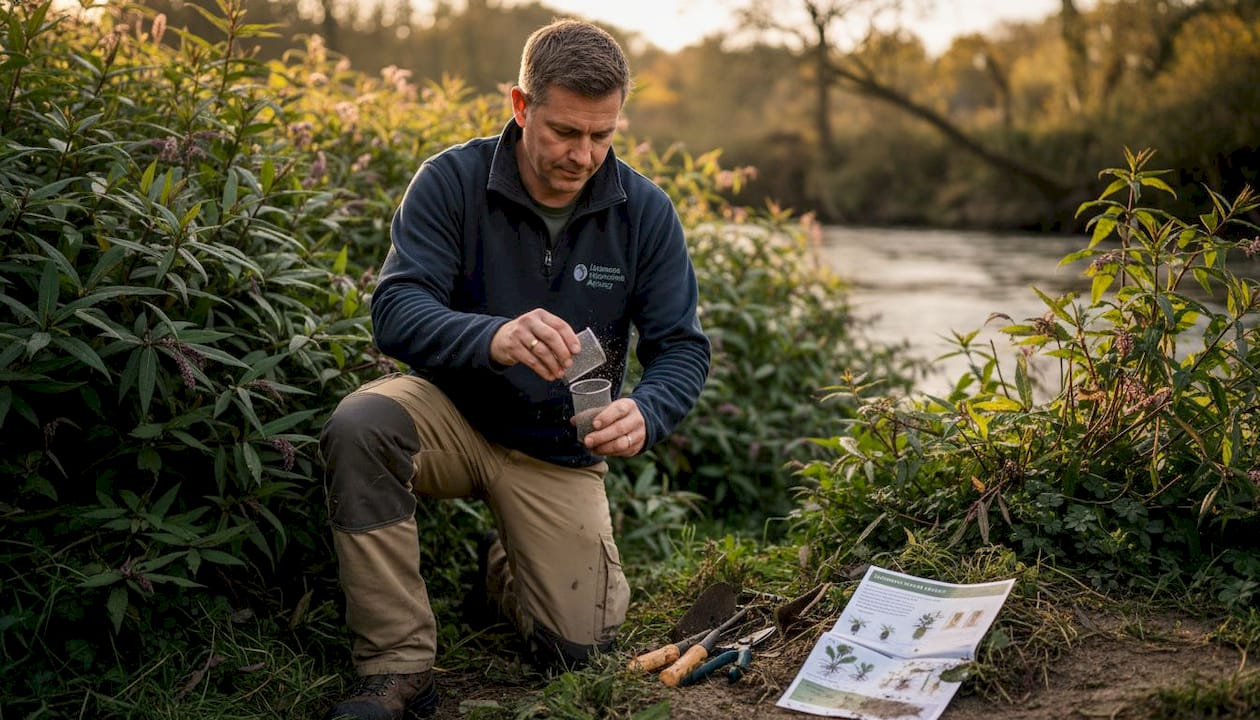
The core challenge is ecological lag. Biocontrol agents are living organisms with their own lifecycles, reproduction rates, and environmental sensitivities. Agent populations lag behind weed growth, and their effectiveness is influenced by weather and host plant availability, so results are not quick or straightforward. In a wet Irish summer, psyllid populations may decline. In an unusually dry English spring, knotweed rhizomes draw on stored energy and push fresh growth regardless of surface-level pressure.
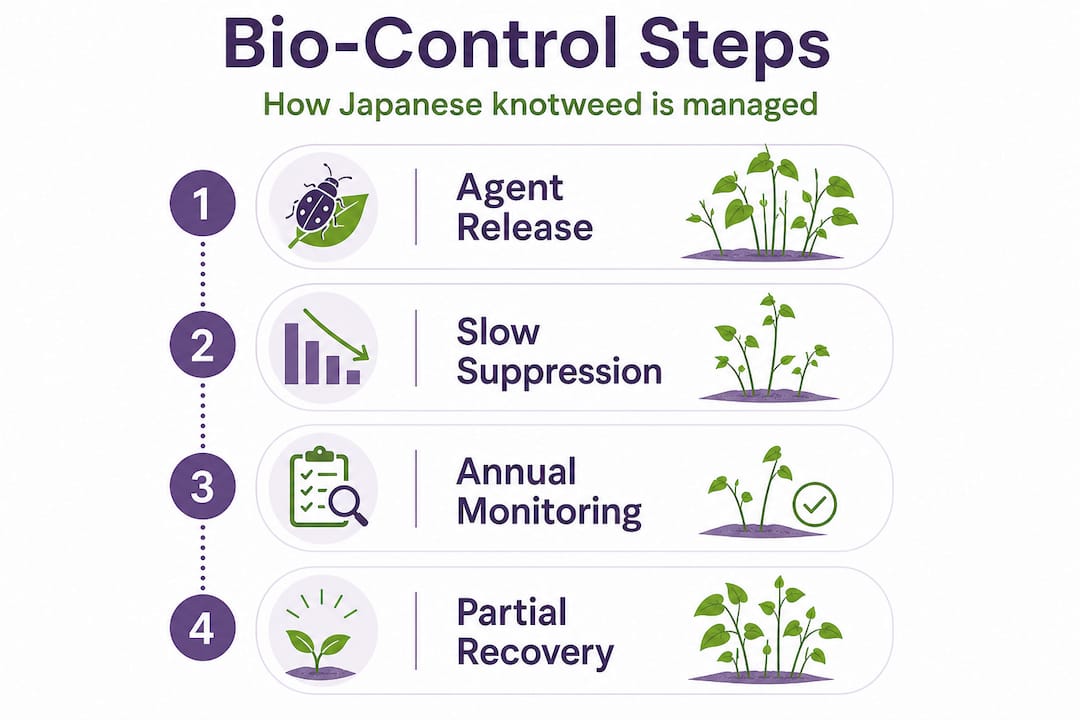
Consider what this looks like in practice. A site treated with an approved biological agent in year one may show very little visible change by the end of that season. By year two, researchers monitoring the site might record slightly reduced cane height or reduced shoot density. Meaningful suppression, in controlled trial conditions, often takes three to five years to become clearly measurable. For a homeowner hoping to sell their property, or one dealing with a knotweed stand near a boundary wall, that timeline can feel unworkable.
| Method | Typical timeline | Eradication possible? | Chemical use | Regulatory approval needed? |
|---|---|---|---|---|
| Biological control | 3 to 7+ years | No | No | Yes |
| Thermo-electric treatment | Multiple sessions over 1 to 3 years | Possible | No | No |
| Excavation and removal | Immediate physical clearance | Yes (with disposal) | No | No |
| Root barrier installation | Ongoing containment | No (containment only) | No | No |
| Regulated herbicide | 2 to 5 years typically | Yes in some cases | Yes | Licensed application recommended |
The table above illustrates why biocontrol alone is rarely sufficient for homeowners facing urgent property or legal pressures. Understanding the full landscape of chemical-free benefits for knotweed helps in making an informed decision about which combination of methods is appropriate.
Pro Tip: Set clear annual benchmarks when using biocontrol. Photograph and measure the knotweed stand at the same point each season. Suppression is gradual, and without documented comparison, it is easy to misjudge whether progress is being made.
The reality for Japanese knotweed: partial suppression, not eradication
Now that we understand the challenge, let’s address what homeowners dealing with Japanese knotweed can realistically expect from biocontrol.
The Royal Horticultural Society is direct on this point. Biological control for Japanese knotweed is currently about long-term suppression, not commercial eradication or development clearance. If your property purchase is on hold because a surveyor flagged knotweed, biocontrol will not resolve that situation within any commercially practical timeframe. If you are a landowner obligated under the Wildlife and Countryside Act 1981 or Irish law to prevent knotweed spreading beyond your boundary, you cannot rely on biocontrol alone to meet that legal duty.
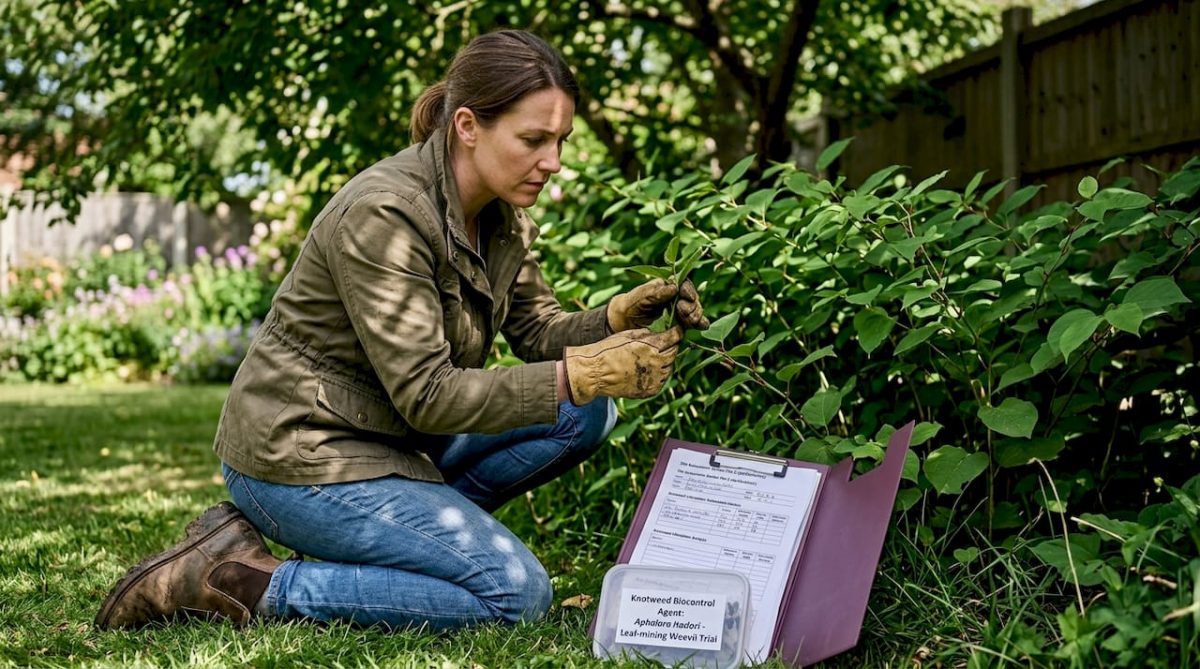
The most advanced biocontrol work in the UK has focused on Aphalara itadori, a psyllid native to Japan. Field trials have demonstrated that this insect can reduce knotweed vigour in research settings, but commercial approval for widespread domestic use has been slow and results in open garden conditions remain variable. Weather patterns in the British Isles and Ireland introduce significant variability compared to controlled trial plots.
Here is what biocontrol genuinely offers at present:
- Reduced shoot vigour over multiple seasons in favourable conditions
- Decreased cane density when agent populations establish successfully
- A chemical-free contribution to an integrated management plan
- Ecological compatibility with sensitive sites such as riverbanks or wildlife corridors
What it does not offer:
- Complete clearance of the rhizome network
- A viable standalone solution for properties requiring mortgage surveys or planning compliance
- Predictable results within a single year
- Any guarantee of effectiveness where site conditions (shade, soil type, climate) are unfavourable
If you are uncertain whether knotweed has already spread beyond your boundary or into neighbouring land, reporting Japanese knotweed early gives you greater legal protection and management options.
Ongoing research context: Scientists are actively investigating fungal pathogens and additional insect species as biocontrol candidates for knotweed. This research is promising, but none of these candidates have received full UK or Irish regulatory clearance for general garden use as of 2026. Treating this as an imminent solution would be premature.
Practical approaches: combining bio-control with other safe methods
Having set realistic expectations, here’s how to put bio-control into a wider, practical plan for your property.
An integrated management approach is consistently what evidence-based sources recommend. The RHS acknowledges that weeds can often be controlled without chemicals, but that regulated weedkillers may be necessary in severe or biodiversity-impact cases. For most homeowners, the practical path forward involves layering several methods, each contributing to the overall weakening of the plant.
Here is a step-by-step framework you can follow:
-
Commission a professional survey. Before taking any action, have the extent of the rhizome network professionally assessed. Knotweed crowns can extend three metres deep and seven metres laterally. Acting without knowing the scope wastes time and money.
-
Install physical root barriers where containment is the priority. High-density root barrier membrane, correctly installed at sufficient depth, prevents lateral spread into neighbouring land or foundations. This is a legal safeguard as much as a management tool.
-
Introduce repeated cutting and stem removal above ground. Consistent cutting throughout the growing season forces the plant to draw on stored rhizome energy, weakening it progressively. Never compost cuttings; bag and dispose of them as controlled waste.
-
Incorporate biocontrol at the appropriate stage. Where approved agents become available and site conditions are suitable, monitored biocontrol can complement physical efforts. This stage requires professional guidance, not self-sourcing.
-
Review outcomes annually and adjust the approach. A plan that is not monitored is a plan that stalls. Annual photographic records, growth measurements, and, where necessary, rhizome sampling allow you to track real progress.
-
Consider thermo-electric treatment as a chemical-free intensification option. Delivered directly to the plant, high-voltage thermo-electric treatment causes internal cellular damage and depletes the energy reserves in the rhizome network. This is the methodology pioneered by Japanese Knotweed Agency and requires no chemical substances on or around your land.
-
Engage regulated chemical intervention only when legally or practically necessary. If knotweed is actively threatening biodiversity, drainage infrastructure, or a neighbouring property, a regulated herbicide programme applied by a licensed professional may be the appropriate escalation.
Pro Tip: Avoid any service that promises full knotweed eradication in a single season using purely natural methods. Reputable, regulator-linked guidance is consistently clear that no such solution exists. If a claim seems too good to be true in this field, treat it with scepticism and verify against official sources such as the RHS or NNSS (Non-native Species Secretariat).
Exploring professional weed removal options gives you a clearer picture of what qualified, accountable management looks like in practice.
Why quick fixes fail: our perspective on safe weed control
We have observed a consistent pattern across the properties we survey and treat throughout England, Wales, and Ireland. Homeowners arrive having already spent one or two growing seasons attempting home remedies or applying methods loosely described as “natural” or “biological.” The knotweed, meanwhile, has continued to extend its rhizome network, often reaching the foundations, drainage channels, or neighbouring boundaries.
The honest truth is this: Japanese knotweed does not respond to optimism or convenience. Its rhizome system can store extraordinary energy reserves, surviving years of surface disturbance and re-emerging each spring with full vigour. Any approach that only targets what you can see above ground is fundamentally mismatched to the nature of the problem.
We also see the downstream damage from misleading marketing. As the RHS has noted, homeowner-focused websites sometimes market “chemical-free” knotweed methods aggressively; however, reputable science-based sources advise caution. The consequence of acting on those claims is often a two-year delay in proper management, during which the plant expands, and the eventual cost of proper intervention increases significantly.
Our position is that the real chemical-free weed benefits are genuine and worth pursuing. Avoiding herbicide use protects soil ecology, water courses, and non-target plant species. But those benefits are best delivered through scientifically grounded, professionally managed methods: thermo-electric treatment, root barrier installation, excavation where necessary, and monitored cultural control. Biological control, where approved agents are available and appropriate, has a role within that integrated framework. It is not, however, a shortcut.
Patience, professional oversight, and evidence-based method selection are what consistently produce results. There is no credible substitute for that combination.
Turn expert guidance into action: get support for safe knotweed control
If this article has clarified the complexity of managing Japanese knotweed without chemicals, the logical next step is to have your site properly assessed by professionals who understand both the science and the regulations.

Japanese Knotweed Agency offers safe chemical-free knotweed solutions backed by a track record of 95% success rates, using our specialist thermo-electric treatment technology alongside root barrier installation and excavation works. We carry out property surveys across England, Wales, and Ireland, giving you a clear, evidence-based picture of what you are dealing with and what the most effective course of action is. Explore our weed eradication best practices and find out how to work with our plant eradication survey specialists to protect your property with confidence.
Frequently asked questions
Does biological control remove Japanese knotweed completely?
No. Current biological control does not eradicate knotweed and is not effective as a standalone option for complete removal. It suppresses growth over time as part of a broader integrated management plan.
Is bio-control the same as using vinegar or boiling water for weeds?
No. Biological control requires organisms that are specifically selected and approved for use against target weeds. Household substances such as vinegar or boiling water are cultural interventions, not biological control.
Can I use only bio-control for invasive weed problems in my garden?
Integrated methods consistently produce better outcomes. The RHS advises that many weeds can be managed without chemicals, but that targeted regulated weedkiller may sometimes be necessary alongside physical and biological measures.
Is biological control approved and available for all weeds in England and Ireland?
No. Biocontrol agents must receive specific regulatory approval for each target weed, and research into biological controls using natural enemies such as insects and fungal pathogens remains ongoing. Not all weed problems currently have an approved biocontrol solution available.