
TL;DR:
- Japanese Knotweed’s underground rhizomes can damage foundations and pose legal risks for homeowners. A structured, chemical-free removal process includes site preparation, physical excavation, root barriers, and ongoing monitoring to ensure eradication. Proper disposal and documentation are essential to comply with legal requirements and protect long-term property value.
Japanese Knotweed is not simply a garden nuisance. Its underground rhizome network can push through concrete foundations, void buildings insurance, and place homeowners in legal jeopardy. A chemical-free removal process offers a responsible, enforceable path to eradication that protects your family, your soil, and your property’s long-term value. This guide walks you through every stage of non-toxic removal, from site preparation and physical excavation to waste disposal and ongoing monitoring, so you can approach the problem with clarity and confidence.
Table of Contents
- What you need before starting a chemical-free removal
- Step-by-step guide to chemical-free Japanese knotweed removal
- Disposal and legal responsibilities for homeowners
- Monitoring, troubleshooting, and preventing regrowth
- Rethinking Japanese knotweed removal: why chemical-free matters more than ever
- How Japanese Knotweed Agency supports your chemical-free removal journey
- Frequently asked questions
Key Takeaways
| Point | Details |
|---|---|
| Thorough preparation | Legal compliance and proper equipment are essential before starting chemical-free knotweed removal. |
| Structured removal steps | Cutting, excavation, screening, and barriers form the core non-chemical eradication process. |
| Safe waste disposal | Use licensed waste carriers and approved sites to avoid environmental damage and legal penalties. |
| Ongoing monitoring | Regular inspection and action prevent regrowth and ensure long-term control. |
| Professional support | Accredited experts improve success rates and protect property investment with formal management plans. |
What you need before starting a chemical-free removal
To avoid spreading the infestation or exposing yourself to legal liability, preparation is not optional. It is the foundation of every successful chemical-free removal.
Personal protective equipment (PPE) is the first requirement. Knotweed fragments are classified as controlled waste, and any contact with skin, clothing, or footwear can inadvertently transport viable plant material to unaffected areas. You will need:
- Disposable coveralls or dedicated site clothing
- Heavy-duty gloves
- Sturdy waterproof boots
- Eye protection when cutting or excavating
Beyond PPE, effective chemical-free methods always begin with a professional survey. Mapping the full extent of an infestation before breaking ground prevents costly errors. Rhizomes can extend up to seven metres horizontally from the visible stems, meaning what you see at the surface represents only a fraction of the problem underground.
Your tools matter, too. Spades, forks, and cutting instruments should be dedicated solely to knotweed work. Heavy-duty bags rated for controlled waste are mandatory for collecting all cuttings and excavated material. Before leaving the site, as safe manual removal guidelines confirm, every tool must be thoroughly cleaned to prevent cross-contamination.
| Preparation item | Purpose | Critical requirement |
|---|---|---|
| Full PPE | Prevent personal contamination | Disposable or site-dedicated only |
| Professional survey | Map full rhizome extent | Before any excavation |
| Heavy-duty controlled waste bags | Legal collection of plant material | Minimum double-bagged |
| Dedicated tools | Avoid cross-site contamination | Cleaned thoroughly on site |
| Licensed waste carrier arranged | Legal disposal | Must be booked before work begins |
Legal compliance runs through every stage. Only licensed waste carriers may transport knotweed away from your property, and disposal must occur at authorised facilities. Preparation also means isolating the affected area fully; equipment must be cleaned before leaving the site to ensure no fragments escape.
Step-by-step guide to chemical-free Japanese knotweed removal
With thorough preparation in place, follow this structured removal process to tackle the infestation safely and systematically.
-
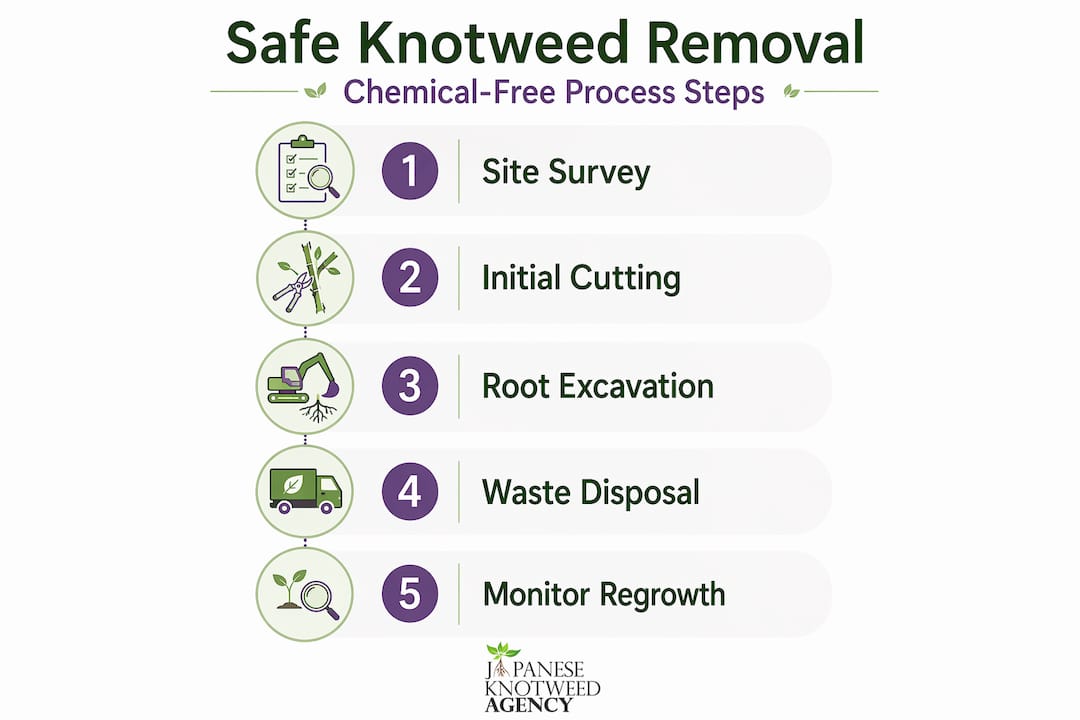
Cut all above-ground growth. Cut stems as close to ground level as possible, ideally in late spring or early summer when the plant is actively growing and most vulnerable. Seal all cut material in double-bagged controlled waste bags immediately. Never leave cuttings loose on the ground.
-
Excavate the rhizome network. Dig methodically to a minimum depth of one metre and extend at least two metres beyond the visible plant boundary. Rhizomes are typically cream or orange in colour internally and can be as thick as a garden hose. Remove every visible fragment, no matter how small.
-
Screen all excavated soil. Screen excavated soil through a fine mesh to capture residual rhizome fragments before any soil is reused on site or removed. A single two-centimetre fragment left in the ground can establish a new colony.
-
Install root barriers. Follow the root barrier installation guide to install heavy-duty, HDPE barriers at boundaries and near structures. Barriers should extend at least 600mm below ground level and turn outward at the base to prevent rhizomes from growing underneath.
-
Apply solarisation. Cover the treated area with UV-stable polythene sheeting secured at the edges. Solarisation uses solar heat to desiccate any remaining rhizome fragments in the upper soil layer and should remain in place for a minimum of one full growing season.
-
Monitor and cut regrowth. Any shoots that emerge through solarisation sheeting or at the barrier perimeter should be cut immediately. Do not allow regrowth to reach 30cm in height or the plant will begin redirecting energy back into the rhizome.
| Stage | Timing | Key action |
|---|---|---|
| Initial cutting | Late spring to early summer | Cut to ground level; bag all material |
| Full excavation | Same season as cutting | Minimum 1 metre depth, 2 metres beyond stems |
| Soil screening | During excavation | Fine mesh, all fragments removed |
| Barrier installation | Post excavation | HDPE, minimum 600mm depth |
| Solarisation | Post barrier | Minimum one full growing season |
| Monitoring | Every 4 to 6 weeks | Cut any regrowth immediately |
Follow the full chemical-free removal workflow to stay on track between site visits.
Pro Tip: Time your initial cutting to coincide with the plant’s most vigorous growth phase in late spring. At this point, the rhizome is actively sending energy upward, making it more susceptible to depletion through repeated cutting over the season.
Disposal and legal responsibilities for homeowners
After removal, managing the waste correctly is not merely good practice. Under UK law, it carries real legal consequences.
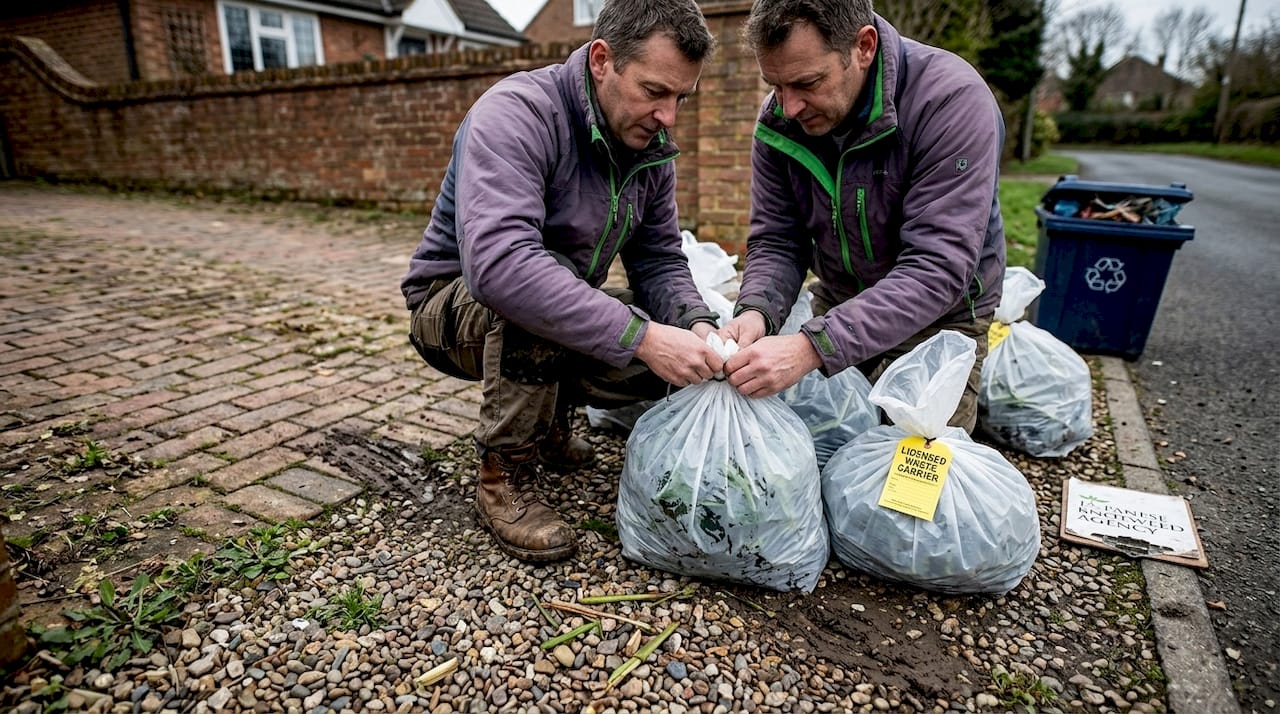
Japanese Knotweed waste is classified as controlled waste under the Environmental Protection Act 1990. This means the same legal framework that governs commercial industrial waste applies directly to what you dig up in your garden. You must use licensed waste carriers and ensure disposal at permitted landfill sites; incorrect disposal risks legal penalties including prosecution.
What you must never do with knotweed waste:
- Place it in household wheelie bins
- Add it to compost heaps or bonfires unless fully desiccated and permitted
- Dispose of it in skips unless the skip company holds a licensed waste carrier permit
- Transport it off site in an unmarked or unlicensed vehicle
- Leave bags on the pavement or in communal areas
Follow the invasive weed management steps carefully to ensure your disposal chain is fully documented.
Retain all waste transfer notes. These documents confirm your knotweed was disposed of legally and are increasingly requested by mortgage lenders, solicitors, and surveyors during property transactions. Without them, even a successful physical removal can be challenged.
Key legal point: On-site burning or drying of knotweed material is permissible in certain circumstances and preferable to transportation when conditions allow, as it eliminates the risk of material escaping in transit. Always verify local authority permissions before burning.
Monitoring, troubleshooting, and preventing regrowth
Removing the main plant is only part of the process. Vigilant monitoring over the subsequent growing seasons secures long-term success and protects your legal position.
Continual monitoring is vital to prevent Japanese Knotweed from re-establishing, particularly in the first two years following initial treatment. Rhizomes can remain dormant in soil for extended periods and regenerate from fragments as small as a fingernail. A site that appears clear in spring may show regrowth by July.
Your monitoring schedule should include:
- Site visits every four to six weeks throughout the growing season (March to October)
- Inspection of the full treated area and a two-metre perimeter beyond it
- Checking beneath solarisation sheeting at the edges for lateral growth
- Looking for soil disturbance or small, reddish shoots breaking the surface
- Inspecting root barriers annually for signs of damage or deformation
Follow knotweed removal best practices to build a site diary that records every visit, every observation, and every intervention. This documentation is invaluable for planning applications, mortgage applications, and boundary disputes.
After a minimum of two clear growing seasons with no regrowth, you can consider replanting. Establishing dense ground cover, turf, or ornamental planting stabilises the soil and reduces the likelihood of airborne or water-borne knotweed seeds establishing. A bare, disturbed site is more vulnerable to reinfestation than a well-planted one.
Pro Tip: Photograph your site at every visit using the same fixed reference points. A photographic time series is far more persuasive to a lender or solicitor than written records alone, and it demonstrates the diligence your management programme demands.
Rethinking Japanese knotweed removal: why chemical-free matters more than ever
The default response to Japanese Knotweed for decades has been herbicide application, primarily glyphosate-based products. It is worth examining honestly whether that default still serves homeowners, their neighbours, or the wider environment.
Chemical herbicides carry documented risks to soil health, waterways, and non-target species. Chemical-free methods protect local ecosystems while ensuring compliance. The question is no longer purely ecological. It is financial and legal.
Mortgage lenders increasingly scrutinise the treatment methods used on affected properties. Several lenders now require evidence of a professional management plan using accredited methods before releasing funds on properties where knotweed is present. A poorly documented herbicide programme, carried out by unaccredited contractors, can be as commercially damaging as no treatment at all. A structured, chemical-free approach with a formal treatment plan and documented site visits gives lenders precisely the evidence they need.
Soil health is another dimension that receives insufficient attention. Repeated glyphosate application degrades microbial diversity in the soil, which affects the long-term performance of any planting or landscaping you undertake after eradication. Non-toxic removal methods preserve that biological capital.
The benefits of chemical-free control extend to biodiversity, too. Gardens treated with herbicides see a measurable reduction in pollinator activity and soil invertebrate populations in the treatment zone. Organic removal alternatives maintain the ecological function of the land throughout the management process.
Our position at Japanese Knotweed Agency is grounded in practical experience across hundreds of sites in England, Wales, and Ireland. Thermo-electric treatment, which delivers up to 5,000 volts directly into the rhizome network, causes progressive cellular damage and energy depletion without any chemical input. It achieves results comparable to multi-season herbicide programmes, often within one to two years, without the ecological trade-offs. The technology exists. The results are documented. The case for chemical-free management has never been stronger.
How Japanese Knotweed Agency supports your chemical-free removal journey
For peace of mind and lasting results, professional expertise makes all the difference when facing a Japanese Knotweed infestation.
Japanese Knotweed Agency specialises in chemical-free knotweed solutions that achieve up to 95% success without a single drop of herbicide. Our thermo-electric treatment delivers direct energy up to 5,000 volts into the rhizome network, disrupting cellular function and depleting the plant’s energy reserves with each application. We begin every project with a thorough property survey to map the infestation precisely, ensuring no rhizome network is overlooked. We also provide root barrier installation, licensed waste disposal, and full documentation to satisfy mortgage lenders and solicitors across England, Wales, and Ireland.
Frequently asked questions
What is the safest way to remove Japanese knotweed without chemicals?
The safest chemical-free removal involves professional surveys, physical excavation to at least one metre depth, root barrier installation, solarisation, and ongoing monitoring with fully compliant waste disposal.
Can I remove Japanese knotweed manually on my own?
Manual removal is only advisable for very small, isolated outbreaks under 1m² and must strictly follow legal protocols, including PPE use and licensed waste disposal, to avoid spreading the infestation or incurring liability.
How long does chemical-free treatment usually take to eradicate knotweed?
Thermo-electric treatment takes 1 to 2 years with up to 95% success; physical cutting and barrier methods typically require 2 to 4 years or more depending on the severity and extent of the infestation.
Why is ongoing monitoring necessary after knotweed removal?
Rhizomes can remain dormant for years and regenerate from tiny fragments; monitoring for at least two years after initial treatment allows early detection and swift intervention before any regrowth establishes.
Do chemical-free methods affect the value of my property?
Yes, professional chemical-free treatment plans with full documentation actively help satisfy mortgage lender requirements, protecting and potentially improving your property’s market value compared with untreated or poorly documented infestations.