

TL;DR:
- Innovative, chemical-free methods now enable faster, environmentally responsible Japanese knotweed eradication within months. These approaches include anaerobic tarping, soil microbiome adjustments, and physical rhizome removal, which outperform traditional herbicide treatments requiring years. However, success relies on professional implementation, diligent monitoring, and correct handling to prevent spreading fragments or causing long-term issues.
For decades, homeowners across England, Wales, and Ireland have been told that eliminating Japanese knotweed means committing to years of herbicide applications, watching chemicals seep into soil and waterways, and still facing uncertainty about long-term results. That assumption is now being firmly challenged. Chemical-free eradication approaches are shifting the industry away from multi-year pesticide programmes towards faster, environmentally responsible mechanisms that protect both property and biodiversity without toxic residues.
Table of Contents
- Why innovation is changing the battle with Japanese knotweed
- Chemical-free innovations: From anaerobic covers to organic compost
- High-tech weed control: Energy treatments, robotics and precision
- Pitfalls, best practices, and homeowner mistakes to avoid
- How does evidence stack up? Comparing innovative and traditional methods
- The uncomfortable truth about rapid chemical-free knotweed success
- Next steps: Professional support for innovative weed eradication
- Frequently asked questions
Key Takeaways
| Point | Details |
|---|---|
| Chemical-free success rates | Innovative methods can match or exceed 95% elimination rates in real trials, with faster regrowth prevention. |
| Quicker replanting options | Evidence-backed innovations like Roots Reset allow native replanting in days or weeks, not years. |
| Mistakes can backfire | Errors like cutting, rushing, or poor disposal increase the risk of knotweed spreading instead of eradication. |
| Choose site-specific methods | No single approach fits every home—site assessment and matching technique to situation is essential for long-term success. |
Why innovation is changing the battle with Japanese knotweed
With the scale of the knotweed problem clear, what has changed in recent years is the rate at which innovation is redefining best practice.
Japanese knotweed is not simply an unsightly garden nuisance. Its root system, known as the rhizome network, can extend three metres deep and seven metres laterally, pushing through tarmac, cracking foundations, and rendering properties unmortgageable. Standard herbicide programmes typically require three to five consecutive growing seasons to show meaningful results, and even then, residual chemical contamination can complicate land sales, affect planning applications, and pose risks to neighbouring ecosystems.
Regulatory and market pressures are also reshaping priorities. Increasing restrictions on certain herbicide active substances, combined with growing lender scrutiny of contamination disclosures, have created genuine commercial incentive for faster, cleaner solutions. Homeowners, surveyors, and land managers are now actively seeking alternatives that satisfy mortgage providers without introducing further environmental liability.
The key shifts driving this change include:
- Speed: Innovative methods are reporting eradication timelines measured in months rather than years.
- Environmental safety: No herbicide residues in soil, groundwater, or adjacent habitats.
- Property value protection: Faster resolution supports mortgage and sale timelines.
- Biodiversity: Treated ground recovers for planting significantly sooner.
- Regulatory confidence: Chemical-free documentation increasingly satisfies lender and insurer requirements.
“Innovation is central to chemical-free Japanese knotweed eradication approaches, shifting from long multi-year herbicide programmes to alternative mechanisms that are both faster and more environmentally responsible.”
Exploring sustainable approaches to knotweed management is no longer a fringe consideration. It is rapidly becoming industry standard thinking.
Chemical-free innovations: From anaerobic covers to organic compost
Now let us look more closely at which chemical-free innovations are achieving real results, and how you can distinguish them in practice.
Anaerobic tarping (oxygen-tight covering)
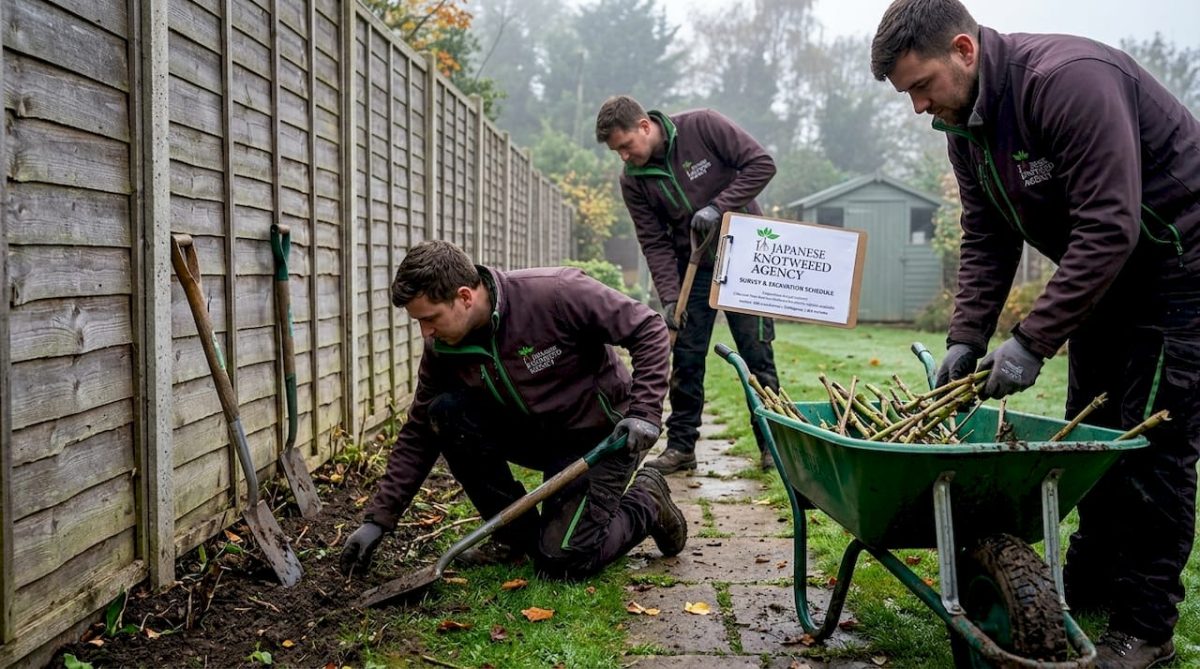
The Roots Reset method, trialled extensively in Wales and north-western Europe, works by sealing the knotweed site within an oxygen-tight, anaerobic covering system. Deprived of light and oxygen, the rhizome network is forced to exhaust its energy reserves without the ability to photosynthesise and recover. The chemical-free methodology trialled in Wales has reported full elimination across the majority of treated sites, with replanting possible within as little as five days of completion and the full treatment cycle taking approximately twelve months.
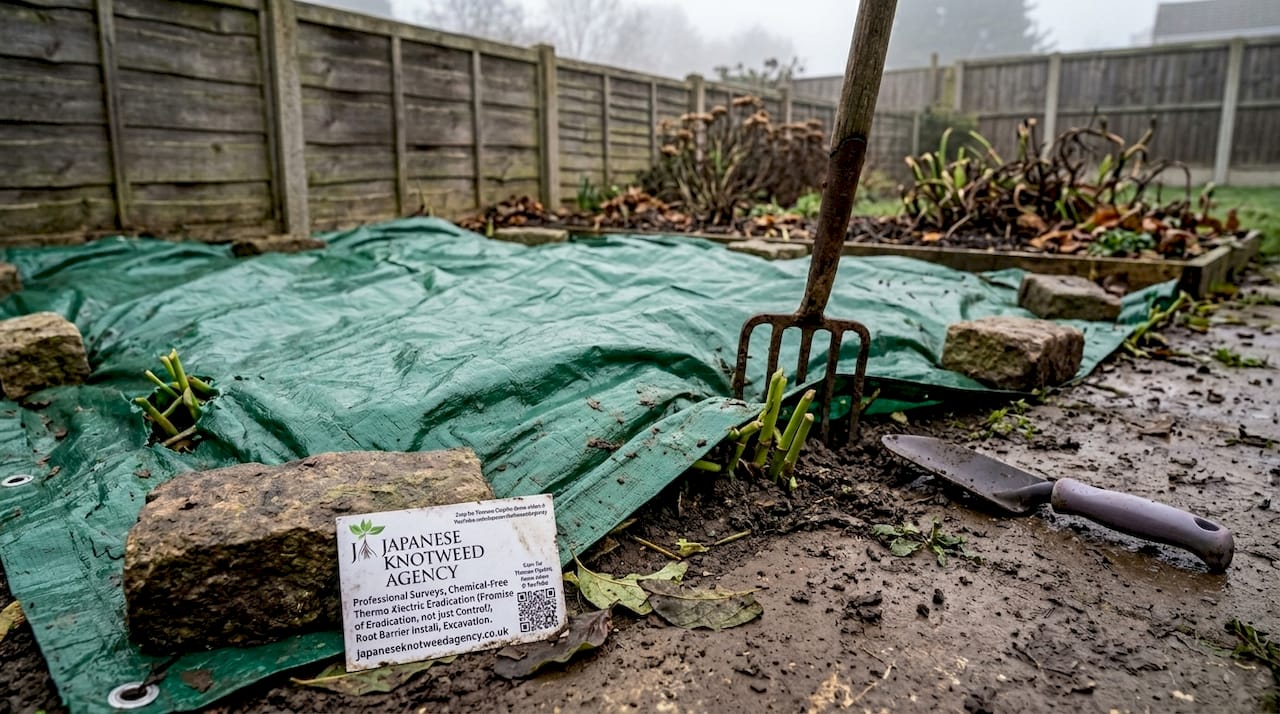
This is a dramatic departure from the standard herbicide approach. Where glyphosate-based programmes require repeat applications over multiple seasons, anaerobic tarping creates a single, contained treatment window with a defined end point. For homeowners with active sale timelines or planning applications, that certainty carries significant practical value.
Organic compost and soil microbiome adjustment
In Ireland, a different but equally compelling approach has been developed through the KNOT project, piloted under a local authority programme. This method applies bespoke organic compost formulations designed to alter the soil microbiome in ways that actively inhibit knotweed viability. Rather than attacking the plant directly, the treatment targets the soil conditions that sustain its growth. Results from pilot sites have been sufficiently encouraging for the programme to be expanded, signalling that this ecological approach has genuine scalability.
Physical and mechanical rhizome removal
Methods such as Resi-Dig-Out and Xtract focus on direct physical excavation and extraction of the rhizome mass. When conducted by trained professionals who understand the risk of fragmentation and spread, these approaches can deliver rapid clearance suitable for construction timelines. The key is controlled extraction: every fragment left in soil is a potential new plant.
The chemical-free solutions workflow and the step-by-step process behind each technique matter enormously when selecting the right method for your site.
| Method | Principle | Outcome timeline | Evidence base |
|---|---|---|---|
| Anaerobic tarping (Roots Reset) | Oxygen deprivation, energy depletion | 10 to 14 months | North Wales, north-western Europe trials |
| Organic compost (KNOT) | Soil microbiome adjustment | 12 to 18 months | Ireland local authority pilots |
| Excavation (Resi-Dig-Out/Xtract) | Physical rhizome removal | Days to weeks | England and Wales construction sites |
| Thermo-electric treatment | Direct energy to rhizome cells | Progressive, multi-treatment | Emerging UK professional applications |
| Herbicide (traditional) | Chemical absorption and kill | 3 to 5 years | Long-established, multi-site data |
Pro Tip: Always match the technique to your specific site conditions, local guidance, and planning requirements. A method that works well on an open garden may be entirely unsuitable for a site adjacent to a watercourse, where even organic treatments must be assessed for run-off risk.
High-tech weed control: Energy treatments, robotics and precision
While traditional and ecological methods are effective for many gardens, high-tech options are emerging for unique or especially challenging sites.
At Japanese Knotweed Agency, our thermo-electric treatment delivers up to 5,000 volts of direct energy into the knotweed’s rhizome network on-site. This causes internal cell damage at a structural level, progressively depleting the stored energy reserves that allow the plant to regenerate season after season. Unlike surface treatments, this approach targets the underground mass directly, making it particularly effective for sites where excavation is impractical or where soil disruption must be minimised.
Robotic and precision weed control technologies are also moving into the professional field. A 2026 review of emerging precision weed control technologies confirms that energy-based, thermal, and robotic systems broaden the chemical-free toolkit significantly, though most require careful fit-to-site selection and professional implementation to achieve reliable results. These are not products you will find in a garden centre. They require trained operators, site surveys, and considered application planning.
| Technology | Mechanism | Pros | Cons | Who should use it |
|---|---|---|---|---|
| Thermo-electric treatment | Direct energy to rhizome network | No chemicals, targets root mass | Requires professional delivery | Professionals only |
| Thermal/steam application | Heat to above-ground and root material | No residues | Limited depth penetration | Professionals, some specialist units |
| Robotic precision systems | Targeted mechanical/chemical-free action | Scalable, repeatable | High cost, early-stage availability | Large-scale or commercial sites |
| Electric pulse devices | Electrical discharge to root zone | Fast cell disruption | Not suitable for all soil types | Professional assessment required |
Situations where high-tech methods offer a clear advantage include:
- Sites adjacent to watercourses, where herbicide use is restricted or prohibited.
- Properties with knotweed growing close to foundations or utilities, where excavation would cause structural risk.
- Brownfield redevelopment sites requiring rapid clearance without chemical contamination.
- Gardens where the homeowner has environmental objections to chemical use.
- Properties where mortgage lenders require documented chemical-free treatment methodology.
The safe chemical-free guide for knotweed treatment outlines when professional assessment is not just advisable but essential.
Pitfalls, best practices, and homeowner mistakes to avoid
With options in hand, how do you make sure your efforts do not accidentally backfire or put your property at risk?
The most significant risk in knotweed management is not inaction. It is incorrect action. Knotweed spreads readily from even small fragments of rhizome. A single piece of root material, as small as a centimetre, can establish a new colony if left in disturbed soil or disposed of incorrectly. The Invasives.ie knotweed guide stresses that any action which cuts, fragments, or disperses plant material increases regrowth and spread risk considerably.
The five most common homeowner mistakes are:
- Cutting or strimming the plant. This fragments stem and rhizome material, increasing spread risk and triggering vigorous regrowth. Never cut knotweed without a professional plan in place.
- Disturbing soil without a containment strategy. Digging around knotweed without knowing the full extent of the rhizome network spreads fragments through previously unaffected areas.
- Disposing of material in general waste or garden compost. Knotweed is classified as controlled waste in the UK. Incorrect disposal is a legal offence under waste regulations, and placing it in garden compost simply spreads it further.
- Rushing to replant. Replanting before eradication is confirmed can mask regrowth and delay identification of treatment failure until the colony is re-established.
- Ignoring professional guidance on monitoring. Even successful treatments require post-treatment monitoring. Skipping this step is one of the most common reasons for long-term failure.
Pro Tip: A rushed or poorly planned knotweed removal attempt can transform a manageable problem into a significantly worse one. Debris handled incorrectly, or soil disturbed without containment, can spread the infestation across an entire garden boundary. Always follow the removal best practices recommended by qualified professionals before you begin.
How does evidence stack up? Comparing innovative and traditional methods
To tie everything together, it is vital to measure how these innovative methods truly perform versus what they promise.
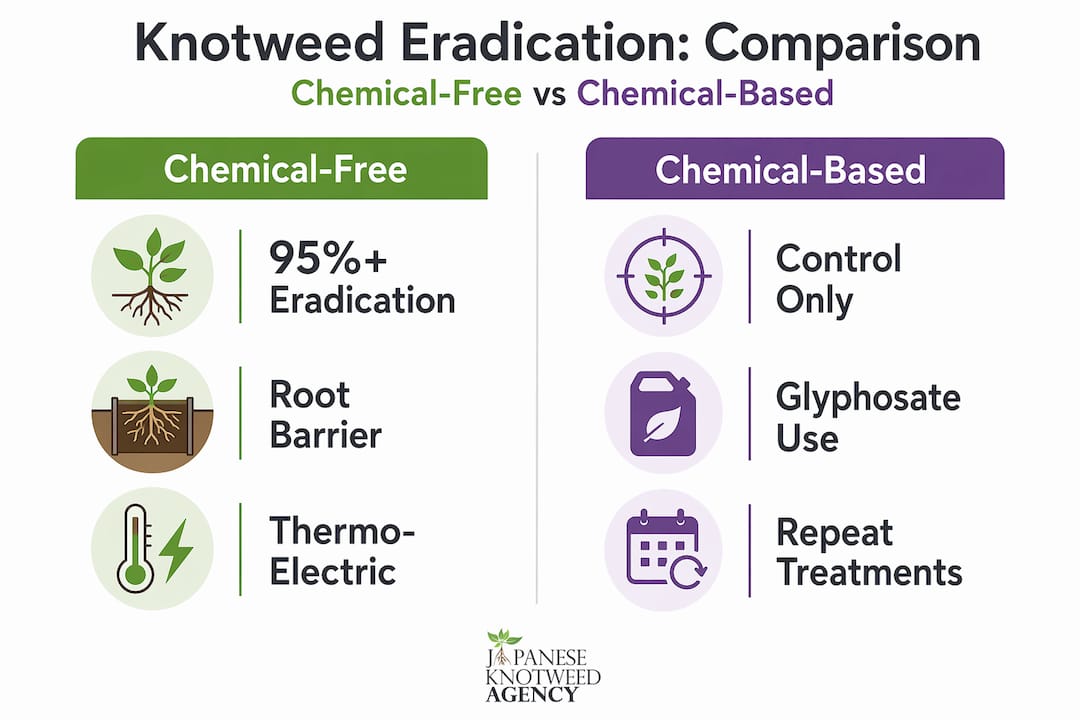
The headline figure from the Roots Reset trials is striking. Full elimination was reported in more than 95% of cases across over 325 sites in north-western Europe, with treatment timelines of approximately twelve months. Traditional herbicide programmes, by contrast, routinely require three to five years before the same standard of eradication can be declared. For a homeowner trying to sell a property or satisfy a mortgage lender, that difference is not marginal. It is transformative.
However, longer-term independent monitoring remains an important caveat. Rigorous comparison against established pesticide programmes over extended periods is explicitly identified as a need within the research literature. Trial success rates reflect controlled conditions and professional implementation. Replicated independently across variable site types, soil conditions, and climate zones, results will inevitably show some variance.
Where innovative methods clearly outperform traditional approaches:
- Properties with mortgage or sale deadlines requiring rapid resolution.
- Sites near watercourses or sensitive habitats where herbicide use is restricted.
- Gardens where biodiversity recovery and replanting are immediate priorities.
- Homeowners with children or pets for whom chemical residue is an unacceptable risk.
- Sites where documented chemical-free treatment is a contractual requirement.
Where a combined or cautious approach may be more appropriate:
- Large-scale infestations with uncertain rhizome extent.
- Sites with highly variable soil conditions that may reduce tarping or compost efficacy.
- Cases where independent survey data has not yet confirmed full rhizome depth.
The chemical-free success rate data from professional applications provides a useful benchmark, but site-specific survey remains the most reliable foundation for any eradication decision.
The uncomfortable truth about rapid chemical-free knotweed success
Headlines about 95% success rates and twelve-month eradication timelines are genuinely encouraging. But in our experience working across England, Wales, and Ireland, the outcomes that fall outside that success rate have a common cause. They are not method failures. They are process failures.
The trials that produce strong results are conducted under strict operational control. Tarping systems are properly sealed. Debris is handled by trained personnel under controlled waste protocols. Post-treatment monitoring is carried out by professionals who know precisely what early rhizome regeneration looks like. When homeowners attempt to replicate headline results without that operational rigour, the outcomes are predictably worse.
The Invasives.ie guidance is explicit: if you cut, fragment, disturb, or dispose of knotweed material incorrectly, the risk of regrowth and spread increases sharply, even within a so-called chemical-free programme. Rapid does not mean easy. Chemical-free does not mean low-risk. It means that the risk profile is different, and in some respects more demanding of precision, not less.
Success in knotweed eradication is not solely determined by the method chosen. It is determined by the diligence, expertise, and follow-through applied at every stage of the process.
Our view is that homeowners are best served by understanding that innovation raises the ceiling for what is achievable, but it does not eliminate the floor of professional competence required to reach it. The benefits of chemical-free control are real and well evidenced. Realising them reliably still requires professional assessment, a site-specific plan, and committed post-treatment monitoring.
Vetting a provider credibly means asking for site-specific evidence, not just headline success statistics. Ask what post-treatment monitoring is included. Ask what the protocol is if regrowth is identified. Ask whether the treatment method suits your specific soil type and site access. A provider who answers those questions with confidence and detail is one worth trusting.
Next steps: Professional support for innovative weed eradication
Understanding the options is the first step. Acting on them correctly is what determines the outcome.
At Japanese Knotweed Agency, we specialise in chemical-free treatment and eradication across England, Wales, and Ireland. Our thermo-electric treatment delivers direct energy up to 5,000 volts into the rhizome network on-site, depleting energy reserves progressively without any chemical application. We also provide root barrier installations, excavation works, and professional property surveys. Whether you are facing an active infestation or need a survey before sale, our team will build a site-specific eradication plan around your timeline and property needs. Explore our chemical-free solutions or book a professional survey to take the first step with confidence.
Frequently asked questions
Can you permanently remove Japanese knotweed without chemicals?
Yes. Proven methods such as anaerobic oxygen-tight covering have achieved full elimination in over 95% of treated sites, provided the process is correctly managed by qualified professionals with proper post-treatment monitoring.
How fast are innovative, chemical-free knotweed methods compared to traditional treatments?
Some methods, such as anaerobic tarping, complete eradication in around twelve months with replanting possible within days, compared to three to five years for standard herbicide programmes.
Are energy and robotic methods practical for home gardens?
High-tech options such as thermo-electric treatment are effective but must be delivered by trained professionals following a site-specific assessment, as suitability varies significantly depending on soil type, site access, and rhizome depth.
What mistakes should I avoid with knotweed eradication?
Never cut, fragment, strim, or dispose of knotweed in general waste or garden compost. The Invasives.ie guide confirms these actions increase spread risk considerably. Always develop a professional plan before any physical intervention.