

TL;DR:
- Removing surface knotweed does not eliminate its extensive underground rhizome network.
- Effective eradication requires multi-year treatment and professional intervention targeting deep roots.
- Legally, homeowners must disclose knotweed presence, control its spread, and follow proper disposal protocols.
Most homeowners assume that removing visible Japanese Knotweed solves the problem. It does not. The real threat lies underground, in a dense network of rhizomes that can lie dormant for up to 20 years and regenerate from a fragment no larger than a fingernail. Whether you are dealing with an active infestation, preparing to sell, or buying a property where knotweed has been flagged, understanding how this plant regenerates is not optional. It is the foundation of every effective management decision you will make.
Table of Contents
- What is knotweed regeneration and why is it so difficult to eliminate?
- Understanding the regeneration cycle: dormancy, growth and spread
- Why home remedies and surface removal usually fail
- How to break the cycle: legal, survey and treatment essentials
- What most homeowners get wrong about knotweed regeneration
- Take the next step: professional help and resources
- Frequently asked questions
Key Takeaways
| Point | Details |
|---|---|
| Regeneration from tiny fragments | Knotweed can regrow from rhizome pieces as small as 1cm or less than a gram, making complete removal extremely challenging. |
| Dormancy lasts decades | Rhizomes can lie dormant for up to 20 years before ‘waking up’ and spreading again. |
| Proper treatment required | DIY solutions often fail; multi-year professional eradication and survey documentation is essential. |
| Legal disclosure needed | Homeowners must disclose knotweed on TA6 forms, and improper disposal or spread can lead to fines. |
What is knotweed regeneration and why is it so difficult to eliminate?
Now that you know why surface removals so often fail, let’s interrogate the underlying science — what exactly allows knotweed to regenerate when so many other weeds do not?
Japanese Knotweed (Fallopia japonica) does not spread through seeds in the UK. Regeneration is primarily vegetative, driven by rhizome fragments and stem segments rather than viable seed dispersal. UK plants are mostly female and produce sterile seeds, which means the entire burden of spread falls on the physical movement of root material. This is a critical distinction because it means every time soil is disturbed, excavated, or moved without proper controls, you risk creating new infestations.
The rhizome network is extraordinarily resilient. A fragment as small as 1cm, containing a single node or bud, is sufficient to establish a new plant. Roots extend up to 3 metres deep and spread laterally up to 7 metres from the visible stem. Explore the Japanese Knotweed Help Centre for guidance on identifying how far an infestation may have travelled on your site.
“A single rhizome fragment as small as 1cm or weighing just 0.5–0.7g, provided it contains a node or bud, is capable of establishing an entirely new infestation.” — RHS Japanese Knotweed Guide
Why surface removal consistently fails:
- Digging removes the visible plant but leaves rhizomes intact at depth
- Soil disturbance fragments rhizomes and spreads viable pieces laterally
- Roots at 2–3 metres depth are unreachable by standard garden tools
- Dormant rhizomes can remain undetected for years before re-emerging
| Removal method | Reaches rhizome depth | Addresses dormancy | Prevents fragment spread |
|---|---|---|---|
| Hand digging | No | No | No |
| Rotavating | No | No | Worsens spread |
| Surface cutting | No | No | No |
| Professional treatment | Yes | Yes | Yes |
The RHS Japanese Knotweed Guide confirms that the plant’s underground architecture is the primary reason eradication demands specialist intervention. Understanding this biology is not academic — it has direct consequences for your property’s value, mortgageability, and legal standing.
Understanding the regeneration cycle: dormancy, growth and spread
Having established why regeneration is so persistent, the next step is to visualise and sequence the entire cycle — from dormancy right through to uncontrollable growth.
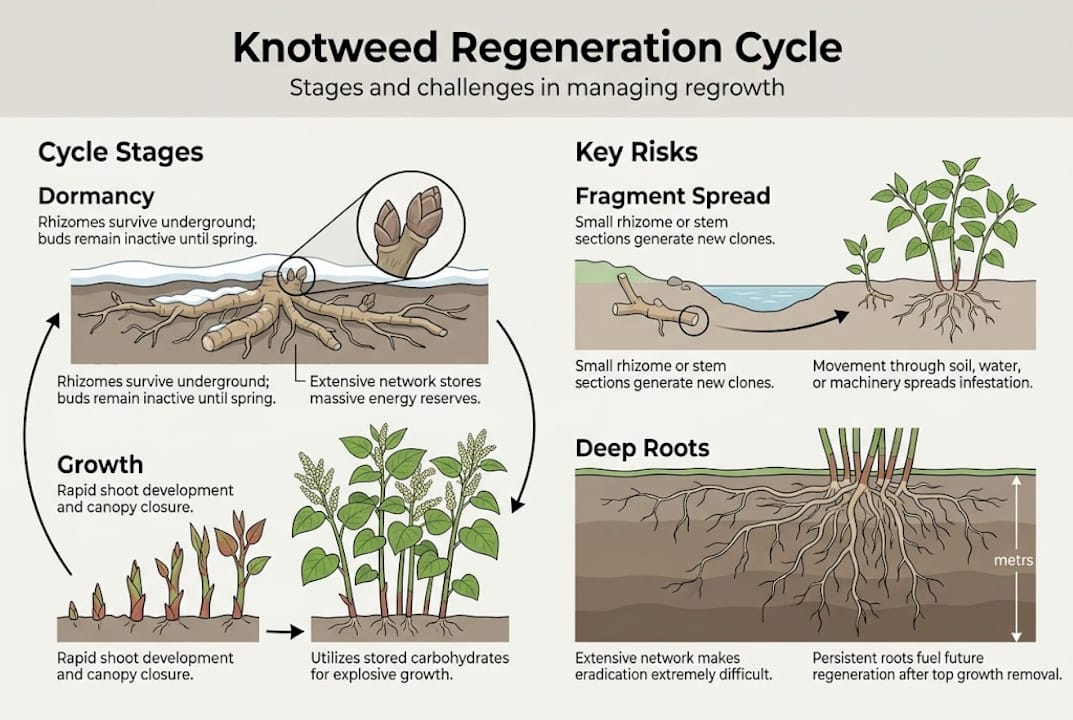
Knotweed follows a distinct seasonal pattern, but the underground rhizome network is active year-round, storing nutrients even when the surface plant appears dead. Rhizomes store nutrients year-round, lying dormant for up to 20 years before conditions trigger regrowth. This is what makes a site that appears clear so deceptive.
The knotweed regeneration cycle, step by step:
- Late winter to early spring: Dormant rhizomes detect temperature and moisture changes and begin mobilising stored energy reserves.
- Spring: Red or purple shoots emerge rapidly from the ground, sometimes growing several centimetres per day in favourable conditions.
- Summer: Hollow, bamboo-like canes reach full height, with dense canopy growth shading out competing vegetation.
- Autumn: The aerial plant dies back, but nutrients are drawn back down into the rhizome network, strengthening it for the following year.
- Winter: The plant appears eradicated. Underground, rhizomes remain viable and continue extending laterally.
| Season | Above-ground activity | Below-ground activity |
|---|---|---|
| Spring | Rapid shoot emergence | Energy mobilisation |
| Summer | Full canopy growth | Lateral rhizome extension |
| Autumn | Die-back begins | Nutrient withdrawal to roots |
| Winter | No visible growth | Dormancy, continued spread |
According to knotweed regeneration studies, mid-stem segments collected during the flowering period are particularly successful at regrowing, which is why autumn clearance work can inadvertently worsen an infestation if not managed correctly.
Pro Tip: If you are commissioning a UK weed survey for mortgages, do not wait until winter when the plant has died back. A survey conducted in late spring or summer, when growth is visible, produces far more accurate results and supports a stronger management plan. You can also review a knotweed survey checklist to understand exactly what a thorough inspection should cover.
Why home remedies and surface removal usually fail
With the full cycle in mind, it is now clear why so many approaches falter. You need more than effort — you need science on your side.
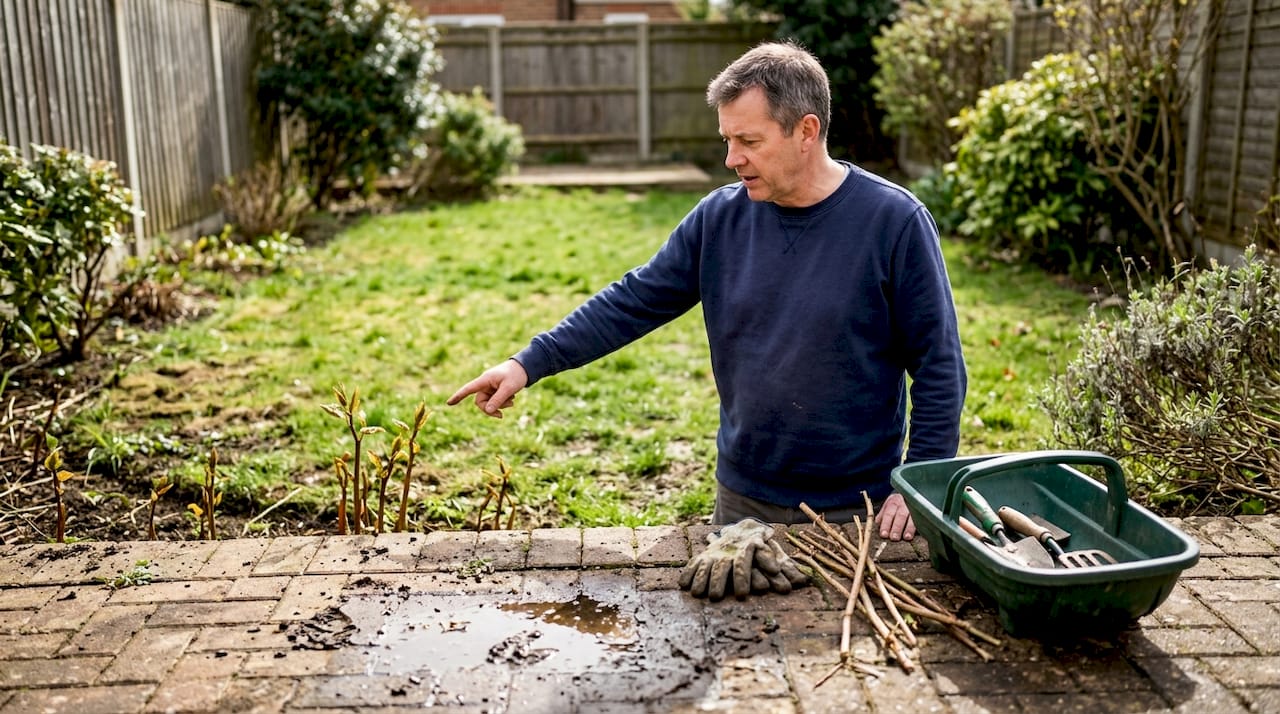
The most common mistake homeowners make is treating knotweed as a surface problem. Cutting it back, pouring boiling water over shoots, or applying off-the-shelf weedkiller may suppress visible growth temporarily, but none of these methods reach the rhizome network at depth. Surface removal fails precisely because the plant’s energy reserves and regenerative capacity sit well beyond the reach of garden-level intervention.
Common DIY methods and why they fall short:
- Cutting and strimming: Stimulates vigorous regrowth; does not affect rhizomes
- Domestic weedkiller: Active ingredients rarely penetrate more than a few centimetres into soil
- Boiling water: Affects surface roots only; no impact at depth
- Covering with membrane: Delays growth but does not kill rhizomes; plants eventually find gaps
- Rotavating: Fragments rhizomes into hundreds of viable pieces, dramatically worsening spread
Even partial excavation without proper containment protocols can create new satellite infestations across a site. Any soil containing knotweed material is classified as controlled waste under UK regulations, and moving it without appropriate disposal procedures carries legal risk.
Pro Tip: If you are planning to sell a property with knotweed, be aware that mortgage lenders will scrutinise treatment history closely. A failed DIY attempt followed by incomplete documentation can be more damaging to a sale than the original infestation. Acting early with professional support is always the more cost-effective route.
Professional eradication programmes combine multi-year treatment schedules with insurance-backed guarantees. These guarantees are specifically recognised by mortgage lenders and surveyors, making them an essential document for any property transaction. If you are unsure whether your property qualifies for a survey, a free knotweed survey can provide an initial assessment without financial commitment.
How to break the cycle: legal, survey and treatment essentials
Once you know the pitfalls of common tactics, the path forward is clear: legal compliance and expert help are not optional — they are fundamental.
Owning a property with Japanese Knotweed carries specific legal responsibilities in England, Wales, and Ireland. Understanding them protects you from fines, disputes, and failed property transactions.
Your legal obligations as a homeowner:
- Prevent spread to neighbouring land or the wild under Schedule 9 of the Wildlife and Countryside Act 1981. Allowing knotweed to spread beyond your boundary can result in civil action from neighbours.
- Disclose knotweed on the TA6 property information form when selling. Failure to disclose is a legal liability and can result in post-sale claims against you.
- Dispose of knotweed waste as controlled waste under the Environmental Protection Act 1990. It must be taken to a licensed landfill site; it cannot be composted or left in green waste collections.
- Engage a PCA-accredited specialist if a mortgage lender requires a management plan as a condition of lending.
Key statistic: Knotweed affects an estimated 5% of properties in the UK, yet the majority of affected homeowners remain unaware of their legal disclosure obligations until a sale is already in progress.
For homeowners who suspect knotweed but are unsure of their obligations, reporting knotweed correctly from the outset establishes a documented timeline that protects you legally. Understanding the full property survey workflow also ensures you know what to expect at each stage of the process, from initial identification through to lender-accepted sign-off.
What a professional treatment programme should include:
- Site survey and rhizome mapping
- Multi-year treatment schedule with documented progress
- Insurance-backed guarantee accepted by major mortgage lenders
- Controlled waste disposal certification
- Post-treatment monitoring visits
What most homeowners get wrong about knotweed regeneration
It is clear by now that this is not just another weed problem. Here is a deeper look at where most approaches fall apart.
The most persistent error we encounter is the belief that a single treatment season resolves the infestation. Homeowners see no visible growth the following spring and conclude the problem is solved. What has actually happened is that the rhizome network has retreated deeper, conserving energy, waiting for the right conditions. Surface removal fails not because of poor effort, but because the biology of knotweed demands a multi-year, systematic approach that targets the rhizome network directly.
The second critical misunderstanding concerns dormancy. Rhizomes that have been untouched for a decade can reactivate when a neighbouring construction project disturbs the soil. We have seen sites declared clear by previous owners where knotweed re-emerged years later, creating significant legal complications during resale. Checking whether a surveyor missed knotweed in a previous inspection is a legitimate and important step for any buyer.
Mortgage lenders and professional surveyors are increasingly sophisticated in their assessment of knotweed management history. A poorly documented or incomplete treatment attempt raises more red flags than a professionally managed programme, even one still in progress. Long-term thinking, supported by accredited specialists and proper documentation, is the only approach that protects both your property and your legal position.
Take the next step: professional help and resources
If you are ready to act or need specialist support, these resources make it straightforward to protect your property and peace of mind.

At Japanese Knotweed Agency, we deliver chemical-free thermo-electric treatment directly to the rhizome network, applying up to 5,000 volts onsite to cause internal cell damage and deplete energy reserves across the root system. We also install root barriers and carry out excavation works where required. Our property surveys cover England, Wales, and Ireland, and our documentation is structured to satisfy mortgage lender requirements. Visit our Japanese Knotweed FAQs for immediate answers, explore our eradication workflow to understand the treatment process, or review our survey process for invasive weeds to prepare for your next steps with confidence.
Frequently asked questions
How long can knotweed rhizomes stay dormant?
Knotweed rhizomes can remain dormant for up to 20 years before regrowing when soil conditions or disturbance trigger reactivation. This is why sites that appear clear can produce new infestations years after initial treatment.
Can cutting down knotweed stop it spreading?
No. Cutting only removes the surface plant, while underground rhizomes regrow unless the root network is treated directly. Repeated cutting can actually stimulate more vigorous regrowth.
Is it illegal to have Japanese Knotweed in my garden?
It is not illegal to have knotweed on your property, but you must prevent wild spread under Schedule 9 of the Wildlife and Countryside Act 1981 and disclose its presence on the TA6 form when selling.
What is the best way to stop knotweed from coming back?
Engage a PCA-accredited specialist for a multi-year treatment programme and obtain an insurance-backed guarantee that is recognised by mortgage lenders. Documented, professional management is the only reliably effective approach.