
TL;DR:
- Illegal invasive plants like Spanish bluebells and Japanese knotweed are still sold in Ireland despite strict regulations and penalties. Homeowners and buyers should obtain specialized invasive species surveys before property transactions to identify and manage potential risks effectively. Public awareness and enforcement need strengthening, but diligent due diligence remains crucial to prevent ecological and structural damage.
If you have recently visited a garden centre or browsed plant listings online, you may be surprised to learn that illegal invasive plants found for sale in Ireland remain a genuine and documented problem in 2026. Despite clear legal prohibitions, species such as Spanish bluebells and Japanese knotweed continue to appear in nurseries, trade shows, and online marketplaces. For homeowners and property buyers, this is not merely an environmental concern. It carries direct legal, financial, and practical consequences that a standard property survey will not reveal.
Table of Contents
- Key takeaways
- Illegal invasive plants found for sale in Ireland: the legal framework
- Ecological and property risks from harmful plants in Ireland
- Why illegal invasive plants are still found for sale
- Managing the risks: what homeowners and buyers should do
- My perspective on enforcement and what homeowners must prioritise
- How Japaneseknotweedagency can help
- FAQ
Key takeaways
| Point | Details |
|---|---|
| Illegal sales persist | Over 34 invasive species are banned in Ireland, yet some are still sold online and at trade events in 2026. |
| Severe legal penalties | Selling or transporting banned plants can result in fines up to €100,000 or two years’ imprisonment. |
| Property and mortgage risk | Japanese knotweed can cause mortgage refusals and requires specialist disclosure during property transactions. |
| Misidentification is common | Spanish bluebells are frequently confused with native bluebells, leading to inadvertent purchase and spread. |
| Professional surveys are critical | A dedicated invasive species survey is separate from a standard structural inspection and often required by lenders. |
Illegal invasive plants found for sale in Ireland: the legal framework
Ireland’s regulations on invasive alien species have strengthened considerably in recent years. The European Union (Invasive Alien Species) Regulations 2024 form the backbone of the current legal framework, building on earlier EU legislation and transposing it directly into Irish law. These rules prohibit the sale, breeding, transport, and deliberate release of species classified as “Species of Union Concern.”
Over 34 invasive plant species are currently banned from sale in Ireland, and the list continues to grow. Spanish bluebells, water primrose, and floating pennywort are among the species that have been added in recent years, yet reports confirm they remain available through certain retail channels. The National Parks and Wildlife Service (NPWS) is the primary enforcement body, but resources are stretched and prosecution rates remain low relative to the scale of the problem.
The penalties for breaching these regulations are not trivial. Fines reach up to €100,000 and custodial sentences of up to two years are possible for those found selling, transporting, or breeding prohibited species. These consequences apply to commercial sellers and, in certain circumstances, to private individuals who knowingly propagate or distribute banned plants.
“The availability of a plant in a shop or online does not make it legal. Retailers may sell invasives under false names or while awaiting formal regulation. Buyers carry a responsibility to verify what they are purchasing.” — Invasives.ie
Enforcement challenges are real and widely acknowledged. Experts call for better government action and ring-fenced multi-annual budgets to address the gap between legislation and practice on the ground. Until that changes, the burden of due diligence falls significantly on buyers and landowners.
Ecological and property risks from harmful plants in Ireland
The ecological damage caused by invasive species extends well beyond the boundaries of any single garden. When invasive plants escape into the wider environment, they outcompete native species for light, water, and nutrients, reducing biodiversity and disrupting the habitats that native wildlife depends upon. Economic damage from invasive species in Ireland reaches hundreds of millions of pounds annually, accounting for control costs, lost agricultural productivity, and property devaluation.
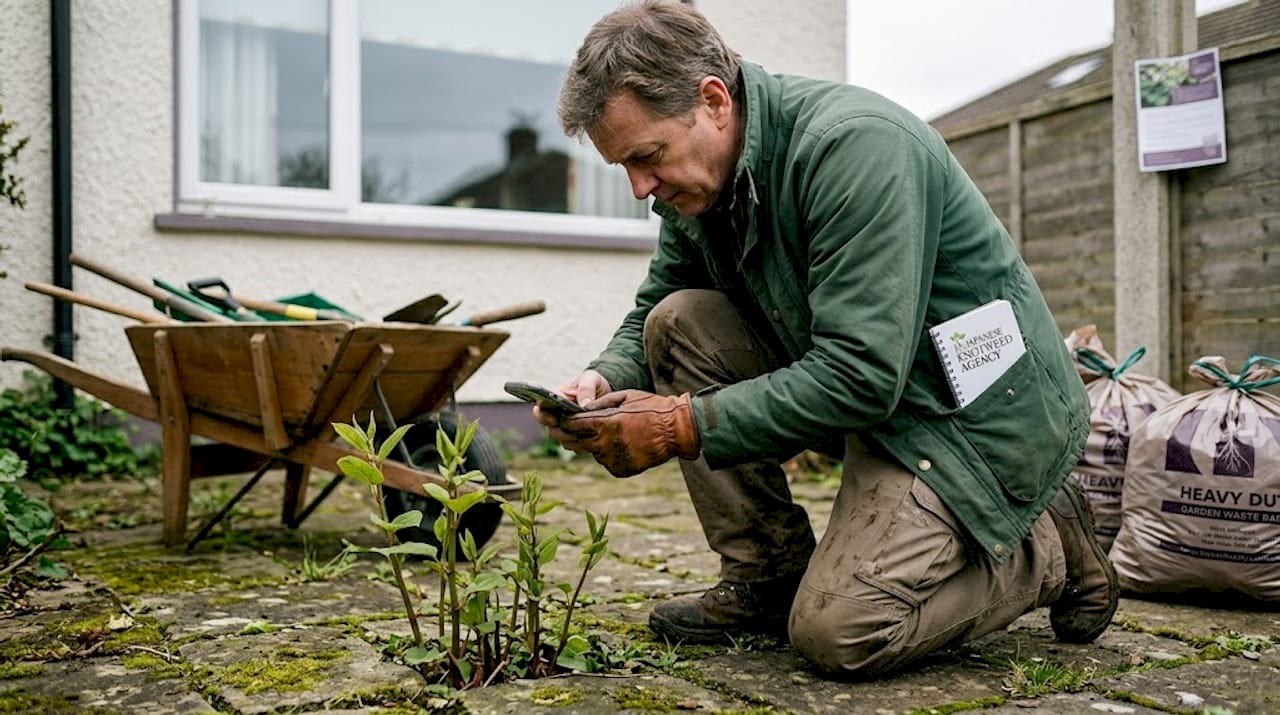
Japanese knotweed is the species most frequently encountered in property transactions, and for good reason. Its rhizome network can extend three metres deep and seven metres laterally from the visible stem. It can push through tarmac, crack concrete foundations, and compromise drainage systems. The visible above-ground growth represents only a fraction of the problem.
| Risk category | Impact on property |
|---|---|
| Structural damage | Foundations, walls, drainage, and hard surfaces can all be compromised by rhizome growth. |
| Property value | Presence of knotweed can reduce market value and deter buyers entirely. |
| Mortgage eligibility | Mortgage refusals are common when knotweed is identified without a management plan in place. |
| Legal disclosure | Sellers are required to disclose known invasive plant infestations to prospective buyers. |
| Treatment costs | Professional management programmes can span multiple years and cost several thousand euros. |
Spanish bluebell poses a different but equally serious ecological threat. Unlike Japanese knotweed, it does not damage structures, but it hybridises readily with the native bluebell, diluting the genetic integrity of one of Ireland’s most cherished wildflowers. Once established, it is extremely difficult to remove from a garden or woodland.
Pro Tip: If you are purchasing a property in Ireland, do not rely solely on a standard structural survey. Request a dedicated invasive species assessment, particularly if the garden contains dense ground cover, bamboo-like stems, or large-leafed climbing plants near boundaries.
Specialist surveys for invasive plants are often required by mortgage lenders as a separate condition of loan approval, and they must be carried out by qualified professionals. A standard surveyor’s report will rarely identify knotweed correctly, particularly outside the growing season when above-ground growth has died back.
Why illegal invasive plants are still found for sale
Understanding why banned plants remain available is not straightforward. Several overlapping factors contribute to the problem, and awareness of them helps buyers protect themselves.
-
Misleading labelling. Retailers may sell invasives under false names, either deliberately or through ignorance of the regulations. A Spanish bluebell sold as a “garden bluebell” or “ornamental bluebell” may be entirely illegal to purchase or plant.
-
Regulatory lag. Species are added to the banned list periodically, and there is often a gap between a plant being identified as harmful and its formal prohibition. During this window, legal sales can continue even as the ecological risk is well understood.
-
Difficulty of identification. Spanish bluebells are frequently confused with native bluebells by both sellers and buyers. The differences are subtle: Spanish bluebells have broader leaves, upright flower stems, and flowers on all sides of the stem, whereas native bluebells droop to one side and have a stronger scent.
-
Online marketplace gaps. The DIY and gardening retail market increasingly operates through online platforms where enforcement is difficult. Individual sellers listing plants through classified sites or social media are rarely subject to the same scrutiny as registered nurseries.
-
Low public awareness. Many gardeners simply do not know which species are regulated. Without clear labelling requirements or point-of-sale information, buyers have little means of knowing they are purchasing a banned plant.
Pro Tip: Before purchasing any unfamiliar plant, cross-reference it against the official regulated invasive plants guide at invasives.ie. The guide includes photographs and identification notes for all currently banned species in Ireland.
Private gardens serve as frontline habitats where invasive plants can escape via seeds, bulbs, or garden waste. A single Spanish bluebell bulb discarded in a green bin or composted incorrectly can establish a new colony in a matter of seasons. Responsible garden waste disposal is not optional. It is a legal and ecological obligation.
Managing the risks: what homeowners and buyers should do
For homeowners and property buyers, the path forward involves several clear and practical steps. The most important of these is obtaining a professional invasive species survey before completing any property purchase or before undertaking significant garden works.
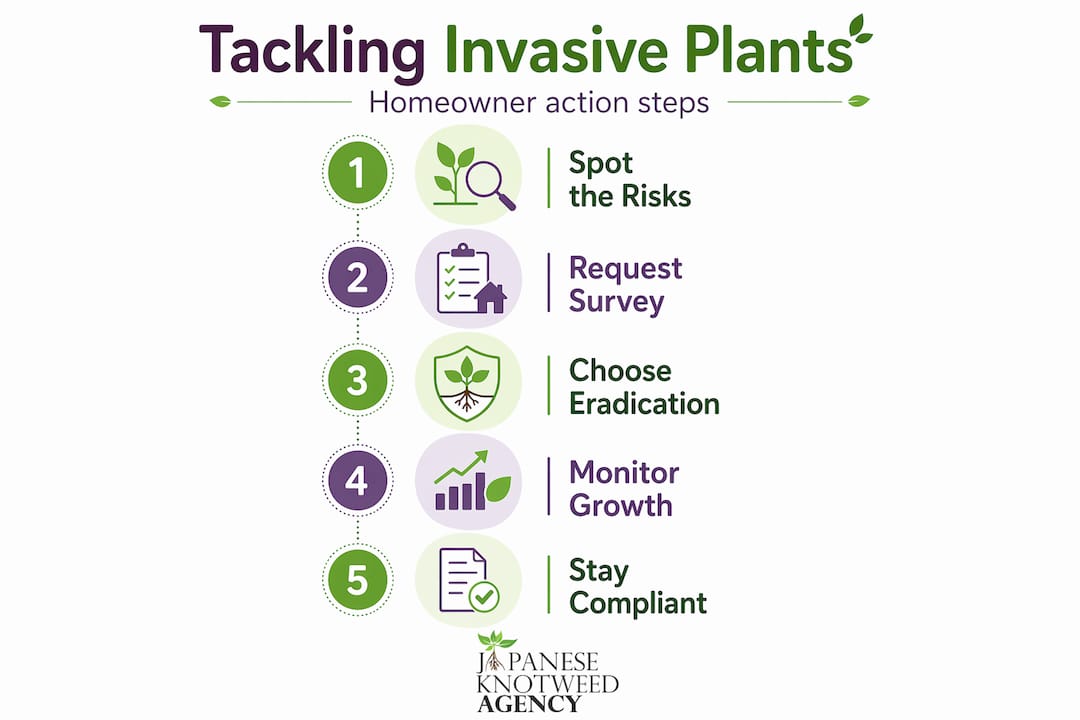
A dedicated invasive weed survey goes beyond what a standard structural inspection covers. It assesses the full extent of any infestation, maps rhizome spread where applicable, and provides a management plan that satisfies mortgage lender requirements. Without this, buyers risk inheriting a problem that can take years and considerable expense to resolve.
When knotweed or another invasive species is confirmed, treatment options have expanded significantly in recent years:
- Thermo-electric treatment. Japaneseknotweedagency delivers direct energy at up to 5,000 volts onsite, causing internal cell damage and depleting energy reserves within the rhizome network without the use of herbicides. This chemical-free treatment approach achieves a 95% success rate and is particularly suited to environmentally sensitive sites.
- Root barrier installation. Physical barriers are used to contain rhizome spread, particularly where excavation is not feasible due to proximity to structures or utilities.
- Excavation. Full removal of the rhizome network is the most thorough option and is often required where development is planned. All excavated material must be treated as controlled waste and disposed of at a licensed facility.
Landowners in Ireland have a legal duty under EU Species of Union Concern regulations to prevent the spread of regulated invasive species from their land. This duty applies regardless of whether the infestation was present before purchase. Early detection paired with rapid professional response is the most effective way to limit long-term management costs and legal exposure.
Monitoring treated areas over successive growing seasons is also critical. Knotweed in particular can regenerate from fragments as small as a fingernail, and a single missed treatment cycle can set a management programme back considerably.
My perspective on enforcement and what homeowners must prioritise
I have worked with properties across Ireland and the wider UK where homeowners genuinely did not know they had a regulated invasive species on their land until a survey revealed it. In many of those cases, the plant had been purchased legally at a garden centre years earlier, before it was added to the banned list, or it had been sold under a name that gave no indication of its status.
What strikes me most is not the existence of the legislation. The law is clear and the penalties are serious. What concerns me is the gap between what the law says and what happens on the ground. Enforcement is patchy, public awareness is low, and the responsibility for due diligence falls disproportionately on homeowners who have no specialist training.
In my experience, the homeowners who fare best are those who treat invasive species as a property risk in the same category as subsidence or damp. They commission a survey before exchange of contracts, they ask questions about garden history, and they do not assume that because a plant is for sale it must be safe to buy or plant.
The voluntary diligence of gardeners and property buyers is, at present, doing a great deal of the work that legislation alone cannot achieve. That is not a sustainable position, and I believe the case for improved public education and sustained multi-annual management funding is unanswerable. Until that changes, the most protective thing you can do is know what you are buying, know what is on your land, and act on it early.
— Alan
How Japaneseknotweedagency can help

Japaneseknotweedagency carries out professional invasive species surveys across Ireland, England, and Wales, providing the detailed assessments that mortgage lenders and property solicitors require. Whether you are purchasing a property and need clarity before exchange, or you have identified a potential infestation on land you already own, the team can provide a thorough survey and a clear management plan.
As pioneers of chemical-free knotweed treatment, Japaneseknotweedagency offers thermo-electric treatment, root barrier installation, and full excavation works, all delivered with an understanding of the legal obligations that apply to Irish landowners. For answers to common questions, the knotweed FAQ resource is a useful starting point, and the team is available to discuss your specific situation directly.
FAQ
Are invasive plants still legally sold in Ireland in 2026?
Yes. Despite bans on over 34 species under the 2024 EU Invasive Alien Species Regulations, some prohibited plants including Spanish bluebells continue to be sold online and at trade events, often under misleading names.
What are the penalties for selling banned plants in Ireland?
Selling, transporting, or breeding prohibited invasive species can result in fines of up to €100,000 and imprisonment for up to two years under current Irish law.
Does Japanese knotweed affect mortgage applications in Ireland?
Yes. Mortgage lenders frequently require a specialist invasive species survey and a management plan before approving a loan on a property where knotweed has been identified. A standard structural survey is not sufficient.
How do I identify Spanish bluebells versus native bluebells?
Spanish bluebells have broader leaves, upright stems, and flowers arranged around all sides of the stem. Native bluebells droop to one side and have a noticeably stronger scent. When in doubt, consult the official identification guide at invasives.ie before purchasing or planting.
What should I do if I find an invasive plant on a property I am buying?
Commission a dedicated invasive species survey from a qualified specialist before exchange of contracts. The survey will map the extent of the infestation, confirm the species, and provide a management plan that satisfies lender requirements.