


TL;DR:
- Chemical-free Japanese knotweed management relies on persistent physical control methods like cutting, excavation, and thermo-electric treatment to weaken and eliminate the plant. Proper surveying and documentation are essential for property transactions and mortgage approval, with specialist reports providing the necessary guarantees. Early professional intervention offers the most effective, environmentally friendly, and financially sound solution for homeowners facing infestations.
Japanese knotweed is one of the most persistent invasive plants affecting homeowners across England, Wales, and Ireland, and the assumption that chemical-free methods cannot match its resilience is one of the most damaging misconceptions in property management. This guide to chemical-free weed solutions addresses that directly, outlining evidence-based, non-toxic approaches that are not only effective but also acceptable to mortgage lenders and compatible with RICS professional standards. Whether you are preparing to sell, remortgage, or simply reclaim your garden, understanding your options is the essential first step.
Table of Contents
- Understanding Japanese knotweed and its impact on property
- The guide to chemical-free weed solutions for your garden
- Surveying Japanese knotweed for chemical-free management and property sales
- Evaluating natural homemade weed treatments versus professional chemical-free solutions
- Applying chemical-free weed control: a practical guide for homeowners
- Why chemical-free knotweed management is a wise choice for homeowners
- Get expert chemical-free Japanese knotweed solutions today
- Frequently asked questions
Understanding Japanese knotweed and its impact on property
Japanese knotweed (Fallopia japonica) is not an ordinary garden weed. Its rhizome network, the underground root system that drives its spread, can extend up to three metres in depth and seven metres horizontally from the visible plant. It can push through tarmac, breach foundations, and destabilise drainage systems. Standard weed management approaches are simply not designed for a plant of this scale.
For homeowners, the most immediate concern is often financial rather than horticultural. As surveyors and mortgage professionals note, Japanese knotweed can affect not just the property itself, but also mortgage lending, insurance, value, and the speed of the transaction. That is a significant cluster of risks concentrated in a single invasive species.
Understanding what you are dealing with is the foundation of any effective response. Here are the core impacts homeowners should be aware of:
- Property value: Confirmed knotweed presence can reduce valuations significantly, particularly in proximity to structures.
- Mortgage approval: Many lenders require specialist evidence and a professionally prepared management plan before releasing funds.
- Conveyancing delays: Undisclosed knotweed is a common cause of transaction collapse or legal dispute post-sale.
- Neighbour liability: Allowing knotweed to spread to adjacent land carries legal consequences under the Wildlife and Countryside Act 1981.
- Standard survey limitations: General property surveyors can flag visible signs but do not typically verify the subterranean extent of an infestation.
Reviewing knotweed removal best practices before committing to any treatment route will help you avoid costly errors and ensure your chosen approach meets lender expectations.
The guide to chemical-free weed solutions for your garden
The Royal Horticultural Society confirms that non-chemical weed control in gardens involves hand-removal, trimming, smothering, installing barriers, hoeing seedlings on warm, dry, or windy days, and repeated cutting over several years. For most garden weeds, this is sound, practical advice. For Japanese knotweed, these methods require specialist adaptation to be genuinely effective.
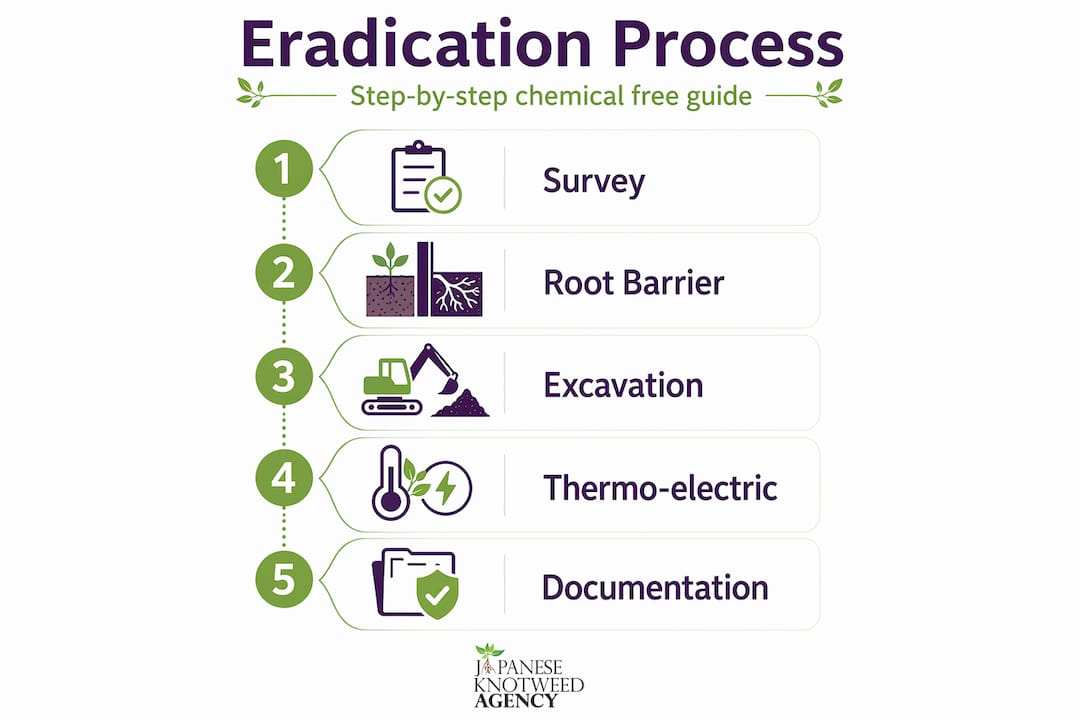
The core non-toxic strategies, and how they apply to knotweed specifically, are as follows:
- Repeated cutting: Cutting growth back to ground level at regular intervals throughout the growing season depletes the plant’s energy reserves. This works because knotweed draws heavily on stored carbohydrates in the rhizome to regenerate. Done consistently over multiple seasons, it weakens the plant’s capacity to regrow.
- Root barriers: Physical barriers made from high-density polyethylene are installed in the ground to contain rhizome spread. This is particularly relevant when knotweed is near boundaries or structures, preventing lateral expansion while other treatments reduce the above-ground plant mass.
- Smothering and light exclusion: Covering growth with heavy-duty membrane or layered cardboard can suppress new shoots, though for knotweed this is a supporting measure rather than a primary control.
- Excavation: Full physical removal of the rhizome mass, carried out to the required depth, is one of the most direct chemical-free routes. It is labour-intensive but can deliver faster results when executed thoroughly and disposed of correctly as controlled waste.
- Thermo-electric treatment: This is the method that represents genuine innovation in how to eliminate weeds naturally at scale. By delivering direct electrical energy at up to 5,000 volts into the plant’s vascular system, the treatment causes internal cell damage and depletes energy resources within the rhizome network. Unlike surface-level contact treatments, it targets the biology of the plant at the root level, without any herbicide.
Pro Tip: Never attempt to compost knotweed cuttings or rhizome material on site. Any fragment of rhizome can regenerate a new plant. All removed material must be treated as controlled waste and disposed of by a licensed contractor.
The chemical-free weed treatment guide details how these physical methods are combined in practice to meet the standards required by lenders and the RICS framework.
Surveying Japanese knotweed for chemical-free management and property sales
A survey is not simply a box-ticking exercise before a sale. It is the document that establishes the scope of the infestation, informs the management plan, and provides the evidence base that mortgage lenders require. Without it, even the most diligent physical treatment programme lacks the credibility to satisfy a conveyancer or lending institution.
Standard home buyer surveys will flag visible knotweed, but as specialist guidance confirms, they recommend specialist follow-up inspections to confirm presence and plan management. A general surveyor’s report noting “possible knotweed” is the beginning of a process, not a conclusion.
The RICS professional standard applies an evidence-led decision tree to determine the appropriate management approach based on the risk level and proximity to the built environment. This means the management plan must match the evidence, not simply describe generic treatments.
The following table summarises what different survey types cover:
| Survey type | Identifies visible knotweed | Maps rhizome extent | Produces management plan | Acceptable to mortgage lenders |
|---|---|---|---|---|
| Standard homebuyer survey | Yes | No | No | No |
| Specialist invasive weed survey | Yes | Yes | Yes | Yes |
| RICS-compliant specialist report | Yes | Yes | Yes (with guarantees) | Yes |
- Book a specialist invasive weed survey as early in the sales or purchase process as possible.
- Ensure the surveyor provides a written management plan, not just an assessment.
- Confirm the plan is backed by an insurance-backed guarantee where required by your lender.
- Share the survey report with your solicitor to include in the property disclosure documentation.
The invasive weed survey process covers what to expect at each stage and how the resulting documentation is structured to satisfy legal and lending requirements.
Evaluating natural homemade weed treatments versus professional chemical-free solutions
Many homeowners exploring organic gardening weed solutions begin with household remedies. Vinegar-based sprays are widely cited online, and they do have a limited role, but that role does not include Japanese knotweed management. DIY vinegar-based sprays act as contact killers requiring repeated treatments and do not address root systems at any depth, making them unsuitable for knotweed management plans.

The following comparison illustrates the practical difference between DIY approaches and professional chemical-free treatment:
| Method | Targets foliage | Targets rhizomes | Produces mortgage documentation | Risk of spread from fragmentation |
|---|---|---|---|---|
| Vinegar-based spray | Yes | No | No | Low |
| Manual cutting (DIY) | Yes | No | No | Moderate if disposed incorrectly |
| Physical excavation (professional) | Yes | Yes (to depth) | Yes | Low with proper disposal |
| Thermo-electric treatment (professional) | Yes | Yes | Yes | Very low |
| Root barrier installation (professional) | No | Containment only | Yes (as part of plan) | Very low |
There is an important risk that many homeowners do not anticipate. Disturbing knotweed rhizomes without fully removing them, through amateur digging or repeated surface cutting without monitoring, can cause fragmentation. Each fragment left in the soil is capable of generating a new plant. This means poorly executed DIY efforts can actively worsen the infestation.
Pro Tip: When assessing non-toxic weed management tips online, check whether the advice is written for annual garden weeds or specifically for invasive perennials with deep rhizome systems. Advice designed for annual weeds can actively cause harm when applied to knotweed.
The reasons for choosing non-chemical methods go beyond personal preference. The non-chemical reasons for knotweed removal are relevant to environmental protection, neighbour relations, and long-term soil health in ways that homeowners often do not fully consider at the outset.
Applying chemical-free weed control: a practical guide for homeowners
Acting promptly and following a structured approach is the most reliable way to bring a knotweed infestation under control while maintaining the documentation trail that property transactions require. Here is a practical sequence:
- Conduct a visual inspection. Look for hollow, bamboo-like stems with distinctive purple-red speckles, shovel-shaped leaves with a flat base, and clusters of small cream flowers in late summer. Note the locations and approximate spread.
- Book a specialist knotweed survey. As specialist reports confirm, standard survey assessments identify risks but treatment planning requires commissioning a specialist report separately. Do not wait until a sale is agreed.
- Obtain a written management plan. The plan should specify the treatment method, frequency, expected duration, and what guarantees are provided. For mortgage purposes, this document is essential.
- Implement the recommended physical controls. These may include thermo-electric treatment sessions, root barrier installation, or excavation, depending on the location, severity, and proximity to structures.
- Maintain thorough records. Document every treatment visit, site visit, and communication with your specialist. These records support mortgage applications, conveyancing disclosure, and any future property sale.
- Schedule ongoing monitoring. Knotweed requires multi-season management. Re-surveys and follow-up treatments should be booked as advised by your specialist, not deferred.
The chemical-free knotweed treatment process outlines what each stage involves in detail, and you can book a knotweed survey directly to start the process.
Why chemical-free knotweed management is a wise choice for homeowners
There is a temptation, when faced with an infestation as persistent as Japanese knotweed, to reach for the most aggressive solution available. That instinct is understandable. But the long-term argument for chemical-free management is stronger than many homeowners initially realise, and not only for environmental reasons.
The RHS position is clear that non-chemical weed control depends on integrated physical strategies and persistence rather than expecting immediate eradication. This framing is important. Chemical-free does not mean passive. It means applying the right physical interventions, consistently, over time, with professional oversight.
From our perspective at Japanese Knotweed Agency, the properties we have worked with across England, Wales, and Ireland confirm that homeowners who commit early to a professionally led, chemical-free management programme consistently achieve better outcomes than those who attempt DIY control first and commission specialist work later. The delay often means a more extensive rhizome network, less predictable treatment timelines, and greater costs overall.
There is also a property-specific argument. A professionally produced chemical-free management plan, backed by an insurance-backed guarantee, carries more weight with mortgage lenders than a herbicide treatment that lacks documentation. The benefits of chemical-free knotweed control extend into the financial and legal dimensions of property ownership, not just garden ecology.
Chemical-free methods also preserve the health of the surrounding soil biome, protect neighbouring plant life, and eliminate the risk of herbicide drift to adjacent gardens or watercourses. These are not abstract environmental concerns. They are practical protections for you, your neighbours, and the long-term value of the land.
Get expert chemical-free Japanese knotweed solutions today
If you have identified or suspect Japanese knotweed on your property, the most important action you can take right now is to commission a specialist survey. The documentation it produces is the foundation for everything that follows, from treatment planning to mortgage approval.

At Japanese Knotweed Agency, we are pioneers of chemical-free treatment and eradication across England, Wales, and Ireland. Our thermo-electric treatment delivers direct energy up to 5,000 volts into the rhizome network, causing targeted cell damage without a single drop of herbicide. We also carry out root barrier installations and full excavation works, all producing the certified documentation your lender and solicitor will require. You can explore our full range of chemical-free knotweed solutions or book a Japanese knotweed survey online today. Take the first step before your timeline is determined by the transaction rather than the treatment.
Frequently asked questions
Can chemical-free methods effectively eradicate Japanese knotweed?
Chemical-free methods can control and progressively reduce Japanese knotweed when applied persistently over multiple seasons, as integrated physical strategies rather than single treatments are what deliver long-term results. Full eradication is achievable but requires professional management and realistic timeframes.
Will a standard property survey identify Japanese knotweed?
Standard surveys check for visible signs of knotweed but typically stop short of confirming extent or producing a management plan, so a specialist survey is necessary for transaction or mortgage purposes.
Are homemade vinegar sprays effective for knotweed control?
Vinegar sprays can scorch visible foliage but do not reach rhizomes at depth, making them ineffective as a standalone treatment for Japanese knotweed and unsuitable for any professionally recognised management plan.
Why is specialist survey documentation needed for mortgage approval?
Mortgage lenders require evidence-based plans with insurance-backed guarantees to assess knotweed risk before approving lending, and only specialist reports produced to RICS standards satisfy this requirement.