

TL;DR:
- Glyphosate-free weed control in the UK involves ecological, mechanical, and technological methods tailored to weed biology, emphasizing persistence over time. Techniques like mulching, repeated cutting, and electric weeding target different weed types effectively, especially when applied with correct timing and depth. Professional solutions, such as thermo-electric treatment and root barriers, are recommended for invasive species like Japanese Knotweed, ensuring safe, chemical-free management.
Glyphosate free weed control in the UK is defined as the management of unwanted plants using ecological, mechanical, and technological methods that exclude synthetic herbicides containing glyphosate. The RHS recommends non-chemical methods tailored to weed biology, distinguishing between annual and perennial species because each requires a fundamentally different strategy. Annual weeds respond well to smothering and surface removal, while perennials such as creeping thistle and bindweed demand repeated suppression over multiple seasons. Tools like electric weeders, organic mulches, and root barriers now give UK gardeners a credible, effective toolkit that protects soil health, supports biodiversity, and keeps gardens free from synthetic chemicals. Understanding the glyphosate regulatory position in the UK adds further reason to explore these alternatives with confidence.
1. Glyphosate free weed control UK: matching method to weed biology
The single most important principle in non-chemical weed management is matching your chosen technique to the biology of the weed you are targeting. Annual seedlings are easily smothered by mulch or temporary fabrics, while perennials need repeated cutting or smothering to weaken their root reserves over time. Treating a perennial like a groundsel with a single hoe pass will not work. Treating a shallow-rooted annual with an expensive root barrier is unnecessary.
This biological matching principle applies across every method covered in this guide. Annuals complete their life cycle in one season, so preventing seed set is the priority. Perennials store energy in deep or spreading root systems, so the goal is exhaustion through repeated depletion rather than single-event removal.
2. Hand removal and hoeing for annual weeds
Hand weeding and hoeing remain the most direct and cost-effective methods for managing annual weeds in borders, vegetable plots, and lawns. Hoe on a dry, sunny day so severed seedlings desiccate quickly on the soil surface rather than re-rooting. A sharp Dutch hoe or oscillating stirrup hoe from brands such as Burgon and Ball or Sneeboer cuts just below the surface without bringing buried weed seeds up into the light.
For perennials, hand removal is only effective when you extract the full root system. Dandelions and docks respond well to a long-handled dandelion weeder that levers the taproot intact. Leaving root fragments in the soil will regenerate new growth within weeks.
Pro Tip: Hoe when weeds are at the white thread stage, before they are even visible above the surface. This is the most efficient point of intervention and dramatically reduces the workload across the season.
3. Repeated cutting to weaken perennial weeds
Repeated cutting and physical removal weaken stubborn perennials by exhausting root reserves over time, and persistence across multiple growing seasons is the defining factor in success. Cutting alone will not kill a well-established perennial in a single season. However, cutting every two to three weeks throughout spring and summer progressively reduces the plant’s ability to photosynthesise and replenish its root energy.
This method suits large areas of couch grass, bramble regrowth, or ground elder where full root extraction is impractical. Combine repeated cutting with mulching to compound the suppression effect. The RHS confirms that planning for persistent follow-up rather than expecting a single-application cure is the realistic expectation for any non-chemical perennial programme.
4. Mulching and smothering techniques
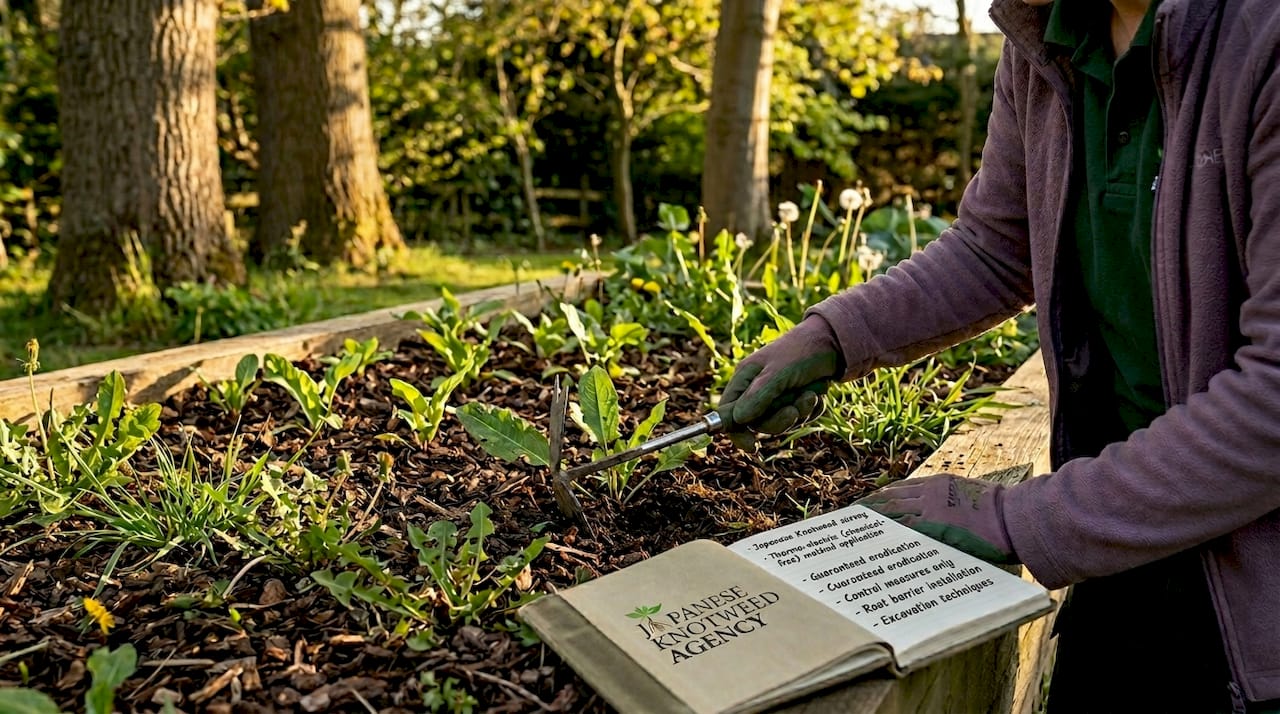
Mulch suppresses weed growth by blocking sunlight and conserving soil moisture, and biodegradable mulches nurture soil life while non-biodegradable options primarily suppress weeds without improving fertility. Apply organic mulch such as composted bark, wood chip, or garden compost at a minimum depth of 5cm, ideally 7.5cm or more, to achieve reliable suppression. Thinner applications allow light-tolerant weeds to push through.
Timing matters considerably. Apply mulch in spring before annual weed seeds germinate, or in autumn after clearing spent growth. For persistent perennials such as creeping thistle, combining mulch with a cardboard layer underneath increases suppression significantly by creating a double light-blocking barrier that also degrades into the soil over time.
| Mulch type | Biodegradable | Weed suppression | Soil benefit | Recommended depth |
|---|---|---|---|---|
| Composted bark | Yes | High | High | 7.5cm |
| Wood chip | Yes | High | Moderate | 7.5cm |
| Garden compost | Yes | Moderate | High | 5cm |
| Gravel or slate | No | Moderate | None | 5cm |
| Landscape fabric | No | High | None | N/A |
5. Root barriers for spreading perennials
Root barriers are physical membranes installed vertically in the soil to contain the lateral spread of invasive perennial root systems. They are particularly relevant for species such as Japanese Knotweed, bamboo, and ground elder, where rhizome spread into neighbouring properties or structures creates legal and structural risk. High-density polyethylene barriers from manufacturers such as Rootbarrier or Greenfix are rated for depths of 600mm to 1200mm depending on the species being contained.
Root barriers do not eradicate a plant. They contain it, buying time for other suppression methods to reduce the above-ground mass. For Japanese Knotweed specifically, a professional root barrier installation combined with a management plan is often required to satisfy mortgage lender requirements. This is not a DIY task for serious infestations.
6. Weed control on hard surfaces: patios, paths, and driveways
Controlling weeds on hard surfaces without glyphosate requires a different approach to garden borders, and tools like dandelion weeders and weeding knives effectively control taproot weeds in paving joints. The key principle on hard surfaces is mechanical severing at or below the crown, combined with repeated removal of any regrowth to progressively weaken the root system.
Follow this stepwise approach for paved areas:
- Use a paving knife or crack weeder to sever the weed at the base of the joint, cutting as deep as the tool allows.
- Remove all above-ground material and dispose of it away from the garden to prevent re-rooting.
- Brush kiln-dried sand or polymeric jointing sand into the cleared joints to reduce the growing medium available for future germination.
- Repeat the process every four to six weeks throughout the growing season to exhaust root reserves.
- For gravel paths, hoe regularly to disturb seedlings before they establish, and top up gravel depth to at least 5cm to reduce germination.
Weed burners using propane gas are widely sold but the RHS notes they carry fire risk and offer limited long-term effectiveness compared to mechanical methods. They destroy top growth but leave roots intact, meaning regrowth is rapid.
Pro Tip: Severing the root mechanically and following up within two weeks is consistently more effective than burning alone. Combine both on established weeds in joints for faster results.
7. Electric weeding technology
Electric weeding uses high-frequency AC current to kill weeds systemically without chemicals or soil disturbance, representing one of the most significant advances in non-chemical weed management in recent years. The current travels through the plant’s vascular system, causing internal cell damage that depletes the root’s energy reserves. Trials show almost 100% efficacy when the equipment is operated at the correct forward speed of approximately 4 km/h.
Key characteristics of electric weeding technology:
- Systemic action: The electrical current reaches the root system, not just the foliage, making it more effective than contact herbicides on perennials.
- No soil disturbance: Unlike hoeing or cultivation, electric weeding does not bring buried weed seeds to the surface.
- Organic compatibility: The Soil Association recognises electric weeding as compatible with organic and regenerative systems.
- Speed sensitivity: Inconsistent application reduces efficacy, particularly on well-established weeds, so maintaining the correct operating speed is critical.
- Professional adoption: Japaneseknotweedagency applies thermo-electric treatment delivering up to 5000 volts directly to invasive plant root networks, demonstrating the professional-grade application of this principle.
8. Comparing glyphosate-free methods: choosing the right approach
Selecting the right non-chemical method depends on weed type, garden location, available labour, and your environmental priorities. The table below provides a practical comparison for common UK garden scenarios.
| Method | Best for | Effort required | Environmental impact | Limitations |
|---|---|---|---|---|
| Hand weeding and hoeing | Annual weeds, borders | Low to moderate | Minimal | Ineffective on deep perennial roots |
| Repeated cutting | Perennial weeds, open areas | Moderate, ongoing | Minimal | Slow results over multiple seasons |
| Organic mulching | Borders, vegetable beds | Low, seasonal | Positive, improves soil | Needs topping up; not for hard surfaces |
| Root barriers | Spreading perennials, boundaries | High, one-off | Neutral | Contains rather than eradicates |
| Electric weeding | Perennials, high-value areas | Moderate, professional | Very positive | Requires correct technique and equipment |
| Weeding knife on hard surfaces | Paving joints, paths | Low to moderate | Minimal | Requires frequent repeat visits |
For a typical UK garden border with a mix of annual and perennial weeds, combining organic mulch with seasonal hand weeding delivers the best results for the least ongoing effort. For invasive species like Japanese Knotweed, professional chemical-free eradication methods are the appropriate route, not DIY mulching.
Key takeaways
Effective glyphosate free weed control in the UK requires matching the method to the weed’s biology, applying techniques with correct timing, and maintaining persistence across seasons for perennial species.
| Point | Details |
|---|---|
| Match method to weed type | Annuals respond to hoeing and mulching; perennials need repeated suppression and root containment. |
| Mulch depth matters | Apply organic mulch at 7.5cm minimum; combine with cardboard for persistent perennials. |
| Hard surfaces need mechanical severing | Use a weeding knife to cut roots in joints, then follow up every four to six weeks. |
| Electric weeding is systemic | High-frequency AC current depletes root energy without chemicals or soil disturbance. |
| Invasive species need professional input | Japanese Knotweed and similar species require specialist surveys and treatment plans. |
Why I believe cultural methods deserve more credit than they receive
Having worked alongside property owners and land managers dealing with everything from garden bindweed to full-scale Japanese Knotweed infestations, the pattern I observe repeatedly is this: people reach for a chemical solution first because it feels decisive. The appeal of a single application that promises to resolve the problem is understandable. But for the majority of perennial weed problems in UK gardens, cultural methods applied with correct timing and genuine persistence outperform contact herbicides over a two-season period.
The mulching evidence from the RHS is particularly compelling. A 7.5cm layer of composted bark over cardboard, applied in early spring before germination, suppresses the vast majority of annual weeds and progressively weakens shallow-rooted perennials without any repeat chemical input. I have seen this approach transform neglected borders within a single growing season when the depth and timing are right.
Where I believe the conversation is genuinely shifting is in electric weeding technology. The systemic action of high-frequency current reaching root networks without soil disturbance is a meaningful advance, not a gimmick. The energy-based weed control principle that Japaneseknotweedagency applies to Japanese Knotweed at professional scale reflects the same biological logic: deplete the root’s energy reserves repeatedly until the plant cannot recover. That principle scales from a garden border to a commercial site.
My practical advice is to start with the simplest method appropriate to your weed type, apply it at the right time, and commit to follow-up. The gardeners who struggle with non-chemical control are almost always those who apply the right technique once and expect permanent results.
— Alan
Professional chemical-free weed solutions for UK homeowners

When garden weeds escalate beyond what cultural methods can manage, or when an invasive species like Japanese Knotweed is identified on your property, professional intervention becomes the responsible next step. Japaneseknotweedagency specialises in chemical-free invasive plant treatment delivering up to 5000 volts of thermo-electric energy directly to root networks, achieving a 95% success rate without glyphosate or any synthetic herbicide. Services cover property surveys across England, Wales, and Ireland, root barrier installation, and full excavation works. If you suspect an invasive species on your land, book a professional survey to get an accurate assessment and a clear, chemical-free management plan.
FAQ
What is the most effective glyphosate-free weed control method in the UK?
The most effective method depends on weed type. For annual weeds, hoeing and organic mulching at 7.5cm depth are highly reliable. For perennial weeds, the RHS recommends combining repeated cutting with thick mulching or root barriers, applied persistently across multiple seasons.
Are there organic weed killers available in the UK without glyphosate?
Yes. Contact herbicides based on acetic acid (vinegar-based products) and pelargonic acid are available in the UK as organic weed killers. These damage foliage but do not act systemically, so repeated applications are needed and they are less effective on established perennials than mechanical methods.
Are glyphosate-free weed control methods safe for pets?
Mechanical methods such as hoeing, mulching, and electric weeding carry no chemical residue risk to pets. Acetic acid-based contact herbicides should be allowed to dry before pets access treated areas. Always check product labels for specific guidance, as formulations vary.
Can I control Japanese Knotweed without glyphosate?
Yes. Japaneseknotweedagency delivers thermo-electric treatment that depletes the rhizome network without any chemical application, achieving a 95% success rate. Root barrier installation and excavation are also available as chemical-free options for residential and commercial sites.
When should I apply mulch for best weed suppression in the UK?
Apply mulch in early spring before annual weed seeds germinate, or in autumn after clearing spent growth. The RHS recommends a minimum depth of 5cm, ideally 7.5cm, topped up each spring to maintain suppression effectiveness throughout the growing season.