TL;DR:
- Sustainable weed control uses integrated, non-chemical methods to target invasive plant roots effectively.
- Legal requirements demand professional management and proper disposal to prevent spread and penalties.
- Long-term eradication typically takes one to seven years, emphasizing monitored, expert-led strategies.
Most homeowners facing invasive weeds assume that strong herbicides are the only reliable answer. In practice, chemical treatments often fail to address the extensive root systems of species like Japanese Knotweed, creating resistance and compounding both environmental harm and legal risk. Sustainable weed control offers a more effective, legally sound alternative, one that uses integrated, non-chemical strategies to address the problem at its source. Whether you own a property in England, Wales, or Ireland, understanding what genuine sustainable weed management involves could save you significant cost, legal trouble, and long-term damage to your land.
Table of Contents
- What sustainable weed control really means
- Key chemical-free methods for controlling invasive weeds
- Legal and environmental considerations for homeowners
- Practical tips for effective, sustainable weed management
- A new approach: why expert-led, integrated strategy outpaces old methods
- Take the next step towards sustainable weed control
- Frequently asked questions
Key Takeaways
| Point | Details |
|---|---|
| Integrated non-chemical approach | Sustainable weed control blends methods like excavation, barriers, and electrical treatments for lasting results. |
| Legal and environmental compliance | Professional, chemical-free control protects you from fines and ensures responsible disposal and disclosure. |
| Professional input is essential | Commission expert surveys for tailored plans and monitoring, especially for complex species such as Japanese Knotweed. |
| DIY risks legal trouble | Attempting large-scale removal without professional guidance can make things worse and lead to prosecution. |
What sustainable weed control really means
The term ‘sustainable weed control’ is often misunderstood. It does not simply mean avoiding chemicals; it refers to a structured, long-term approach that addresses both the visible plant and its underlying biology. For invasive species like Japanese Knotweed, which can push through tarmac and establish root systems extending several metres below ground, surface-level treatments are rarely sufficient.
Integrated Weed Management (IWM) is the recognised framework for sustainable weed control. It combines multiple non-chemical tactics, including mechanical, cultural, biological, and physical methods, to suppress weeds long-term without relying on herbicides. This layered approach is critical because no single technique eliminates a well-established infestation completely.
The core components of IWM for invasive species include:
- Prevention: Stopping the introduction and early spread of invasive species through site management and regular inspections.
- Cultural control: Managing soil conditions and surrounding vegetation to reduce weed establishment.
- Mechanical control: Physical removal of above-ground growth to deplete energy reserves within the plant.
- Biological control: Using natural predators or pathogens where appropriate and legally permitted.
- Physical control: Installing barriers and using techniques that disrupt root systems directly.
The Royal Horticultural Society and leading UK horticulture bodies consistently recommend professional guidance for invasive species management. This is especially relevant for Japanese Knotweed, which carries specific legal obligations that homeowners may not be aware of. Exploring non-chemical methods for Knotweed early in the process helps homeowners understand the options available before the problem escalates.
Sustainable weed management is not a trend; it is the responsible standard for protecting your property, your neighbourhood, and the wider environment from the long-term consequences of invasive species.
Chemical-free control is the recommended foundation under organic chemical-free standards, particularly where biodiversity, water courses, or neighbouring land are at risk. The goal is not merely eradication but sustainable suppression that prevents re-establishment and avoids collateral ecological damage.
Key chemical-free methods for controlling invasive weeds
Understanding the range of professional, non-chemical methods is essential before commissioning any treatment. Each approach carries specific advantages, limitations, and cost implications that vary by site, infestation size, and proximity to structures or boundaries.
The table below summarises the main methods used by professional practitioners:
| Method | Typical timescale | Disruption level | Success rate |
|---|---|---|---|
| Excavation and removal | Weeks to months | High | High if thorough |
| Root barrier installation | 2 to 4 years | Low to medium | High for containment |
| Thermo-electric treatment | 1 to 2 years | Low | Up to 95% rhizome destruction |
| Integrated approach | 1 to 5 years | Variable | Highest overall |
For Japanese Knotweed in England, Wales, and Ireland, key chemical-free methods include the following:
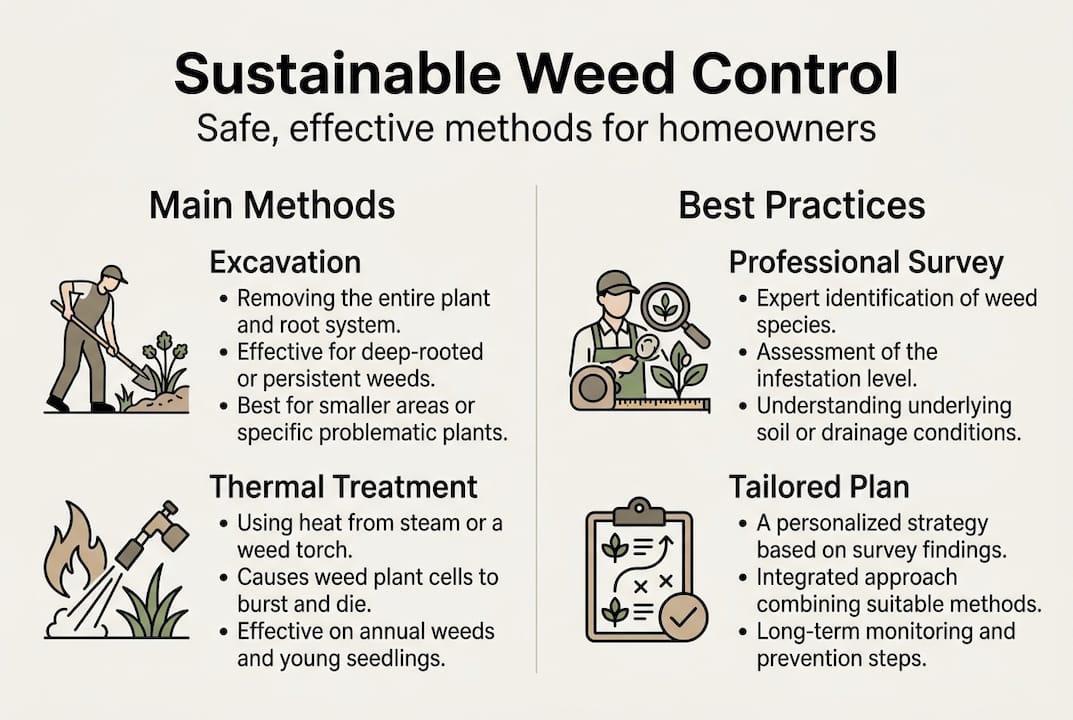
- Excavation and removal: This involves physically digging out the rhizome network. It is effective and relatively fast, but it is highly disruptive and generates significant volumes of controlled waste requiring licensed disposal.
- Root barrier installation: High-density polyethylene barriers are installed below ground to contain lateral spread. This method suits boundary disputes and pre-construction scenarios particularly well.
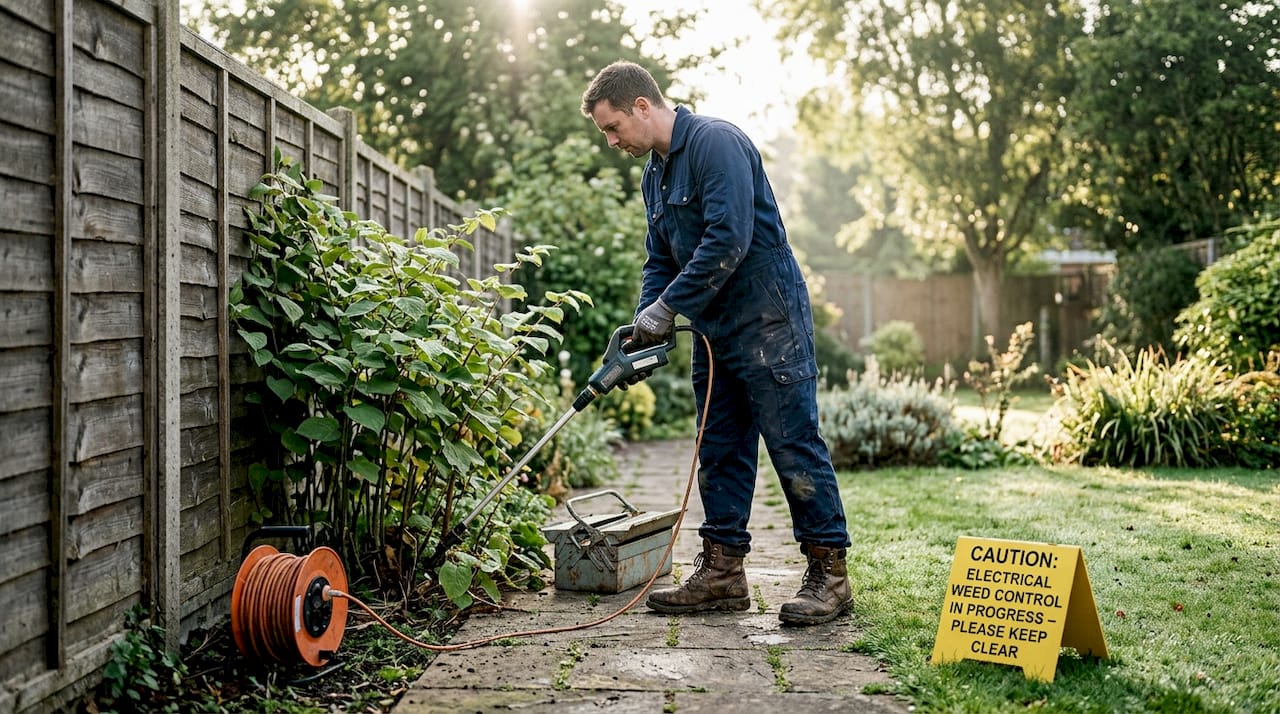
- Thermo-electric treatment: Delivering direct electrical energy up to 5,000 volts directly into the plant causes internal cell damage and progressively depletes energy reserves within the rhizome network. This is a low-disruption, highly targeted technique.
- Integrated management programmes: Combining two or more of the above methods produces the most reliable long-term outcomes, particularly for larger or older infestations.
Pro Tip: Always confirm that your chosen provider can tailor a multi-method plan to your property’s specific context. A provider offering only one technique is unlikely to achieve lasting results for established Japanese Knotweed.
Electrical and electro-physical weed control is an evolving field, and its application to Japanese Knotweed represents a significant advance in eco-friendly management. Following removal best practices ensures that whichever method is selected, the work is carried out to a standard that satisfies both technical and legal requirements. Your Knotweed UK guide can help you understand the full scope of what professional eradication involves before you engage a contractor.
Legal and environmental considerations for homeowners
Many homeowners discover the legal dimension of invasive weed control only after a problem has already escalated. This is a costly mistake. The legal framework governing Japanese Knotweed and similar invasive species in England, Wales, and Ireland is specific and enforceable.
Under the Wildlife and Countryside Act 1981, it is illegal to allow the spread of Japanese Knotweed to neighbouring land. The plant is classified as controlled waste under the Environmental Protection Act 1990, meaning that all excavated material must be disposed of through licensed contractors. Additionally, homeowners are legally required to disclose the presence of invasive species during property sales.
The consequences of non-compliance are significant:
- Financial penalties of up to £5,000 for allowing illegal spread.
- Failed mortgage applications: Many lenders refuse to approve mortgages on properties with untreated Knotweed.
- Civil liability: Neighbouring property owners can pursue legal action if spread occurs.
- Reduced property value: The impact on the property industry is well-documented and can be substantial.
| Scenario | Risk without professional management |
|---|---|
| Selling your property | Legal disclosure obligation; sale may collapse |
| Waste disposal | Controlled waste rules apply; DIY illegal |
| Spread to neighbours | Civil and criminal liability |
| Mortgage approval | Lenders may decline or withdraw offers |
The RHS guidance on non-chemical control reinforces that sustainable approaches, when correctly implemented, protect both the legal position and the ecological integrity of a site. Understanding Knotweed laws before you begin any management work is not optional; it is essential. A qualified professional will also ensure that all Knotweed legal requirements are met throughout the treatment process.
Key statistic: Homeowners who attempt DIY removal without professional oversight face penalties of up to £5,000, in addition to costs associated with remediation if spread occurs.
Practical tips for effective, sustainable weed management
With a clear understanding of both the methods and legal landscape, the final step is taking well-organised, practical action. The sequence in which you approach this matters considerably.
- Commission a professional survey first. Before any physical work begins, a qualified survey establishes the extent of the infestation, identifies risk zones, and informs the correct treatment strategy. The property survey process is the critical first step and should never be skipped.
- Select an integrated, chemical-free management plan. Professional surveys and integrated methods via PCA-accredited firms provide the compliance and guarantees lenders and solicitors require.
- Confirm PCA accreditation. The Property Care Association sets professional standards for Knotweed management. Accredited firms can issue management plans accepted by mortgage lenders and conveyancers.
- Request written guarantees and monitoring schedules. A robust management plan includes defined milestones, monitoring visits, and aftercare commitments. Do not accept verbal assurances.
- Avoid DIY on any area exceeding 10m². Beyond this threshold, the legal complexity and ecological risk increase sharply, and professional involvement is strongly advised.
Pro Tip: Ask your provider for evidence of past case studies on similar infestations. A professional with demonstrable experience on comparable sites will be better placed to manage your specific situation effectively.
Sustainable weed management is not a one-off event. It is a monitored programme that requires consistency, expertise, and accountability at every stage.
Long-term IWM research confirms that integrated, monitored approaches consistently outperform single-method treatments in both effectiveness and durability. The investment in professional, structured management returns measurable benefits in property value, legal compliance, and ecological protection.
A new approach: why expert-led, integrated strategy outpaces old methods
There is a persistent belief among homeowners that invasive weeds can be resolved quickly, either with a dose of herbicide or a weekend of digging. For species like Japanese Knotweed, this belief is not just unhelpful; it is actively dangerous. Rhizomes can extend three metres below ground and seven metres laterally. A partial excavation or single chemical application leaves the majority of the root system intact and, in some cases, stimulates regrowth.
What professional, integrated management offers is something fundamentally different: a strategy calibrated to the biology of the plant, the legal requirements of the site, and the long-term interests of the homeowner. The full Knotweed UK guide illustrates precisely why a structured approach consistently produces superior outcomes compared with reactive, short-term interventions.
Homeowners who invest in proper surveys and tailored treatment plans protect more than their garden. They protect their property value, their legal standing, and the broader environmental health of their community. This is the standard the industry has moved to, and it is the standard every homeowner facing an invasive species should expect.
Take the next step towards sustainable weed control
If you are dealing with Japanese Knotweed or any other invasive species on your property, acting promptly and correctly is essential. Professional agencies like Japanese Knotweed Agency provide end-to-end, chemical-free management, from initial property surveys and infestation mapping through to tailored eradication plans and full compliance documentation.
Our chemical-free Knotweed solutions achieve up to 95% success and are designed to meet the legal and environmental obligations that matter to you as a homeowner. Whether you need a survey, a treatment plan, or a complete eradication plan guide, our specialists are ready to support you across England, Wales, and Ireland. Contact us today to arrange your professional assessment and take the first step towards lasting, eco-friendly results.
Frequently asked questions
What is the difference between sustainable weed control and standard weed killing?
Sustainable weed control uses a mix of non-chemical methods to target roots and prevent resistance, while standard weed killing often relies on herbicides that can fail or cause environmental harm. IWM combines multiple tactics for stronger, more consistent long-term control.
Can I remove Japanese Knotweed myself without chemicals?
DIY removal is strongly discouraged for most homeowners, as it carries serious legal and ecological risks. DIY risks spread and legal issues, and professional methods are usually required by law for large infestations or when selling a property.
What are the fastest non-chemical methods for Knotweed control?
Excavation is the quickest option, though it is highly disruptive. Thermo-electric treatment achieves up to 95% success within one to two years with significantly less disruption to your site.
Is it legally necessary to use professionals for invasive species?
For infestations over 10m² or near property boundaries, licensed professionals are typically required. Licensed disposal and disclosure are mandatory under UK law, and non-compliance can result in significant penalties.
How long does sustainable weed control take to fully eradicate Japanese Knotweed?
Complete eradication with non-chemical methods typically ranges from one to seven years. Physical removal plus monitoring is needed to progressively deplete rhizome reserves, with timescales depending on method, infestation size, and the consistency of aftercare.
Recommended
- Chemical-free weed eradication: Step-by-step for homeowners
- Protecting water sources from invasive weeds: A homeowner’s guide
- Weed Management Plans: Protecting Homes Safely
- Control riverbank weeds and protect your property naturally
- Natural pest control: eco-friendly solutions for healthy gardens – Lushy Gardens