

TL;DR:
- Eco-safe weed management emphasizes sustainable, non-toxic techniques that avoid synthetic herbicides and prioritize soil health. It involves methods like hand weeding, mulching, soil solarisation, and natural contact herbicides, all working together over time to control weeds effectively. Understanding specific weed species and soil conditions helps gardeners achieve lasting results through integrated practices rather than quick chemical reactions.
Most homeowners reach for a chemical spray the moment weeds appear in their garden. It is understandable. Synthetic herbicides offer speed and convenience, but they carry costs that go well beyond the price on the label. What is eco-safe weed management, then, and why does it matter to you as a gardener? It is an approach that prioritises sustainable, non-toxic methods to control weeds without polluting soil, water, or harming the wildlife and people sharing your outdoor space. This article explains what it involves, how it works in practice, and what to expect from the process.
Table of Contents
- Key takeaways
- What is eco-safe weed management?
- Practical eco-friendly weed control methods
- Soil health and garden ecology
- Common misconceptions about organic weed management
- My perspective on eco-safe weed management
- How Japaneseknotweedagency can help
- FAQ
Key takeaways
| Point | Details |
|---|---|
| Eco-safe means non-toxic and sustainable | These methods avoid synthetic herbicides and rely on mechanical, cultural, and natural alternatives instead. |
| Natural herbicides act fast but are non-selective | Products like pelargonic acid and acetic acid can knock down annual weeds quickly but will damage any plant they contact. |
| Soil health drives long-term results | Correcting nutrient imbalances and supporting microbial life reduces weed pressure over months, not days. |
| Persistent perennials need integrated management | Mulch and natural sprays alone will not control established perennial weeds; mechanical removal is also required. |
| Professional surveys add precision | An invasive weed survey helps you understand what you are dealing with before committing to a management plan. |
What is eco-safe weed management?
Eco-safe weed management is a structured approach to controlling unwanted plants by combining mechanical, cultural, and naturally derived methods, while minimising reliance on synthetic chemicals. Weed competition accounts for nearly 45% of agricultural yield losses globally, and weed management represents roughly one-third of production costs in many growing systems. That scale of impact explains why the search for safer alternatives has gathered such momentum in recent years.
The core principles of eco-safe weed management are straightforward:
- Sustainability. Methods should not degrade soil structure, poison waterways, or persist harmfully in the environment.
- Low toxicity. Products and techniques should be safe for children, pets, pollinators, and soil organisms.
- Integration. No single method works in isolation. Effective management combines physical removal, soil improvement, timing, and where needed, naturally derived herbicides.
- Resistance prevention. Unlike synthetic herbicides, which contribute to weed resistance through repeated use, varied eco-safe methods reduce the risk of resistant weed populations developing.
The contrast with conventional synthetic herbicide use is significant. Broad-spectrum chemicals like glyphosate are effective, but their long-term effects on soil biology and non-target species remain a subject of ongoing scientific and regulatory scrutiny. Eco-friendly weed control seeks to manage weeds as part of a living system rather than as a problem to be chemically eliminated.
Pro Tip: Before selecting any eco-safe method, identify the specific weed species in your garden. Annual weeds and perennial weeds respond very differently to the same treatments, and confusing the two wastes time and effort.
Practical eco-friendly weed control methods
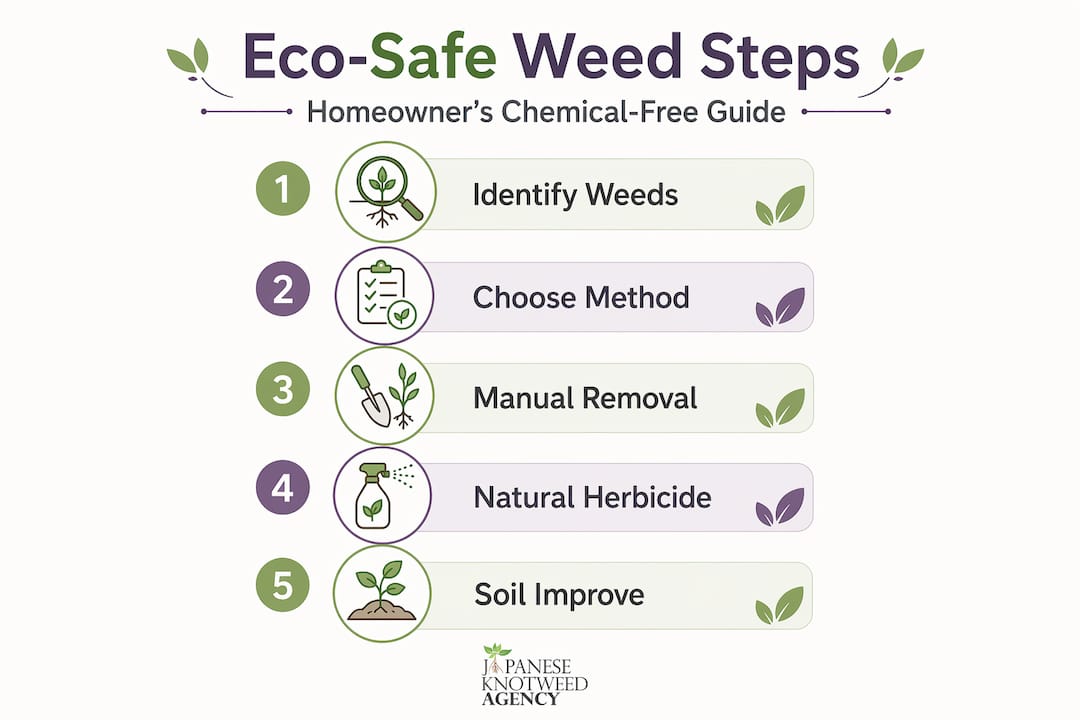
There is no shortage of organic weed management options available to homeowners. The most effective approach layers several methods together rather than relying on one alone. Here is how to manage weeds organically using techniques suited to home gardens:
- Hand weeding and hoeing. The most reliable method for annual weeds. Hoe on warm, dry days so uprooted weeds desiccate quickly rather than re-rooting in moist soil.
- Mulching. A thick layer of organic mulch, bark, wood chip, or compost suppresses light and inhibits germination of weed seeds near the surface. Apply at a depth of at least 7 centimetres for meaningful suppression.
- Soil solarisation. Covering bare soil with clear plastic sheeting in summer traps solar heat. Solarisation targets the top 12 inches of soil and significantly reduces annual weed seed banks before planting. It is less effective on established perennial weeds.
- Natural contact herbicides. Products containing pelargonic acid or acetic acid (concentrated horticultural vinegar) offer rapid knockdown. Pelargonic acid shows results within 3 to 24 hours and breaks down quickly in the environment without leaving persistent residues.
- Thermal and steam methods. Advanced thermal weed control, including steam-foam technology, kills weeds down to the root using heat. Government trials confirm effective weed destruction combined with environmental safety, making this a credible professional-grade option.
- Ground cover planting. Dense, low-growing plants that colonise bare soil remove the conditions weeds need to establish. This is a long-term but highly durable form of eco-conscious weed suppression.
Pro Tip: Apply natural contact herbicides on hot, sunny days above 20°C. UV radiation and heat significantly enhance the efficacy of pelargonic acid and acetic acid-based products, reducing the number of repeat applications required.
For a more detailed step-by-step approach, the chemical-free weed eradication guide at Japaneseknotweedagency covers the process in depth for residential properties.
Soil health and garden ecology
The most commonly overlooked dimension of eco-safe weed management is soil health. Most homeowners focus on what is growing above the surface, but the real leverage lies below it. Soil nutrient imbalances, particularly disrupted calcium-to-magnesium ratios and poor bacterial-to-fungal balance, create conditions that actively favour weed proliferation.
Understanding this changes your entire approach. Consider the following connections:
- Compacted, poorly aerated soil favours dock, plantain, and creeping buttercup. Improving drainage and aeration through aeration, organic matter addition, and reduced foot traffic removes their competitive advantage.
- Nutrient-depleted soil encourages fast-growing annual weeds that thrive where perennial plants struggle to compete. Composting and organic amendments gradually shift this balance.
- Disturbed soil exposed by digging or excavation is an open invitation for opportunistic weed species. Minimising bare soil periods with cover crops or mulch closes that window.
- Microbial diversity plays a direct role in suppressing certain weed seed germination through competitive exclusion and allelopathic interactions in the soil matrix.
“The biggest misconception is expecting immediate weed control like chemical spraying. Sustainable control requires addressing soil imbalances and takes time to restore ecosystem balance, with benefits developing over 2 to 18 months.” — Agronomist Shané Steffen
Organic amendments such as well-rotted compost, green manures, and biochar gradually shift the soil’s microbial ecology. This is not a rapid process, but it is a durable one. Homeowners who invest in soil health typically find their weed burden reduces noticeably across two to three growing seasons, with less intervention required each year.
Common misconceptions about organic weed management
The benefits of eco-safe weed control are real, but so are its limitations. Misunderstanding what these methods can and cannot achieve is one of the main reasons homeowners become frustrated and return to synthetic herbicides.
The table below compares common assumptions with the reality of organic weed management:
| Assumption | Reality |
|---|---|
| Natural herbicides are selective | Most organic herbicides are non-selective and will damage or kill any plant they contact, including desirable ones. |
| One application is sufficient | Annual weeds often need repeat treatments; perennial weeds require multiple seasons of integrated management. |
| Mulch controls all weeds | Mulch cannot control established perennials like bindweed or quackgrass, which can grow through even thick layers. |
| Results are immediate | Eco-safe methods work on different timescales to chemicals. Soil-based improvements take months; contact herbicides act in hours but may need repeating. |
| Any natural product is safe near water | Some concentrated organic acids can still affect aquatic organisms. Always check product guidance before applying near ponds or drainage channels. |
Perennial invasive species present the greatest challenge within any eco-safe programme. Plants like Japanese Knotweed cannot be resolved by mulching, vinegar applications, or hand weeding. They require professional, integrated chemical-free solutions that address the extensive root system, not just the visible growth above ground. Understanding this distinction protects you from wasted effort and prevents weeds from re-establishing season after season.
My perspective on eco-safe weed management
I have worked in invasive weed management for many years, and the most consistent pattern I observe is this: homeowners who expect eco-safe methods to perform like synthetic herbicides will always be disappointed. That is not a failure of the methods. It is a failure of expectation.
What I have found is that success depends entirely on shifting your frame of reference. Chemical sprays suppress symptoms. Eco-safe management addresses causes. When you start improving soil structure, reducing bare ground, and timing your interventions to the weed’s most vulnerable growth stage, you are no longer reacting to a problem. You are modifying the conditions that create it.
The homeowners I see achieving lasting results are those who understand that successful weed management integrates cultural practices across multiple seasons rather than relying on any single product. They are patient, observant, and willing to treat their garden as an ecology rather than a problem to be chemically corrected.
The one piece of advice I return to most often: start with a proper survey. Knowing precisely what species you are managing, where the root systems extend, and how the weed interacts with your soil and surrounding planting transforms your management plan from guesswork into something genuinely purposeful.
— Alan
How Japaneseknotweedagency can help
Eco-safe weed management at home becomes significantly more effective when you understand precisely what you are dealing with from the outset. For homeowners managing persistent or invasive weed species, a professional survey is the logical starting point.

Japaneseknotweedagency are pioneers of chemical-free treatment for Japanese Knotweed and other invasive plant species across England, Wales, and Ireland. Their thermo-electric treatment method delivers up to 5,000 volts directly to the rhizome network, causing internal cell damage without the use of herbicides. With 95% success rates documented for chemical-free knotweed treatment, and additional services including root barrier installation and excavation, they offer a genuinely sustainable alternative to chemical management programmes. To understand your property’s weed risk in full, book a survey and receive expert guidance tailored to your situation.
FAQ
What does eco-safe weed management involve?
Eco-safe weed management uses mechanical, cultural, and naturally derived methods to control weeds without synthetic herbicides. Methods include hand weeding, mulching, soil solarisation, and natural contact herbicides such as pelargonic acid.
Are natural herbicides safe around children and pets?
Most natural contact herbicides break down rapidly in the environment and carry significantly lower toxicity than synthetic alternatives. Always read product labels and allow treated areas to dry fully before allowing children or pets back onto the garden.
How long does eco-safe weed control take to work?
Contact herbicides like pelargonic acid show results within 3 to 24 hours for annual weeds. Soil health improvements that reduce weed pressure over time take between 2 and 18 months to deliver measurable benefits.
Can I manage Japanese Knotweed with organic methods at home?
Japanese Knotweed cannot be effectively controlled through standard organic methods such as mulching or vinegar application. Its extensive rhizome network requires professional treatment, such as the thermo-electric approach used by Japaneseknotweedagency.
When should I call a professional for weed management?
If you are dealing with invasive species, persistent perennial weeds that have not responded to multiple seasons of organic management, or weeds encroaching from a neighbouring property, a professional survey will give you the clarity needed to act effectively.