
Over £170 million is spent annually in the United Kingdom managing Japanese Knotweed, a problem that continues to frustrate British homeowners and environmental authorities. As this invasive species outcompetes native plants and spreads relentlessly, property values and biodiversity suffer real consequences. Understanding what makes Japanese Knotweed such a formidable threat provides vital insights for anyone facing its presence, from property buyers to conservationists.
Table of Contents
- Japanese Knotweed: Invasive Species Explained
- How Early Treatment Prevents Major Spread
- Legal Risks and Property Market Impacts
- Environmental Concerns: Health and Water Quality
- Comparing Chemical-Free and Traditional Methods
Key Takeaways
| Point | Details |
|---|---|
| Invasive Nature | Japanese Knotweed is a highly aggressive species that disrupts native ecosystems and poses significant legal responsibilities for property owners. |
| Importance of Early Intervention | Prompt professional treatment is crucial to prevent extensive ecological damage and ensure effective eradication of the plant. |
| Environmental Impact | The plant significantly compromises biodiversity, riverbank stability, and water quality, necessitating comprehensive management strategies. |
| Management Techniques | A balanced approach, combining traditional herbicide use and innovative chemical-free methods, is required for effective control of Japanese Knotweed. |
Japanese Knotweed: Invasive Species Explained
Japanese Knotweed represents a significant ecological threat that has dramatically transformed landscapes across the United Kingdom since its introduction in the 19th century. Originally brought to Britain as an ornamental garden plant, this highly aggressive perennial has since become one of the most problematic invasive species in the country. Wildlife experts confirm it now extensively colonises riverbanks, waste grounds, and roadside verges, systematically preventing native plant species from establishing and thriving.
The plant’s extraordinary resilience stems from its complex root system, known as rhizomes, which can extend several metres underground and regenerate from tiny root fragments. These underground networks make Japanese Knotweed exceptionally challenging to eradicate, with even minuscule sections capable of producing entirely new plant colonies. Royal Horticultural Society researchers categorise it as a persistent, clump-forming herbaceous perennial subject to stringent legal control measures due to its invasive characteristics.
Key characteristics that distinguish Japanese Knotweed from native plant species include:
- Rapid growth rates of up to 10 centimetres per day
- Bamboo-like hollow stems with distinctive purple speckles
- Large, heart-shaped green leaves arranged in a zigzag pattern
- Ability to penetrate concrete, tarmac, and building foundations
Professional management and early intervention remain critical in preventing widespread ecological and structural damage caused by this formidable invasive species.
How Early Treatment Prevents Major Spread
Early intervention is the cornerstone of effective Japanese Knotweed management, preventing catastrophic ecological and structural damage that can emerge from unchecked plant growth. Government guidance emphasises the critical importance of immediate action, warning that improper handling like strimming or mowing can dramatically exacerbate the plant’s spread by enabling regeneration from even tiny root fragments.
The complex root system of Japanese Knotweed makes eradication particularly challenging, with underground rhizome networks capable of producing new plant colonies from minuscule sections. Professional treatment strategies typically involve systematic herbicide application designed to progressively weaken the plant’s extensive root network. Natural Resources Wales recommends targeted glyphosate-based herbicide treatments during late summer or autumn, with repeated applications over two to three years to ensure complete eradication.
Key strategies for early intervention include:
- Immediate professional identification
- Comprehensive root system mapping
- Targeted herbicide treatment programmes
- Strict monitoring and follow-up assessments
- Preventing soil movement or disturbance
Property owners who delay treatment risk exponential spread, potential structural damage, and significant financial consequences from uncontrolled Japanese Knotweed proliferation.
Legal Risks and Property Market Impacts
Property owners face significant legal obligations regarding Japanese Knotweed management, with potential consequences extending far beyond ecological concerns. Government regulations clearly state that landowners are legally responsible for preventing the spread of this invasive species from their property, and failure to control it can trigger substantial legal actions and critically impact property transactions.

Recent academic research from Leeds University suggests that while the plant presents challenges, the structural damage risk might be somewhat overestimated compared to traditional perceptions. However, this does not diminish the legal and financial implications for property owners, as mortgage providers and insurers remain cautious about properties with confirmed Japanese Knotweed infestations.
Key legal and market impact considerations include:
- Potential mortgage application rejections
- Reduced property market value
- Legal liability for spread to neighbouring properties
- Mandatory disclosure requirements during property sales
- Potential court-mandated treatment and compensation
Navigating these complex legal landscapes requires proactive management, professional assessment, and comprehensive documentation to mitigate potential financial and legal risks associated with Japanese Knotweed presence.
Environmental Concerns: Health and Water Quality
Japanese Knotweed poses significant ecological risks beyond its immediate visual impact, with profound implications for regional water systems and biodiversity. Broads Authority research highlights the plant’s destructive potential, demonstrating how its aggressive growth can contribute to riverbank erosion and substantially increase flood risks, directly compromising water quality and aquatic ecosystem stability.
The invasive nature of Japanese Knotweed creates a complex environmental challenge that extends far beyond surface-level concerns. Invasive species experts note that its dense growth patterns systematically smother native vegetation, dramatically reducing local biodiversity and fundamentally altering habitat structures. These transformations can create cascading environmental consequences, potentially disrupting delicate ecological balances and water management systems.
Key environmental impact considerations include:
- Accelerated riverbank destabilisation
- Reduction of native plant biodiversity
- Disruption of aquatic ecosystem habitats
- Increased soil erosion potential
- Compromised water filtration mechanisms
Comprehensive environmental management requires understanding these intricate ecological interactions and implementing strategic interventions to mitigate Japanese Knotweed’s widespread environmental consequences.
Comparing Chemical-Free and Traditional Methods
Treatment strategies for Japanese Knotweed present complex challenges that demand sophisticated approaches balancing effectiveness and environmental responsibility. Natural Resources Wales research indicates that mechanical methods like cutting and digging are frequently ineffective due to the plant’s extraordinarily resilient underground rhizome network, which can regenerate from minuscule root fragments.
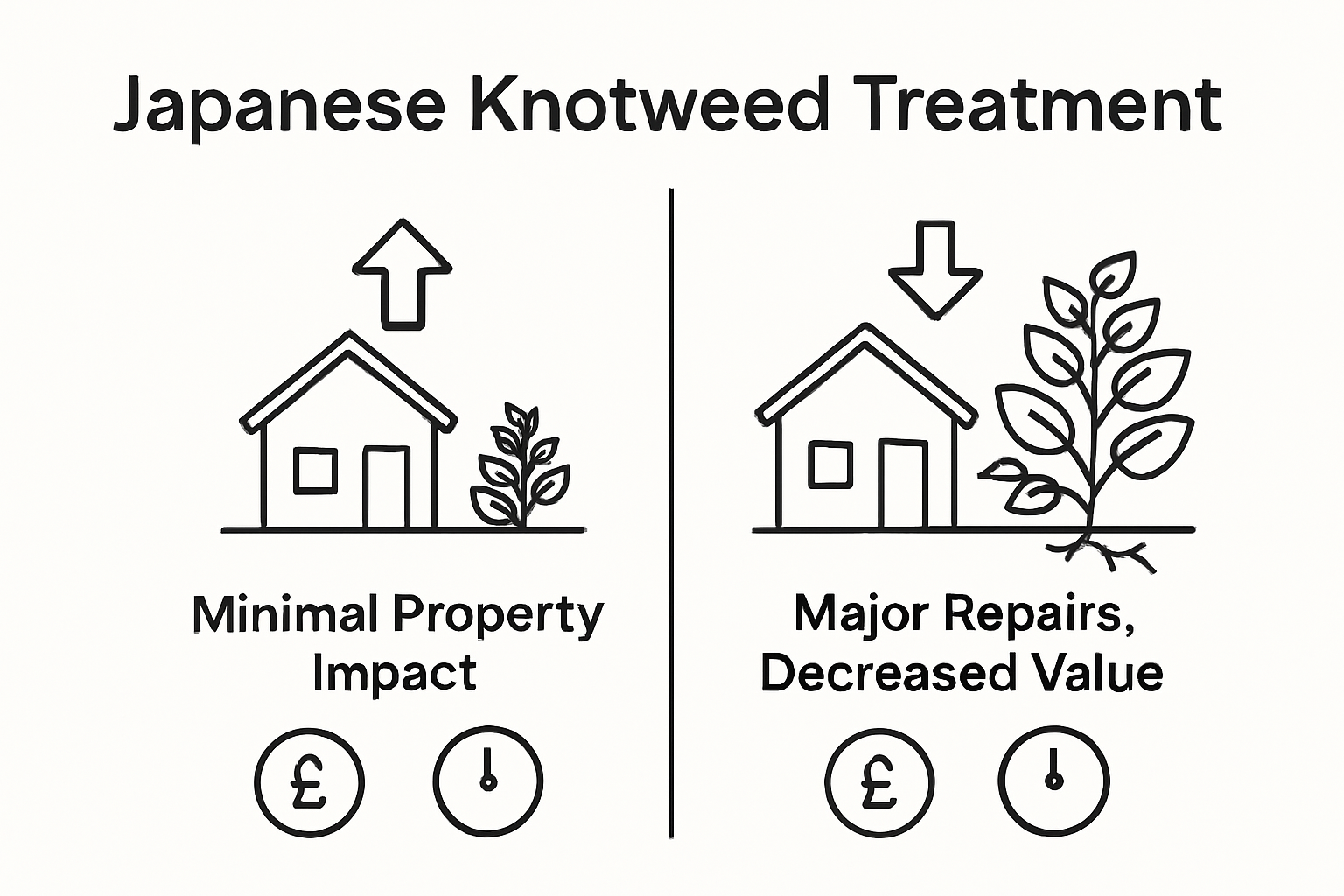
Ecological management experts from Colne Valley Park highlight the nuanced landscape of control methods, emphasising that while traditional approaches such as herbicide treatments remain widely used, emerging chemical-free techniques are gaining prominence. These innovative methods focus on disrupting the plant’s energy systems without introducing potentially harmful chemical interventions.
Key comparative method considerations include:
- Traditional chemical herbicide treatments
- Mechanical extraction techniques
- Thermal energy disruption
- Biological control approaches
- Root barrier installation strategies
Successful Japanese Knotweed management requires a comprehensive, scientifically informed approach that carefully evaluates the specific site conditions, ecological context, and long-term eradication objectives.
Secure Your Property Value With Early Japanese Knotweed Treatment
The article “Why Treat Knotweed Early – Impact on Property Value” highlights the urgent need for early intervention to avoid the financial and legal burdens caused by Japanese Knotweed infestations. Key concerns such as property market devaluation, mortgage complications, and costly structural damage are risks no homeowner or property investor should face. Tackling the invasive species before it spreads uncontrollably means protecting your investment and preventing further ecological harm.
At Japanese Knotweed Agency, we specialise in pioneering chemical-free treatments that target the plant’s extensive rhizome network with direct energy up to 5000 volts. This approach causes internal cell damage at the root to effectively weaken and eradicate the plant. Combined with our root barrier installations and thorough property surveys across England, Wales and Ireland, our solutions are tailored to safeguard your property and its value.

Act now to avoid the escalating legal and financial consequences of ignoring Japanese Knotweed. Discover how our innovative, non-chemical treatments can help you regain control. Start with a comprehensive property survey for invasive weeds or explore our full range of treatment services today and protect your investment for the future.
Frequently Asked Questions
What are the consequences of not treating Japanese Knotweed early?
Delaying treatment of Japanese Knotweed can lead to exponential spread, potential structural damage to properties, and significant financial consequences due to the plant’s aggressive growth and extensive root system.
How does Japanese Knotweed affect property value?
Japanese Knotweed can reduce property market value significantly, as mortgage providers and insurers view active infestations as a liability, potentially resulting in mortgage application rejections and mandatory disclosures during property sales.
What legal obligations do property owners have regarding Japanese Knotweed?
Property owners are legally required to prevent the spread of Japanese Knotweed from their land. Failure to manage it can lead to legal actions and responsibilities for controlling its spread to neighbouring properties.
What is the recommended method for early treatment of Japanese Knotweed?
Early treatment typically involves professional identification, comprehensive root system mapping, and targeted herbicide treatments to weaken the plant, which should be administered during late summer or autumn, with repeated applications over two to three years.