

TL;DR:
- Even small fragments of Japanese Knotweed can regenerate and cause long-term property damage.
- Manual removal often spreads the plant’s roots and makes the infestation worse.
- Professional treatment with guaranteed eradication is essential for property transaction security.
A single fragment of Japanese Knotweed, as small as 1cm, can silently regenerate beneath your garden, undermining years of control efforts and threatening both your mortgage application and property value. For homebuyers and investors in England, Wales, and Ireland, this is not a minor inconvenience. It is a legal, financial, and structural risk that demands a clear-eyed understanding of how invasive weeds survive, why they return, and what genuinely effective eradication looks like. The following sections address each of these questions in turn, equipping you with the knowledge to protect your investment and make sound decisions before signing on any dotted line.
Table of Contents
- How invasive weeds survive: the anatomy of rhizomes
- Why manual removal often spreads invasive weeds further
- Professional eradication and why guarantees matter for property buyers
- Advanced control: chemical-free methods and edge case successes
- Editorial perspective: the truth most property buyers miss about invasive weeds
- Expert resources and solutions for invasive weed risk
- Frequently asked questions
Key Takeaways
| Point | Details |
|---|---|
| Rhizomes drive regrowth | Invasive weeds return because underground rhizomes regenerate from tiny fragments, often years after apparent removal. |
| Manual removal risks | Digging and cutting can worsen invasions by spreading fragments, requiring expert disposal practices. |
| Monitoring ensures success | Long-term monitoring and 10-year guarantees from certified professionals safeguard property value and compliance. |
| Chemical-free options | Electro-thermal and root barrier solutions offer effective, environmentally friendly alternatives for lasting control. |
How invasive weeds survive: the anatomy of rhizomes
To understand why invasive weeds return so persistently, you first need to understand what is happening underground. Japanese Knotweed does not rely solely on what you can see above the surface. The visible canes and leaves are only a fraction of the plant’s total biomass. The real engine of its survival is the rhizome network, a dense, branching system of root-like structures that store energy and drive regrowth season after season.
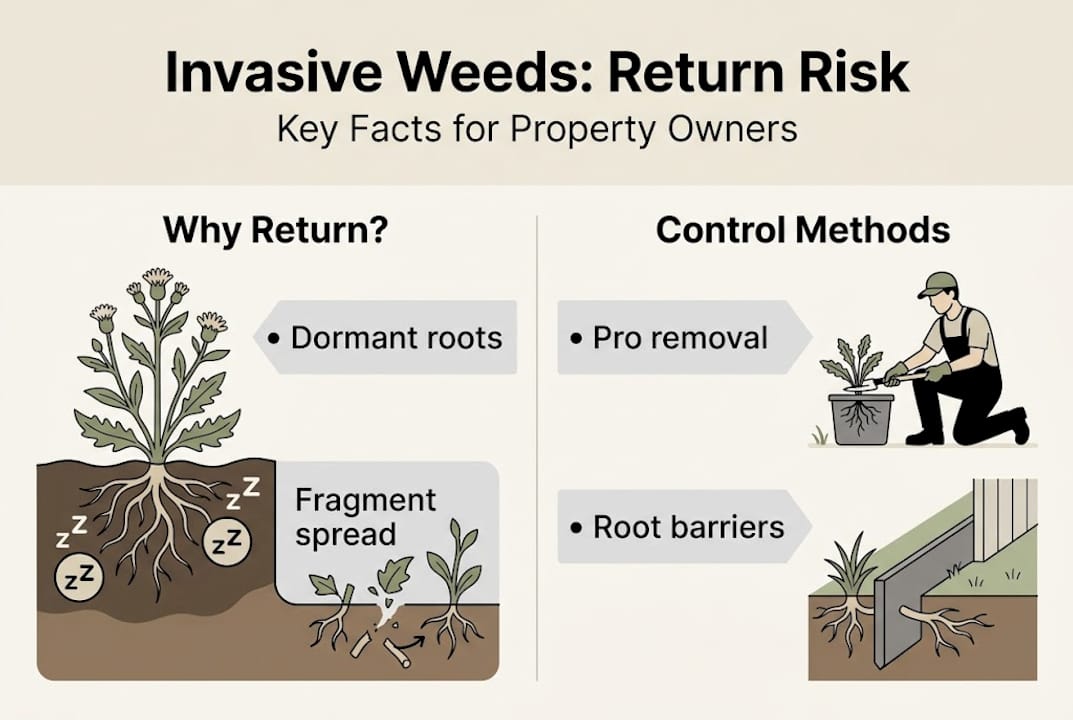
These rhizomes are formidable. Rhizomes extend up to 3m deep and 7m laterally from the parent plant, and fragments as small as 1cm or 0.5g are capable of regenerating an entirely new infestation. This means that even a single missed piece of root material left in disturbed soil can restart the cycle of growth within months.
What makes this especially challenging for property buyers is the plant’s capacity for dormancy. Rhizomes remain viable for many years underground without any visible growth above the surface. A site that appears clear for one or two seasons may simply be in a period of dormancy, not genuinely eradicated. Buyers who rely on visual inspections alone are therefore working with incomplete information.
| Rhizome characteristic | Detail |
|---|---|
| Maximum lateral spread | Up to 7 metres from parent plant |
| Maximum depth | Up to 3 metres |
| Minimum regenerative fragment | 1cm or 0.5g |
| Dormancy potential | Several years with no visible growth |
The knotweed rhizome guidance from Natural Resources Wales reinforces the scale of this challenge, noting that even professionally managed sites require sustained monitoring.
Key behaviours of the rhizome network:
- Acts as an underground energy reserve, fuelling regrowth after cutting or chemical treatment
- Produces new shoots from any viable fragment left in disturbed soil
- Enters dormancy during adverse conditions, resuming growth when conditions improve
- Extends beneath paths, driveways, and foundations, causing property damage caused by knotweed that is often invisible until serious
The impact on property value becomes significant the moment a survey identifies active or dormant knotweed on or adjacent to a site. Understanding rhizome biology is not an academic exercise. It is the foundation of every effective management decision.
Pro Tip: Never assess a knotweed site by appearance alone. Absence of visible canes does not indicate eradication. Commission a specialist survey that includes soil assessment and rhizome mapping before proceeding with any property transaction.
Next, we explore why even digging and manual removal often worsen the problem.
Why manual removal often spreads invasive weeds further
One of the most counterproductive responses to discovering Japanese Knotweed on a property is to reach for a spade. Intuition suggests that if you dig the plant out, you remove the problem. In practice, the opposite is frequently true. Manual methods like digging or cutting spread fragments through the soil, creating multiple new growth points where previously there was one.
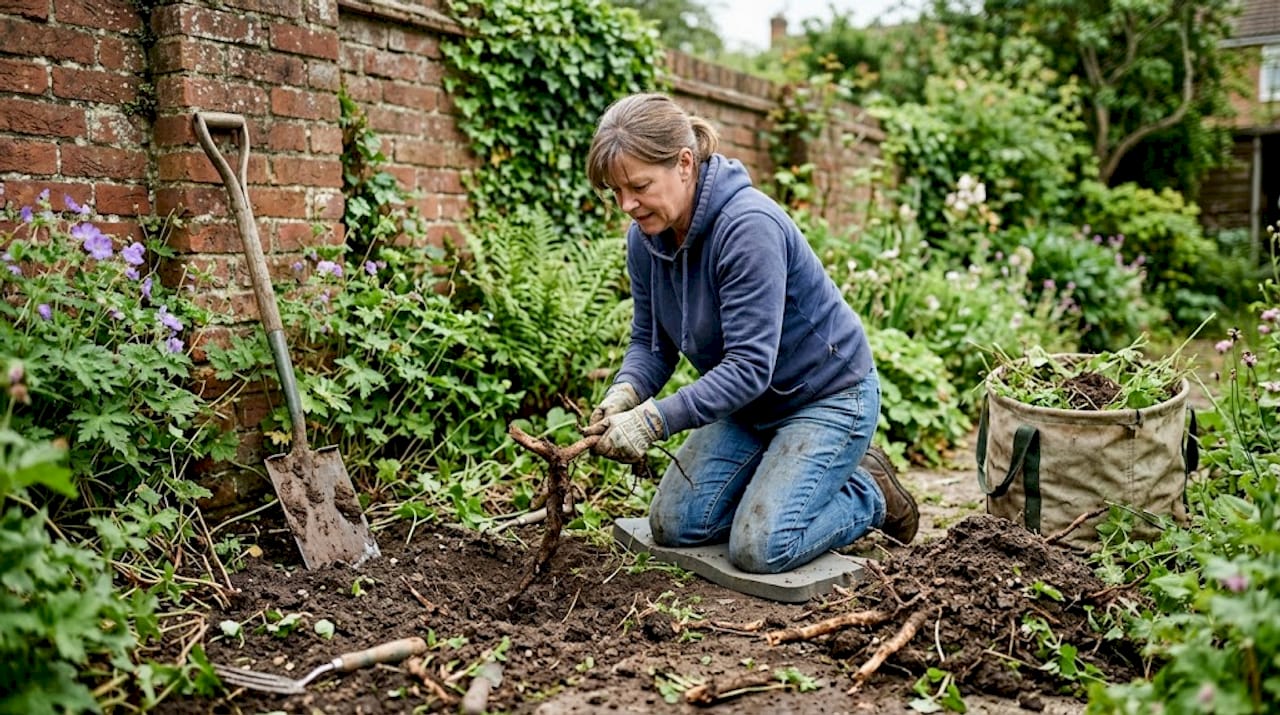
When a rhizome is severed by a spade or fork, each fragment becomes a potential new plant. If those fragments are scattered across the site during digging, or transported elsewhere on tools, boots, or in excavated soil, the infestation multiplies rather than diminishes. This is one of the most common reasons buyers inherit worse infestations than sellers originally disclosed.
Disposal compounds the problem further. Japanese Knotweed waste is classified as controlled waste under the Environmental Protection Act 1990, and its movement and disposal are legally regulated. Placing cut material in general waste, composting it, or fly-tipping it are all offences that carry significant penalties. Refer to the guidance for disposal from Natural Resources Wales for compliant approaches.
Risks of unmanaged manual removal:
- Rhizome fragments spread to previously unaffected areas of the site
- Contaminated soil transported off-site via footwear, machinery, or vehicles
- Illegal disposal resulting in enforcement action against the landowner
- Incomplete removal leaving viable rhizome material to regenerate
- Escalating remediation costs when a worsened infestation requires professional intervention
“Excavation is only effective as an eradication method when every fragment of rhizome material is removed from the soil. Even small amounts of residual material will result in regrowth.”
| Method | Effectiveness | Risk of spread | Legal compliance required |
|---|---|---|---|
| Hand digging | Low | High | Yes (disposal) |
| Mechanical excavation | Moderate to high | Moderate | Yes (soil movement) |
| Cutting alone | Very low | High | No |
| Professional removal | High | Low | Yes (fully managed) |
For those considering excavation as part of a managed programme, reviewing the safe steps for manual removal is essential before any ground works begin. Understanding your obligations around reporting knotweed is equally important when a neighbouring property is involved.
Pro Tip: If you discover knotweed during a pre-purchase survey, do not instruct the seller to “just dig it out.” Insist on a professionally managed eradication programme with documentation, as this protects your legal position and your lender’s requirements.
To build on this, let us see how professional programmes and legal compliance impact property transactions.
Professional eradication and why guarantees matter for property buyers
For most lenders operating in England, Wales, and Ireland, the presence of Japanese Knotweed on a property triggers specific requirements before a mortgage offer will be confirmed. Undocumented or amateur attempts at removal are insufficient. Lenders require a professionally prepared eradication plan, often accompanied by an insurance-backed guarantee, before they will proceed.
Professional eradication achieves 80-95% success, whereas DIY approaches consistently fail due to fragment spread and poor timing. The difference is not merely technical. It is contractual. A certified treatment programme with a 10-year monitoring guarantee provides the documentation that lenders, solicitors, and future buyers will require.
The TA6 property information form, which sellers in England and Wales must complete, includes a mandatory question about Japanese Knotweed. Failure to disclose known knotweed accurately exposes sellers to claims of misrepresentation. Buyers who discover undisclosed knotweed post-completion have grounds for legal action, making honest disclosure and certified treatment in every party’s interest.
What buyers should look for in a professional programme:
- A site-specific management plan prepared by a qualified specialist
- Insurance-backed guarantee of at least 10 years with annual monitoring visits
- Compliance documentation suitable for submission to mortgage lenders
- Written confirmation of legal disposal for all excavated material
- Clear record of treatment dates, methods, and observed regrowth
“An untreated or poorly treated knotweed site is not simply an aesthetic problem. It is a financial liability that follows the property through every future transaction.”
Incomplete treatment reduces property value by 5 to 20% and directly affects mortgage eligibility, making a certified programme a sound financial investment rather than an optional extra. The impact on property values is well documented, and mortgage issues with knotweed can delay or prevent completion entirely.
Understanding the full scope of risks of untreated knotweed on a property is the starting point for any informed buyer or investor. Now, let us look at advanced and chemical-free control strategies gaining favour among experts.
Advanced control: chemical-free methods and edge case successes
Chemical herbicides have long been the standard response to Japanese Knotweed, but their effectiveness is increasingly questioned as resistance patterns develop. Herbicide resistance develops over repeated exposures, making chemical-free methods such as electro-thermal treatment particularly valuable, with up to 95% success achievable within 12 to 24 months.
Electro-thermal treatment works by delivering direct electrical energy, in some systems up to 5,000 volts, into the plant tissue. This causes internal cell damage and depletes the energy reserves stored within the rhizome network with each successive treatment. Unlike herbicides, which require the plant to absorb and translocate the chemical through its vascular system, electro-thermal methods act immediately and physically, reducing the risk of incomplete uptake and resistant regrowth.
Root barriers offer a complementary approach, particularly where rhizome spread into adjacent properties or infrastructure is the primary concern. Installed correctly, they prevent lateral spread without disturbing existing rhizome material, making them especially useful in urban settings or where excavation is impractical.
| Method | Efficacy | Timeline | Suitable near water |
|---|---|---|---|
| Glyphosate herbicide | 60-80% | 3-5 years | No |
| Electro-thermal treatment | Up to 95% | 12-24 months | Yes |
| Root barriers | Containment | Indefinite maintenance | Yes |
| Full excavation | High | Immediate | Site-dependent |
Post-treatment regrowth in the form of small-leaved shoots is normal during year one and two and should not be interpreted as treatment failure. It is an expected response as the weakened rhizome network makes further attempts at recovery. Monitoring over three to five or more years is required to confirm genuine eradication, and this monitoring period must be factored into any professional guarantee.
Advantages of chemical-free electro-thermal treatment:
- No risk of chemical run-off into watercourses or surrounding soil
- Effective in environmentally sensitive areas where herbicide use is restricted
- Immediate physical action on rhizome cells, reducing reliance on plant uptake
- Compatible with lender documentation requirements for compliant treatment records
For guidance on integrating manual removal: safe steps alongside advanced treatments, refer to specialist advice before combining approaches. The RHS knotweed guidance provides a useful reference for understanding what constitutes a complete treatment programme.
Pro Tip: If your property is near a watercourse, stream, or flood plain, electro-thermal treatment is not only preferable from an ecological standpoint but may be legally required, as herbicide application near water is tightly regulated under UK environmental law.
To round off, let us share practical editorial insights that help avoid common buyer misconceptions.
Editorial perspective: the truth most property buyers miss about invasive weeds
In our experience, the single most costly mistake buyers make is trusting what they can see. A clear garden in late autumn tells you very little about what lies beneath. Dormancy deceives buyers with false assurances of success, and monitoring for three to five or more years is the only reliable indicator of genuine eradication.
The property market tends to move faster than the biology of invasive weeds. Sellers under pressure to complete will sometimes point to a season without visible growth as evidence that the problem is resolved. It is not. A rhizome network that has entered dormancy is not a dead rhizome network. It is a waiting one.
The effects on property value are measurable and well evidenced, yet buyers continue to accept verbal assurances where they should demand certified documentation. The pitfalls of manual removal are equally overlooked, particularly by sellers who have made genuine but uninformed attempts to address the problem.
Our position is clear: only 10-year guaranteed, professionally monitored treatment programmes with full compliance documentation should satisfy a buyer’s due diligence. Anything less is a risk carried forward into your ownership.
Expert resources and solutions for invasive weed risk
Understanding the biology of invasive weeds is only part of the answer. Acting on that understanding requires access to the right expertise, certified treatment methods, and ongoing monitoring that lenders and solicitors will accept without question.
At Japanese Knotweed Agency, we provide property surveys across England, Wales, and Ireland, identifying both active and dormant Japanese Knotweed before it becomes a transactional problem. Our chemical-free knotweed treatment uses electro-thermal technology to target rhizome networks without herbicides, making it suitable for sensitive sites and environmentally protected areas. For further guidance on the most common concerns raised by buyers and investors, our knotweed FAQs provide clear, expert-led answers to help you proceed with confidence.
Frequently asked questions
Why does Japanese Knotweed return after apparent eradication?
Rhizomes remain viable and regenerate years after treatment, meaning dormant fragments below the surface can resume active growth long after a site appears clear. A visual inspection is never a reliable substitute for professional monitoring over multiple growing seasons.
How does invasive weed impact property value and mortgages?
Incomplete treatment reduces value by 5 to 20% and directly affects mortgage eligibility, as most lenders require a certified eradication plan before approving any offer. Buyers should request full compliance documentation as a condition of any purchase where knotweed has been identified.
Are manual removal methods effective against invasive weeds?
Manual methods can spread fragments and worsen infestations, making professional removal with properly controlled disposal the only genuinely reliable approach. Digging without specialist oversight typically creates more growth points rather than fewer.
Do professional eradication guarantees actually protect buyers?
Professional programmes achieve 80-95% eradication, and 10-year guarantees backed by insurance provide the documentation lenders and solicitors require to proceed with property transactions. Without this, buyers carry the full remediation risk into their ownership.
What are the best chemical-free strategies for invasive weed control?
Electro-thermal control achieves up to 95% success within 12 to 24 months and is particularly suited to environmentally sensitive locations where herbicide use is restricted or prohibited. Root barriers provide effective containment where excavation or treatment is not immediately practical.