TL;DR:
- Effective weed policies in councils must prioritize regulatory compliance, environmental impact, and public perception.
- Non-chemical methods like mechanical hoeing, flame weeding, and thermo-electric treatment are proven strategies for invasive weed control.
- Site hygiene and operational protocols are essential to prevent the spread of invasive species during management activities.
Councils across England, Wales, and Ireland face a growing challenge: managing invasive weeds effectively whilst responding to legitimate environmental concerns, public pressure, and increasingly stringent regulatory standards. The era of reaching for glyphosate as a first resort is drawing to a close, driven by both public expectation and environmental policy. Yet invasive species such as Japanese Knotweed do not wait for policy frameworks to catch up. What follows are evidence-based, actionable strategies that equip local authorities with the tools to build weed policies that are credible, compliant, and genuinely effective.
Table of Contents
- Key criteria for council weed policies
- Top chemical-free weed control strategies
- Preventing weed spread: site hygiene and access control
- Situational recommendations and expert insights
- The reality of council weed policy implementation
- Practical solutions for councils: further guidance and resources
- Frequently asked questions
Key Takeaways
| Point | Details |
|---|---|
| Frameworks matter | Using a structured policy and expert-led workshops ensures legal compliance and stakeholder buy-in. |
| Integrated management | Mechanical and biological controls work best as part of an integrated weed strategy for councils. |
| Site hygiene prevents spread | Proper site access, machinery cleaning, and containment measures stop invasive weeds from spreading. |
| Adjust to site specifics | Tailor control methods for sensitive areas like watercourses and school grounds for maximum effectiveness. |
| Expert guidance essential | Professional surveys and regular auditing dramatically improve council weed control outcomes. |
Key criteria for council weed policies
Developing a robust weed policy is not simply a matter of choosing a treatment method. It requires a structured approach that accounts for regulatory obligations, environmental sensitivities, and the very real expectations of the communities councils serve.
Effective weed policies must address the following criteria:
- Regulatory compliance: Councils must remain aligned with current legislation, including the Wildlife and Countryside Act 1981 and the Environmental Protection Act 1990, both of which impose specific duties regarding invasive non-native species. Understanding your legal obligations for councils is a non-negotiable starting point for any management plan.
- Environmental impact: Policies must weigh the risk that chemical treatments pose to soil health, biodiversity, and local watercourses. Non-chemical alternatives are increasingly viewed not as compromise positions, but as the preferred standard of care.
- Public perception: Residents and community stakeholders are more informed than ever about herbicide risks. Councils that demonstrate visible, responsible, chemical-free management build public trust and reduce the risk of reputational damage.
- Site-specific risk assessment: No two sites are identical. Proximity to schools, watercourses, Sites of Special Scientific Interest (SSSIs), or residential properties introduces different risk profiles and demands tailored approaches. A blanket policy will fail on this front.
- Documented management plans: Thorough documentation supports accountability, lender confidence, and enforcement capability. Professional surveys should underpin every plan, particularly for high-risk or multi-site operations.
PAN UK supports councils transitioning to non-chemical weed control with policy frameworks, workshops, and specific guidance on Japanese Knotweed alternatives, making them a valuable resource when developing a sustainable weed strategy.
Councils should also consider weed control membrane alternatives as part of a broader integrated approach, particularly for hard-standing areas and managed green spaces where physical suppression is practical and cost-effective.
Pro Tip: Do not attempt to build policy in isolation. Consult framework leaders, specialist contractors, and bodies such as PAN UK early in the process. Integrated Weed Management (IWM) principles should form the backbone of any credible council weed policy, combining multiple non-chemical techniques rather than relying on any single method.
Top chemical-free weed control strategies
With council criteria established, let us break down the most effective non-chemical strategies available for implementation across varied site types.
The Soil Association’s chemical-free guide confirms that Integrated Weed Management uses mechanical hoeing, flame weeding, stale seedbeds, competitive cropping, and rotations with leys to suppress growth without chemicals. These methods are well-proven across agricultural and amenity settings, and are directly transferable to council-managed land.
Key non-chemical approaches include:
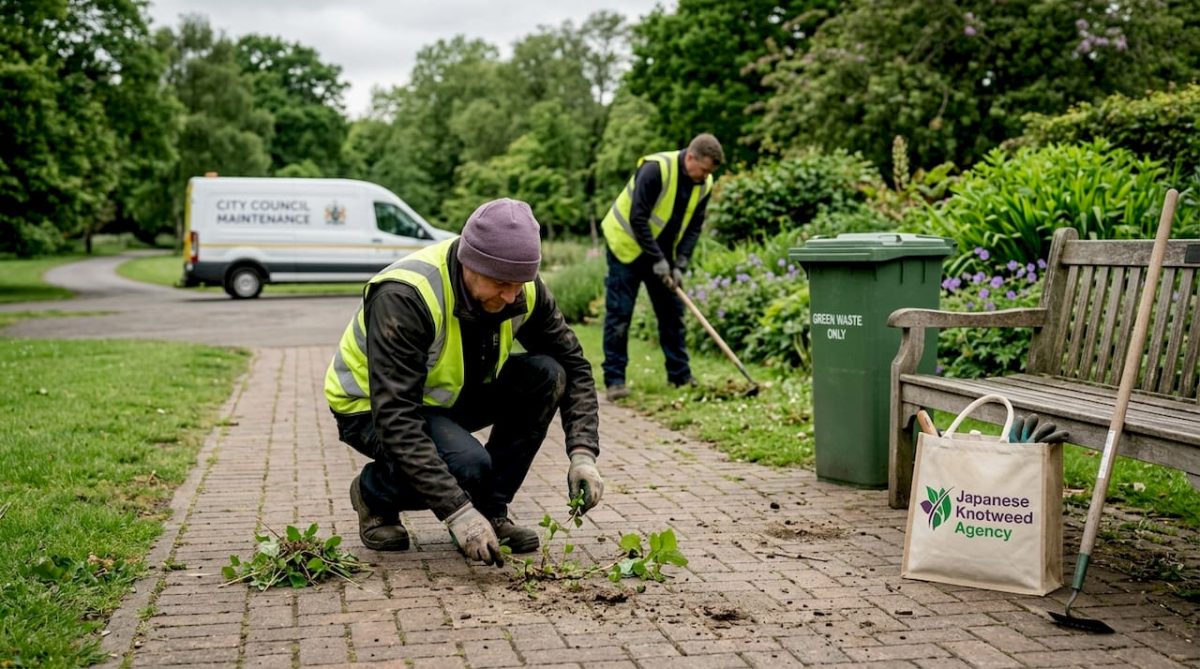
- Mechanical hoeing and cutting: Regular, shallow surface disturbance disrupts weed establishment without soil compaction or chemical residues. For annual weeds, this is often sufficient when applied consistently.
- Flame weeding: Particularly effective for hard surfaces such as footpaths, car parks, and road edges. Hot air or open-flame systems kill emerging weeds rapidly and are well-suited to urban settings.
- Stale seedbeds: Preparing ground and allowing a flush of weed seeds to germinate before disturbing the soil again dramatically reduces weed pressure before planting or surfacing.
- Smothering and suppression: Dense mulching or ground cover materials prevent light from reaching weed growth, effectively starving existing plants and preventing new establishment.
- Thermo-electric treatment: For persistent invasive species such as Japanese Knotweed on sensitive sites, delivering direct electrical energy to the root system causes internal cell damage and depletes the energy reserves within the rhizome network without the need for herbicides. This is particularly valuable near watercourses or school grounds where chemical use is inappropriate.
For natural knotweed management in public spaces, a phased combination of these methods is almost always more effective than any single strategy applied in isolation.
The RHS confirms that repeated mechanical actions, specifically cutting every two to three weeks, deplete rhizome reserves over time. Combining this with smothering or physical barriers consistently produces better outcomes than mechanical action alone.
| Method | Best application | Frequency | Notes |
|---|---|---|---|
| Mechanical hoeing | Annual and perennial weeds | Weekly to fortnightly | Avoid deep tillage |
| Flame weeding | Hard surfaces, paths | Every 4 to 6 weeks | Risk assess for dry conditions |
| Stale seedbeds | Pre-planting | One to two cycles | Effective for annual weed seed banks |
| Smothering/mulching | Borders, green spaces | Seasonal | Use approved materials |
| Thermo-electric | Japanese Knotweed, sensitive sites | Per treatment programme | No chemical risk |
| Root barriers | Boundary management | Permanent install | Use in conjunction with treatment |
Pro Tip: Early, shallow tilling before weed seeds mature can reduce weed emergence by up to 70%. Timing is critical. Acting before seeds set removes future generations of the problem, not just the current flush of growth.
If an infestation is confirmed on council land, it is important to report Japanese Knotweed promptly. Early reporting allows containment measures to be implemented before the plant spreads to adjacent land.
Preventing weed spread: site hygiene and access control
Once control methods are selected, managing operational risk and weed spread becomes crucial. Japanese Knotweed in particular can regenerate from fragments as small as a single node. A single piece of rhizome carried on a boot or vehicle undercarriage can establish a new colony with alarming speed.
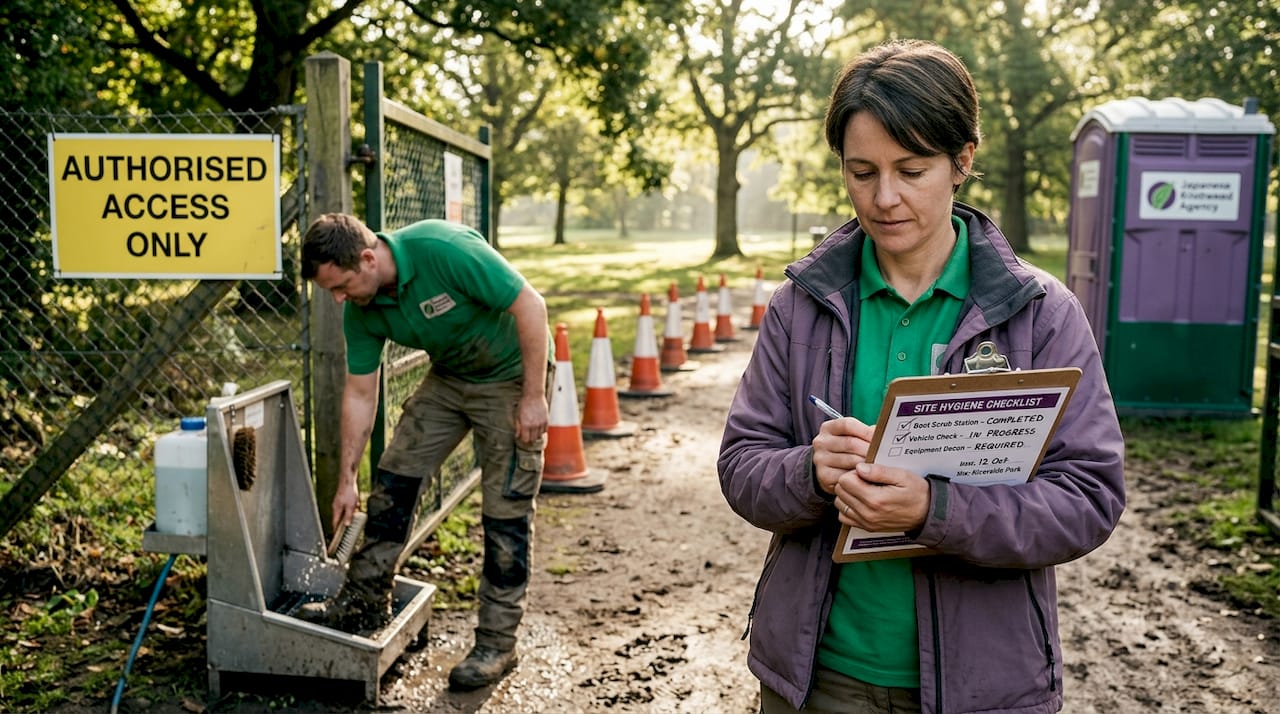
Invasive species management guidance is unequivocal on this point: site hygiene is critical. Designated access routes, machinery cleaning stations, boot washes, and covered loads are all essential measures to prevent fragment spread during and after treatment works.
Practical steps for council operations include:
- Controlled access: Fencing, signage, and designated entry and exit points reduce the risk of fragments being tracked across clean land.
- Machinery decontamination: All plant and vehicles operating within an infested zone must be pressure-washed before leaving site. Dedicated washing bays should be established for ongoing projects.
- Boot wash stations: Operatives should clean footwear at transition points between infested and clean zones. This applies to all personnel, including surveyors and management staff visiting sites.
- Covered loads: Any excavated material, soil, or green waste from infested areas must be covered during transportation. Japanese Knotweed waste classified under the Environmental Protection Act must be disposed of at a licensed facility.
- Monitoring access points: For multi-site council operations, a register of access events supports traceability and reduces the risk of cross-contamination between projects.
| Hygiene measure | Standard approach | Advanced containment |
|---|---|---|
| Site access | Signage and fencing | Controlled single entry/exit with log |
| Machinery cleaning | Rinse at site boundary | Designated pressure-wash bay, inspection checklist |
| Boot hygiene | Brush clean | Boot wash station at zone transitions |
| Waste management | Bagged and labelled | Covered load, licensed disposal site, disposal certificate |
| Record-keeping | Basic site log | Full traceability register with photographic evidence |
Councils managing invasive species across multiple sites should consider contributing to or consulting the knotweed national register, which supports broader tracking and containment efforts across local authority boundaries.
Reviewing landscape care best practices alongside your operational protocols can also provide useful supplementary guidance for maintaining managed green spaces through regular maintenance programmes.
Situational recommendations and expert insights
Having covered control and containment, let us explore how to handle specific scenarios using expert advice tailored to the types of sites councils most commonly encounter.
-
Near watercourses or ecological reserves: Chemical controls present an unacceptable risk in these environments. PAN UK’s pesticide-free guidance confirms that near watercourses, councils should avoid chemicals entirely and instead use thermo-electric treatment or manual controls. Runoff risk alone makes herbicides inappropriate, and the penalties for watercourse contamination under the Water Resources Act are substantial.
-
Managing infestations on school grounds: Schools present particular sensitivities around chemical use, both from a safeguarding perspective and in terms of public trust. Non-chemical methods, specifically thermo-electric treatment, smothering, and physical root barriers, should be the default position. Any treatment programme should be timed to coincide with school closures where possible, and communicated clearly to school leadership and parents.
-
Handling large, established invasive populations: Large-scale infestations of Japanese Knotweed often require excavation as the most definitive response. This is costly but removes the rhizome mass entirely, rather than simply suppressing it. For councils with constrained budgets, a phased programme combining thermo-electric treatment with root barrier installation offers a structured and progressively effective alternative. The impact on property value of unmanaged infestations on adjacent land is a further reason to prioritise action, particularly where council assets neighbour residential or commercial properties.
“Public pressure is driving glyphosate restrictions across local authorities, and rightly so in most settings. But for entrenched invasive species, a blanket ban without any exemption pathway can leave councils without a lawful or effective remedy. The solution is a tiered policy: exhaust non-chemical options first, document thoroughly, and retain minimal targeted chemical use as a final, auditable option where evidence demands it.” — Invasive Species Management Expert
Management plans should be reviewed annually. Site conditions change, infestations spread, and the operational landscape for councils evolves. A plan written two years ago may no longer reflect the reality on the ground, and outdated documentation creates both compliance risk and operational gaps.
The reality of council weed policy implementation
Here is what most guidance documents will not tell you. Policy frameworks are necessary, but they are not sufficient. In practice, the gap between a well-written council weed policy and effective weed management on the ground is often significant, and the reasons are consistently predictable.
Funding shortfalls are the most common cause of policy failure. Non-chemical treatment methods, particularly thermo-electric systems and professional excavation, require upfront investment. Councils that adopt ambitious policies without securing corresponding budget lines often find themselves reverting to cheaper chemical options at the first sign of operational pressure. This is not a failure of intent. It is a failure of planning.
The second issue is staff turnover and inconsistent training. Weed management programmes for persistent invasives like Japanese Knotweed span years, not months. When the operatives or managers who understand a site’s history move on, continuity breaks down. Cross-site audits and structured knowledge transfer processes are not optional extras; they are fundamental to sustained effectiveness.
There is also an uncomfortable truth that most guidance avoids. Some invasive species in some situations genuinely do require a minimal, targeted, and carefully documented use of approved chemicals, particularly where non-chemical methods have been applied consistently and the infestation has not responded sufficiently. This is not a contradiction of a chemical-free principle. It is an evidence-based concession that effective policy must acknowledge rather than ignore.
Pro Tip: Prioritise ongoing staff training and schedule cross-site audits at least twice yearly. A programme that is technically sound but poorly executed in the field will consistently underperform. Ground-level accountability is where policy succeeds or fails.
The public space natural management principles that underpin effective council approaches are not complicated. They require consistency, documentation, and a willingness to invest in specialist expertise rather than defaulting to the cheapest short-term solution.
Practical solutions for councils: further guidance and resources
Councils that are ready to move from policy development to practical delivery need access to specialist expertise and proven methodologies. Japanese Knotweed Agency works directly with local authorities across England, Wales, and Ireland, delivering chemical-free solutions with a documented 95% success rate through thermo-electric treatment, root barrier installation, and professional excavation works.

Before any management programme begins, a thorough site assessment is essential. Our eradication survey guide sets out exactly what a professional survey should cover, how findings should be documented, and how this evidence base supports both compliance and long-term management planning. If your authority is developing or reviewing its weed policy, our survey and specialist treatment services are designed specifically to support the operational realities councils face. Contact Japanese Knotweed Agency to discuss your site requirements.
Frequently asked questions
What are the most effective chemical-free options for Japanese Knotweed?
Repeated cutting every 2 to 3 weeks depletes rhizome energy reserves over time, and combining this with physical smothering or root barriers produces the strongest non-chemical results on council sites.
How can councils prevent weeds from spreading during operations?
Designated access, machinery cleaning, boot wash stations, and covered loads are the core hygiene measures that prevent fragment escape and cross-site contamination during council weed management operations.
Do councils need professional surveys before starting a management plan?
Yes. Professional surveys and documented management plans are essential for regulatory compliance and lender confidence, and PAN UK recommends them specifically for sensitive sites such as those near watercourses or schools where chemical-free methods must be verified.
What methods are best near watercourses?
Near watercourses, avoid chemicals entirely and use thermo-electric treatment or manual controls, as the environmental risk of herbicide runoff and the associated legal penalties make chemical use indefensible in these settings.
Should glyphosate be banned for invasive weeds?
Most councils now restrict glyphosate use, and public pressure supports this in the majority of settings. However, policy should retain a narrow, auditable exemption for established invasive species where non-chemical methods alone have demonstrably failed after sustained application.