


TL;DR:
- Electrical weed control destroys invasive plants by passing high-voltage electricity through their tissues to generate heat and rupture cells. Slower application speeds increase energy delivery, improving control, especially for deep-rooted weeds like Japanese Knotweed. Multiple treatment passes enhance long-term effectiveness by depleting the plant’s energy reserves and targeting regrowth.
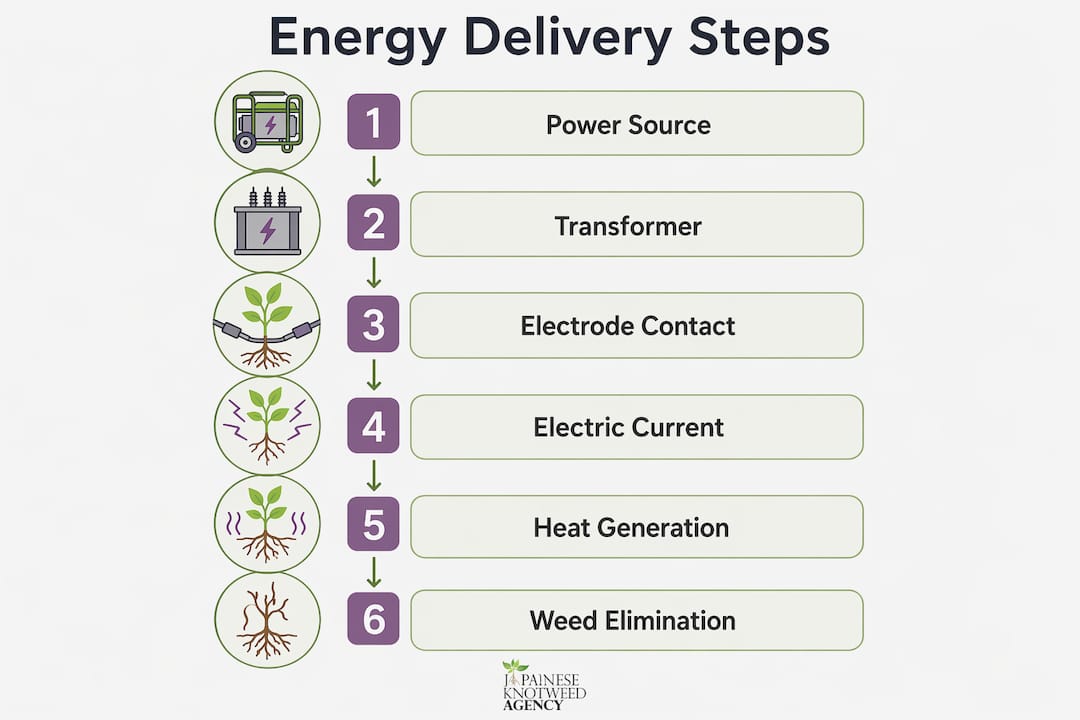
Energy delivery in weed control is the process of passing high-voltage electrical current directly through weed tissues and roots to destroy invasive plants without the use of chemicals. The electrical energy converts to heat inside plant cells, rupturing membranes and causing cell death throughout the plant. This method, often called electrical weed control or thermo-electric treatment, is particularly relevant for persistent invasive species such as Japanese Knotweed, which can push through tarmac and resist conventional management. Understanding energy delivery gives property owners a clear picture of how chemical-free treatment actually works at a biological level.
How does electrical energy kill weeds?
Electrical energy kills weeds by making plant tissue act as a resistor. When current flows through a weed, the plant’s own cells convert electricity to heat, generating temperatures that rupture cell membranes from the inside. Once membranes break down, the cell contents leak and the tissue dies. This process travels from the aboveground stems down through the root system, meaning the damage is not limited to what you can see at the surface.
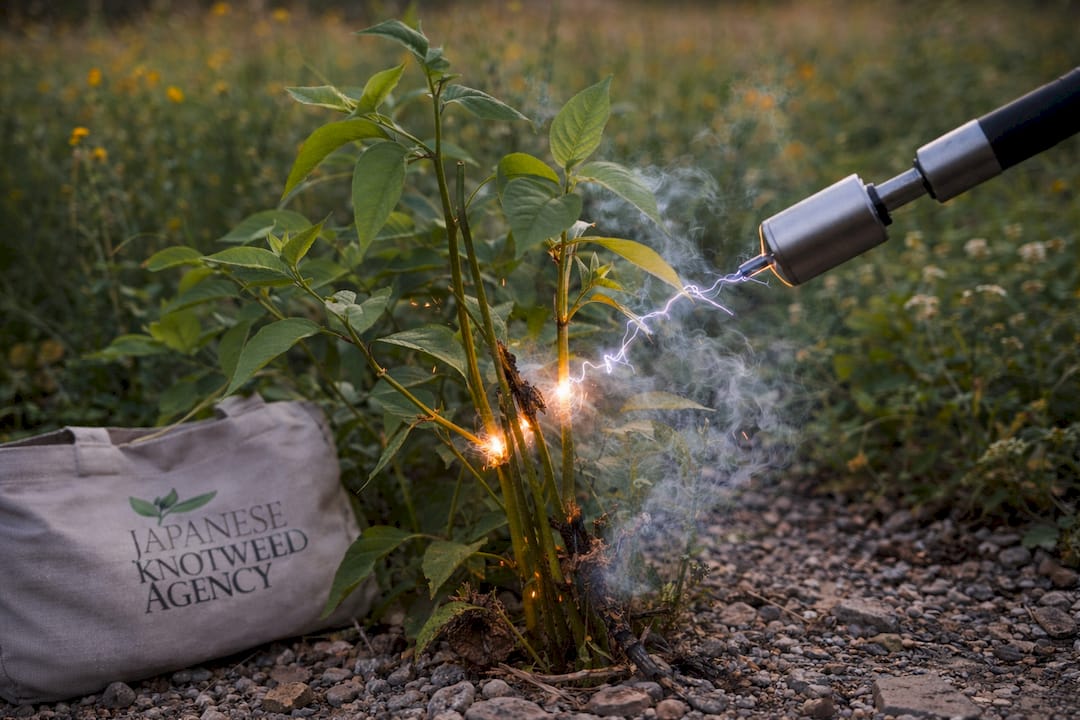
The circuit must be completed through the soil for energy to flow effectively. Circuit completion through soil is what allows the current to travel into the root zone, which is precisely where persistent weeds like Japanese Knotweed store their energy reserves in an extensive rhizome network. Without that circuit, the current stays superficial and the roots survive.
Electrical weed control is also significantly more energy-efficient than other heat-based methods. Research shows it uses 10 to 20 times less energy than flaming or steaming while achieving comparable weed control results. That efficiency matters for property owners who want effective treatment without the environmental cost of high-energy alternatives.
Pro Tip: If you are assessing a chemical-free treatment for Japanese Knotweed on your property, ask your provider specifically how they confirm circuit completion during treatment. It is the single biggest factor in whether energy reaches the roots.
Key biological effects of electrical energy on weeds include:
- Cell membrane rupture caused by internal heat generation within plant tissue
- Root system damage as current travels down through the plant into the rhizome network
- Depletion of energy reserves stored in roots, weakening the plant’s ability to regrow
- No chemical residue left in soil or surrounding vegetation after treatment
Why does application speed affect energy delivery effectiveness?
Application speed directly controls how much energy a plant receives during treatment. Slower speeds increase the time an electrode stays in contact with each plant, which raises the total energy dose delivered per stem. Electrode contact time is the primary variable operators can adjust in the field to change treatment intensity.
Field trials demonstrate this clearly. Control rates reached up to 89% at speeds of 0.3–0.6 mph. At speeds above 1.2 mph, control rates dropped significantly because each plant received less energy per pass. That drop in effectiveness is not a minor variation. It represents the difference between a treatment that kills the root system and one that only scorches the surface growth.
The practical implications for property owners and land managers are straightforward:
- Slower passes deliver higher energy doses per plant, producing stronger initial control of established weeds.
- Faster passes cover more ground but reduce energy transfer, making them less effective as a standalone treatment.
- Optimal speed ranges of 0.3–0.6 mph have been validated in field research as the most effective for achieving high control rates in a single pass.
- Site conditions matter. Soil moisture, plant density, and weed species all affect how well the circuit completes, which means operators must adjust speed to suit the specific site rather than applying a fixed setting.
Operators adjust machine speed and the number of passes to deliver the effective energy dose per unit area, since soil and plant conditions vary across sites. This is why professional assessment before treatment is not optional. It is the foundation of an effective programme.
What role does multiple-pass treatment play in managing regrowth?
A single treatment pass rarely eliminates a well-established invasive weed. Perennial species like Japanese Knotweed store significant energy in their rhizome networks, and even after effective initial treatment, new shoots can emerge from surviving root material. Sequential energy delivery treatments timed to regrowth improve control by targeting those new shoots before they rebuild the plant’s energy reserves.
Research supports a structured approach. Two to three passes spaced approximately two weeks apart increased efficacy and maintained lower weed pressure over time compared to single-pass treatments. Two applications at 2 km/h yielded 77–83% weed control, demonstrating that distributing energy delivery across multiple passes can compensate for faster individual speeds. That finding is significant for large sites where covering ground quickly is a practical necessity.
Pro Tip: Time your follow-up treatments to coincide with visible regrowth, typically two weeks after the initial pass. Treating at this stage targets shoots that are actively drawing on root energy reserves, making each subsequent treatment more damaging to the plant’s long-term survival.
The advantages of a multiple-pass approach include:
- Progressive depletion of rhizome energy reserves with each treatment cycle
- Targeting of regrowth before new shoots can photosynthesise and replenish root energy
- Flexibility to use faster speeds across multiple passes while still achieving high overall control
- Reduced weed pressure maintained over a longer period compared to single intensive treatments
How do different electrical weed control technologies deliver energy?
Electrical weed control equipment uses a tractor’s power take-off (PTO) to power a transformer, which converts mechanical energy to electrical energy delivered through electrodes to the target plants. The two main equipment types differ in how they complete the electrical circuit and which weed types they target most effectively.
| Technology | How it works | Best suited for | Key limitation |
|---|---|---|---|
| Spark-discharge | Single electrode creates a spark to taller weeds rising above the crop canopy | Tall weeds in row crops | Less effective on low-growing or ground-level weeds |
| Continuous electrode-contact | Two electrodes create a circuit through the plant and soil | Weeds between crop rows and ground-level growth | Requires good soil contact to complete the circuit |
Tool design affects weed targeting in ways that matter practically. Spark-discharge systems work well for taller weeds that protrude above surrounding vegetation, while continuous electrode-contact systems are better suited to treating weeds at ground level between rows. Neither system is universally superior. The right choice depends on the weed species, site layout, and growth stage at the time of treatment.
Electrical weed control also carries clear environmental advantages over chemical methods. Advantages include no chemical residues, no herbicide drift risk, and fewer off-target impacts on surrounding biodiversity. The operational trade-offs are slower treatment speeds and fuel consumption from the tractor, both of which are manageable with proper planning. For property owners concerned about chemical exposure near buildings, watercourses, or gardens, these advantages are decisive.
Key takeaways
Energy delivery in weed control is the transfer of high-voltage electrical current through plant tissue, converting to heat that destroys cell membranes and depletes root energy reserves without chemicals.
| Point | Details |
|---|---|
| Biological mechanism | Electrical current converts to heat inside plant cells, rupturing membranes and killing tissue down to the roots. |
| Speed controls energy dose | Slower application speeds increase electrode contact time, delivering more energy per plant and higher control rates. |
| Multiple passes improve results | Two to three passes spaced two weeks apart deplete rhizome energy reserves and maintain lower weed pressure over time. |
| Equipment type matters | Spark-discharge and continuous electrode-contact systems suit different weed types and site conditions. |
| Chemical-free advantage | Electrical treatment leaves no chemical residues in soil and carries no herbicide drift risk. |
Why I think property owners underestimate how technical energy delivery really is
Most property owners who contact Japaneseknotweedagency have already tried something. They have pulled, cut, or sprayed. When they hear about electrical treatment, the assumption is often that it is simply a more powerful version of the same idea. It is not.
What makes energy delivery genuinely different is the circuit. The current has to travel through the plant and complete through the soil. If the soil is too dry, too compacted, or the electrode contact is inconsistent, the energy stays in the stem and the roots survive. I have seen sites where a single treatment looked effective on the surface but left the rhizome network largely intact because the circuit never properly completed. The regrowth six weeks later was indistinguishable from the original infestation.
The other misconception is that faster treatment means better value. Speed reduces energy dose per plant. A faster pass that covers twice the ground but delivers half the energy is not a bargain. It is a setup for repeat visits. The research on optimal speed ranges exists precisely because this trade-off is real and measurable.
What actually works is treating at the right speed for the site, returning for follow-up passes timed to regrowth, and understanding that you are depleting a root system, not just killing visible stems. For Japanese Knotweed specifically, that rhizome network can extend several metres from the visible plant. Depleting it takes time and repeated, well-targeted energy application. There are no shortcuts that hold up over a full growing season.
— Alan
Professional energy-based treatment for invasive weeds
Japaneseknotweedagency specialises in chemical-free Japanese Knotweed solutions, delivering direct electrical energy up to 5,000 volts on site to cause internal cell damage and progressively deplete the rhizome network with each treatment. The approach is grounded in the same principles covered in this article: correct energy dose, timed repeat treatments, and professional assessment of site conditions before any work begins.

Every effective treatment programme starts with a proper survey. A professional invasive weed survey identifies the extent of the infestation, assesses site conditions, and informs the treatment plan. Japaneseknotweedagency carries out property surveys across England, Wales, and Ireland, giving property owners a clear picture of what they are dealing with and what it will take to resolve it. Book a survey to get a tailored assessment for your property.
FAQ
What is energy delivery in weed control?
Energy delivery in weed control is the application of high-voltage electrical current through weed tissue, converting to internal heat that ruptures cell membranes and kills the plant from stem to root without chemicals.
How does electrical energy reach the roots of a weed?
The electrical current travels through the aboveground plant tissue and completes its circuit through the soil, allowing it to reach and damage the root and rhizome system beneath the surface.
How many treatment passes does Japanese Knotweed require?
Field research shows two to three passes spaced approximately two weeks apart achieve significantly better long-term control than a single treatment, as each pass targets regrowth and further depletes rhizome energy reserves.
Is electrical weed control safe near buildings and watercourses?
Electrical treatment leaves no chemical residues in soil and carries no herbicide drift risk, making it well suited to sensitive sites near buildings, gardens, and watercourses where chemical herbicides carry regulatory or environmental risks.
Does application speed affect how well electrical treatment works?
Yes. Trials show control rates of up to 89% at speeds of 0.3–0.6 mph, with effectiveness dropping at speeds above 1.2 mph because each plant receives less electrode contact time and a lower energy dose.