
TL;DR:
- Invasive plants like Japanese knotweed destabilize soil and increase erosion, raising flood risks.
- Proximity to watercourses and underground drains heightens the impact of invasive species on drainage.
- Chemical-free removal, native planting, and site-specific surveys effectively restore drainage stability.
Not all greenery is good for your ground. Many homeowners assume that any plant cover stabilises soil and aids water absorption, but certain invasive species do the precise opposite. Japanese knotweed, Himalayan balsam, and similar invaders can quietly destabilise the very soil structure that keeps drainage functioning correctly, often without any visible warning until serious damage has occurred. This article sets out the real, evidence-based risks these plants pose to drainage systems and surrounding land, and explains how chemical-free solutions tailored for homeowners in England, Wales, and Ireland can protect your property before problems escalate.
Table of Contents
- How invasive plants destabilise drainage and riverbanks
- Where homeowners face the highest drainage risks
- How native plant choices improve drainage performance
- Chemical-free invasive plant management: what really works
- Why most drainage risk guides underplay invasive plants (and what to really watch for)
- How we help you reclaim safe, chemical-free drainage
- Frequently asked questions
Key Takeaways
| Point | Details |
|---|---|
| Invasives weaken drainage | Invasive plants like Japanese knotweed destabilise soil and riverbanks, heightening flood and erosion risk. |
| Site matters most | The greatest drainage danger occurs where invasives grow near pipes, drains, or watercourses. |
| Native plants help | Choosing the right native plants can actively improve stormwater soakage and protect your drains. |
| Go chemical-free safely | Effective chemical-free methods, such as deep excavation and root barriers, need careful installation and planning. |
How invasive plants destabilise drainage and riverbanks
Not every plant root is built the same way. Native species typically develop root systems that bind soil particles together, create stable channels for rainwater infiltration, and support surrounding ground structure over decades. Invasive species, particularly Japanese knotweed, behave very differently. Their root systems, known as rhizomes, are aggressive and wide-reaching, disrupting existing soil structure rather than reinforcing it.
This distinction matters enormously when your land is near a watercourse, a drainage channel, or sits on a slope. When invasive species colonise riverbanks or saturated ground, they do not simply replace native vegetation. They fundamentally alter the mechanics of the soil itself. Invasive non-native plants reduce riverbank stability, lowering shear strength and increasing erosion and sediment delivery downstream. Reduced shear strength means the bank simply cannot hold together as effectively under pressure from water or rainfall.
“Invasive species colonising riverbanks measurably reduce soil shear strength, accelerating erosion and increasing sediment loads downstream—posing significant risk to property and water management infrastructure.”
The consequences of that sediment movement are not limited to one property. Silt displaced from one eroding bank can settle downstream, raising the bed of a watercourse and reducing its ability to carry water quickly during heavy rainfall. This increases drainage maintenance and property flooding risk across a wider area. You should consider reporting Japanese knotweed promptly if you identify it near any watercourse or drainage feature on or near your land.
Native vs. invasive plant impacts on drainage and soil stability
| Factor | Native plants | Invasive plants (e.g. knotweed) |
|---|---|---|
| Soil binding | Strong, gradual root development | Disrupted by aggressive rhizome spread |
| Water infiltration | Improved, steady soakage | Reduced, uneven surface runoff |
| Riverbank stability | Maintained over time | Reduced shear strength, erosion risk |
| Sediment delivery | Low | Significantly increased downstream |
| Biodiversity | Supported | Displaced, reducing ecological resilience |
Key risks to be aware of include:
- Dense knotweed stands can destabilise riverbanks during winter die-back, leaving bare soil vulnerable to erosion
- Himalayan balsam dies back entirely each autumn, exposing colonised banks to torrential rainfall on unprotected soil
- Increased sediment loads in local watercourses can raise flood risk for neighbouring properties, not just your own
- Ground destabilised by invasive roots becomes less effective at absorbing sudden heavy rainfall events
Where homeowners face the highest drainage risks
Understanding the broader ecosystem risks is just the start. Next, let’s zoom into your property and see where the real vulnerabilities lie.
Not every knotweed infestation poses an equal drainage risk. Drainage impacts are most severe when an infestation is physically close to underground services, drains, or dense riverbank stands. Distance and soil type both influence how quickly damage can develop, which is why a professional site survey is essential before assuming the scale of risk.
Scenario comparison: knotweed location vs. drainage risk
| Location of infestation | Primary risk | Urgency |
|---|---|---|
| Adjacent to underground drains or pipes | Root infiltration, blockage, displacement | High |
| Along garden perimeter near hardscaping | Surface water redirection, cracking | Moderate to high |
| On or adjacent to a watercourse | Bank erosion, downstream sedimentation | High |
| In open garden away from services | Limited drainage impact currently | Lower but monitor closely |
Common warning signs homeowners should watch for:
- Drains that empty noticeably more slowly than usual, particularly after moderate rainfall
- Visible garden erosion at lawn edges or boundaries, especially close to existing plant growth
- Surface water pooling in areas that previously drained well
- Inspection chamber lids that are difficult to lift or show signs of distortion around the surround
- Cracks appearing in paving, patios, or hardstanding near established knotweed growth
A critical point that many homeowners overlook is that surface water management involves the full landscape, not just your plot boundary. Sediment and altered water flow patterns originating on neighbouring or upstream land can return to affect your drainage directly. You cannot manage your risk in isolation.
Considering root barrier installation at the earliest opportunity significantly reduces the chance of rhizome spread reaching vulnerable drainage infrastructure.
Pro Tip: Simply cutting back visible knotweed growth without addressing the rhizome network beneath will not reduce drainage risk. The underground system remains fully active and continues to expand even when above-ground growth appears to have been controlled. Any effective management plan must account for the full extent of underground spread.
How native plant choices improve drainage performance
While it is crucial to spot the risks, the right planting choices can give your drainage a natural boost.
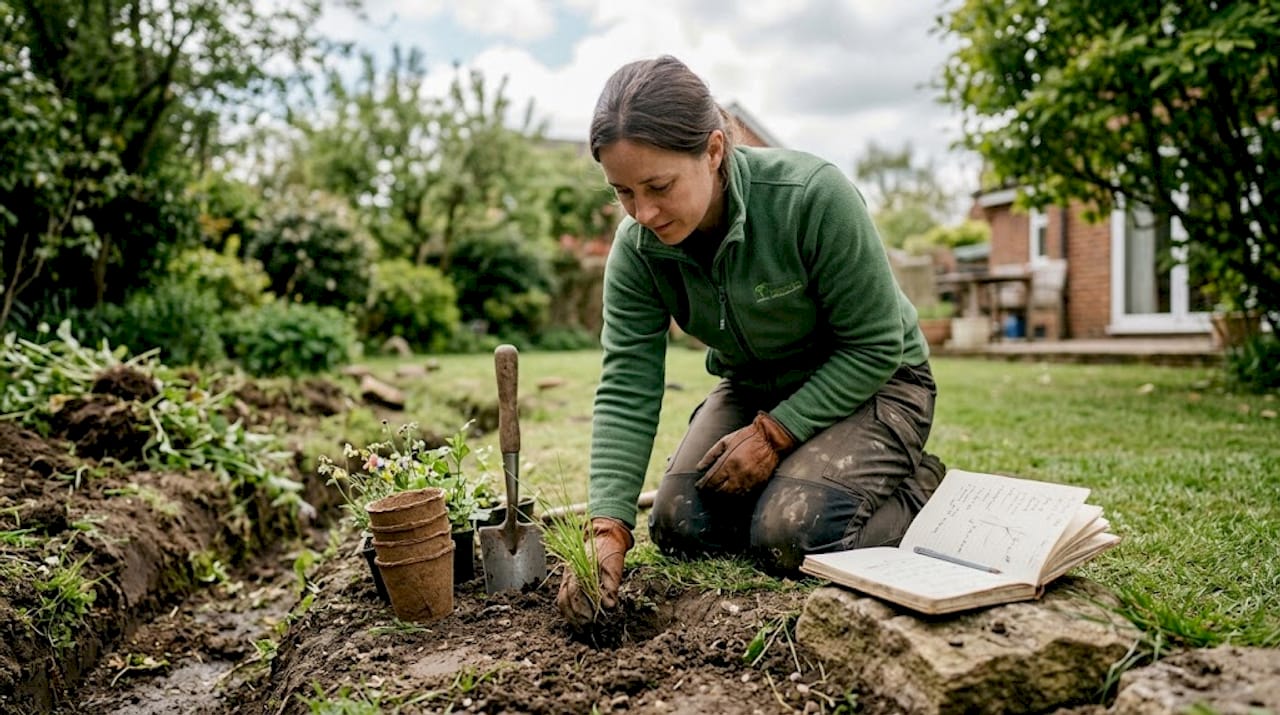
Removing invasive species creates an opportunity. Rather than leaving ground bare, which itself increases erosion risk, replacing invasives with appropriately chosen native species actively improves drainage performance over time. Native plants have evolved alongside local soils, rainfall patterns, and ecosystems, which means their root structures genuinely support water movement through the ground.
Native plants stabilise soil and increase soakage, with well-established native planting schemes typically draining fully within 48 hours after a rain event. That 48-hour window is significant: it is the standard used in many sustainable drainage system (SuDS) assessments across the UK and Ireland.
Native plant drainage benefits vs. invasive plant impacts
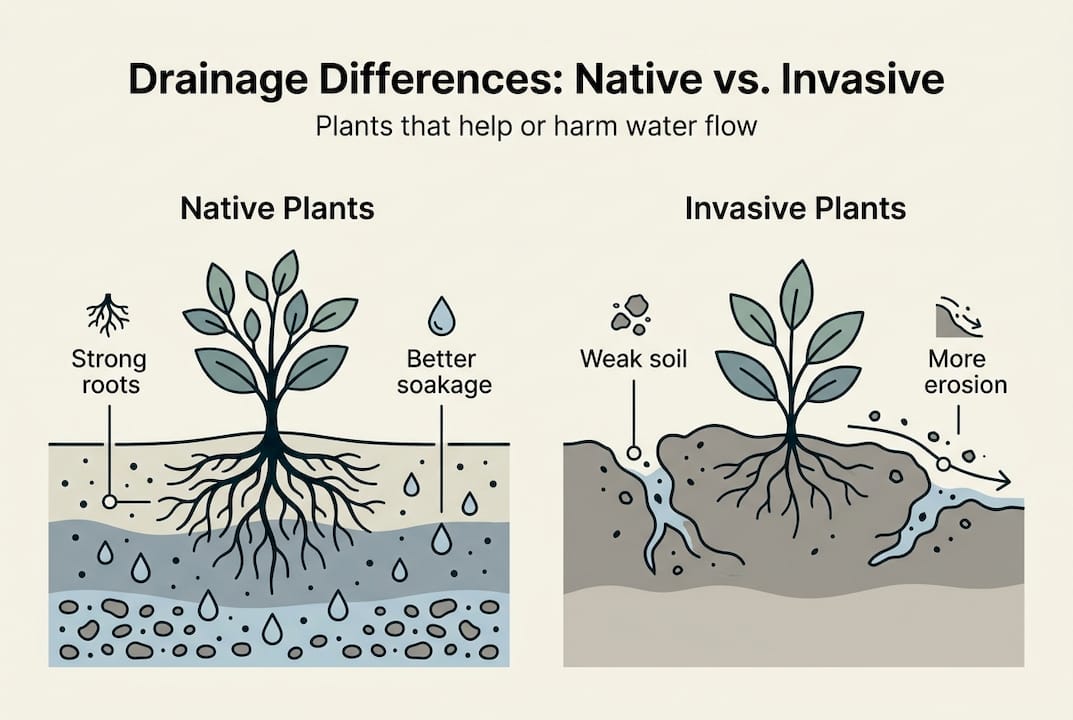
| Attribute | Native species | Invasive species |
|---|---|---|
| Soil soakage | Improved, root channels aid infiltration | Disrupted, rhizomes compact soil locally |
| Post-rain drainage speed | Typically within 48 hours | Slower, increased surface runoff |
| Erosion control | Strong, sustained | Seasonal gaps (e.g. balsam die-back) |
| Long-term maintenance | Lower once established | Ongoing intervention required |
Native species to consider for gardens in England, Wales, and Ireland include:
- Yellow flag iris (Iris pseudacorus): excellent for damp ground and watercourse margins
- Common sedge (Carex nigra): robust in wet soils, strong root binding properties
- Meadowsweet (Filipendula ulmaria): thrives in moist ground, supports pollinator biodiversity alongside drainage function
- Purple loosestrife (Lythrum salicaria): effective on waterlogged or periodically flooded margins
- Native grasses including Molinia caerulea (purple moor grass): deep roots improve infiltration on heavier soils
One challenge worth acknowledging: establishing native planting on ground previously dominated by Japanese knotweed requires patience. The soil may be disturbed and nutrient dynamics altered. Professional guidance on soil preparation and species selection after knotweed removal will accelerate successful re-establishment and maximise drainage benefit.
Chemical-free invasive plant management: what really works
Once you know what to plant, knowing how to safely remove and contain invasives, without chemicals, makes all the difference.
Chemical treatment has long been the default recommendation for Japanese knotweed, but it introduces its own complications near watercourses, drainage features, and properties with children, pets, or environmental sensitivity. Chemical-free methods are not only viable but, when executed with precision, deliver lasting results without ecological side effects.
Chemical-free control options for knotweed include deep excavation, root barrier installation, and direct energy or thermal treatment, each requiring professional precision to comply with legal obligations and deliver lasting outcomes.
The recommended steps for homeowners are:
- Arrange a professional property survey to map the full extent of the infestation and identify proximity to drainage infrastructure, watercourses, and underground services
- Plan the management approach based on survey findings: excavation for contained, accessible infestations; root barriers for boundary or infrastructure protection; energy treatment for ongoing depletion of the rhizome network
- Install root barriers along vulnerable boundaries before any excavation to prevent rhizome migration during works
- Undertake excavation for knotweed removal using specialist equipment to remove rhizome material to adequate depth, typically two to three metres in established infestations
- Dispose of excavated material lawfully: knotweed is classified as controlled waste in the UK, and improper disposal carries legal penalties. Ensure your contractor operates under appropriate waste carrier licences
Key considerations when comparing methods:
- Excavation: high upfront cost, fastest result, requires knotweed excavation preparation and controlled waste disposal
- Root barriers: cost-effective for containment, essential near infrastructure, requires correct specification and depth to be effective
- Thermo-electric energy treatment: delivers up to 5,000 volts directly to the plant, causing internal cell damage and depleting rhizome energy reserves across multiple treatment cycles
Pro Tip: Never attempt to dispose of knotweed cuttings or rhizome material in household waste or compost. Even small fragments can regenerate and spread the infestation. Always engage a licensed waste carrier and confirm disposal is at a permitted facility.
Why most drainage risk guides underplay invasive plants (and what to really watch for)
Most mainstream drainage risk guides focus on the visible: blocked gullies, failing gutters, or cracked pipes. Invasive plant risk rarely features prominently, and when it does, the advice typically defaults to herbicide application without addressing the underlying structural and hydrological consequences.
In our experience, this is precisely where homeowners are left exposed. Chemical treatment of knotweed, even when effective, does not undo riverbank destabilisation, does not restore soil shear strength, and does not address displaced drainage patterns. The plant may die, but the erosion risk it created can persist for years unless active restoration follows.
True drainage safety from invasive plant risk requires three things working together: a site-specific survey that maps both plant extent and proximity to drainage features, a management plan that combines effective root barrier planning with excavation or energy treatment where needed, and a restoration strategy that reintroduces appropriate native planting. Generic checklists from insurers or local authorities simply cannot substitute for professional, site-specific assessment. If your property sits near a watercourse, or if you have already seen drainage changes you cannot readily explain, that is the moment to commission a proper survey, not after the next flood event.
How we help you reclaim safe, chemical-free drainage
If you are ready to move beyond DIY and ensure lasting drainage security, here is how our experts can help.
At Japanese Knotweed Agency, we bring together professional property surveying, root barrier installation, excavation works, and our pioneering thermo-electric energy treatment, all without chemical intervention. We carry out invasive weed surveys across England, Wales, and Ireland, giving you a precise picture of your risk before any work begins.

Our chemical-free knotweed solutions have achieved a 95% success rate across residential and commercial sites. Whether you need a thorough property survey service for invasive plants or a full management programme, our team is ready to deliver the drainage-safe, legally compliant outcome your property deserves. Get in touch today to arrange your survey.
Frequently asked questions
Can Japanese knotweed damage drains and pipes directly?
Root systems can infiltrate weak points in drains and inspection chambers, causing blockages and pipe displacement over time. Drainage risk is highest when an infestation is in close proximity to underground services or dense riverbank stands.
What are the signs of drainage problems linked to invasive plants?
Look for unexplained surface water pooling, garden erosion at boundaries, or slow and blocked drains, particularly where knotweed or similar plants are present nearby. Invasive plants reduce riverbank stability, increasing erosion and sediment delivery that can disrupt drainage across a wide area.
Which chemical-free method works best against invasive plants near drains?
Deep excavation combined with root barriers is generally most effective for containing and removing established infestations, while thermo-electric energy treatment provides a proven chemical-free alternative for ongoing rhizome depletion.
Does replacing invasive plants with native species improve drainage?
Yes. Native plants stabilise soil and improve soakage, actively reducing runoff and supporting stormwater management, all of which benefit local drainage performance over time.