
TL;DR:
- Chemical-free removal methods can effectively eradicate Japanese Knotweed within 1-2 years.
- Proper surveys, documented treatment plans, and licensed waste disposal are crucial for legal compliance.
- Professional, documented, guarantees-backed approaches are essential for mortgage approval and property sale.
A single rhizome fragment weighing just 0.7g can regenerate into a full Japanese Knotweed plant, which makes the idea that you can simply dig it out and be done with it dangerously misleading. For homeowners and buyers across England, Wales, and Ireland, this invasive species represents one of the most serious threats to property value, mortgage eligibility, and legal standing. The good news is that chemical-free removal is not only possible but is increasingly the smarter, more future-proof choice. This guide walks you through the protocols you need, from initial survey to long-term monitoring, without relying on herbicides.
Table of Contents
- Understanding invasive weeds and why chemical-free removal matters
- Survey, assessment and legal compliance: your first steps
- Step-by-step protocols for non-chemical weed removal
- Managing risks: what often goes wrong and how to avoid it
- What most homeowners and buyers miss about weed removal protocols
- Take the next step: expert help for guaranteed weed removal
- Frequently asked questions
Key Takeaways
| Point | Details |
|---|---|
| Survey before action | Always start with a professional survey to avoid legal and financial pitfalls before removing invasive weeds. |
| Chemical-free works | Modern non-chemical methods can reliably eradicate Japanese Knotweed as quickly as, or faster than, traditional herbicides. |
| Professional help pays | Using guaranteed professional protocols protects property value and is required by most lenders for mortgages. |
| Monitor for success | Regular monitoring and proper documentation ensure long-term success and prevent costly regrowth issues. |
Understanding invasive weeds and why chemical-free removal matters
Japanese Knotweed (Fallopia japonica) is not an ordinary garden nuisance. It can push through tarmac, undermine foundations, and spread from a fragment smaller than your thumbnail. Once established, its rhizome network extends up to three metres deep and seven metres in every direction. For property owners, that means structural damage, mortgage refusals, and significant legal exposure.
Understanding identifying invasive weeds correctly is your first line of defence, because misidentification leads to wasted effort and potential legal liability. Beyond Japanese Knotweed, species such as Giant Hogweed and Himalayan Balsam carry their own risks and obligations under UK law.
Chemical removal, particularly glyphosate-based treatments, has long been the default response. That is changing fast. Glyphosate alternatives are gaining preference after the UK moved to restrict its use in December 2025, reflecting growing concern about environmental harm, soil health, and biodiversity. Mortgage lenders and insurers are increasingly scrutinising which removal methods were used and whether they carry meaningful guarantees.
The legal rules for Japanese Knotweed in England and Wales sit primarily under the Wildlife and Countryside Act 1981 and the Environmental Protection Act 1990. In practical terms, this means:
- You must not allow Japanese Knotweed to spread to neighbouring land or the wild
- All excavated material must be treated as controlled waste
- Disposal must only be carried out by a licensed waste carrier
- Failure to comply can result in prosecution, civil claims, or enforcement notices
Professional protocols matter not just for eradication, but for your ability to sell, remortgage, or insure your property. Without documented, lender-accepted treatment, buyers will walk away.
Chemical-free approaches address all of these concerns simultaneously. They eliminate residual chemical contamination, satisfy increasingly strict lender requirements, and deliver outcomes backed by guarantees that hold up at the point of sale.
Survey, assessment and legal compliance: your first steps
With the risks clarified, it is vital to know where to begin. Your first action should always be a proper survey and legal check, because acting without both is where most costly mistakes originate.
A professional survey does several things that a visual inspection cannot. It maps the extent of the rhizome network below ground, identifies any spread towards watercourses or boundaries, and establishes a documented baseline for treatment planning. When booking a surveyor, look for accreditation with the Property Care Association (PCA) or the Invasive Non-Native Specialists Association (INNSA). These credentials matter significantly when it comes to lender and insurer acceptance.
The property weed survey process we follow at Japanese Knotweed Agency covers England, Wales, and Ireland, providing a thorough assessment that feeds directly into a compliant management plan. Here is the sequence to follow:
- Book a professional survey with an accredited specialist before any physical work begins
- Review your legal obligations under the Wildlife and Countryside Act and Environmental Protection Act
- Check your mortgage or lender requirements, as most major lenders require a management plan and long-term guarantee
- Notify your insurer if the infestation is discovered during a purchase or remortgage process
- Document everything from survey date and findings to treatment records and waste disposal certificates
Controlled waste disposal is required by law, and the Environment Agency maintains oversight of how contaminated material is handled and transported. This is not a step you can bypass or defer.
Your Japanese Knotweed legal obligations extend to documentation at every stage. Buyers and solicitors now routinely request this paperwork as part of conveyancing, and gaps in the record can delay or collapse a sale. Exploring weed management strategies that include monitoring schedules and written guarantees will serve you far better in the long run.
Pro Tip: Keep a dedicated folder, physical or digital, for every piece of documentation related to your infestation. Survey reports, treatment logs, waste transfer notes, and guarantee certificates should all be immediately accessible for solicitors or lenders.
Step-by-step protocols for non-chemical weed removal
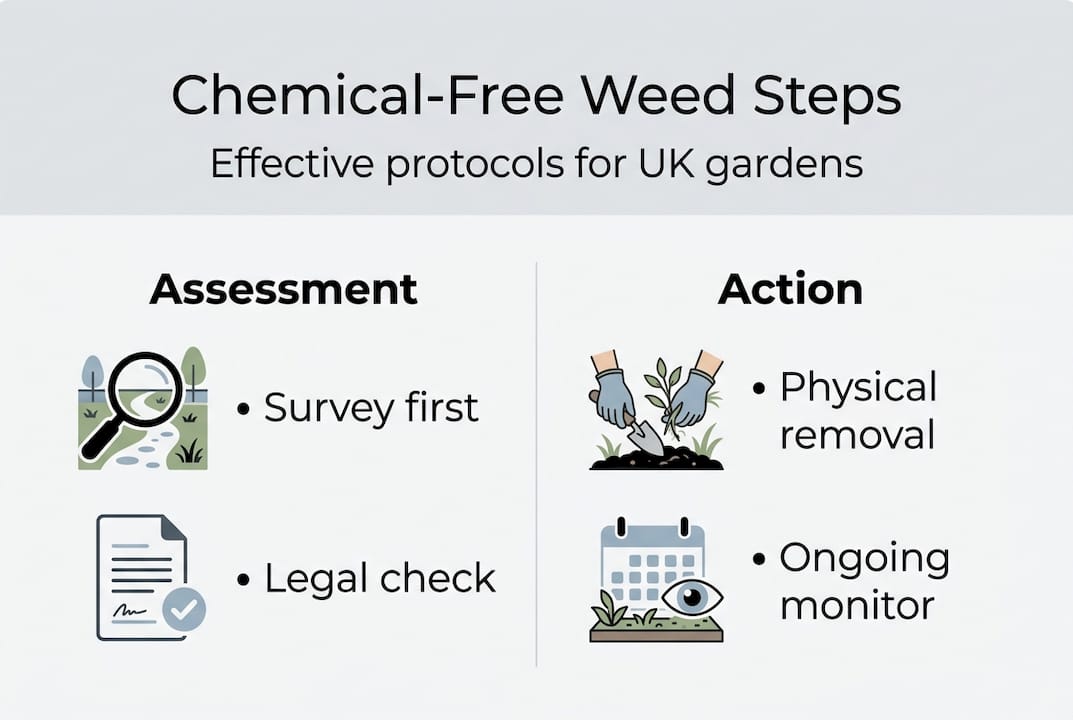
With your survey complete and legal obligations understood, you are ready to move into active treatment. Non-chemical removal is not a single method. It is a set of approaches, each suited to different infestation sizes, site conditions, and timelines.
| Method | Success rate | Typical timeframe | Lender accepted |
|---|---|---|---|
| Thermo-electric treatment | Up to 95% | 1 to 2 years | Yes, with guarantee |
| Excavation and removal | High, site-dependent | Weeks to months | Yes, with documentation |
| Root barrier installation | Preventative/containment | Immediate | Yes, alongside treatment |
| Roots Reset (biological) | 95%+ | 1 treatment plus monitoring | Yes, with guarantee |
Thermo-electric treatments deliver up to 95% success within one to two years, and the Roots Reset approach achieves over 95% eradication after a single application, with replanting possible within five days. A North Wales Wildlife Trust trial confirmed 95%+ eradication within one year using the Roots Reset method, compared to three to five years for herbicide-based programmes.
Here is how the step-by-step protocol works in practice:
- Cut and record all above-ground growth. Never compost or move cut material off-site without licensed disposal arrangements in place
- Assess excavation needs with your surveyor. Deep excavation is necessary when foundations or services are at risk
- Install root barriers where the infestation borders boundaries, watercourses, or neighbouring property
- Apply the primary treatment, whether thermo-electric, Roots Reset, or excavation, based on your survey findings and site conditions
- Arrange licensed waste removal immediately. All excavated material must go to a licensed facility, with a waste transfer note retained
- Begin a 12 to 24 month monitoring programme with documented site visits
Our safe chemical-free treatment protocols at Japanese Knotweed Agency use direct energy delivery of up to 5,000 volts, targeting the rhizome network and depleting its energy reserves with each treatment cycle. For detailed manual removal steps, our guidance covers every stage of safe site management. For specific site situations, organic pest control alternatives may also be relevant to consider alongside your primary plan.
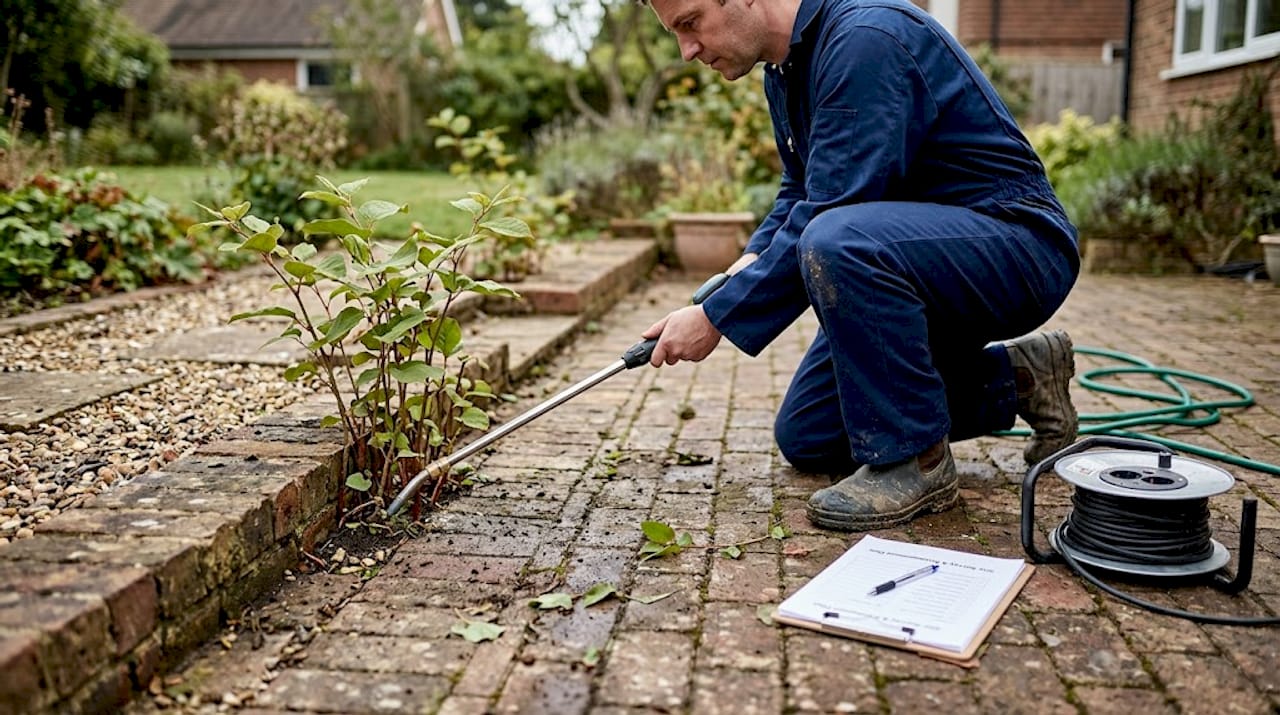
Pro Tip: Never rotovate or mechanically churn soil in an affected area without expert supervision. This spreads rhizome fragments and can rapidly worsen the infestation.
Managing risks: what often goes wrong and how to avoid it
Being aware of common pitfalls is just as important as following the correct protocol. Many property owners begin with good intentions and end up in a more serious legal or financial position than when they started.
Unskilled excavation can worsen infestations by spreading fragments into watercourses, neighbouring land, or deeper soil layers. Once this happens, the scale of legal liability increases significantly. The most common mistakes include:
- Starting work without a professional survey or management plan
- Disposing of excavated material in domestic bins or garden compost
- Treating only the visible stems while ignoring the rhizome network below
- Failing to monitor the site following initial treatment
- Working near watercourses without Environment Agency guidance
| Removal approach | Success rate | Lender guarantee | Typical cost range | DIY risk level |
|---|---|---|---|---|
| DIY (small patches) | Low to moderate | No | Low upfront, high long-term | High |
| Professional non-chemical | Up to 95%+ | Yes | Moderate to higher | Low |
| Professional excavation | High | Yes | Higher | Very low |
DIY is only suitable for patches under 1m² and will not produce the guarantees or lender approval required for mortgage-critical situations. Our best practice removal tips and guidance on reasons for non-chemical approaches make clear why professional involvement is not optional for anything beyond the smallest, most contained cases.
Ongoing monitoring for 12 to 24 months is non-negotiable. Regrowth from missed fragments is common, and without documented site visits you lose both the evidential record and the basis for any guarantee claim.
What most homeowners and buyers miss about weed removal protocols
Most people focus almost entirely on the physical act of removal. What they underestimate, often significantly, is the importance of documentation and guarantees. A property with a well-documented, professionally managed knotweed history is far more mortgageable and saleable than one where removal was carried out informally, regardless of how thoroughly the work was done.
We see this regularly: a homeowner treats an infestation competently but without professional records, then faces a collapsed sale because the buyer’s lender will not accept unverified claims. The treatment cost becomes irrelevant when there is no guarantee to present.
Ignoring evolving regulations is equally costly. Relying on glyphosate-based treatments applied before the December 2025 restrictions does not protect you from regulatory scrutiny today. Lenders and insurers are assessing current compliance, not historical intent.
Chemical-free methods are not simply the environmentally responsible choice. They are increasingly the commercially rational one. High success non-chemical solutions now deliver outcomes that rival or exceed chemical programmes, with the added advantage of regulatory durability and lender acceptance built in from the outset. The shift towards these methods is not a trend. It is the direction of the entire sector.
Take the next step: expert help for guaranteed weed removal
If you have identified Japanese Knotweed or another invasive species on your property, the most important step you can take right now is to arrange a professional survey before committing to any physical removal work.
At Japanese Knotweed Agency, we provide guaranteed non-chemical solutions using thermo-electric treatment, root barrier installation, and excavation across England, Wales, and Ireland. Our protocols are lender-accepted, fully documented, and backed by guarantees that protect your property transaction. Browse our common weed removal questions for immediate guidance, or download our survey checklist for your home to prepare for your first consultation. Protecting your property starts with the right assessment.
Frequently asked questions
Can I remove Japanese Knotweed myself without chemicals?
DIY is only suitable for patches under 1m² and carries significant legal and regrowth risks. Professional support is strongly advised for any infestation requiring lender guarantees or near-boundary management.
How long does chemical-free Knotweed removal take?
Thermo-electric methods typically require one to two years of treatment cycles, while the Roots Reset North Wales trial demonstrated 95%+ eradication within one year using a single treatment followed by structured monitoring.
Is chemical-free removal accepted by mortgage lenders?
Yes, when carried out and guaranteed by recognised professionals. 5 to 10 year guarantees from PCA or INNSA accredited firms are essential for homebuyers seeking mortgage approval.
What are the legal risks if I disturb or spread invasive weeds?
Allowing spread to neighbouring land or the wild is a prosecutable offence under the Wildlife and Countryside Act 1981, making proper protocols and disposal documentation legally essential.