TL;DR:
- Professional surveys are essential for accurate identification, legal compliance, and documenting eradication efforts.
- Chemical-free methods like thermo-electric treatment are effective, environmentally friendly, and accepted by lenders.
- DIY removal risks legal penalties, incomplete eradication, and insufficient evidence for property transactions.
Japanese Knotweed is one of the most legally fraught plants a homeowner in England, Wales, or Ireland can encounter. Many people assume a quick dig or a spray from the garden centre will resolve the problem, but even a fragment as small as 1cm can regrow into a new infestation, making DIY attempts genuinely dangerous. Getting the removal wrong does not just set back your garden work; it can stall a property sale, trigger legal disputes, and land you in breach of controlled waste regulations. A professional plant eradication survey is the starting point for getting it right.
Table of Contents
- Understanding plant eradication surveys: What they involve
- Identifying invasive plants: Survey best practices
- Chemical-free eradication solutions: Proven methods for homeowners
- Legal compliance and professional support: Avoiding property pitfalls
- Our expert perspective: What most guides get wrong about eradication surveys
- Explore professional solutions for invasive plant eradication
- Frequently asked questions
Key Takeaways
| Point | Details |
|---|---|
| Surveys protect your property | Professional plant eradication surveys provide legal evidence and prevent costly mistakes during property transactions. |
| DIY risks costly spread | Attempting DIY Japanese Knotweed removal can worsen infestations and violate waste regulations. |
| Chemical-free methods are effective | Modern, evidence-backed treatments offer sustainable removal options for homeowners. |
| Legal compliance is essential | Only expert eradication and proper documentation meet requirements for sales, mortgages, and insurance. |
| Expert advice saves money | Getting professional support early prevents legal disputes and future property headaches. |
Understanding plant eradication surveys: What they involve
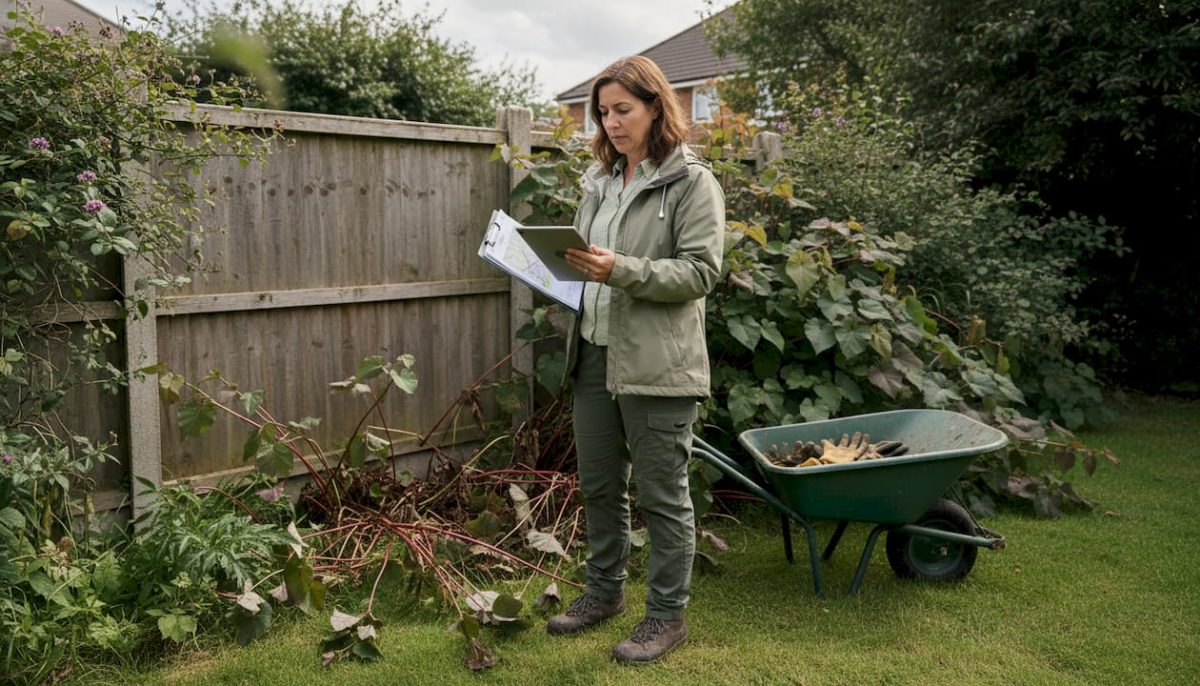
A plant eradication survey is a structured, professional assessment of a property to identify, map, and evaluate invasive plant species present on or near the land. It goes far beyond a visual check. Surveyors examine above-ground growth, probe for underground rhizome (root network) spread, assess proximity to structures, and document findings in a formal report that can be used in legal and financial contexts.
For homeowners navigating a property sale or purchase, this documentation is not optional. Mortgage lenders across England and Wales routinely ask for survey evidence before approving lending on properties where Japanese Knotweed has been identified. Without a professionally produced report, you have no means to demonstrate the extent of the problem, the treatment approach, or the progress made.
What a professional plant eradication survey typically covers:
- Full site walkover, including boundary areas and adjacent land
- Identification of all invasive species present, not just Japanese Knotweed
- Mapping of infestation zones, including estimated rhizome spread below ground
- Assessment of proximity to buildings, drainage systems, and neighbouring properties
- Photographic evidence gathered systematically throughout the survey
- A written report detailing findings, risk levels, and recommended eradication strategies
- Guidance on reporting Japanese Knotweed where legal obligations apply
Pro Tip: Before commissioning any survey, use a survey checklist for Knotweed to understand what questions to ask and what your surveyor’s report should contain.
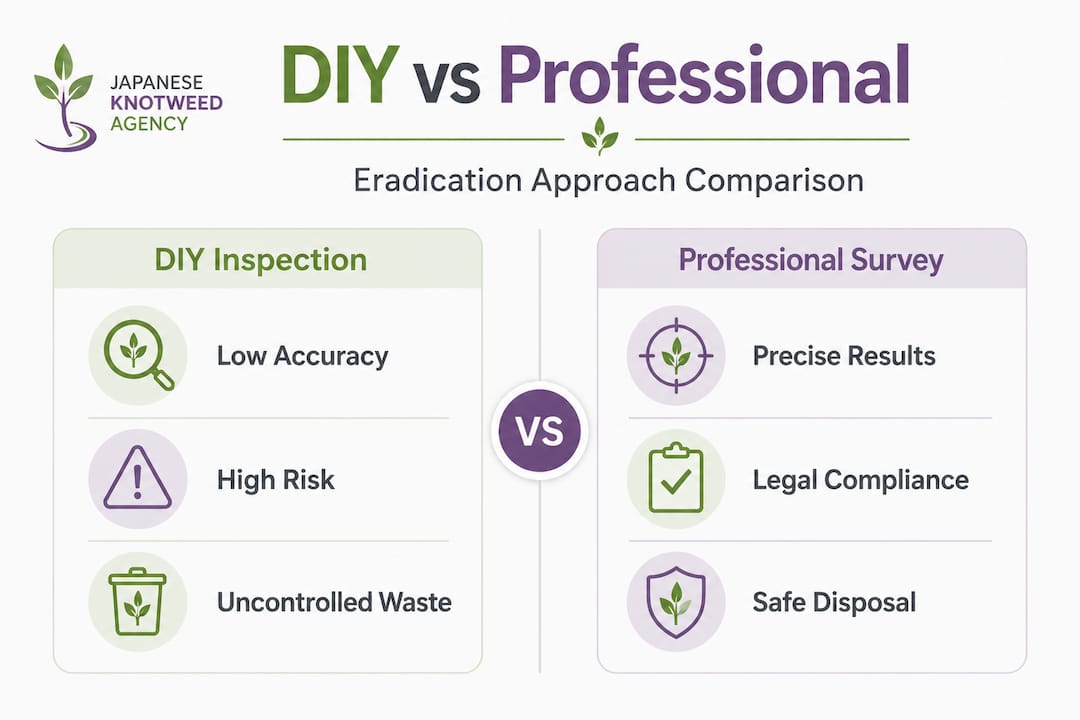
The following table illustrates the stark contrast between a DIY inspection and a professional survey, which is important context for any homeowner weighing up their options.
| Factor | DIY inspection | Professional survey |
|---|---|---|
| Species identification accuracy | Low, lookalikes frequently missed | High, trained identification protocols |
| Rhizome depth assessment | Not possible without specialist tools | Systematic probing and mapping |
| Legal standing of findings | None | Accepted by lenders and solicitors |
| Controlled waste compliance guidance | Not provided | Included as standard |
| Spread risk during inspection | High if disturbed incorrectly | Minimised through strict protocols |
| Insurance and mortgage support | Not applicable | Directly supports applications |
The RHS confirms that waste disposal of Japanese Knotweed is classified as controlled waste, meaning even well-intentioned amateur removal attempts can create a legal liability. A professional survey ensures that every stage of the process, from identification through to disposal, is handled within the bounds of current legislation.
Identifying invasive plants: Survey best practices
Accurate identification is the foundation of any successful eradication programme. Japanese Knotweed is widely recognised, but it is frequently confused with plants such as Russian Vine, Giant Knotweed, Himalayan Knotweed, and even Bindweed during certain seasons. Misidentification wastes time and money. More critically, it risks leaving a genuine infestation untreated while focusing resources on the wrong plant entirely.
Professional surveyors are trained to identify Japanese Knotweed at every stage of its annual growth cycle. In spring, it emerges as reddish-purple shoots. By summer, it presents as dense stands of hollow, bamboo-like canes reaching up to three metres in height. In autumn, it produces small white flowers before dying back to leave distinctive brown skeletal stems. Each stage requires different identification skills, and a survey conducted in winter looks very different from one carried out in July.
Common pitfalls during invasive plant identification:
- Confusing Japanese Knotweed with ornamental plants such as Houttuynia or large-leaved shrubs
- Underestimating rhizome spread, which can extend up to seven metres from visible growth
- Failing to check adjacent land, from where reinfestation frequently originates
- Disturbing plant material during inspection, increasing the risk of accidental spread
- Overlooking dormant winter growth, which leaves no visible above-ground indicators
- Missing companion invasive species such as Himalayan Balsam or Giant Hogweed on the same site
The survey process itself follows a disciplined sequence. This numbered approach reflects professional best practice and the sequence most credible eradication programmes follow:
- Pre-survey documentation review: Examine historical maps, planning records, and prior survey reports for the site.
- Site boundary walkover: Methodically cover all accessible areas, beginning at the perimeter and working inward.
- Species identification and verification: Use definitive identification keys for each suspect plant, including rhizome examination where safe.
- Risk and spread assessment: Estimate current and potential spread, noting proximity to structures, water courses, and boundaries.
- Photography and mapping: Capture systematic photographic evidence and produce a scaled infestation map.
- Report compilation: Produce a written report with findings, risk ratings, and recommended treatment methodology.
Following Knotweed removal best practices throughout this process protects both the surveyor and the homeowner from accidental spread.
Pro Tip: Even a 1cm rhizome fragment is sufficient to establish a new colony. All tools, footwear, and equipment used during survey work must be decontaminated before leaving the site to prevent spreading the plant to clean areas of the property or adjacent land.
Strict adherence to sustainable Knotweed eradication principles during identification work means that the survey itself does not become a source of further spread, which is a risk that is often underestimated in standard guidance.
Chemical-free eradication solutions: Proven methods for homeowners
Once a thorough survey has established the extent of an infestation, the eradication phase begins. Historically, herbicide treatment was the default approach, but chemical methods carry their own significant concerns, particularly for homeowners with children, pets, or properties near water courses. Professional chemical-free solutions have advanced considerably and now offer highly effective alternatives that are both legally compliant and environmentally responsible.
The most significant innovation in chemical-free eradication is thermo-electric treatment. This method delivers direct electrical energy of up to 5,000 volts into the plant’s rhizome network, causing internal cell damage and progressively depleting the energy reserves stored within the root system. Unlike surface cutting or manual removal, thermo-electric treatment targets the underground structure that gives Japanese Knotweed its remarkable resilience. Each treatment session compounds the effect of the last, systematically weakening the plant’s ability to regenerate.
Benefits of chemical-free eradication approaches:
- No chemical residues left in soil or groundwater
- Safe for use in proximity to water courses, drainage systems, and boundaries
- Appropriate for residential properties where herbicide restrictions apply
- Environmentally responsible, supporting biodiversity in the surrounding area
- Accepted by a growing number of mortgage lenders as a legitimate treatment methodology
- Suitable for sensitive ecological sites where herbicide licences would otherwise be required
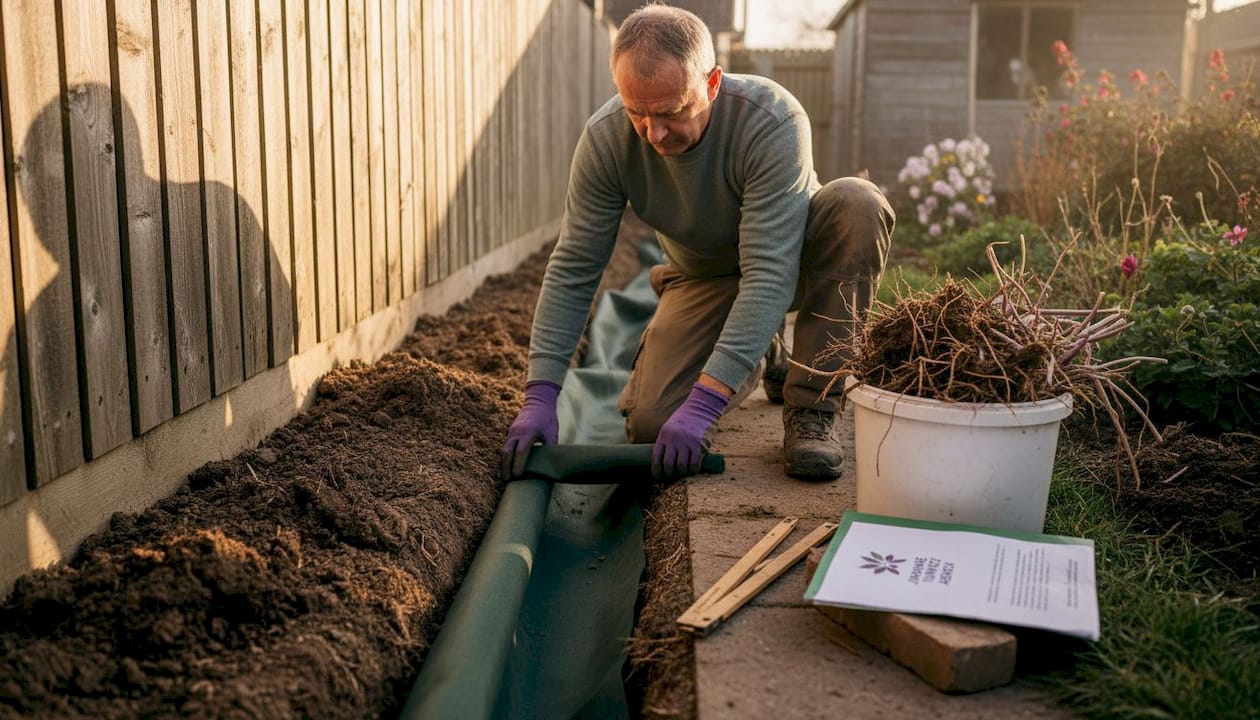
Root barrier installation is a further professional option, particularly useful where excavation is impractical or where the infestation borders a neighbouring property. High-density polyethylene root barriers are installed below ground to physically prevent rhizome migration into treated or unaffected zones. This method is frequently combined with thermo-electric treatment to both contain and eliminate the infestation in parallel.
Excavation remains the most immediate solution in some circumstances, particularly where development works are planned or where infestation density demands it. However, excavated material must be disposed of as controlled waste at a licensed facility, a requirement that underscores why professional involvement is not merely recommended but legally necessary.
| Method | Effectiveness | Chemical use | Disruption level | Legal compliance |
|---|---|---|---|---|
| Thermo-electric treatment | High (multiple sessions) | None | Low | Full compliance |
| Root barrier installation | Containment focused | None | Moderate | Full compliance |
| Excavation | Immediate and thorough | None | High | Requires licensed disposal |
| Herbicide treatment | High (multiple seasons) | Yes | Low | Licence may be required |
| DIY cutting or digging | Very low | None | Moderate | Risk of non-compliance |
Pro Tip: Chemical-free does not mean effort-free. Thermo-electric treatment and root barrier installation require precise application by trained professionals, and attempting to replicate these methods without proper equipment or training will not produce the same results. Always commission chemical-free Knotweed solutions from a qualified provider.
The environmental case for non-chemical Knotweed removal is increasingly compelling. As regulatory scrutiny of herbicide use intensifies and public awareness of soil and water health grows, chemical-free eradication is fast becoming the preferred methodology for ecologically responsible homeowners and developers alike.
Legal compliance and professional support: Avoiding property pitfalls
The legal framework surrounding Japanese Knotweed and other invasive species is more demanding than many homeowners realise. Under the Wildlife and Countryside Act 1981, it is an offence to cause Japanese Knotweed to spread in the wild. Under the Environmental Protection Act 1990, Knotweed material is classified as controlled waste, meaning its disposal must be handled by a licensed contractor at a licensed waste facility. Breaching either regulation can result in criminal prosecution.
For homeowners in the process of selling a property, the stakes are equally high. The TA6 property information form (used in England and Wales) requires sellers to disclose the presence of Japanese Knotweed. Failure to disclose, or providing inaccurate information, can form the basis of a legal claim by the buyer after completion. Survey reports and professionally produced management plans are the primary means by which sellers demonstrate both transparency and compliance.
“Japanese Knotweed must be disposed of as controlled waste at a licensed landfill site. It is an offence to cause it to spread, and all removal should be carried out following professional guidance to ensure full legal compliance.” — Royal Horticultural Society
Legal pitfalls that arise from amateur eradication attempts:
- Spreading Knotweed to neighbouring land, which can result in civil liability claims
- Disposing of Knotweed material in general waste or green bins, breaching controlled waste law
- Cutting and leaving plant material on site, where any fragment can re-establish
- Providing inaccurate property disclosure due to lack of professional survey documentation
- Failing to secure a management plan accepted by a mortgage lender, delaying or blocking a sale
- Underestimating rhizome spread and treating only visible growth, giving a false impression of eradication
Understanding the full scope of your Knotweed compliance guide requirements before undertaking any removal work is essential. Similarly, knowing the practical and financial implications of choosing between excavation vs treatment methods will directly affect both your timeline and your legal position during a property transaction.
Mortgage lenders and their surveyors require documented evidence that an infestation is being professionally managed. A written management plan, treatment records, and insurance-backed guarantees are all components that solicitors and lenders increasingly expect before they will proceed. No amount of physical removal work translates into the legal protection that formal documentation provides.
Our expert perspective: What most guides get wrong about eradication surveys
Most guidance available to homeowners focuses on the visible problem: the plant itself. Guides explain what Japanese Knotweed looks like, how fast it grows, and broadly what to do when you find it. What they consistently fail to address is the hidden complexity of the legal and evidential framework that determines whether your eradication effort actually protects you.
We have seen countless situations where homeowners have done everything they believed was correct. They cut the canes, removed the visible material, and even applied treatments they purchased online. Yet when a sale fell through or a neighbour raised a legal challenge, there was no survey report, no documented management plan, and no evidence that controlled waste obligations had been met. The physical work became irrelevant because the paper trail did not exist.
The uncomfortable reality is that a survey is not administrative paperwork sitting alongside the practical work. It is the legal foundation upon which everything else rests. Without it, even a genuinely effective eradication programme may offer no protection in a property dispute. Lenders, solicitors, and courts require documented, professional evidence, not a homeowner’s verbal assurance that the problem has been addressed.
There is also a persistent misconception that surveys are only relevant at the start of the process, as a means of identifying the problem. In practice, surveys serve an equally critical function at the end of an eradication programme, providing the evidence of success that satisfies mortgage and legal requirements. The Knotweed eradication workflow treats survey work as a continuous thread running through identification, treatment, and final verification, not a one-time event.
Our position, informed by years of professional practice across England, Wales, and Ireland, is that the survey is the single most important investment a homeowner can make when dealing with invasive species. It is the difference between a problem managed and a problem evidenced.
Explore professional solutions for invasive plant eradication
Protecting your property from invasive species requires more than good intentions. It demands professional expertise, legally sound documentation, and access to the most effective treatment methodologies available.
Japanese Knotweed Agency provides expert invasive weed surveys across England, Wales, and Ireland, combining rigorous site assessment with the UK’s most advanced chemical-free eradication techniques. Whether you are buying, selling, or managing an existing infestation, our team can guide you through every stage of the process. Explore our detailed property survey process guide for a clear overview of what to expect, or review our dedicated survey guide for property purchase if you are in the process of a transaction. Our reports are accepted by lenders and solicitors, and our chemical-free treatment methods are designed to deliver lasting results without environmental compromise.
Frequently asked questions
What does a plant eradication survey include?
A professional survey covers site inspection, identification of all invasive species present, rhizome spread assessment, risk evaluation, and a formal written eradication plan. It produces the documented evidence required for mortgage and legal compliance.
Why is Japanese Knotweed problematic for property sales?
Mortgage lenders frequently decline applications or impose conditions on properties where Japanese Knotweed is present without a professionally managed treatment plan. Sellers are also legally required to disclose its presence on property information forms.
Can I remove Japanese Knotweed myself?
DIY removal is strongly inadvisable. Even 1cm fragments can regrow into new infestations, and disposing of Knotweed material incorrectly constitutes a breach of controlled waste legislation, which carries serious legal consequences.
Are chemical-free eradication methods effective?
Yes. Professionally applied chemical-free methods, including thermo-electric treatment, can achieve eradication success rates above 90% when administered correctly over an appropriate treatment programme by trained specialists.
How do I prove eradication for legal or mortgage purposes?
Survey reports, professional management plans, and treatment certificates produced by a qualified invasive species contractor are the accepted forms of evidence required by mortgage lenders, solicitors, and courts in England, Wales, and Ireland.