


TL;DR:
- Compliance with DWI orders 2025 involves strict adherence to statutory PFAS detection, monitoring, and reporting requirements issued by the Drinking Water Inspectorate. Water utilities must conduct comprehensive source assessments, perform accredited laboratory analysis, install appropriate treatment technologies when thresholds are exceeded, and submit structured reports on time to avoid legal penalties. Maintaining detailed, proactive documentation and establishing continuous monitoring practices are essential for ongoing compliance and effective risk management.
Compliance with DWI orders 2025 is defined as the full and documented adherence to statutory requirements issued by the Drinking Water Inspectorate (DWI) concerning the detection, monitoring, and management of per- and polyfluoroalkyl substances (PFAS) in public water supplies. The DWI issued formal enforcement orders in 2025 requiring water undertakers and local authorities across England and Wales to meet specific PFAS concentration thresholds, submit structured compliance reports, and maintain verifiable monitoring records. Failure to meet these obligations carries legal consequences under the Water Industry Act 1991, including enforcement notices and potential prosecution. This guide explains the 2025 DWI legal requirements in precise, procedural terms for water industry professionals and local government officials responsible for delivering compliance.
How to comply with DWI orders 2025: core requirements
Complying with DWI orders 2025 begins with understanding exactly what the Inspectorate mandates. The DWI’s 2025 orders set enforceable PFAS parametric values aligned with the revised Drinking Water Directive (EU 2020/2184), which the UK transposed into domestic regulation through the Water Supply (Water Quality) Regulations 2016 (as amended). The sum of PFAS is subject to a parametric value of 0.10 micrograms per litre, with individual PFAS compounds capped at 0.10 µg/l each.
What the 2025 orders require from water undertakers
Water undertakers subject to a DWI order must meet the following mandatory conditions:
- Baseline PFAS assessment: A full audit of all water sources, treatment works, and distribution zones potentially affected by PFAS contamination, completed within the timeframe specified in the individual order.
- Analytical monitoring programme: Regular sampling using accredited laboratory methods, specifically EN ISO 21675 or equivalent, capable of detecting PFAS at or below the parametric value.
- Treatment installation or upgrade: Where PFAS concentrations exceed parametric values, installation of granular activated carbon (GAC) filtration, high-pressure membrane systems, or ion exchange resin treatment is required.
- Compliance reporting: Structured written reports submitted to the DWI at intervals defined in the order, typically quarterly or following each monitoring event.
- Public notification obligations: Where a supply zone is affected, undertakers must notify consumers in accordance with Regulation 27 of the Water Supply (Water Quality) Regulations 2016.
Pro Tip: Review your individual DWI order document line by line before drafting any compliance plan. Orders vary in their specific thresholds, timelines, and reporting formats. A generic compliance template will not satisfy an order with bespoke conditions.
The table below summarises the principal documentation and thresholds relevant to most 2025 DWI orders.
| Document or Threshold | Requirement |
|---|---|
| PFAS sum parametric value | 0.10 µg/l across all PFAS compounds |
| Individual PFAS parametric value | 0.10 µg/l per compound |
| Monitoring method standard | EN ISO 21675 or equivalent accredited method |
| Compliance report frequency | As specified in order; typically quarterly |
| Consumer notification trigger | Exceedance of parametric value in supply zone |
| Treatment review deadline | As stated in individual order; often 6–12 months |
Understanding these thresholds is the foundation of all subsequent compliance activity. Treating them as approximate rather than absolute is the single most common cause of enforcement action.
How to prepare and submit compliance documentation to the DWI
Procedural precision in documentation is not optional. The DWI assesses compliance partly on the quality and completeness of submitted records, not only on whether parametric values are met. A well-structured compliance packet consolidating all required reports and proofs, presented proactively even when not explicitly requested, demonstrates ongoing responsibility and reduces friction with the Inspectorate.
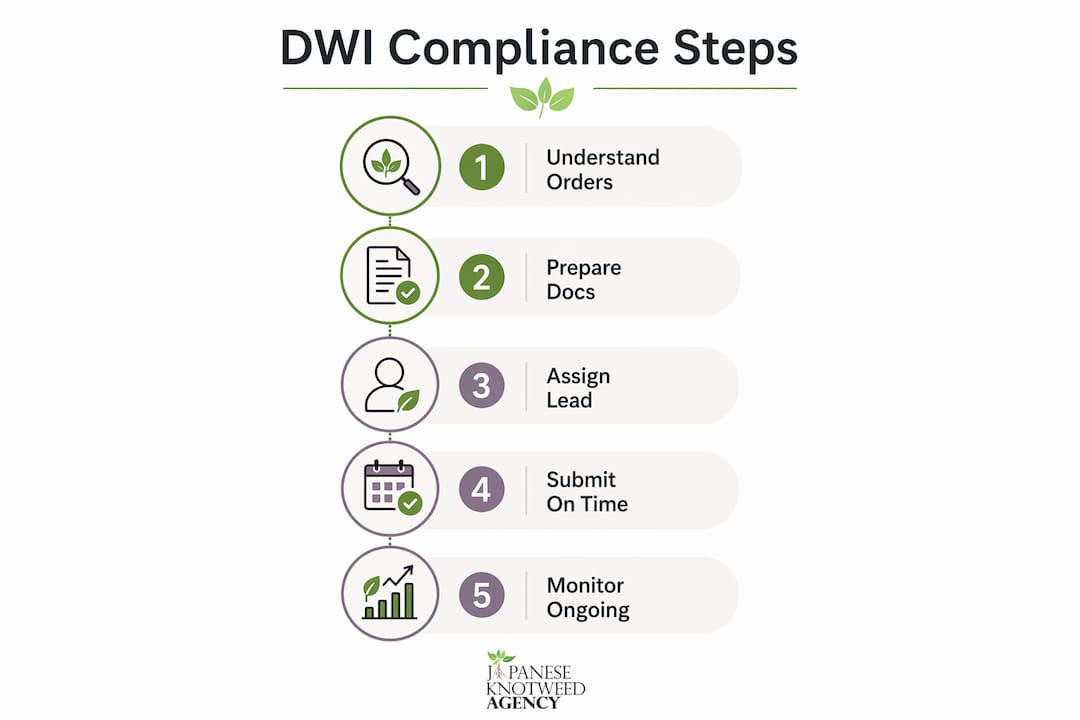
Follow these steps when preparing and submitting compliance documentation:
- Confirm the submission format. Contact your DWI regional officer to confirm whether submissions are required via the DWI’s online portal, by secure email, or in hard copy. Format requirements differ between orders.
- Compile sampling data. Gather all laboratory certificates of analysis, chain-of-custody records, and sampling location maps. Each sample record must include the date, time, sampling point reference, analyst name, and accreditation number.
- Prepare the compliance narrative. Write a concise technical summary explaining what was sampled, what was found, what treatment or remedial action was taken, and what the current status of each supply zone is.
- Cross-reference against order conditions. Check every condition in your DWI order against your submission. Missing a single condition, even a minor procedural one, can trigger a request for further information and delay compliance sign-off.
- Submit within the stated deadline. Strict adherence to deadlines is non-negotiable. Missing a submission window can result in automatic escalation, regardless of whether your monitoring data shows satisfactory results.
- Retain a complete copy. Store a full copy of every submission, including any covering correspondence, for a minimum of five years.
Pro Tip: Assign a named compliance lead within your organisation for each DWI order. Diffuse responsibility across teams is the primary reason submissions arrive incomplete or late.
Effective communication with DWI officials matters as much as the documentation itself. Prompt communication about compliance difficulties reduces the risk of formal violations. If you anticipate a delay or identify a data gap, contact your DWI case officer before the deadline, not after.

What are the practical steps for ongoing monitoring and record keeping?
Initial compliance with a DWI order is only the starting point. The Inspectorate expects water undertakers to maintain continuous compliance through structured monitoring programmes and audit-ready records throughout the life of the order.
Practical steps for ongoing compliance include:
- Establish a monitoring schedule. Map all sampling points against the order’s required frequency. Use a shared digital calendar or compliance management software such as Ideagen Qualtrax or Intelex to schedule and track sampling events.
- Maintain a live compliance register. Record every monitoring result, treatment performance reading, and corrective action in a single, searchable document. The register should be updated within 48 hours of each sampling event.
- Conduct internal compliance audits. Schedule quarterly internal reviews comparing actual monitoring data against order thresholds. Identify any upward trends in PFAS concentrations before they reach reportable levels.
- Prepare for DWI inspections. The DWI may conduct unannounced or scheduled inspections. Keep all compliance records accessible and ensure staff responsible for water quality can explain the monitoring programme clearly and accurately.
- Document corrective actions. Where a parametric value is exceeded or a procedural requirement is missed, record the corrective action taken, the date it was completed, and the outcome. Proactively presenting compliance records reduces friction with supervisory authorities during inspections.
Compliance management in water regulation shares a structural parallel with other regulated sectors. Just as administrative and criminal tracks in legal proceedings operate independently and require separate attention, DWI orders often run alongside other regulatory obligations such as Environment Agency discharge consents or Ofwat performance commitments. Missing a deadline in one track does not pause obligations in another.
What common challenges arise when following DWI orders, and how do you resolve them?
Water industry professionals and local government officials encounter predictable obstacles when managing 2025 DWI legal requirements. Recognising these challenges in advance allows you to resolve them before they become enforcement issues.
- Misunderstanding PFAS parametric values. Some organisations apply the 0.10 µg/l threshold to individual compounds only, overlooking the sum-of-PFAS requirement. Both apply simultaneously. Review your analytical reports against both criteria at every monitoring event.
- Delays in laboratory turnaround. Accredited PFAS analysis using EN ISO 21675 can take 10–15 working days. Build this lead time into your submission schedule so that laboratory delays do not cause you to miss DWI reporting deadlines.
- Incomplete chain-of-custody records. Laboratories occasionally return results without full chain-of-custody documentation. Establish a standard operating procedure requiring your sampling teams to confirm documentation completeness before samples leave site.
- Unclear order conditions. Misunderstanding or treating mandated conditions as optional leads frequently to compliance failures. Where an order condition is ambiguous, seek written clarification from your DWI case officer immediately. Do not interpret ambiguity in your own favour.
- Staff turnover disrupting compliance continuity. When a compliance lead leaves, institutional knowledge about order conditions and submission history often leaves with them. Maintain a written compliance manual that any qualified successor can follow without a handover period.
“Court orders are rigorously enforced and seen as evidence of responsibility; non-compliance negatively impacts outcomes.” This principle applies directly to DWI orders. The Inspectorate treats compliance history as a material factor when deciding whether to escalate enforcement or grant extensions.
Strategies for correcting compliance lapses include notifying your DWI case officer in writing as soon as a lapse is identified, submitting a corrective action plan within 10 working days, and providing evidence of remediation at the next scheduled reporting point. Voluntary disclosure consistently produces better outcomes than lapses discovered during inspection.
Key takeaways
Effective compliance with DWI orders 2025 requires documented monitoring, procedural precision in reporting, and proactive communication with the Drinking Water Inspectorate throughout the life of each order.
| Point | Details |
|---|---|
| Know your parametric values | Apply the 0.10 µg/l threshold to both individual PFAS compounds and the sum of all PFAS. |
| Meet every submission deadline | Missing a reporting window triggers automatic escalation regardless of monitoring results. |
| Build a compliance packet | Consolidate all sampling data, treatment records, and corrective actions in one accessible register. |
| Communicate early with the DWI | Notify your case officer of any anticipated delays or data gaps before deadlines pass. |
| Audit continuously, not annually | Quarterly internal reviews catch upward PFAS trends before they become reportable exceedances. |
Why proactive compliance culture defines success under DWI orders
Having worked alongside water quality teams navigating the 2025 DWI orders, the pattern I observe most consistently is this: organisations that treat compliance as a continuous operational discipline outperform those that treat it as a periodic reporting exercise. The difference is not technical capability. Most water undertakers have the analytical infrastructure to meet PFAS monitoring requirements. The gap is cultural.
Teams that maintain live compliance registers, assign named accountability for each order condition, and communicate openly with the DWI when problems arise rarely face enforcement escalation. Teams that consolidate documentation only when a submission deadline approaches frequently find gaps they cannot close in time.
The evolving PFAS regulatory picture reinforces this point. The DWI’s 2025 orders are not the final word on PFAS management. The World Health Organisation and the European Food Safety Authority continue to refine PFAS risk assessments, and UK parametric values are likely to tighten further as the evidence base develops. Organisations that build audit-ready compliance systems now will absorb future regulatory changes with far less disruption than those starting from scratch each time a new order arrives.
Reviewing invasive weed legislation 2025 offers a useful parallel: environmental compliance obligations across sectors share the same structural logic. Understand the requirement precisely, document your response thoroughly, and communicate proactively with the regulator.
— Alan
Environmental compliance and responsible land management with Japaneseknotweedagency

Japaneseknotweedagency brings the same commitment to procedural rigour and environmental responsibility that defines effective DWI compliance to its work in invasive species management across England, Wales, and Ireland. Whether you are a local authority managing land adjacent to water catchment areas or a water industry professional assessing site risk, Japaneseknotweedagency offers expert plant eradication surveys and chemical-free treatment programmes that meet the highest environmental standards. Japanese Knotweed on or near water infrastructure is a material risk to both biodiversity and regulatory standing. Book a survey with Japaneseknotweedagency to assess your site and protect your compliance position.
FAQ
What does a DWI order require water undertakers to do in 2025?
A 2025 DWI order requires water undertakers to monitor PFAS concentrations against a parametric value of 0.10 µg/l, submit structured compliance reports at defined intervals, and install treatment where values are exceeded.
What is the PFAS parametric value under 2025 DWI regulations?
The parametric value is 0.10 micrograms per litre, applied both to individual PFAS compounds and to the sum of all PFAS detected in a sample.
How do i avoid missing a DWI compliance submission deadline?
Assign a named compliance lead, build laboratory turnaround time into your schedule, and contact your DWI case officer in writing before any deadline you cannot meet.
What happens if a water undertaker fails to comply with a DWI order?
Non-compliance can result in enforcement notices, mandatory remedial directions, and potential prosecution under the Water Industry Act 1991. Voluntary disclosure of lapses consistently produces better regulatory outcomes than lapses identified during inspection.
How should compliance records be maintained for DWI inspections?
Maintain a live compliance register updated within 48 hours of each monitoring event, retain all laboratory certificates and chain-of-custody records, and keep a complete copy of every DWI submission for a minimum of five years.