

TL;DR:
- Japanese knotweed is a problematic invasive species in the UK that can impact property value and legal disclosures. Proper identification involves recognizing its distinctive leaves, hollow stems, flowers, and orange-centered rhizomes, especially during seasonal changes. Confirming its presence with a professional survey is crucial for legal, financial, and management reasons.
Japanese knotweed (Fallopia japonica) is defined as one of the most problematic invasive plant species in the United Kingdom, carrying real consequences for property value, mortgage applications, and legal disclosure obligations. Knowing how to recognise Japanese knotweed before you buy or sell a property is not optional. It is a practical necessity. This japanese knotweed identification guide covers every key visual feature, seasonal change, and common lookalike, so you can identify this plant with confidence and take the right steps to protect your property.
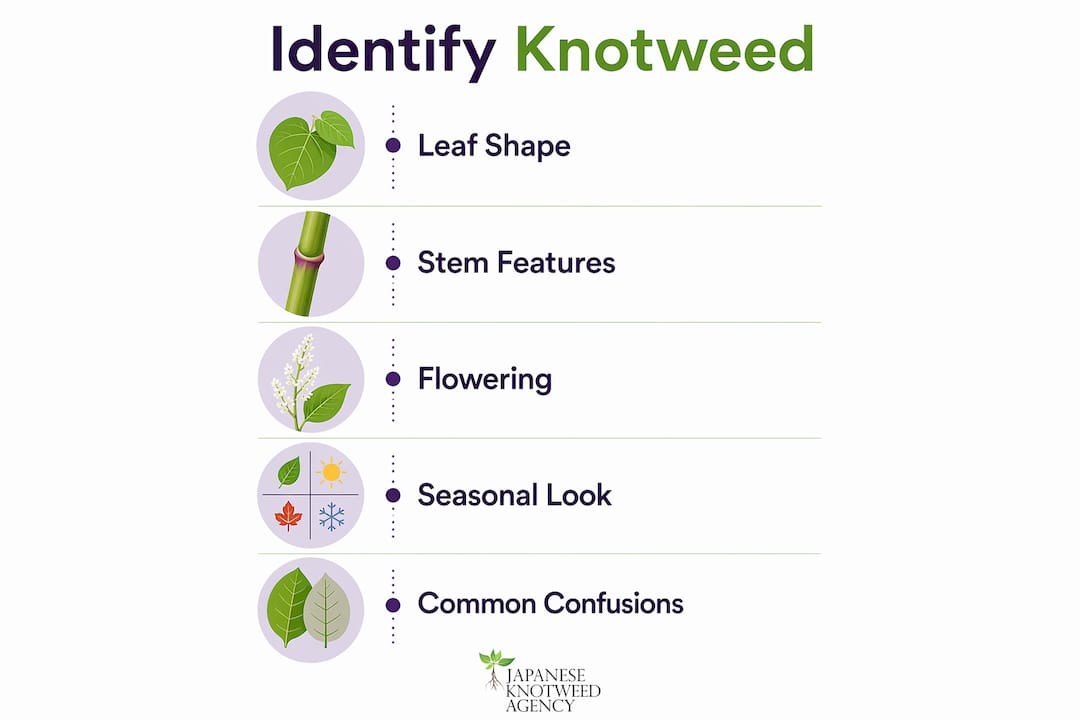
How do you recognise Japanese knotweed by its physical features?
Japanese knotweed has a set of physical characteristics that, taken together, make it unlike any other plant you will find in a British garden or boundary. The challenge is that these features change with the seasons, which is why so many homeowners miss it or misidentify it.
Leaves
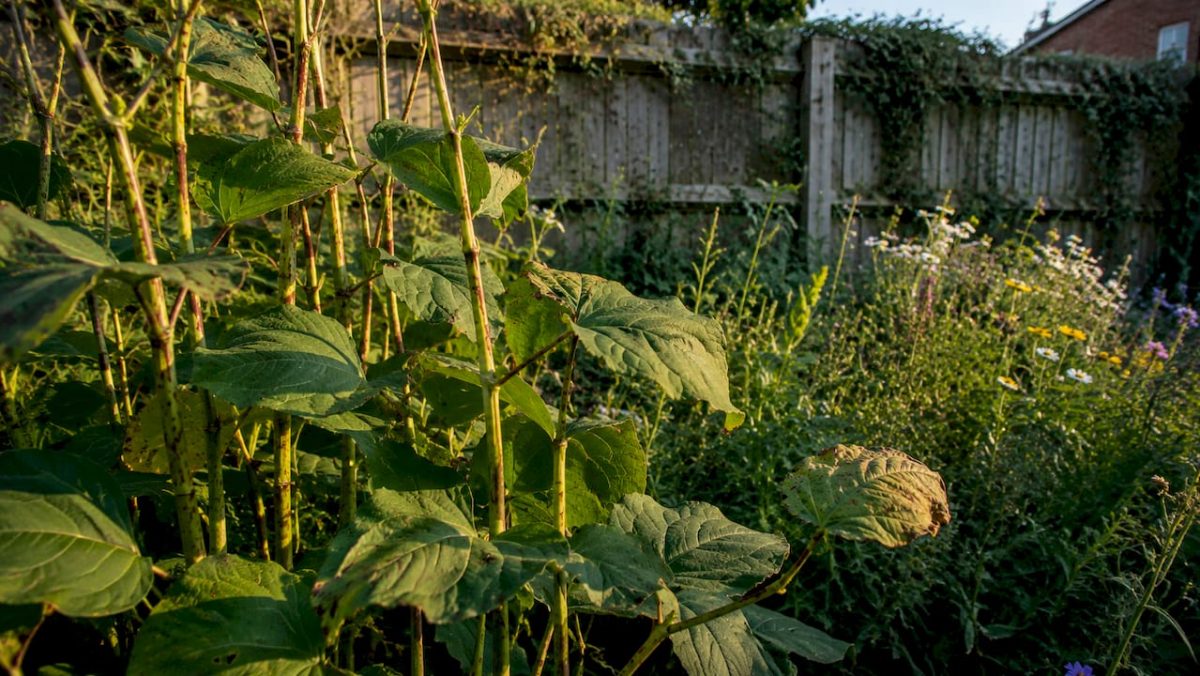
Knotweed leaves are heart-shaped, sometimes described as shovel-shaped, and typically 10–15cm long. They grow in an alternating zig-zag pattern along the stem, with each leaf emerging from a different side. The tip of the leaf comes to a sharp point, and the base is flat rather than rounded. This flat base is one of the clearest distinguishing features when you hold a leaf in your hand.
Stems
Stems are hollow and bamboo-like, with clearly visible nodes at regular intervals. Fresh growth in spring and early summer often shows reddish-purple speckles on a green or purple stem. The stems are rigid and can reach considerable thickness by midsummer. In winter, the stems die back but remain standing as dry, hollow canes, which is a useful identification clue even when the plant is dormant.

Flowers and rhizomes
Creamy-white flower clusters appear in late summer to early autumn, typically from august through to october. These small, delicate flowers grow in loose sprays along the upper stems and are a reliable identification feature during the flowering season. Below ground, the rhizomes are equally distinctive. Orange-centred rhizomes extend several metres horizontally and snap cleanly when broken, much like a carrot. If you dig up a root fragment and see that vivid orange centre, you are almost certainly dealing with knotweed.
Seasonal changes at a glance
- Spring: Red or pink shoots push up from the ground, resembling asparagus spears
- Early summer: Rapid upward growth, stems become cane-like, leaves unfurl fully
- Late summer to autumn: Creamy-white flowers appear; leaves begin to yellow
- Winter: Stems die back, leaving brown hollow canes standing above ground
Pro Tip: Photograph the plant at multiple angles and in multiple seasons. A single winter photograph of bare canes is rarely enough for a professional to confirm identification with certainty.
Which plants are commonly mistaken for Japanese knotweed?
Misidentification is one of the most common problems Japaneseknotweedagency encounters during property surveys. Several plants share superficial similarities with knotweed, and confusing them can lead to unnecessary alarm or, worse, a missed infestation.
- Bamboo: Bamboo stems are also hollow and jointed, but the leaves are narrow and grass-like, nothing like knotweed’s broad, flat leaves. Bamboo also does not produce the same creamy-white flower sprays.
- Himalayan knotweed (Persicaria wallichii): This close relative has similar leaf shapes but produces pink or white flowers and has a more upright, less spreading growth habit. The stems lack the distinctive reddish-purple speckles.
- Russian vine (Fallopia baldschuanica): Also in the same plant family, Russian vine is a climbing plant with similar small white flowers. Its climbing habit and smaller leaves set it apart from the upright, cane-forming knotweed.
- Red-osier dogwood (Cornus sericea): This shrub has red stems that can cause confusion in winter. However, its stems are solid, not hollow, and it produces berries rather than the knotweed’s characteristic flower clusters.
- Bindweed and broad-leaved dock: Both are sometimes flagged incorrectly. Bindweed twines and climbs; dock leaves are much larger and lack the zig-zag stem arrangement.
The most dangerous period for misidentification is winter, when knotweed is dormant. Without leaves or flowers, the hollow brown canes are the only visible clue. If you are viewing a property in january or february, ask the vendor directly whether knotweed has been identified on site, and consider a professional weed survey before exchanging contracts.
How do you confirm suspected knotweed and why does it matter legally?
Suspecting knotweed is not the same as confirming it. Accurate identification matters because the legal and financial consequences of getting it wrong cut both ways. A false positive causes unnecessary anxiety and cost. A missed identification during a property sale can result in serious legal exposure.
Steps to confirm identification
- Document what you see. Take clear photographs of the leaves, stems, nodes, and any flowers or rhizomes visible. Include a ruler or common object for scale.
- Check the season. If the plant is dormant, note the location and return in may or june when growth is active and identification is far easier.
- Examine the rhizome. If you can safely expose a small section of root, look for the orange centre. Do not disturb the rhizome extensively, as fragments can spread the plant.
- Book a professional survey. A professional knotweed survey involves a thorough site inspection, photographic evidence, and a written report that supports mortgage applications and legal processes.
- Check your TA6 form. Sellers in England and Wales must disclose knotweed presence on the TA6 property information form. Failure to disclose knotweed risks legal and financial consequences after completion.
“Experts recommend erring on the side of caution and disclosing any suspected knotweed presence to protect property transactions and avoid legal issues. Transparency at the point of sale is always the safer position.”
Management options available once knotweed is confirmed include thermo-electric treatment, root barrier installation, and knotweed excavation. The right approach depends on the location, extent of growth, and the timeline of any planned property transaction.
Pro Tip: Always monitor the boundaries of your property, not just the garden centre. Knotweed frequently encroaches from neighbouring land, and you are still legally responsible for managing any growth that spreads from your side.
What visible effects does Japanese knotweed have on property and gardens?
Japanese knotweed grows up to 20cm per day and can reach heights of up to 3 metres in a single growing season. That rate of growth means a small stand can become a dense thicket within weeks, shading out lawns, borders, and native planting entirely.
The structural risk is real but frequently overstated. No scientific evidence shows that knotweed actively breaks solid foundations. What it does is exploit and enlarge existing cracks in walls, drains, and paving. The real risk is accelerated deterioration in structures that are already compromised. This distinction matters because it changes how you assess risk during a property purchase.
| Effect | Reality |
|---|---|
| Foundation damage | Exploits existing cracks; does not break intact concrete |
| Garden biodiversity | Shades out native plants, reducing biodiversity significantly |
| Property value | Can affect mortgage offers and buyer confidence |
| Growth rate | Up to 20cm per day; forms dense stands up to 3m tall |
| Mortgage impact | Lenders may require a management plan before approving a loan |
The impact on mortgage applications is one of the most immediate practical concerns for buyers. Many lenders require a professional management plan, and some will decline to lend until treatment is underway. Identifying knotweed early gives you the time to address it before it becomes a transaction-blocking issue.
Key takeaways
Accurate identification of Japanese knotweed, confirmed by a professional survey, is the single most effective step a homeowner or property buyer can take to protect their legal position and property value.
| Point | Details |
|---|---|
| Leaf identification | Look for heart-shaped leaves, 10–15cm long, in an alternating zig-zag pattern along the stem. |
| Stem identification | Hollow, bamboo-like stems with nodes and reddish-purple speckles confirm knotweed in active growth. |
| Seasonal awareness | Knotweed is hardest to spot in winter; hollow brown canes and rhizome colour are the key winter clues. |
| Legal disclosure | Sellers must declare knotweed on the TA6 form; non-disclosure carries legal and financial risk. |
| Professional survey | A written survey report supports mortgage applications and confirms identification with certainty. |
What I have learned from years of knotweed identification in the field
The most common mistake I see is homeowners dismissing a plant because it does not match the “classic” summer image they found online. Knotweed in march looks nothing like knotweed in august. The hollow canes standing in a corner of the garden in winter are just as significant as the lush green stands in july, but they are far easier to walk past without a second thought.
The second mistake is panic. Knotweed is manageable. The property industry has spent years overstating the structural threat, and that has led buyers to walk away from perfectly sound properties unnecessarily. The real impact on property value is real but proportionate. A confirmed infestation with a credible management plan in place is a very different situation from an unmanaged, undisclosed stand discovered after completion.
What I advocate for consistently is transparency and early action. If you suspect knotweed, document it, get a professional opinion, and disclose it. The legal obligations around the TA6 form exist for good reason. Sellers who try to conceal knotweed face claims after completion that cost far more than the treatment would have. And buyers who skip a proper survey to save money often pay for that decision later.
Chemical-free treatment methods, including thermo-electric treatment, have changed what is possible for homeowners who want to manage knotweed without introducing herbicides into their gardens. That is a genuine development worth knowing about.
— Alan
Japaneseknotweedagency: expert surveys and treatment for homeowners
Japaneseknotweedagency carries out professional property surveys for invasive weeds across England, Wales, and Ireland, providing the written confirmation that mortgage lenders and solicitors require.

If you have spotted a plant you cannot identify, or if you are buying a property and want certainty before exchange, a professional knotweed survey is the right first step. Japaneseknotweedagency also offers chemical-free treatment solutions including thermo-electric treatment, root barrier installation, and knotweed excavation. Early identification means more management options and a stronger position in any property transaction. Contact Japaneseknotweedagency to book a survey and get a clear, written assessment of your site.
FAQ
What does Japanese knotweed look like in summer?
In summer, Japanese knotweed produces tall, hollow, bamboo-like stems with heart-shaped leaves arranged in a zig-zag pattern, reaching up to 3 metres in height. Creamy-white flower clusters appear from late summer onwards.
Can Japanese knotweed damage house foundations?
Knotweed does not actively break solid foundations, but it exploits and enlarges existing cracks in walls, drains, and paving. Structures already in poor condition face the greatest risk of accelerated deterioration.
Do I have to declare Japanese knotweed when selling my home?
Yes. Sellers in England and Wales must disclose knotweed on the TA6 property information form. Failure to disclose carries legal and financial consequences after completion.
How do I tell Japanese knotweed apart from bamboo?
Bamboo has narrow, grass-like leaves, while Japanese knotweed has broad, heart-shaped leaves up to 15cm long. Knotweed also produces creamy-white flower sprays in late summer, which bamboo does not.
When is the best time to identify Japanese knotweed?
Late spring to early summer is the clearest period for identifying Japanese knotweed, when active growth, distinctive leaves, and stem features are all visible. Winter identification is possible using hollow brown canes and the orange-centred rhizome.