

TL;DR:
- Discovering invasive weeds like Japanese Knotweed can jeopardize property sales and mortgage approvals without proper management. A specialist survey following current RICS guidelines provides accurate risk assessment and eco-friendly treatment plans acceptable to lenders. Early engagement with qualified experts ensures protection for your property, transaction, and the environment.
Discovering an invasive weed on your property at the wrong moment can bring a sale to a grinding halt. Japanese Knotweed alone has the capacity to push through tarmac, undermine foundations, and trigger mortgage rejections before you even reach exchange of contracts. Buyers withdraw, lenders refuse, and valuations collapse. Yet with the right survey process and a commitment to eco-friendly management, these outcomes are entirely avoidable. This guide walks you through every stage of a proper invasive weed survey across England, Wales, and Ireland, so that you can protect your property, your transaction, and the surrounding environment.
Table of Contents
- Understanding invasive species and survey standards
- Survey preparation: what you need before starting
- Step-by-step invasive weed survey process
- Interpreting findings and next steps
- Common mistakes and how to avoid them
- Why most property surveys fail to protect homeowner interests
- Get expert help with your invasive weed survey
- Frequently asked questions
Key Takeaways
| Point | Details |
|---|---|
| Modern risk-based surveys | The latest RICS guidance uses a risk-based, damage-focused approach that replaces the obsolete ‘7 metre rule’. |
| Specialist surveys required | Standard home surveys rarely suffice for invasive weeds – seek a specialist for credible results. |
| Eco-friendly options first | Chemical-free solutions now offer up to 95% success and are recommended for most properties. |
| Documentation is crucial | Thorough, photo-backed survey reports are necessary to satisfy buyers and lenders. |
| Certified plans ease transactions | A robust management plan is essential to protect property value and secure mortgage approval. |
Understanding invasive species and survey standards
Invasive weeds are not simply an aesthetic nuisance. Japanese Knotweed, Giant Hogweed, Himalayan Balsam, and similar species carry profound legal, structural, and financial implications for homeowners. Japanese Knotweed, in particular, has a rhizome network that can extend up to three metres deep and seven metres horizontally, allowing it to damage drainage systems, crack concrete, and destabilise retaining walls. The property values impact associated with these species can be severe, with some lenders refusing to mortgage affected properties outright.
Standard home surveys, including Level 2 and Level 3 RICS surveys, are not designed to provide specialist invasive weed assessments. A general surveyor may note visible growth in a comment box, but they will not produce the risk-based report, management plan, or category classification that mortgage lenders actually require. This distinction matters enormously when you are buying, selling, or remortgaging.
The RICS guidance on invasive species has evolved substantially. Prior to 2022, the industry operated under the so-called “7 metre rule,” which flagged any knotweed growth within seven metres of a habitable structure as an automatic risk. The updated guidance replaces that rigid metric with a risk-based approach, focusing instead on actual evidence of damage, amenity impact, and whether a credible management plan is in place. This shift is significant because it allows surveyors to take a proportionate view rather than applying a blanket trigger.
| Approach | Key criterion | Effect on mortgage |
|---|---|---|
| Legacy 7 metre rule (pre-2022) | Proximity to structure | Often automatic decline |
| New risk-based RICS guidance | Evidence of damage and management plan | Case-by-case, plan can satisfy lenders |
| Standard home survey | Visual note only | No lender-ready report produced |
| Specialist invasive weed survey | Full risk assessment and categories A-D | Lender and insurer acceptable |
The following points summarise what distinguishes a specialist survey from a standard one:
- Specialist surveys follow the updated RICS framework and produce a formal management plan
- Standard surveys record visible anomalies but do not classify risk or recommend treatment pathways
- Eco-friendly management is now actively favoured within current guidance, with chemical herbicides remaining compliant only where applied through a registered Professional Contractor Association (PCA) operative
- A specialist surveyor will assess the full site, not merely the visible above-ground growth
Pro Tip: Always ask your surveyor directly whether they follow the latest RICS guidance and whether their report will include a management plan acceptable to mortgage lenders. If they cannot confirm this, commission a specialist instead.
Survey preparation: what you need before starting
With standards in mind, it is essential to prepare properly before anyone sets foot on your site. Thorough preparation reduces delays, prevents gaps in your report, and ensures the surveyor has full context for their assessment.

Begin by gathering all relevant documentation. This includes title deeds, any previous survey reports, aerial photographs if available, records of past treatment or excavation works, and planning documents for any recent developments on or near the site. If you have photographic evidence of the plant at different times of year, include these too, since seasonal variation in appearance can affect identification.
Consider who should carry out the survey. A qualified specialist with PCA accreditation and recent experience of invasive weed assessments across England, Wales, and Ireland is the appropriate choice for a formal report. DIY assessments are useful for initial identification but will not satisfy mortgage lenders or legal requirements. Refer to the knotweed homebuyer checklist to ensure you have covered every pre-survey action before your appointment.
The choice between chemical-free and chemical treatment begins at this preparation stage. Chemical versus non-chemical approaches are both addressed within current RICS guidance, with eco-friendly solutions actively preferred where they are practicable and effective.
| Item | Chemical-free survey and treatment | PCA-compliant chemical survey and treatment |
|---|---|---|
| Site documentation | Deeds, photos, previous reports | Deeds, photos, previous reports |
| Specialist equipment | Thermo-electric treatment unit, root barriers | Licensed herbicide applicator equipment |
| Accreditation required | PCA membership, RICS-aligned surveyor | PCA licence for herbicide application |
| Environmental risk | Minimal, no chemical residue | Requires buffer zones and COSHH records |
| Preferred under new RICS guidance | Yes | Compliant but secondary preference |
Before the survey date, complete the following preparatory checklist:
- Confirm surveyor credentials and ask for recent case examples
- Gather all site documentation and organise chronologically
- Clear access routes to all areas of the property, including boundaries and outbuildings
- Photograph any visible plant growth from multiple angles
- Notify your mortgage lender or solicitor that a specialist survey is being arranged
- Confirm whether you prefer a chemical-free management plan at the outset
Statistic: Eco-friendly treatment solutions now achieve up to 95% success rates on newly identified Japanese Knotweed sites, making them a highly effective first-choice option for homeowners.
Step-by-step invasive weed survey process
Once you are prepared, you are ready to follow the survey process itself. The steps below reflect best practice for specialist invasive weed surveys aligned with current RICS guidance.
-
Initial visual inspection. The surveyor conducts a thorough walkthrough of the entire site, including boundaries, outbuildings, and neighbouring land where visible. Japanese Knotweed is identifiable by its distinctive shovel-shaped leaves, hollow bamboo-like stems with purple speckles, and creamy-white flower clusters in late summer. Giant Hogweed and Himalayan Balsam have their own identifying features, and a trained eye will distinguish between species accurately.
-
Specialist risk assessment. Rather than applying the outdated 7 metre proximity rule, the surveyor uses the new RICS categories A-D to classify the level of risk. Category A represents the most significant risk, where the plant is causing active structural damage. Category D reflects minimal risk with no evidence of damage. Categories B and C fall between these extremes, indicating proximity risk or amenity impact without confirmed structural harm.
-
Rhizome assessment and growth mapping. The surveyor documents the extent of the rhizome network using soil probing and visual mapping. This stage determines whether root barriers or excavation will be necessary alongside treatment.
-
Sample collection where required. In cases where identification is uncertain, plant samples may be taken for laboratory analysis. This is particularly relevant for species that resemble knotweed, such as Russian Vine or Broadleaved Dock, which do not carry the same legal or financial implications.
-
Photographic documentation. Every identified growth point, boundary encroachment, and area of concern is photographed with reference markers. This evidence base is critical for lenders, insurers, and legal proceedings.
-
Report preparation and management plan. The surveyor produces a formal written report including the category classification, risk rationale, site map, photographic evidence, and a recommended management plan. For eco-friendly treatment, this plan will specify thermo-electric treatment schedules, root barrier installation, or excavation as appropriate.
Follow the knotweed survey checklist to cross-reference each stage and ensure nothing is missed before the surveyor leaves site.
Warning: Failure to disclose known invasive weed presence during a property sale carries legal consequences under the Consumer Protection from Unfair Trading Regulations 2008. Ignoring a positive survey finding does not remove the liability; it compounds it. Speak to your solicitor and surveyor immediately if a species is identified.
Pro Tip: When photographing evidence for lenders or insurers, include a scale reference such as a ruler or a standard item next to the plant. Record the date, GPS location, and compass direction for each image. This level of documentation accelerates lender approval considerably.
Interpreting findings and next steps
After the survey, you will need to interpret your results and decide your next steps with clarity and precision.
The four RICS risk categories translate into practical actions. Category A requires urgent intervention and carries the highest risk of mortgage refusal without a credible, funded management plan. Category B typically allows a transaction to proceed provided a specialist contractor is engaged and a plan is in place. Categories C and D are generally manageable with monitoring and, where growth is confirmed, a straightforward treatment programme.
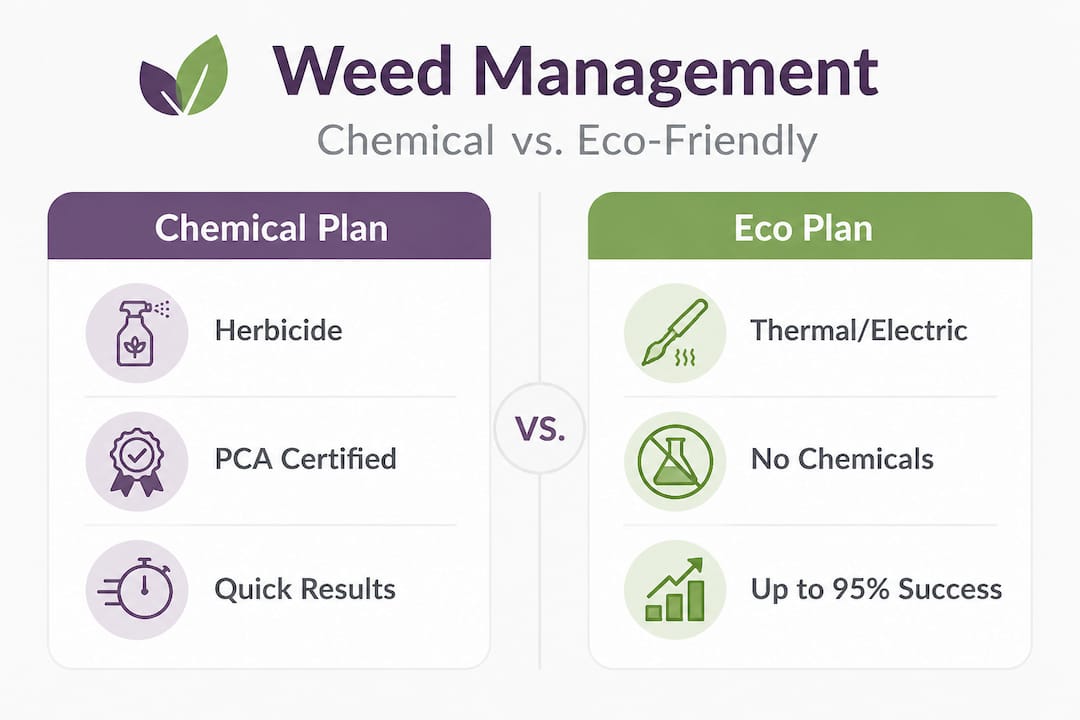
| Factor | Chemical-free management plan | PCA-compliant chemical plan |
|---|---|---|
| Treatment method | Thermo-electric energy delivery, root barriers, excavation | Herbicide injection or stem injection |
| Environmental impact | Minimal, no soil or water contamination | Requires buffer zones, disposal records |
| Lender acceptability | Fully acceptable with management plan | Fully acceptable with PCA contractor |
| Treatment duration | Multiple sessions over growing seasons | Typically 3 to 5 year herbicide programme |
| Preferred by RICS guidance | Yes, where practicable | Compliant alternative |
The impact on property transactions of unmanaged invasive weeds extends beyond mortgage approval. Conveyancers flag positive knotweed surveys, insurers adjust premiums, and buyers negotiate aggressively on price when no management plan exists. A funded plan, by contrast, demonstrates control and responsibility, and lenders respond to that reassurance.
If an invasive weed is confirmed on your property, act on the following steps without delay:
- Appoint a PCA-accredited specialist to prepare a formal management plan
- Notify your solicitor and mortgage lender immediately with the survey report
- Do not attempt to cut, strim, or disturb the plant before treatment, as this spreads rhizome fragments
- Confirm whether management plans will be backed by an insurance-backed guarantee, which lenders strongly prefer
- Request that your treatment contractor uses eco-friendly methods as the primary approach, with chemicals only as a secondary option
Common mistakes and how to avoid them
Understanding pitfalls is crucial to ensure your survey efforts pay off.
-
Relying on legacy advice. The outdated 7 metre rule still circulates among general surveyors and online forums. Following it will either cause unnecessary panic or, worse, allow a genuine risk to be dismissed. Always insist on the current risk-based approach.
-
Failing to document adequately. Photographs taken on a mobile phone without date stamps, location data, or scale references are of limited use to lenders and legal teams. Documentation must be systematic from the outset.
-
Defaulting to chemicals without considering eco alternatives. Many homeowners assume that herbicide treatment is the only effective route. This assumption is outdated and environmentally costly. Thermo-electric treatments and root barrier systems offer proven, chemical-free results that are both lender-acceptable and ecologically responsible.
-
Ignoring management plan requirements. Some homeowners address the plant informally and assume the problem is resolved. Without a formal, documented management plan backed by a credible contractor, this approach carries no weight with lenders or buyers.
-
Appointing an unqualified surveyor. Not all surveyors hold the specialist credentials required for invasive weed assessments. Confirm that your surveyor holds current PCA membership and has specific experience with invasive species surveys. Refer to knotweed survey certification guidance to understand what qualifications to look for.
Pro Tip: Ask your surveyor for two or three recent examples of reports they have produced that satisfied mortgage lenders. A qualified specialist will be able to provide these references without hesitation. If they cannot, consider this a significant warning sign.
Why most property surveys fail to protect homeowner interests
The technical steps of a survey are well-documented, yet a significant proportion of homeowners still find themselves blindsided by knotweed findings at the point of sale. The reason is systemic rather than individual.
General surveyors are trained broadly. They are not invasive weed specialists, and the commercial pressures of volume survey work mean that anything beyond a visible flag is unlikely to receive serious attention. The adoption of new RICS standards has been uneven, and many practitioners continue to apply legacy frameworks because they are familiar and unchallenged. This leaves homeowners exposed to risk that the industry has technically resolved on paper but has not yet resolved in practice.
The deeper issue is that specialist surveys with formal management plans remain underutilised, despite being the single most effective tool for protecting a transaction. Homeowners who invest in a specialist survey early, before listing their property, gain a decisive advantage: they can demonstrate control, document the risk accurately, and present lenders with exactly the evidence they need. Those who wait until a buyer’s survey flags the issue are left reacting under time pressure, often at significant financial cost.
We firmly believe that mortgage issues with knotweed are almost entirely avoidable when homeowners choose specialist, eco-focused surveyors from the outset. Eco-friendly treatments are frequently overlooked, yet they protect both your property and the surrounding environment without introducing chemical residues into soil or waterways. The industry is moving in this direction. The homeowners who act on that knowledge now will be the ones who transact with confidence.
Get expert help with your invasive weed survey
Navigating invasive weed surveys, management plans, and lender requirements is considerably more straightforward with the right expertise alongside you.

Japanese Knotweed Agency delivers specialist property surveys for invasive weeds across England, Wales, and Ireland, combining certified expertise with a commitment to chemical-free solutions. Our thermo-electric treatment technology delivers up to 5,000 volts directly to the rhizome network, causing internal cell damage and depleting energy reserves without the use of herbicides. For full details on our invasive weeds survey guide and to understand the full scope of our chemical-free knotweed solutions, visit our website. Our team is ready to provide the survey report, management plan, and treatment programme that protects your property and satisfies your lender.
Frequently asked questions
How is a specialist invasive weed survey different from a standard home survey?
A specialist invasive weed survey assesses specific risks such as Japanese Knotweed in depth and produces a formal management plan, whereas standard home surveys rarely address these plants beyond a brief visual note that carries no weight with mortgage lenders.
What is the RICS risk-based approach for invasive weeds?
The new RICS approach replaces the old 7 metre rule with a site-specific risk assessment using categories A to D, focusing on evidence of actual damage and whether a credible management plan is in place, rather than proximity alone.
Is eco-friendly invasive weed management as effective as chemicals?
Yes, eco-friendly solutions including thermo-electric treatment now demonstrate up to 95% success rates on newly identified Japanese Knotweed sites and are actively preferred under current RICS guidance where practicable.
Can invasive weed findings affect my property sale or mortgage?
Yes, lenders routinely require a specialist survey report and a funded management plan before approving transactions on properties where invasive weeds have been identified, making early specialist engagement essential.