


TL;DR:
- Knotweed encroachment law in the UK governs property owners’ duties to prevent Japanese knotweed from spreading beyond their land, with key legislation including the Wildlife and Countryside Act 1981, the Environmental Protection Act 1990, and the Anti-social Behaviour, Crime and Policing Act 2014. Non-disclosure during property transactions and improper disposal or management can result in criminal and civil liabilities, including nuisance claims and mortgage complications. Recent case law clarifies that liability arises from spreading or encroachment, with damages limited to losses during the period of breach, emphasizing the importance of professional survey, documented management, and lawful disposal practices.
Knotweed encroachment law is defined as the body of UK legal obligations governing a property owner’s duty to prevent Japanese knotweed from spreading beyond their land boundaries and causing harm to neighbouring properties. Under the Wildlife and Countryside Act 1981, causing knotweed to grow in the wild beyond your boundary is a criminal offence, even though having it on your land is not illegal in itself. For homeowners and buyers, this distinction carries significant financial and legal consequences, from civil nuisance claims and mortgage complications to property value losses that courts have now clarified in landmark rulings. Understanding where your obligations begin and end is the most practical protection you have.
What legislation governs knotweed encroachment and homeowner responsibilities?
Three principal pieces of legislation shape knotweed property law in England and Wales, and they operate across both criminal and civil frameworks.
The Wildlife and Countryside Act 1981 (Schedule 9, Section 14(2)) prohibits any person from planting or causing Japanese knotweed to grow in the wild. The focus is on spread, not presence. A homeowner who allows an unmanaged stand to push rhizomes under a fence and establish on a neighbour’s land is potentially committing a criminal offence. This is the most misunderstood aspect of Japanese knotweed legislation: many owners believe that because the plant is not listed as requiring mandatory removal, they face no legal risk. That belief is incorrect.
The Environmental Protection Act 1990 classifies knotweed-contaminated soil and plant material as controlled waste. This means disposal through a skip, a general waste bin, or a neighbour’s compost heap is unlawful. All excavated material must be handled by a licensed waste carrier and taken to an authorised facility. Breaches here carry criminal liability, including prosecution for fly-tipping.
The Anti-social Behaviour, Crime and Policing Act 2014 gives local authorities the power to issue Community Protection Notices where an unmanaged knotweed infestation is causing or is likely to cause nuisance to the community. Failure to comply with a CPN can result in fixed penalty notices or prosecution.
Beyond criminal law, civil nuisance principles apply directly to knotweed encroachment cases. A neighbour whose property is affected by rhizome spread from your land can pursue a private nuisance claim for treatment costs and associated losses. Failure to control spread that harms neighbours creates financial liability, regardless of whether any criminal offence has occurred.
Pro Tip: Keep a written record of every management action you take, including dates, methods used, and any professional visits. This log is your primary evidence if a civil nuisance claim is ever raised against you.
How does knotweed encroachment law affect property transactions?
Disclosure is the central legal issue when buying or selling a property with known or suspected knotweed. The TA6 property information form, which sellers complete as part of the conveyancing process, includes a direct question about Japanese knotweed. Non-disclosure on the TA6 form can expose a seller to misrepresentation claims, which may result in the buyer seeking damages or even rescission of the contract after completion.
Buyers should be aware that lenders apply their own scrutiny. Most mortgage providers require evidence of a professional survey and an active management plan before they will lend against a property where knotweed is present or has been treated. A detailed inspection survey that maps infestation extent and confirms treatment progress is the standard document lenders and solicitors expect. Superficial visual assessments do not satisfy this requirement.
The practical steps for buyers and sellers differ, but both carry legal weight:
- Sellers must disclose any known knotweed presence on the TA6 form accurately and honestly.
- Sellers should obtain a professional survey and a documented management plan before listing the property.
- Buyers should commission an independent survey rather than relying solely on the seller’s disclosure.
- Buyers should request copies of all treatment records, waste disposal documentation, and any management plan warranties.
- Both parties should instruct solicitors experienced in knotweed property law to review the implications before exchange.
Pro Tip: If you are a buyer and suspect the seller has not disclosed knotweed accurately, you can seek legal advice on misrepresentation claims before or after completion.
| Scenario | Legal implication |
|---|---|
| Seller discloses knotweed with active management plan | Transaction can proceed; lender may require plan evidence |
| Seller fails to disclose known knotweed | Risk of misrepresentation claim post-completion |
| Buyer discovers knotweed post-purchase with no disclosure | Grounds for damages or contract rescission |
| Knotweed present but professionally treated and documented | Mortgage approval more likely; reduced stigma risk |
What best practices must homeowners follow to comply with knotweed encroachment law?
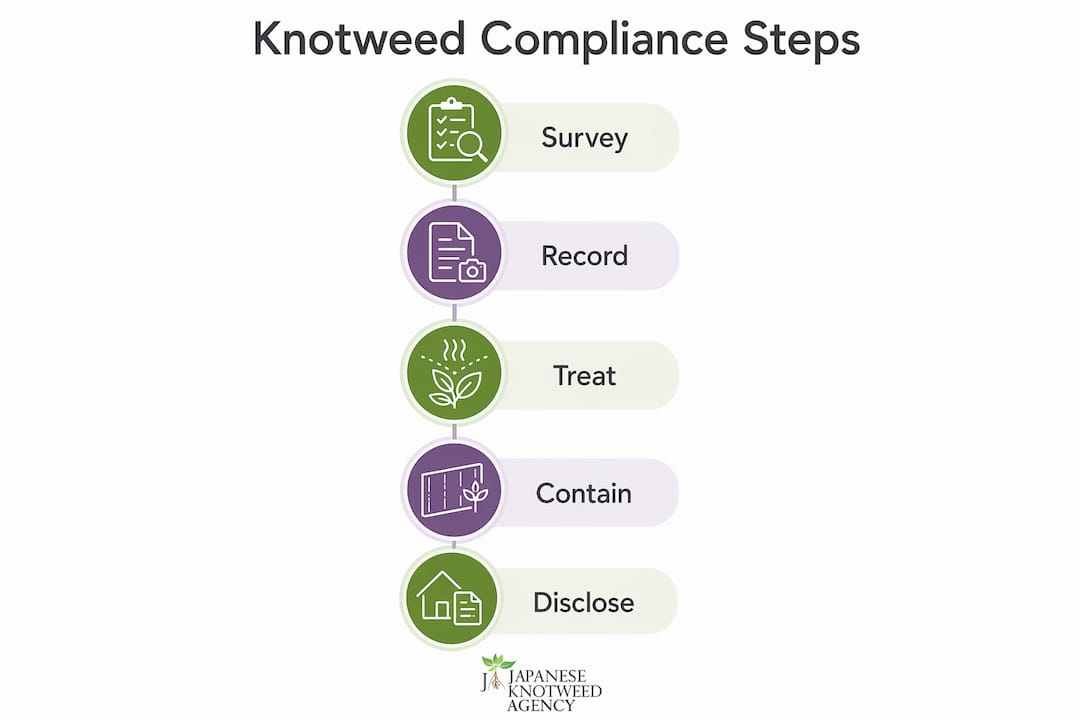
Compliance with knotweed removal regulations is not simply a matter of treating the plant. It requires a structured approach to control, disposal, and documentation.
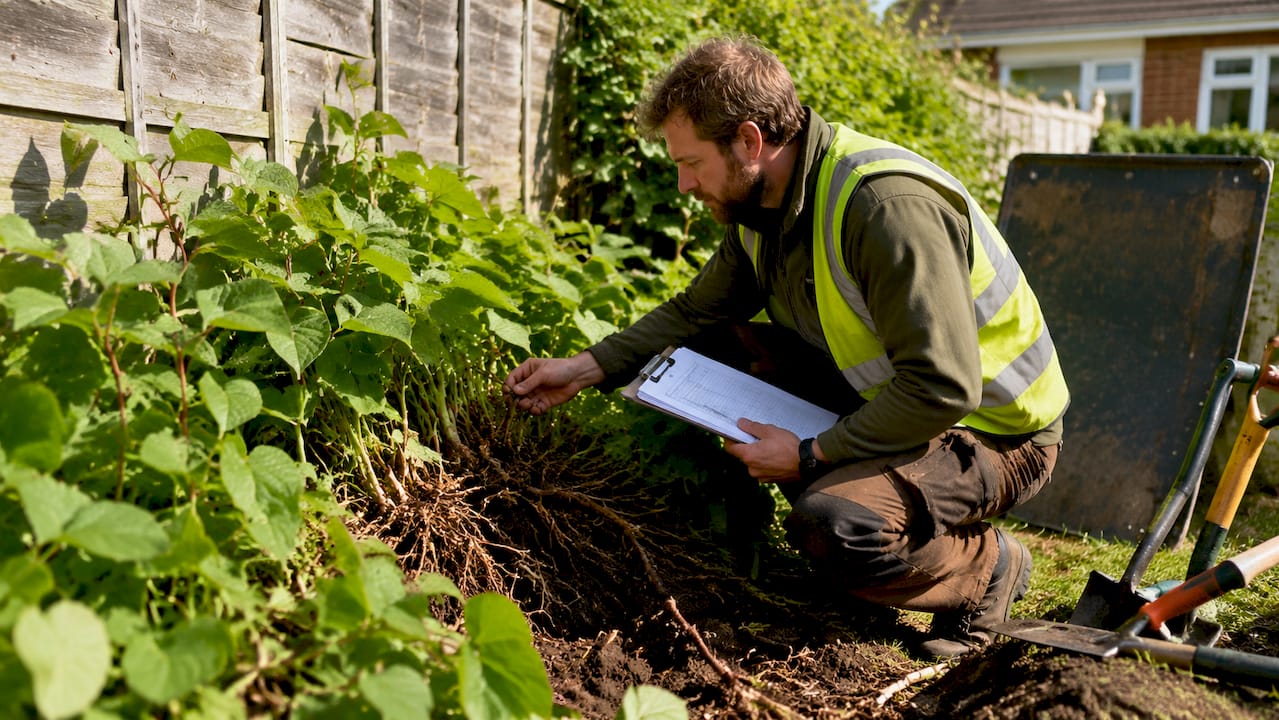
The most common source of legal exposure is improper physical intervention. Cutting, strimming, and bagging knotweed without correct treatment spreads viable rhizome fragments and increases liability under encroachment law. Even a fragment smaller than a fingernail can establish a new colony. Mowing and hedging equipment that contacts knotweed must be thoroughly cleaned before use elsewhere on the property.
Correct disposal is equally critical. Improper disposal of contaminated soil or plant material is a frequent source of criminal breaches, including fly-tipping prosecutions. All waste must go through a licensed waste carrier to an authorised landfill or incineration facility.
Professional treatment options that avoid spreading viable material include:
- Thermo-electric treatment: Japaneseknotweedagency delivers up to 5,000 volts directly to the plant, causing internal cell damage and depleting the rhizome network without the use of chemicals. This approach is particularly suited to sensitive sites and properties where chemical use is restricted.
- Root barrier installation: Physical barriers installed to the correct depth and specification prevent rhizome migration across boundaries and are accepted as a compliant management measure by lenders.
- Excavation: Full removal of contaminated soil and rhizome material, carried out by specialists with licensed waste disposal, provides the most complete resolution where site conditions allow.
Documenting every stage of management is not optional. Treatment records, waste transfer notes, and survey reports form the evidence base that protects you in both civil disputes and property transactions. If a neighbour raises a nuisance claim, your documentation is the difference between a defensible position and an expensive settlement.
Pro Tip: Before any excavation or ground works on a property where knotweed is suspected, book a professional survey to map the rhizome extent. Disturbing an unmapped infestation without a plan can spread it significantly and increase your legal exposure.
How has recent case law clarified knotweed claims and liabilities?
Two court decisions have materially shaped how knotweed infestation liability is assessed in England and Wales.
In Network Rail Infrastructure Ltd v Williams, the Court of Appeal confirmed that knotweed encroachment constitutes private nuisance even without physical structural damage to a neighbouring property. The ruling established that rhizome presence alone, and its impact on property amenity and value, is sufficient to found a nuisance claim. This was a significant development: it removed the need for claimants to prove physical damage and opened the door to claims based on treatment costs and diminution in value.
The 2024 UK Supreme Court ruling in Davies v Bridgend County Borough Council introduced an important limitation. The court held that damages for diminution in property value predating the defendant’s breach are unrecoverable. Claimants must isolate the loss caused specifically during the period of actionable breach. Residual stigma losses that existed before the breach cannot be attributed to the defendant.
“Causation timing in claims is critical; claimants must isolate diminution in value caused during actionable breach periods.” — Davies v Bridgend County Borough Council, UK Supreme Court, 2024
The practical implications of these two rulings are significant:
| Case | Key ruling | Implication for homeowners |
|---|---|---|
| Network Rail v Williams | Nuisance without physical damage | Neighbours can claim for treatment costs and amenity loss |
| Davies v Bridgend Council | Pre-breach losses unrecoverable | Claimants must prove loss arose during the breach period |
For defendants, the Davies ruling provides some protection against claims that overreach into historic stigma losses. For claimants, it demands precise evidence of when the encroachment began and what loss it caused from that point forward. Both positions reinforce the value of understanding your legal obligations and maintaining contemporaneous records of any knotweed activity on or near your boundary.
Key takeaways
Knotweed encroachment law requires homeowners to actively manage and document Japanese knotweed control to avoid criminal liability, civil nuisance claims, and property transaction complications.
| Point | Details |
|---|---|
| Presence is not the offence | Causing knotweed to spread beyond your boundary is the criminal act, not having it on your land. |
| Disclosure protects sellers and buyers | Accurate TA6 disclosure and documented management plans prevent misrepresentation claims and mortgage delays. |
| Disposal must be lawful | Contaminated soil and plant material are controlled waste; use a licensed carrier and authorised facility. |
| Case law limits recoverable losses | Post-Davies, claimants can only recover losses caused during the actionable breach period, not historic stigma. |
| Documentation is your legal defence | Treatment records, survey reports, and waste transfer notes are the evidence base for any dispute or transaction. |
Why I think most homeowners are exposed without realising it
Having worked in invasive species management across England, Wales, and Ireland, the pattern I see most consistently is not wilful neglect. It is a genuine misunderstanding of where legal risk actually sits. Most homeowners who have knotweed on their land believe that because they are not breaking any law by having it there, they are safe. They are not.
The risk is not in the presence. The risk is in the management, or the absence of it. A homeowner who cuts knotweed back each summer, bags it, and puts it in the general waste bin has committed a controlled waste offence. A homeowner who does nothing and allows rhizomes to cross the boundary has created the conditions for a private nuisance claim. Neither of these people set out to break the law. Both are exposed.
The other consistent failure I see is in property transactions. Sellers who disclose knotweed without supporting documentation, or who assume a previous treatment is sufficient without a current survey, create problems that surface months after completion. Buyers who rely on a seller’s word rather than commissioning their own survey take on risk they cannot quantify.
The solution in both cases is the same: professional assessment, documented management, and honest disclosure. These are not expensive burdens. They are the minimum standard that the law, lenders, and the courts now expect. Proactive communication with neighbours when knotweed is near a shared boundary is also worth doing early. A documented conversation is far less costly than a civil claim.
How Japaneseknotweedagency supports legal compliance and property protection

Japaneseknotweedagency provides the professional surveys, treatment programmes, and documentation that homeowners and buyers need to meet their legal obligations and protect property value. The agency’s chemical-free thermo-electric treatment delivers up to 5,000 volts directly to the rhizome network, causing internal cell damage without the use of herbicides. This makes it suitable for sensitive sites, watercourses, and properties where chemical treatment is restricted or undesirable.
For properties where physical containment is required, Japaneseknotweedagency installs root barriers to the specification accepted by mortgage lenders. Excavation works are also available where full removal is the appropriate solution. Every service is supported by detailed survey reports and treatment records that satisfy the evidential requirements of solicitors, lenders, and courts.
Start with a professional eradication survey to establish the extent of any infestation and the most appropriate management pathway. For further guidance on managing invasive species on residential land, the agency’s step-by-step management guide provides practical detail for homeowners at every stage of the process. To book a survey, visit japaneseknotweedagency.co.uk/book-a-survey.
FAQ
Is it illegal to have Japanese knotweed on my property?
Having Japanese knotweed on your land is not a criminal offence. The offence under the Wildlife and Countryside Act 1981 is causing it to spread beyond your boundary into the wild.
Do I have to declare knotweed when selling my house?
Yes. The TA6 property information form requires sellers to disclose known knotweed presence. Non-disclosure can lead to misrepresentation claims and legal action after completion.
Can my neighbour sue me for knotweed on my land?
Yes, if rhizomes from your property encroach onto theirs. The Network Rail v Williams ruling confirmed that knotweed encroachment constitutes private nuisance even without physical structural damage.
Can I dispose of knotweed in my household bin?
No. Knotweed plant material and contaminated soil are classified as controlled waste under the Environmental Protection Act 1990 and must be handled by a licensed waste carrier.
What damages can be claimed in a knotweed nuisance case?
Treatment costs and losses caused during the period of actionable breach are recoverable. Following Davies v Bridgend Council, pre-breach diminution in property value is not recoverable from the defendant.