

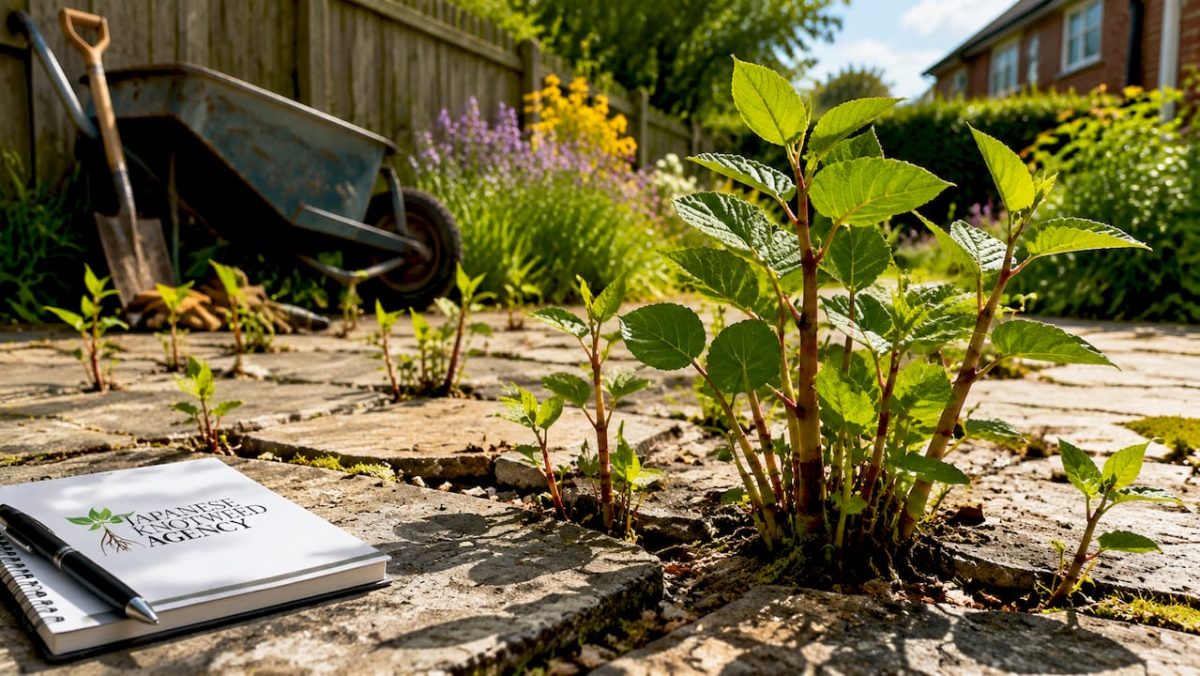
TL;DR:
- Japanese knotweed exploits existing cracks and weak points in concrete rather than penetrating intact slabs, making early detection crucial. Its rhizome network can extend up to 2.5 meters horizontally and 3 meters vertically, often far beyond visible canes, necessitating multi-season treatment plans and professional surveys. Proper management involves mapping, careful removal, physical barriers, and possibly thermo-electric treatment to prevent spread and property damage.
Japanese knotweed is defined as an invasive non-native plant (Fallopia japonica) whose rhizome network can penetrate concrete surfaces through existing cracks, joints, and structural weak points, not through intact slabs. This distinction matters enormously for property owners across England, Wales, and Ireland. Knotweed growing through concrete is one of the most misunderstood property risks in the UK, and acting on the wrong information can worsen an infestation considerably. This article explains how knotweed exploits concrete weaknesses, what damage it can realistically cause, and which knotweed control methods give you the best chance of long-term success.
How does Japanese knotweed grow through concrete surfaces?
The term “growing through concrete” is accurate in one specific sense. Knotweed penetrates concrete up to 8 cm thick mainly through cracks or weak points rather than drilling through sound material. Solid, well-laid concrete slabs present a genuine barrier. The problem is that very few concrete surfaces in a domestic setting remain perfectly intact over time.
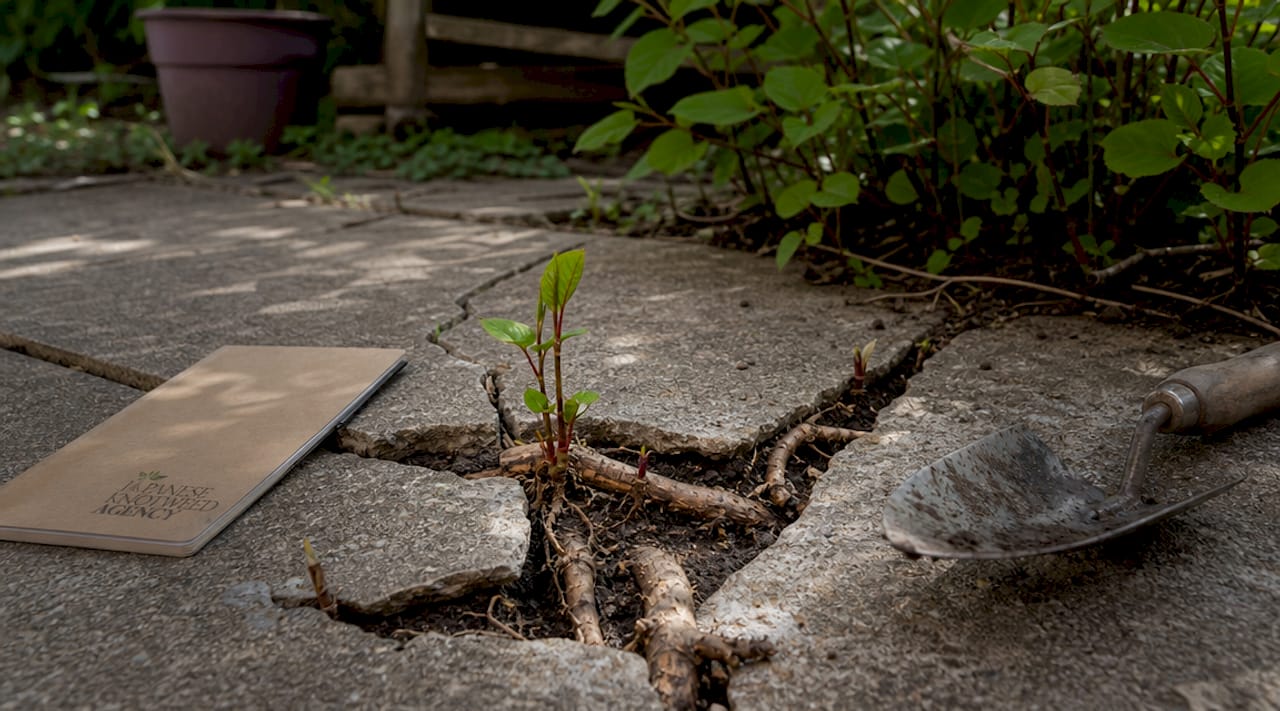
Knotweed rhizomes grow both horizontally and vertically, seeking out the path of least resistance. Frost damage, poorly sealed expansion joints, ageing mortar between paving slabs, and gaps around drainage channels all create the entry points that rhizomes exploit. Once a rhizome tip finds a crack, the pressure exerted by continued growth can widen that crack progressively, accelerating deterioration that was already underway.
Common concrete vulnerabilities that knotweed exploits include:
- Expansion joints in driveways and paths that have not been sealed or have degraded over time
- Frost-heaved sections of paving where the substrate has shifted
- Gaps around utility pipes, drainage covers, and inspection chambers
- Poorly bonded concrete repairs or patches
- Edges of concrete slabs where the material thins towards the perimeter
Pro Tip: If you notice knotweed canes emerging at the edge of a concrete driveway or path, the rhizome network beneath is almost certainly more extensive than the visible shoots suggest. Do not cut or disturb the canes before seeking professional advice.
The plant does not “drill” through concrete in the way popular media sometimes implies. What it does is exploit weaknesses that already exist, and it does so with considerable persistence across multiple growing seasons.
What damage can knotweed cause to concrete and property?
The effects of knotweed on foundations and concrete hardscapes are real but frequently overstated. Understanding the difference between confirmed risk and myth is important for making proportionate decisions.
When rhizomes grow through existing cracks, the physical pressure of continued growth can widen those cracks. This allows water ingress, which accelerates freeze-thaw damage in winter. Soil displacement beneath concrete slabs can cause uneven settlement, creating trip hazards on paths and driveways. In worst-case scenarios near building structures, rhizome activity close to shallow foundations can compromise drainage and increase subsidence risk over time.
“Many homeowners mistakenly believe knotweed punches through concrete, but the reality is it exploits existing weaknesses, making early detection and repair critical.” — Ontario’s Invasive Species Centre
The table below summarises realistic damage risks versus common misconceptions:
| Risk category | Realistic assessment |
|---|---|
| Crack widening in existing concrete | Confirmed: rhizome growth pressure accelerates deterioration of pre-existing cracks |
| Water ingress through widened cracks | Confirmed: increased risk of freeze-thaw damage and damp penetration |
| Damage to sound, intact concrete | Not confirmed: solid concrete without cracks is not penetrated |
| Foundation damage from rhizomes | Possible near shallow foundations; professional assessment required |
| Mortgage and property valuation impact | Confirmed: lenders and surveyors treat knotweed presence as a material risk |
Mortgage lenders across the UK routinely flag knotweed presence during conveyancing. If knotweed is identified within 7 metres of a habitable structure, many lenders require a professional management plan before proceeding. This makes a professional knotweed survey not just advisable but often a practical necessity for property transactions.
What are the most effective methods to stop knotweed in concrete?
Stopping invasive knotweed growth around concrete requires a structured, multi-season approach. Single interventions rarely succeed because rhizomes extend an average of 2.5 metres horizontally and up to 3 metres vertically, meaning the visible plant represents only a fraction of the problem.
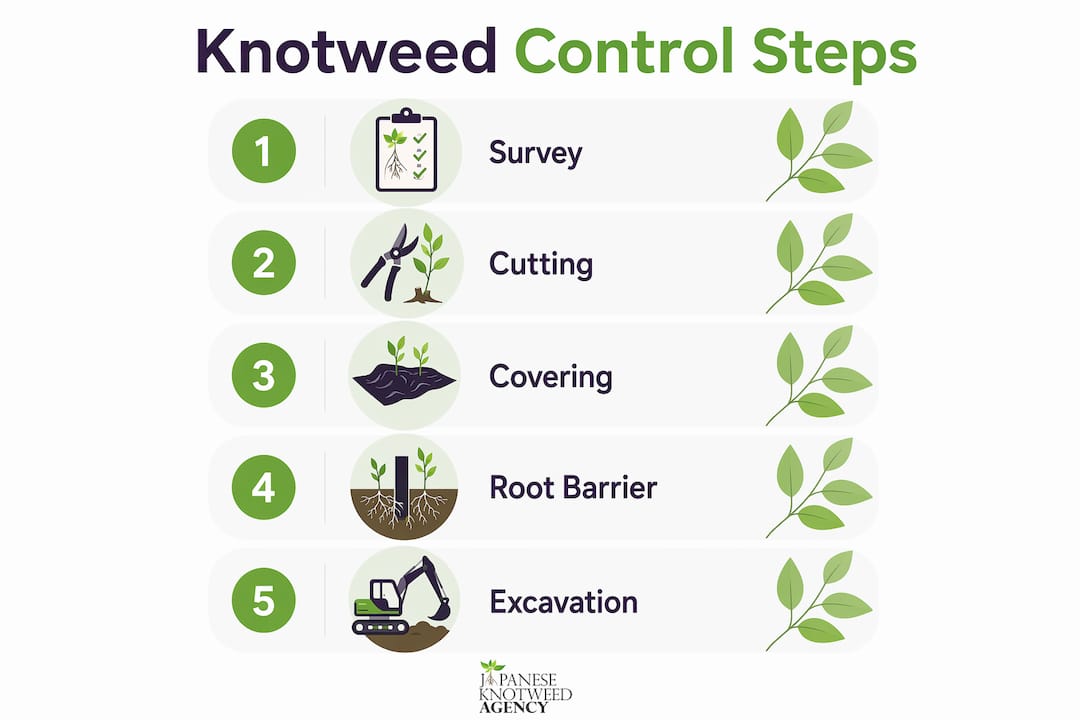
The most effective integrated approach follows this sequence:
- Map the infestation. Before any treatment begins, establish the full extent of rhizome spread beyond visible canes. Near concrete, this is particularly important because rhizomes may be travelling beneath the surface for several metres in any direction.
- Remove top growth carefully. Cut canes close to ground level before covering, but do not strim or mow, as fragmented rhizomes discarded on soil can generate new infestations. All arisings must be treated as controlled waste.
- Apply smothering with a buffer zone. The University of Connecticut’s Connecticut Invasive Plant Working Group (UConn CIPWG) recommends securing cover material with at least a 3-foot buffer zone around the visible infestation and monitoring regularly to prevent rhizome escape beneath the edges.
- Install root barriers. For infestations adjacent to concrete driveways, paths, or building structures, root barrier installation creates a physical membrane that prevents rhizomes from re-entering treated zones or spreading further beneath hardscapes.
- Commit to multi-season treatment. Eradication typically requires at least two full growing seasons of consistent treatment. Stopping early is one of the most common reasons infestations return.
- Consider thermo-electric treatment. For situations where chemical herbicides are unsuitable, particularly near watercourses or in ecologically sensitive areas, thermo-electric treatment delivers direct energy into the rhizome network, causing internal cell damage without chemical residue.
Pro Tip: Avoid unplanned excavation near concrete without professional guidance. Disturbing rhizomes without controlled containment protocols risks spreading viable fragments to new areas of your property, which is both counterproductive and potentially a legal liability under the Wildlife and Countryside Act 1981.
Maine’s Department of Agriculture, Conservation and Forestry confirms that combined cutting, covering, and barriers are more effective than any single method alone, particularly where rhizomes have penetrated beneath hardscapes.
How do professional surveys help manage knotweed near concrete?
A professional Japanese knotweed survey does more than confirm presence. It maps rhizome extent, assesses structural risk to nearby concrete and foundations, and produces a management plan that satisfies mortgage lender requirements. For property buyers, this documentation is frequently the difference between a transaction proceeding and stalling.
Japaneseknotweedagency carries out property surveys for invasive weeds across England, Wales, and Ireland. A survey from a qualified specialist will typically include:
- Visual identification and boundary mapping of the infestation
- Assessment of proximity to structures, drainage, and concrete hardscapes
- Rhizome extent estimation based on visible growth and site conditions
- A written management plan with treatment recommendations and timescales
- Documentation suitable for mortgage lenders and conveyancers
Treatment options available through professional services extend well beyond herbicide application. Japaneseknotweedagency’s thermo-electric treatment delivers up to 5,000 volts directly into the rhizome network, depleting energy reserves without chemical intervention. This is particularly relevant for infestations near concrete where herbicide drift or soil contamination is a concern. Excavation works and root barrier installation provide physical containment where rhizomes have already spread beneath paved or concreted areas.
For homeowners considering whether they can build on land with knotweed, professional assessment is a prerequisite. Planning authorities and building control bodies increasingly require evidence of knotweed management before granting permissions adjacent to affected land.
Key takeaways
Japanese knotweed exploits existing weaknesses in concrete rather than penetrating sound material, making early detection and professional assessment the most effective first response.
| Point | Details |
|---|---|
| Knotweed and concrete damage | Knotweed widens existing cracks but cannot penetrate sound, intact concrete slabs. |
| Rhizome extent | Rhizomes extend up to 2.5 m horizontally and 3 m vertically, far beyond visible canes. |
| Multi-season commitment | Effective eradication requires at least two full growing seasons of consistent treatment. |
| DIY risks | Cutting, strimming, or unplanned excavation can spread viable rhizomes to new areas. |
| Professional survey value | A survey maps rhizome extent, satisfies lenders, and produces a compliant management plan. |
What I have learned from knotweed at concrete boundaries
Having assessed knotweed infestations across England, Wales, and Ireland, the pattern I see most often is a homeowner who has spent two or three seasons cutting back visible canes, believing they are making progress, while the rhizome network beneath their driveway or path continues to expand unchecked. The canes are the symptom. The rhizomes are the problem.
The second most common mistake is panic-driven excavation. Digging out knotweed near concrete without a containment protocol is one of the fastest ways to spread an infestation. I have seen single properties develop multiple satellite colonies after unplanned excavation disturbed rhizome fragments across a garden.
What actually works is patience combined with the right sequence of interventions. Mapping first, then treatment, then physical barriers where needed. Chemical-free approaches such as thermo-electric treatment are not a compromise; in many settings near concrete or drainage infrastructure, they are the more appropriate choice. The knotweed assessment workflow for homeowners is a useful starting point if you are unsure where to begin.
My honest advice is this: if knotweed is visible at or through a concrete surface on your property, get a survey before you do anything else. The cost of a professional assessment is a fraction of the cost of managing an infestation that has been inadvertently spread by well-intentioned but poorly planned DIY intervention.
— Alan
How Japaneseknotweedagency can help
If you have identified knotweed growing near or through concrete on your property, Japaneseknotweedagency provides expert surveys and treatment across England, Wales, and Ireland.

A professional survey from Japaneseknotweedagency maps the full extent of the infestation, assesses risk to your concrete surfaces and foundations, and produces documentation that satisfies mortgage lenders. Treatment options include thermo-electric treatment, excavation, and root barrier installation, all delivered without reliance on chemical herbicides where site conditions allow. Book a survey to receive a tailored assessment and management plan for your property.
FAQ
Can knotweed really grow through solid concrete?
Japanese knotweed cannot penetrate intact, sound concrete. It grows through cracks and joints in concrete up to 8 cm thick, exploiting existing structural weaknesses rather than drilling through solid material.
How far can knotweed rhizomes spread beneath a driveway?
Rhizomes can extend up to 2.5 metres horizontally and 3 metres vertically from visible canes, meaning the underground network beneath a driveway may be far larger than surface growth suggests.
Will removing knotweed canes stop it growing through concrete?
Cutting canes alone will not stop knotweed. The rhizome network beneath the surface remains active and will produce new shoots. Multi-season treatment combining physical and chemical or thermo-electric methods is required for effective control.
Does knotweed affect property value and mortgage applications?
Knotweed presence within 7 metres of a habitable structure is treated as a material risk by most UK mortgage lenders. A professional management plan is typically required before a lender will proceed with a mortgage on an affected property.
Is DIY removal of knotweed near concrete safe?
Unplanned DIY removal near concrete carries significant risk. Disturbed rhizome fragments can generate new infestations, and improper excavation may spread the plant further. Professional guidance is strongly recommended before any physical intervention.