

TL;DR:
- Buying a property or remortgaging in 2025 without a thorough survey risks expensive unseen defects and future costs. Selecting the appropriate survey level based on property age, condition, and risks ensures comprehensive inspection and stronger negotiation leverage. Utilizing detailed survey findings and specialist reports can significantly reduce post-purchase surprises and protect your investment.
Buying a property or remortgaging in 2025 without a thorough survey is one of the most expensive risks you can take. A well-structured property survey checklist 2025 does more than tick boxes. It protects your investment, reveals hidden defects before you exchange contracts, and gives you documented leverage in price negotiations. Many buyers still rely on a mortgage valuation alone, mistaking it for a genuine inspection, and pay dearly when structural problems surface after completion. This guide covers every stage of the survey process, from choosing the right level to understanding what surveyors actually check and how to act on their findings.
Table of Contents
- Key takeaways
- 1. Essential criteria in your property survey checklist 2025
- 2. What a thorough home survey checklist covers
- 3. Comparing RICS Level 1, 2, and 3 surveys
- 4. Using survey findings strategically
- My perspective on using surveys effectively in 2025
- How Japaneseknotweedagency supports your property survey process
- FAQ
Key takeaways
| Point | Details |
|---|---|
| Survey level matters | Choose your survey based on property age and condition, not cost alone, to avoid serious oversights. |
| Mortgage valuations are not surveys | Lenders’ valuations protect the bank, not you. Commission a separate survey for genuine buyer protection. |
| Condition ratings guide your response | RICS traffic-light ratings help prioritise which defects need immediate action versus routine maintenance. |
| Specialist surveys fill the gaps | Visual surveys cannot detect all risks. Japanese Knotweed, asbestos, and damp may require dedicated follow-on reports. |
| Survey findings support renegotiation | Documented defects from a qualified surveyor give you credible grounds to reduce your offer or request repairs. |
1. Essential criteria in your property survey checklist 2025
Before any survey takes place, the scope and level of inspection must reflect the specific characteristics of the property you are buying or remortgaging against. This is where most buyers go wrong. Selecting by price rather than complexity is one of the most common mistakes, and it routinely results in insufficient inspections on properties that genuinely needed more rigour.
Your 2025 property assessment list should begin with these criteria:
- Property age and construction type. Modern homes built post-2000 with standard materials carry different risks than Victorian terraces or properties with non-traditional construction such as prefabricated concrete or timber frame.
- Visible defects and alterations. Extensions, loft conversions, conservatories, and removed walls all affect structural integrity and require closer scrutiny than an unaltered property.
- Purpose of the survey. A purchase survey needs to establish full condition. A remortgage survey may be narrower but should still address any visible concerns that could affect the lender’s security.
- RICS survey levels. Three survey levels exist: Level 1 for newer builds, Level 2 for conventional homes, and Level 3 for older or substantially altered properties.
- Specialist surveys. Where a surveyor flags concerns about damp, asbestos, subsidence, or invasive plants, commissioning specialist follow-on reports is not optional. It is prudent.
- Technology in surveys. Reputable surveyors now use drones and thermal imaging cameras to inspect roof spaces, identify heat loss, and detect moisture behind walls without intrusive investigation.
Brief your surveyor before the appointment. Tell them about any areas of concern, known alterations, or specific risks such as proximity to watercourses where Japanese Knotweed is commonly found. A well-briefed surveyor conducts a more targeted inspection.
Pro Tip: Ask your surveyor directly whether they carry out invasive weed assessments as part of the inspection, or whether a specialist survey would be required separately. Do not assume it is included.
2. What a thorough home survey checklist covers
A professional survey is a visual and non-destructive inspection. Surveyors do not move furniture or drill into walls unless explicitly commissioned to do so as a separate service. Understanding this scope is critical because it defines what you will and will not learn from a standard report.
Structural components
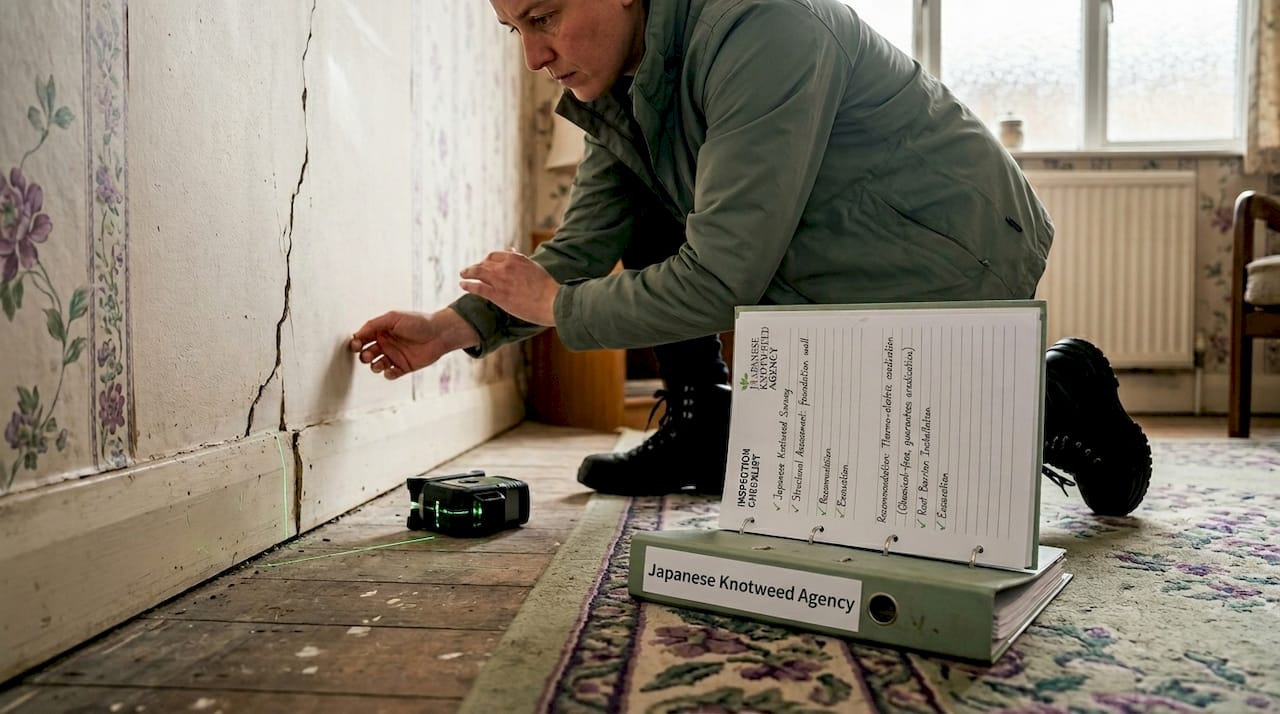
The surveyor examines load-bearing walls, roofs, chimneys, foundations, floors, and ceilings. They look for signs of movement, cracking, sagging, or settlement that could indicate subsidence or structural compromise. Roof spaces are inspected where accessible, including rafters, purlins, and insulation levels.
Services and utilities
Electrical wiring condition, boiler age and specification, plumbing systems, and drainage are all reviewed visually. It is worth noting that surveyors distinguish between checking and testing. Checking means visual observation only. Testing, such as electrical installation condition reports or CCTV drainage surveys, requires separate commissioning and additional fees.
Visible signs of common problems
Damp, condensation, rising moisture, rot in timber frames, and cracking in plasterwork all appear in the surveyor’s assessment. Each is rated using the RICS traffic-light condition rating system.
External features
Windows, doors, external render, gutters, downpipes, chimney stacks, fascias, and boundary walls are all assessed. Condition and age of double glazing units, signs of failed seals, and deteriorating pointing are recorded.
Garden and land assessment
This is where the property inspection guide 2025 diverges from older practice. In areas with Japanese Knotweed risks, a dedicated invasive plant survey is critical. Knotweed can push through tarmac, destabilise foundations, and directly affect mortgage lending decisions. A general surveyor may note a suspicion but rarely provides the specialist assessment that lenders and conveyancers require.
Pro Tip: If the property has a garden boundary near a railway embankment, riverbank, or brownfield land, treat Japanese Knotweed as a probable risk rather than a remote one and commission a specialist survey before you proceed.
The condition ratings used across all these elements follow RICS standards: Condition Rating 1 (green) means no repair needed, Rating 2 (amber) requires attention, and Rating 3 (red) signals a serious defect requiring urgent action.
| Element inspected | What surveyors assess | Condition rating applied |
|---|---|---|
| Roof structure | Rafters, tiles, flashing, chimney stacks | 1, 2 or 3 |
| Walls and foundations | Cracks, movement, damp penetration | 1, 2 or 3 |
| Floors | Deflection, rot in timbers, concrete condition | 1, 2 or 3 |
| Services | Boiler age, wiring type, drainage visible condition | 1, 2 or 3 |
| Garden and grounds | Boundary condition, invasive plants, drainage | 1, 2 or 3 |
3. Comparing RICS Level 1, 2, and 3 surveys
Choosing the right level is the single most consequential decision in any real estate survey process. Getting it wrong at this stage means paying for a report that tells you far less than your property’s condition warrants.
| Survey level | Best suited to | Typical cost | Inspection depth |
|---|---|---|---|
| Level 1 (Condition Report) | Modern homes, newer builds, straightforward properties | £300 to £500 | Visual overview, no advice on repairs |
| Level 2 (HomeBuyer Report) | Conventional homes in reasonable condition | £400 to £1,000 | Detailed condition ratings, market valuation, rebuild cost |
| Level 3 (Building Survey) | Older, altered, or complex properties | £600 to £1,500 | Comprehensive structural assessment, full repair advice |
The Level 2 survey averages approximately £455 for a standard residential property and takes two to four hours on site. For most buyers purchasing a conventional semi-detached or terraced home built in the last 50 years, this level provides the balance of depth and cost that serves them well.
Older properties, listed buildings, or homes with alterations require a Level 3 survey. The additional expenditure is minor relative to the risk of missing structural issues that a Level 2 report would not examine in sufficient depth. A Victorian terrace with an extended rear addition, for example, could have compromised party walls, underpinned foundations, or unauthorised structural alterations that only a Level 3 investigation would capture.
The cost difference between Level 2 and Level 3 is minor relative to the potential cost of uncovered hidden defects. A Level 3 survey that costs £300 more than a Level 2 could identify £30,000 worth of structural remediation. That mathematics is straightforward.
Survey reports now integrate stronger commentary on energy efficiency, building safety, and climate risk, reflecting updated UK legislation. This makes the 2025 property evaluation criteria more far-reaching than surveys conducted even three years ago.
4. Using survey findings strategically
A survey report is not simply an information document. It is a negotiating instrument, a maintenance schedule, and a legal record. Here is how to use it effectively once you have it.
- Review Condition Rating 3 items immediately. These are serious defects requiring urgent action. Before proceeding to exchange, obtain specialist quotes for remediation and use those figures as the basis of a renegotiation with the vendor.
- Document all defects formally. Detailed survey findings support renegotiation. Submit a written request to the vendor’s solicitor citing the specific condition ratings and the cost estimates obtained.
- Commission follow-on specialist reports. Where the surveyor flags suspected damp, asbestos, or invasive plants, commissioning specialist reports following flags improves risk detection substantially and protects you legally post-completion.
- Stop relying on mortgage valuations. Mortgage valuations protect lenders, not buyers. They assess minimum lending security and will not detail structural defects or invasive plant risks.
- Plan your long-term maintenance. A Level 2 or Level 3 report effectively doubles as a prioritised maintenance schedule for the first five years of ownership. Use the amber-rated items to budget for work that will prevent them escalating to red.
- Act on invasive plant findings before exchange. If knotweed or other invasive species are identified, obtain a management plan and remediation costs from a specialist before you legally commit. You can read more about how surveys assess weed risks for homebuyers in detail.
Accurate survey level selection increases buyer leverage during price renegotiations and substantially reduces post-purchase surprises.
My perspective on using surveys effectively in 2025
I’ve seen buyers spend six months finding the right property and then make a £350 saving on their survey by selecting a Level 2 report for a 1920s terraced house with a rear extension, a converted loft, and no Building Regulations certificate for either. That is not a false economy. It is a genuine risk that no checklist can substitute for.
What I’ve learnt from working in invasive species assessment alongside wider property transactions is that specialist surveys are consistently underused. Buyers treat them as an optional add-on rather than a core part of due diligence. When Japanese Knotweed appears post-completion, the financial and legal consequences are significant. Lenders can withdraw mortgage offers on properties where knotweed is found without a compliant management plan in place. That is a binary outcome.
My view on survey cost is this: the relevant comparison is not between the Level 2 and Level 3 price. It is between the survey fee and the cost of what the survey might reveal. A £700 report that identifies £18,000 of required roof repairs before exchange is not an expense. It is precisely the kind of protection that the entire process should be built around.
Ask your surveyor specific questions. Ask them what they cannot see. Ask whether any elements they observed require specialist investigation. The best surveyors will tell you exactly where the limits of their visual inspection end.
— Alan
How Japaneseknotweedagency supports your property survey process

Japaneseknotweedagency provides specialist invasive plant surveys across England, Wales, and Ireland, giving homebuyers and homeowners the documented evidence they need before proceeding with property transactions. Where Japanese Knotweed or other invasive species are identified, the team delivers chemical-free knotweed solutions using thermo-electric treatment up to 5,000 volts, root barrier installation, and excavation works. Every survey report is prepared to a standard accepted by mortgage lenders and conveyancers. If your property survey has flagged invasive species concerns, or you want to manage that risk before it surfaces, book a professional survey with Japaneseknotweedagency today. For answers to common questions about knotweed and property, the Japaneseknotweedagency FAQ is a practical starting point.
FAQ
What is the difference between a survey and a mortgage valuation?
A mortgage valuation protects the lender’s security interest and does not provide a detailed assessment of property condition. A survey, commissioned independently by the buyer, identifies defects, condition ratings, and risks across the whole property.
Which RICS survey level do I need for an older property?
Older or altered properties generally require a Level 3 Building Survey, which provides the depth of structural assessment that Level 1 and Level 2 inspections do not cover.
Can a surveyor detect Japanese Knotweed?
A general RICS surveyor may note the visual presence of suspected knotweed but cannot provide the specialist assessment required by lenders. A dedicated invasive weed survey from a qualified specialist, such as those carried out by Japaneseknotweedagency, is required to satisfy mortgage conditions.
How long does a home survey take?
A Level 2 survey typically takes two to four hours on site, with the written report delivered within a few working days. A Level 3 survey on a larger or more complex property will take longer.
Can I use survey findings to renegotiate the purchase price?
Yes. Documented condition ratings and specialist cost estimates from a qualified surveyor provide credible grounds for requesting a price reduction or remediation works from the vendor before exchange.