


TL;DR:
- Weed treatment records prove invasive plants have been lawfully managed, protected, and disposed of properly. They are essential for property transactions, satisfaction of lenders, and regulatory compliance. Maintaining complete, contemporaneous records safeguards all parties and prevents delays or legal issues.
Weed treatment records are documented evidence proving that invasive plants such as Japanese knotweed have been treated, managed, and disposed of lawfully. The role of weed treatment records extends far beyond simple paperwork. They protect property value, satisfy mortgage lenders, demonstrate regulatory compliance, and give buyers the confidence to proceed with a purchase. Without them, even a completed treatment programme carries no verifiable weight with solicitors, surveyors, or local authorities. This guide explains what those records must contain, why they matter to every party in a property transaction, and how to maintain them correctly.
What are the essential components of weed treatment records?
A complete weed management documentation pack is built from several distinct elements, each serving a specific evidential purpose. No single document is sufficient on its own. The strength of the pack comes from the combination.
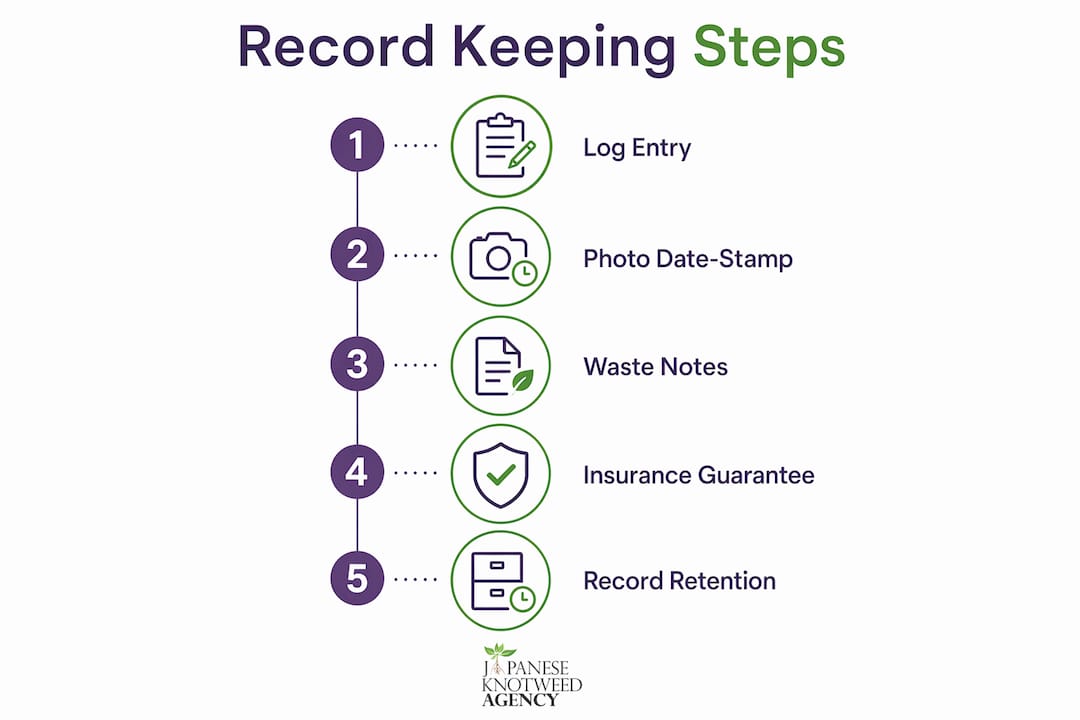
The core components are:
- Treatment plan. This sets out the methods, products, schedules, and responsible operatives for the full programme. It establishes the baseline against which all subsequent visits are measured.
- Photographic records. Each treatment visit requires dated photographs showing the plant’s condition before and after treatment. These images create a visual timeline that supports the written log.
- Waste transfer notes. Controlled waste transfers in England and Wales legally require a waste transfer note retained by both parties for at least two years. The waste description on the note is examined closely in knotweed disposal cases.
- Insurance-backed guarantees. A transferable guarantee from a reputable contractor reassures lenders and future buyers that the treatment commitment survives a change of ownership.
- Continuity records across seasons. Because knotweed treatment programmes span multiple seasons, continuous record updates showing progress over time are essential evidence for buyers, lenders, and regulators.
Pro Tip: Ask your contractor to date-stamp every photograph at the time of capture, not retrospectively. Retrospective labelling is one of the first things an inspector or solicitor will question.
The records must be filled out at the time of each treatment visit. Delays or summary entries risk producing incomplete evidence that inspectors can reject, even when the treatment itself was carried out correctly. Contemporaneous records are the only records that hold up under scrutiny.
Why are weed treatment records vital for buyers, homeowners, and lenders?
Weed control record-keeping directly affects whether a property sale proceeds or stalls. Mortgage lenders require documented evidence before lending on properties affected by Japanese knotweed. A professional treatment plan backed by a transferable guarantee is usually sufficient for lender reassurance, but only when the records are complete.
The TA6 property enquiry form, which sellers complete as part of the conveyancing process, asks directly about the presence and treatment of Japanese knotweed. Incomplete or absent records force sellers to declare uncertainty. That uncertainty can block lending or trigger renegotiation. Buyers gain confidence from records that prove responsible management from the outset.
“Recordkeeping is the mechanism enabling third parties to verify proper treatment, lawful disposal, and continuous management over time.” — RHS Advice on Japanese Knotweed
Local authorities rely on the continuous evidence trail from surveys, schedules, photographs, and disposal records when assessing landowner responsibility in invasive species control. Without that trail, a landowner cannot demonstrate that they have met their duty of care. The practical consequences include enforcement notices, civil disputes with neighbours, and failed property sales.
Records protect all parties in the following ways:
- Buyers receive proof that the plant has been managed and that the guarantee transfers to them.
- Sellers avoid disputes arising from undisclosed or unverified treatment history.
- Lenders can assess risk accurately rather than declining on the basis of uncertainty.
- Local authorities have the evidence needed to confirm compliance or pursue enforcement.
Understanding knotweed mortgage issues before a sale begins is the most effective way to prevent a transaction from collapsing at the final stage.
What are the legal and regulatory requirements for weed treatment records in the UK?
UK law imposes specific obligations on professional users of plant protection products. Under Article 67 of Regulation (EC) No 1107/2009, professional pesticide users must keep records of every application. From january 2026, those records must include product authorisation numbers, EPPO codes, and BBCH growth stage codes.
DAERA guidance confirms that paper records remain acceptable until the end of 2026, with mandatory electronic records required from january 2027. This transition affects contractors operating in Northern Ireland and signals the direction of travel for the wider UK.
The legal requirements for a compliant record set are:
- Product name and authorisation number.
- Date, location, and area treated.
- Dose applied and equipment used.
- Operator name and qualification number.
- EPPO code for the target organism.
- BBCH growth stage code for the crop or plant.
- Waste transfer note for any removed material.
| Record element | Legal basis | Retention period |
|---|---|---|
| Pesticide application log | Regulation (EC) No 1107/2009, Article 67 | Minimum 3 years |
| Waste transfer note | Environmental Protection Act 1990 | Minimum 2 years |
| Insurance-backed guarantee | Contractual obligation | Indefinitely with deeds |
| Photographic evidence | Best practice / lender requirement | Indefinitely with deeds |
Completeness in records is often decisive during audits. Blank or missing entries visibly indicate a failure to demonstrate compliance, even when the treatment itself took place. An inspector does not need to prove the treatment was skipped. The absence of a signed entry is sufficient to raise a compliance failure.
Pro Tip: Retain all weed management documentation indefinitely with your property deeds, not just for the statutory minimum period. Future buyers, remortgage lenders, and solicitors may request records from years prior to a sale.
How should homeowners maintain and use weed treatment records effectively?
Effective record maintenance begins before the first treatment visit, not after. The benefits of weed treatment logs are only realised when the documentation is complete, consistent, and stored securely from the outset.
Practical steps for homeowners and property professionals:
- Commission a professional survey first. A property survey for invasive weeds establishes the baseline record, including the extent of infestation, species identification, and risk category. Without this starting point, subsequent treatment records lack context.
- Verify contractor documentation before work begins. Ask for a written treatment plan, confirmation of insurance-backed guarantee terms, and a clear explanation of how waste will be disposed of and documented.
- Check waste transfer notes at each removal visit. The note must describe the waste accurately. Vague descriptions such as “garden waste” are insufficient for knotweed, which is classified as controlled waste.
- Store records with the property, not with the contractor. Contractors change, retire, or cease trading. The homeowner must hold the original documentation.
- Prepare for digital transition. As electronic recordkeeping becomes mandatory for professional users, request digital copies of all logs and photographs in a format you can store and share easily.
A complete evidence pack includes survey dates, a treatment timeline, photographs, waste notes, and insurance guarantees. This approach reduces the need to re-prove treatment facts during a future sale or remortgage. Gaps in the timeline are the single most common reason lenders request additional evidence or decline to proceed.
Pro Tip: When evaluating a contractor, ask specifically how they document each visit and whether their guarantee is transferable to a new owner. A contractor who cannot answer both questions clearly is not the right choice.
Key takeaways
Weed treatment records are the definitive proof that invasive plant management has been carried out lawfully, continuously, and to a standard that satisfies lenders, solicitors, and regulators.
| Point | Details |
|---|---|
| Records enable third-party verification | Lenders, solicitors, and local authorities rely on records to confirm treatment, disposal, and compliance. |
| Completeness is non-negotiable | Missing fields or unsigned entries can invalidate a record even when treatment occurred. |
| Waste transfer notes are a legal requirement | Controlled waste transfers require a note retained by both parties for at least two years. |
| Store records indefinitely with deeds | Future buyers and remortgage lenders may request historical records from years before a sale. |
| Electronic records become mandatory from 2027 | DAERA confirms paper records are acceptable until end of 2026; digital format is required from january 2027. |
Why the record pack matters more than the certificate
The most common misconception I encounter is that a completion certificate from a contractor is sufficient. It is not. A certificate tells a lender that treatment happened. A full record pack tells them how it happened, when it happened, who carried it out, and where the waste went. Those four questions are exactly what a mortgage underwriter needs answered before approving a loan on an affected property.
Incomplete records are the single biggest cause of delays I see in property transactions involving Japanese knotweed. A seller who has spent three years and considerable money on a proper treatment programme can still find their sale stalled because the contractor failed to include waste transfer notes or skipped photographic records for two visits. The treatment was real. The evidence was not good enough.
My advice to any homeowner starting a treatment programme is to treat the documentation with the same seriousness as the treatment itself. Request a copy of every record at the end of each visit. Do not wait until the end of the programme. By then, gaps are harder to fill and contractors may be less responsive.
For buyers, the record pack is also your legal defence in a neighbour dispute. If knotweed from an adjacent property encroaches onto yours, your own treatment records demonstrate that you have managed your land responsibly. That matters in civil proceedings and in any enforcement action by a local authority.
The legal obligations around knotweed are clear. The records are the proof that you have met them.
— Alan
How Japaneseknotweedagency supports your treatment records and surveys
Japaneseknotweedagency provides professional property surveys for invasive weeds across England, Wales, and Ireland, producing the baseline documentation that every treatment programme requires. Each survey generates a detailed report that forms the foundation of your weed management documentation pack.

Japaneseknotweedagency’s thermo-electric treatment method delivers up to 5,000 volts directly to the plant, causing internal cell damage without the use of chemicals. Every treatment visit is documented with photographs, treatment logs, and waste transfer notes. Insurance-backed guarantees are transferable to future owners, giving buyers and lenders the assurance they need. Book a survey to start building a complete, compliant evidence pack from day one. You can also find answers to common questions about treatment records and compliance on the Japaneseknotweedagency FAQ page.
FAQ
What is the role of weed treatment records in a property sale?
Weed treatment records provide verifiable proof that invasive plants have been managed, treated, and disposed of lawfully. Mortgage lenders and solicitors require this evidence before a sale on an affected property can proceed.
How long must waste transfer notes be kept?
Waste transfer notes for controlled waste, including Japanese knotweed, must be retained by both parties for at least two years under the Environmental Protection Act 1990. Homeowners are advised to keep them indefinitely with their property deeds.
Can a property sale fail due to incomplete weed records?
Yes. Incomplete records create uncertainty that lenders cannot accept. Missing entries, absent waste notes, or gaps in the photographic timeline are sufficient grounds for a lender to decline or delay a mortgage application.
When do electronic weed treatment records become mandatory?
DAERA confirms that paper records remain acceptable for professional pesticide users until the end of 2026. Mandatory electronic recordkeeping takes effect from january 2027.
What should a complete weed treatment record pack contain?
A complete pack includes a treatment plan, dated photographs from each visit, waste transfer notes, operator details, and an insurance-backed guarantee. Survey dates and a full treatment timeline should also be included to support buyer and lender queries.