

Step by step invasive weed assessment for UK homes 2026
Japanese knotweed poses serious risks to UK homeowners, threatening structural integrity, property values, and legal compliance. Early detection and systematic assessment form the foundation of effective management, yet many homeowners struggle to conduct thorough evaluations without professional guidance. This comprehensive guide walks you through preparing for, conducting, and interpreting an invasive weed assessment, empowering you to make informed decisions about protecting your property. Whether you choose DIY management or professional intervention, understanding the assessment process ensures you address infestations accurately and efficiently.
Table of Contents
- Preparing For Your Invasive Weed Assessment
- Conducting A Step-By-Step Invasive Weed Inspection
- Understanding Assessment Results And Planning Treatment
- Common Mistakes And How To Avoid Them During Assessment
- Find Expert Support For Invasive Weed Assessment And Control
Key takeaways
| Point | Details |
|---|---|
| Assessment reveals extent | Systematic inspection identifies weed presence, spread dimensions, and structural risks to your property. |
| Preparation ensures success | Gathering proper tools, understanding regulations, and learning identification prevents costly mistakes during surveys. |
| Documentation drives decisions | Thorough records support treatment planning, regulatory compliance, and potential insurance claims. |
| Professional expertise optimises outcomes | Complex infestations benefit from specialist surveys that combine technical knowledge with chemical-free treatment options. |
Preparing for your invasive weed assessment
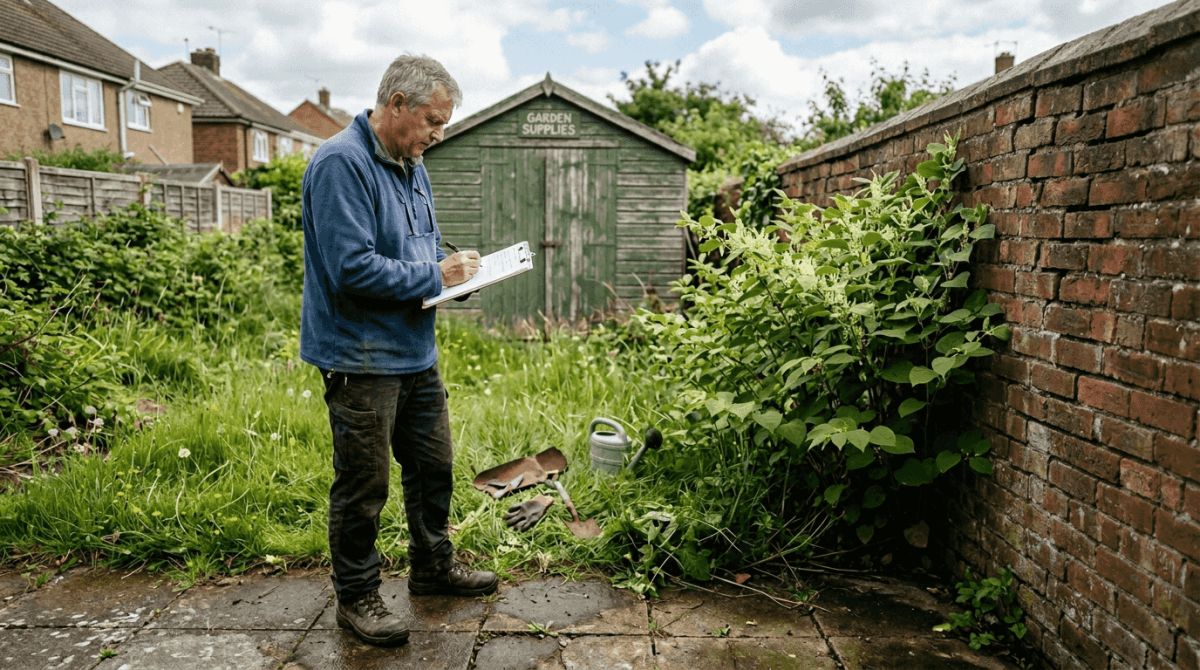
Before stepping onto your property with clipboard in hand, proper preparation separates effective assessments from wasted effort. Homeowners must comply with UK invasive species regulations during surveys, making legal awareness your first priority. Understanding your responsibilities prevents accidental violations that could trigger penalties or forced remediation.
Gather essential equipment to conduct a thorough survey:
- GPS device or smartphone mapping application for precise location recording
- Measuring tape (minimum 30 metres) for documenting spread dimensions
- High-resolution camera with date stamp function for visual evidence
- Survey report forms or digital templates for structured data collection
- Protective gloves and clothing to prevent rhizome disturbance
- Boundary markers to define survey zones systematically
Learning to identify Japanese knotweed accurately prevents confusion with similar species like horsetail or bamboo. Study visual guides showing distinctive features across seasons: bamboo-like hollow stems with purple speckles, heart-shaped leaves arranged alternately, and creamy-white flower clusters appearing late summer. The invasive plant identification UK guide provides seasonal photographs and comparison charts to sharpen your recognition skills.
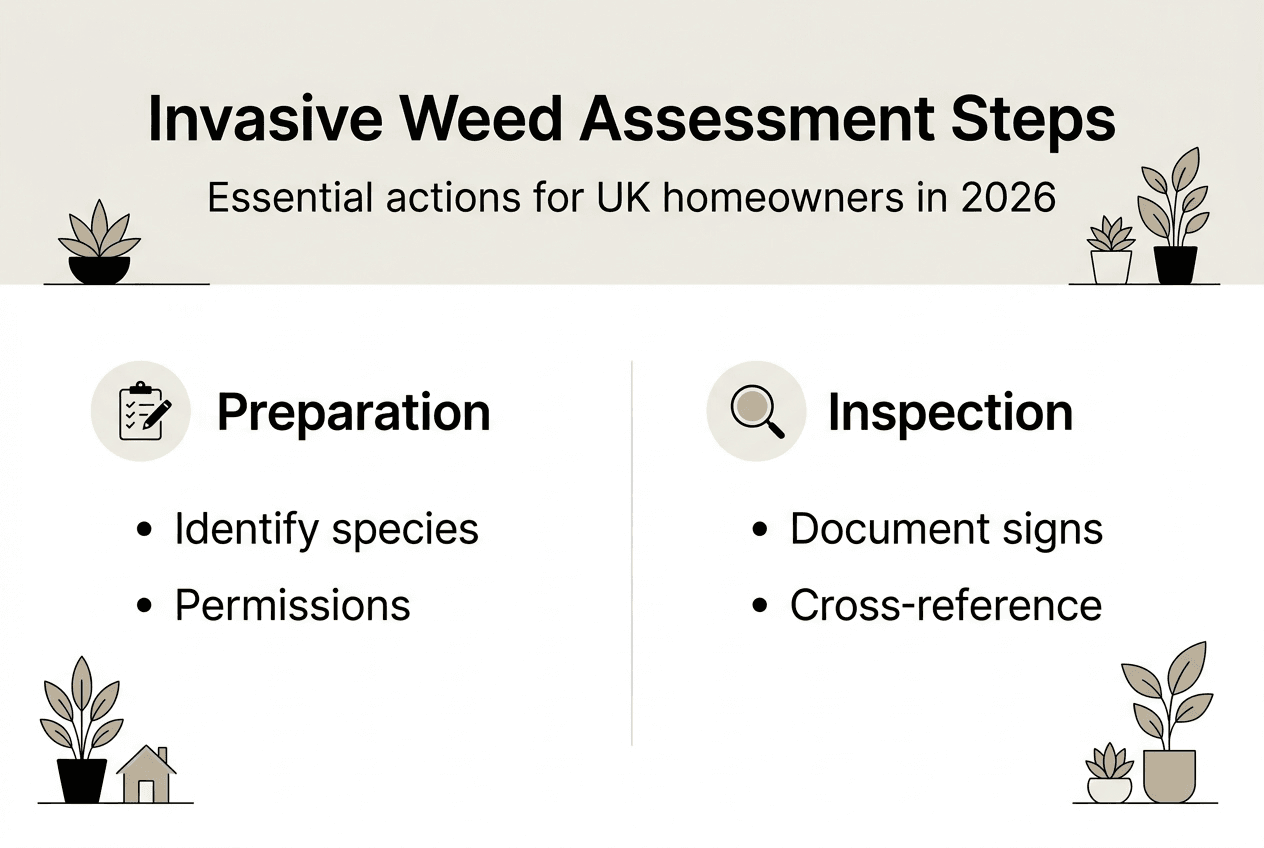
Obtain permission before surveying neighbouring properties where infestations may extend beyond your boundaries. Communicating proactively with neighbours demonstrates responsibility and prevents disputes that could complicate treatment efforts. Document permission in writing to protect against future disagreements.
Safe survey practices prevent accidental spread of viable rhizome fragments. Avoid digging or disturbing soil around suspected knotweed stands. Clean footwear and tools between survey zones to prevent transferring contaminated soil. Mark boundaries clearly using temporary fencing or spray paint to ensure systematic coverage without overlap.
Pro tip: Schedule your assessment during late summer when Japanese knotweed reaches peak growth, making identification straightforward and spread measurements most accurate.
Conducting a step-by-step invasive weed inspection
Systematic monitoring improves control success over time, making structured inspection methodology critical for reliable results. Follow this numbered sequence to gather comprehensive data:
- Begin at known or suspected infestation points identified during preliminary observations or property records.
- Establish a systematic grid pattern working outward from initial sites, ensuring complete property coverage.
- Measure surface spread dimensions using tape measure, recording length and width at widest points.
- Estimate underground rhizome extent, typically extending 3 metres horizontally and 2 metres vertically beyond visible growth.
- Photograph each infestation zone from multiple angles, including close-ups of identifying features and wide shots showing context.
- Document plant density using categories: sparse (individual stems), moderate (clustered stands), or dense (continuous coverage).
- Note growth stages present: emerging shoots, mature canes, flowering specimens, or winter dieback remnants.
- Record environmental conditions including soil type, drainage patterns, proximity to watercourses, and surrounding vegetation.
- Mark GPS coordinates for each infestation zone to enable accurate mapping and future monitoring comparisons.
Create a structured data table to organise findings systematically:
| Zone ID | GPS Coordinates | Surface Area (m²) | Density | Growth Stage | Proximity Risks |
|---|---|---|---|---|---|
| A1 | 51.5074, 0.1278 | 12.5 | Dense | Mature flowering | 2m from patio foundation |
| B3 | 51.5076, 0.1282 | 6.2 | Moderate | Mixed stages | Adjacent to boundary fence |
| C2 | 51.5072, 0.1275 | 3.8 | Sparse | Emerging shoots | Near drainage pipe |
Cross-reference your observations against established knotweed characteristics to eliminate misidentification. Compare leaf shape, stem structure, and growth patterns with reference materials. The guide to invasive plant surveys for homeowners offers detailed comparison frameworks distinguishing Japanese knotweed from commonly confused species.
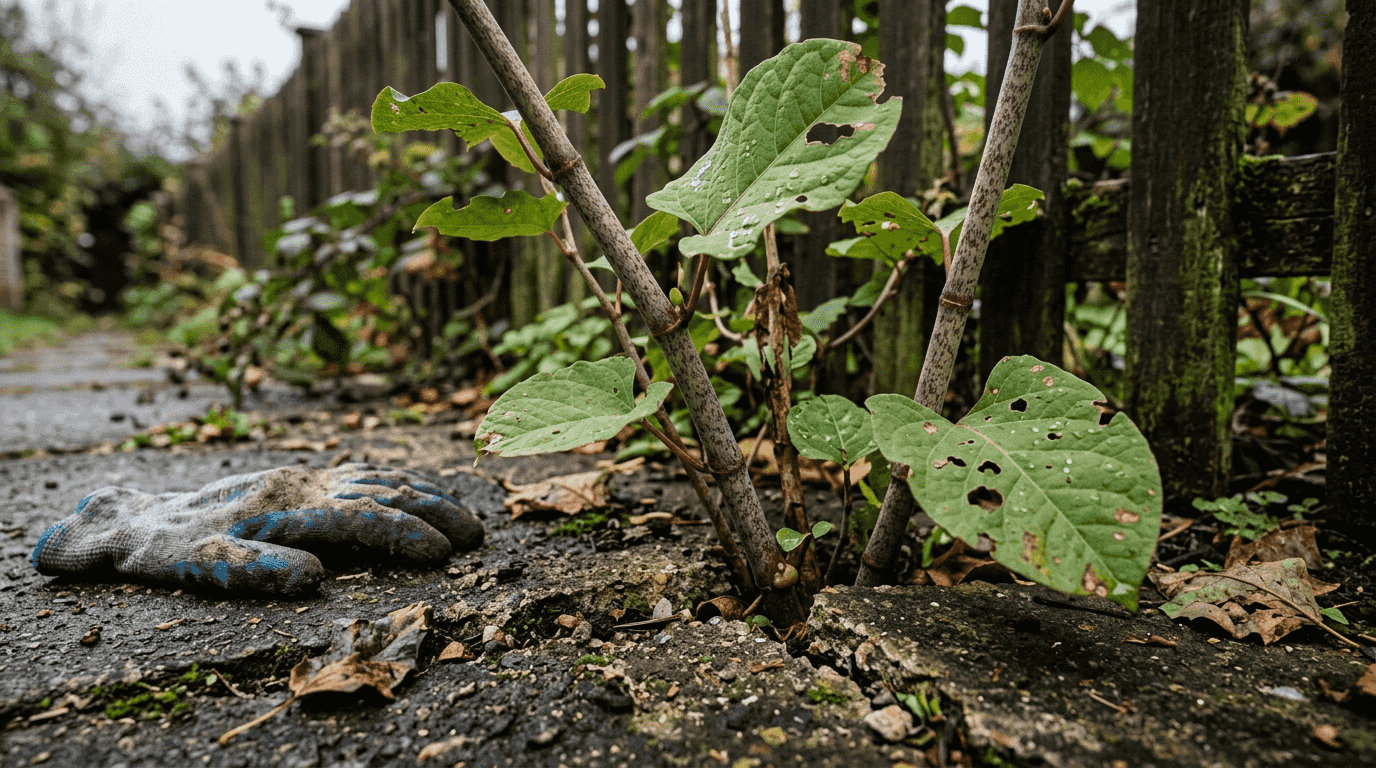
Document any signs of structural impact: cracked paving, displaced boundary walls, or compromised drainage systems. These observations inform treatment urgency and help quantify potential property damage for insurance or legal purposes.
Pro tip: Conduct inspections during late summer when distinctive creamy-white flowers and full foliage make identification unmistakable, avoiding the ambiguity of spring shoots or winter dieback.
Understanding assessment results and planning treatment
Interpreting your collected data transforms raw observations into actionable management strategies. Severity classifications guide decision-making: minor infestations (under 5m² with no structural threats) allow DIY approaches, moderate cases (5-20m² or near buildings) warrant professional consultation, and severe situations (over 20m² or causing damage) demand immediate expert intervention.
Effective treatment depends on accurate assessment enabling targeted approaches tailored to your specific infestation characteristics. Compare treatment methods using this framework:
| Treatment Type | Effectiveness | Duration | Environmental Impact | Cost Range |
|---|---|---|---|---|
| Chemical herbicide | 85-95% over 3-5 years | Long-term commitment | Soil and water contamination risks | £1,500-£5,000 |
| Chemical-free energy | 90-98% over 2-4 years | Faster results | Zero chemical residue | £2,000-£6,000 |
| Excavation | 95-100% immediate | Single intervention | Soil disposal regulations | £5,000-£15,000+ |
| Root barrier | Containment only | Permanent installation | Minimal impact | £3,000-£8,000 |
Property features significantly influence treatment selection. Infestations near watercourses prohibit certain chemical applications under environmental regulations. Proximity to foundations demands methods preventing further structural damage. Shared boundaries require neighbour coordination to prevent recolonisation from adjacent properties.
Legal responsibilities vary by jurisdiction but generally mandate preventing spread onto neighbouring land. Your assessment documentation provides evidence of proactive management, protecting against liability claims. Some mortgage lenders require professional treatment plans before approving property transactions, making thorough assessment records valuable for future sales.
Weigh DIY management against professional services honestly. Small, accessible infestations identified early suit informed homeowner intervention following strict protocols. Complex situations involving multiple zones, structural risks, or regulatory complications benefit from specialist expertise combining survey accuracy with proven eradication methods.
Common mistakes and how to avoid them during assessment
Disturbance of rhizome networks represents the most damaging error homeowners make during assessments. Digging exploratory holes or pulling stems fragments viable rhizomes, creating new infestation points that spread contamination. Always mark suspected areas without soil disturbance, relying on surface observations and measuring tape rather than excavation to estimate underground extent.
Misidentification undermines entire management programmes, directing resources toward wrong species whilst knotweed continues spreading unchecked. Don’t confuse Japanese knotweed with horsetail (thin, segmented stems with needle-like leaves) or bamboo (woody stems, narrower leaves, different growth pattern). Cross-reference multiple identification features rather than relying on single characteristics. Seasonal variations complicate recognition, making spring assessments particularly error-prone when only shoots appear without distinctive mature features.
Failing to document thoroughly invalidates insurance claims, legal defences, and treatment planning. Incorrect or incomplete assessments can lead to failed eradication and costly property damage. Photograph every infestation zone with date stamps, record precise measurements, and maintain written notes describing conditions. Digital records enable easy sharing with professionals, insurers, or legal advisors when needed.
Ignoring neighbour communication creates disputes that escalate into legal battles and treatment complications. Knotweed respects no boundaries, frequently spreading between properties through underground rhizomes. Proactive dialogue demonstrates good faith and facilitates coordinated management preventing recolonisation. Understanding legislation for invasive control affecting homeowners in England clarifies your obligations and rights regarding shared infestations.
Improper assessment handling risks severe legal consequences including court-ordered remediation, neighbour compensation claims, and mortgage complications that can derail property transactions indefinitely.
Use pre-survey and post-survey checklists ensuring completeness. Before starting, verify you have all equipment, understand identification features, and know legal requirements. After completing fieldwork, confirm you documented every zone with photographs, measurements, and written observations. Review data for gaps or inconsistencies whilst details remain fresh, returning to site if necessary to fill missing information.
Find expert support for invasive weed assessment and control
Whilst this guide empowers you with DIY assessment knowledge, professional expertise delivers comprehensive solutions for challenging infestations. Japanese Knotweed Agency offers specialist surveys tailored for UK homeowner needs, combining technical accuracy with practical treatment planning that addresses your specific property situation.
Our survey teams document infestations systematically using proven methodologies that satisfy regulatory requirements, mortgage lender standards, and insurance specifications. Professional assessments provide legally defensible evidence supporting treatment decisions and protecting your property interests. Chemical-free treatment solutions eliminate knotweed whilst safeguarding your family, pets, and surrounding environment from herbicide exposure. Direct energy delivery targets rhizome networks precisely, achieving faster eradication than traditional chemical programmes.
Access our step by step invasive weed management resources to understand how professional intervention complements your assessment efforts. Browse the Japanese Knotweed FAQ listing for answers to common questions about surveys, treatment options, and regulatory compliance. Review our chemical-free knotweed treatment process to see how innovative technology delivers superior results without environmental compromise.
FAQ
How do I identify Japanese knotweed during an assessment?
Look for bamboo-like hollow stems with distinctive purple speckles, heart-shaped leaves arranged alternately along stems, and dense clusters growing 2-3 metres tall during summer. Creamy-white flower spikes appear late summer, providing unmistakable confirmation. Be mindful of seasonal changes: winter dieback leaves only dead brown canes, whilst spring shows red or purple shoots emerging from soil. Refer to the invasive plant identification UK guide for visual confirmation across all growth stages.
What legal responsibilities do homeowners have for invasive weeds?
Homeowners must prevent Japanese knotweed spread onto neighbouring properties and comply with local environmental protection laws governing invasive species management. Allowing knotweed to encroach across boundaries constitutes legal nuisance, exposing you to compensation claims and court-ordered remediation costs. Failure to comply with invasive species compliance requirements can trigger enforcement action from local authorities, including substantial fines and mandatory treatment programmes at your expense.
When is the best time to perform an invasive weed assessment?
Late summer to early autumn provides optimal conditions when Japanese knotweed displays full growth and distinctive features, enabling straightforward identification and accurate spread measurement. Mature plants show characteristic heart-shaped leaves, purple-speckled stems, and creamy flower clusters that eliminate identification ambiguity. Winter assessments prove unreliable due to complete dieback leaving only dead canes, whilst spring shoots lack distinctive features that separate knotweed from similar species.
Can I manage Japanese knotweed on my own, or do I need professional help?
Small infestations under 5m² located away from structures might suit informed DIY management following strict protocols that prevent rhizome disturbance and comply with disposal regulations. However, large or complex sites involving multiple infestation zones, proximity to buildings, or shared boundaries require expert intervention ensuring legal compliance and effective control. Professional services provide guaranteed eradication, satisfy mortgage lender requirements, and protect against liability risks that DIY efforts cannot address comprehensively.