

TL;DR:
- Thermo electric knotweed treatment is a chemical-free method that uses high-voltage pulses to destroy the plant’s cell structure and exhaust its rhizome energy reserves. It requires multiple professional sessions over one to three years, with careful site preparation, legal compliance, and sometimes combined excavation for dense infestations. This environmentally responsible approach is the most suitable for residential areas where chemical treatments are restricted or undesirable.
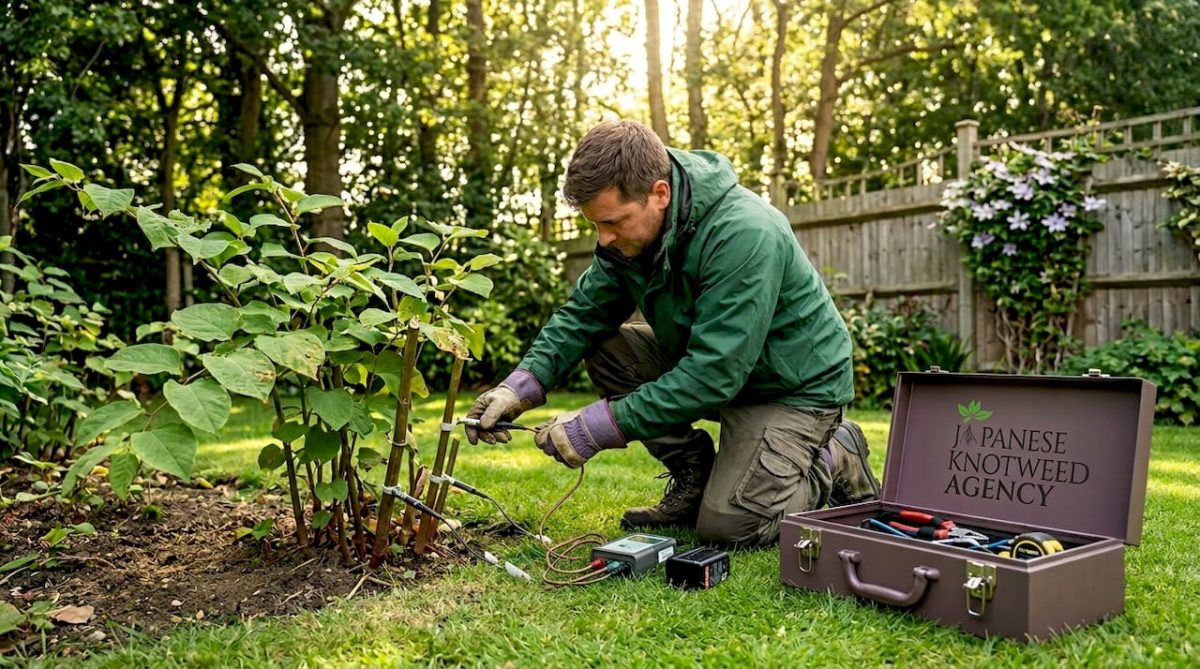
Thermo electric knotweed treatment is defined as a chemical-free eradication method that delivers controlled electrical pulses directly into Japanese knotweed stems and rhizomes, causing irreversible internal cell damage without disturbing surrounding soil life. Japaneseknotweedagency, pioneers in non-chemical invasive species management, deploy systems delivering up to 5,000 volts on site, targeting the plant’s extensive root network with each treatment session. Unlike glyphosate-based programmes, this approach leaves no chemical residue in the soil, making it the preferred knotweed treatment option for environmentally sensitive sites, gardens near watercourses, and properties where mortgage lenders require a documented, insured management plan. The method requires multiple sessions over an extended period, and professional oversight is not optional. It is the most responsible path to controlled knotweed destruction for the majority of residential properties in England, Wales, and Ireland.
What is thermo electric knotweed treatment and how does it work?
Thermo electric treatment, more precisely termed electrothermal treatment in academic and ecological literature, works by passing high-voltage electrical current through the plant’s vascular system. The current generates heat internally, destroying cell walls from the inside outward, and progressively depletes the energy reserves stored in the rhizome network. Japaneseknotweedagency’s field systems deliver direct energy up to 5,000 volts on site, which is calibrated to penetrate deep into the root mass with each application.
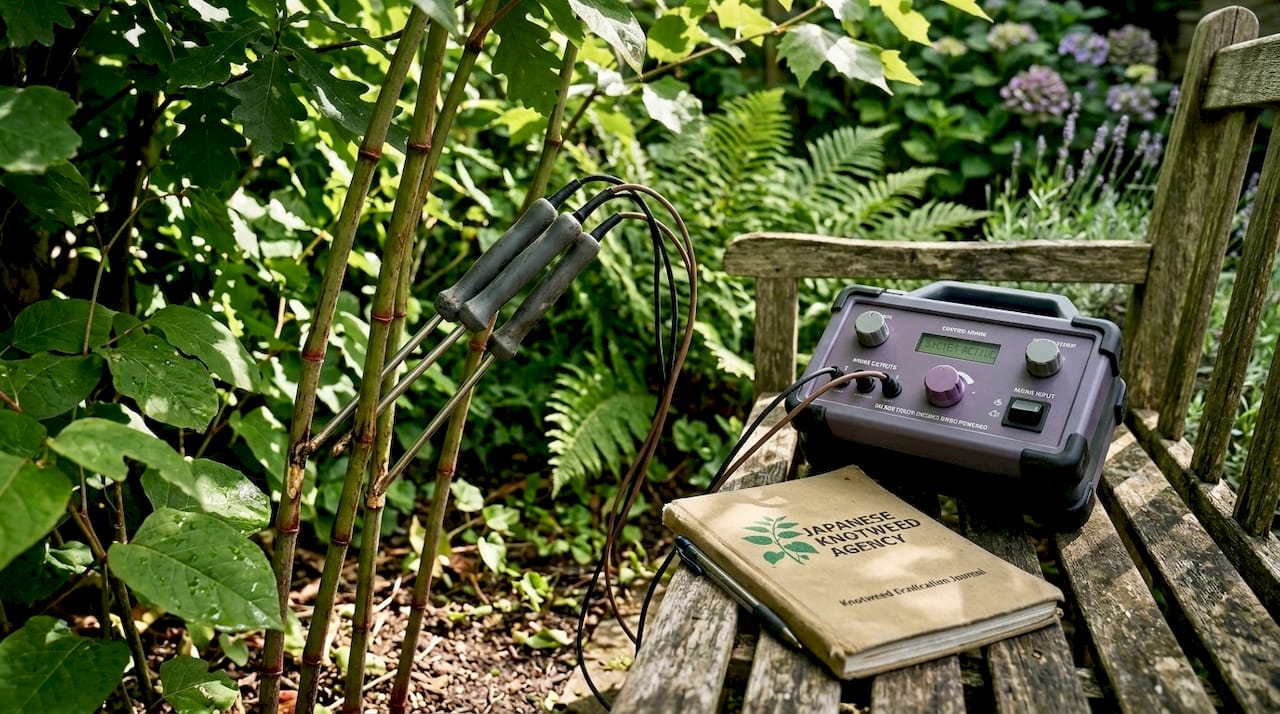
Electrothermal treatment reaches up to 8,000 volts in some professional configurations, achieving 98% effectiveness after four treatment rounds delivered annually. That figure matters because it sets a realistic expectation: this is not a single-visit solution. The plant’s rhizomes can extend up to 7 metres laterally, meaning a single visible stem above ground represents a far larger underground structure that requires persistent, targeted treatment cycles to exhaust.
The process is precise. Electrical probes or lances are inserted into or pressed against the stem at multiple points, delivering pulses that travel downward through the plant’s own conductive tissue. Surrounding soil organisms, tree roots, and adjacent planting are not affected, which is a significant advantage over excavation on established gardens or near structures.
What preparation and equipment are needed before treatment?
Effective thermo electric knotweed treatment begins well before the first electrical pulse is delivered. A professional survey is the non-negotiable first step, establishing the full extent of the infestation, identifying rhizome spread beneath hard surfaces, and producing the documentation that mortgage lenders and solicitors require. You can book a professional survey directly with Japaneseknotweedagency, who cover England, Wales, and Ireland.
Legal obligations you must understand first
Homeowners carry specific legal responsibilities regarding knotweed on their land. Allowing it to spread to neighbouring land or a public highway is a legal offence under UK law, and improper disposal risks prosecution with fines up to £5,000 or imprisonment of up to two years. Knotweed waste is classified as controlled waste under the Environmental Protection Act 1990, meaning it must be transported to a licensed landfill or incineration facility by a registered waste carrier.
Equipment and site preparation overview
| Equipment or step | Purpose | Typical scenario |
|---|---|---|
| Professional survey | Maps rhizome extent and documents infestation | All properties before any treatment |
| High-voltage electrical device | Delivers electrothermal pulses to stems and roots | All thermo electric treatment sessions |
| Protective gear (insulated gloves, boots) | Operator safety during live electrical application | Mandatory for all sessions |
| Mechanical excavator or hand tools | Removes largest root blocks prior to electrical treatment | Dense infestations, large gardens |
| Root barrier membrane | Prevents lateral rhizome spread post-treatment | Boundary areas, driveways |
Key site preparation steps include:
- Clearing surface vegetation to expose main stems clearly
- Identifying and marking the full infestation boundary using survey data
- Removing large, accessible root masses mechanically where ground conditions allow, as mechanical excavation prior to electrical treatment reduces the plant’s energy stores and improves overall efficiency
- Confirming waste disposal arrangements with a licensed carrier before any excavated material leaves the site
- Notifying neighbours if the infestation is near a shared boundary, since coordinated treatment prevents recolonisation from adjacent land
Pro Tip: Request a written management plan from your treatment provider before work begins. Mortgage lenders and conveyancers increasingly require this documentation as part of property transactions involving knotweed.
How is thermo electric treatment carried out step by step?
The treatment process follows a structured sequence across multiple visits. Understanding this sequence helps you set realistic expectations and monitor progress accurately.
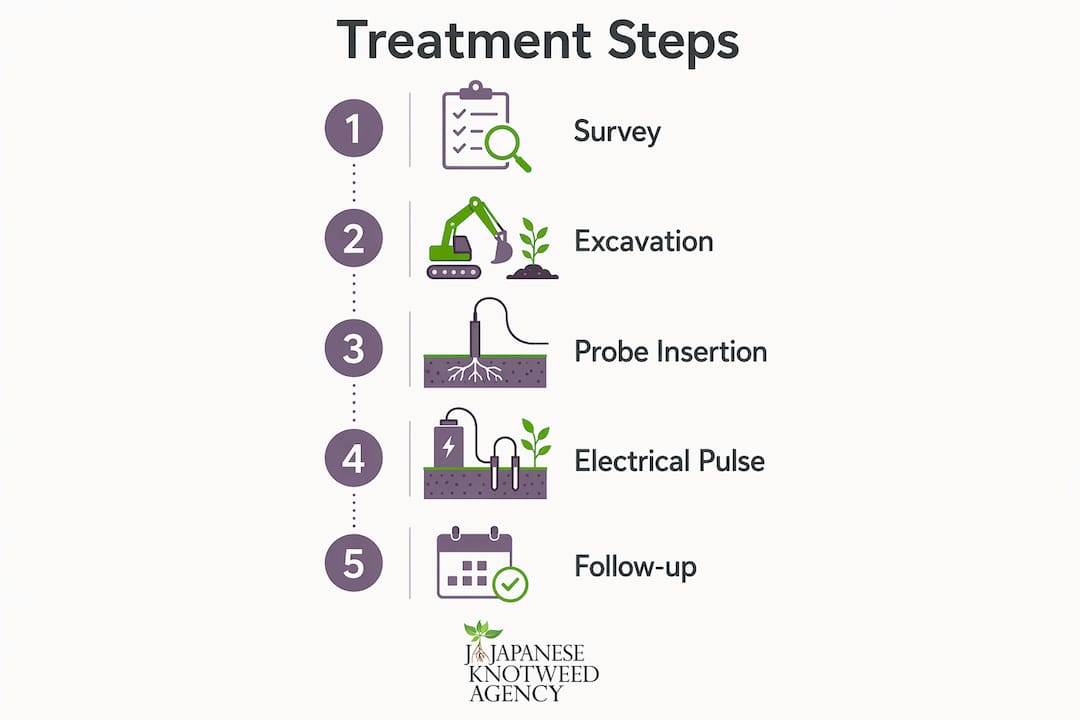
- Initial mechanical excavation where the infestation is dense. Removing the largest root blocks first reduces the volume of plant material the electrical system must work through, and lowers the number of sessions required overall.
- First electrical treatment session. Probes or lances are applied to each stem at multiple points. High-voltage pulses travel through the vascular tissue, generating internal heat and beginning cell destruction throughout the connected rhizome network.
- Removal of treated stems. Dead and dying material is cut back and removed to a licensed disposal facility. Leaving treated stems in place can mask regrowth and complicate monitoring.
- Follow-up sessions at six-week intervals. Four treatment rounds per year is the standard protocol, targeting new growth as it emerges and progressively exhausting the rhizome’s energy reserves.
- Treatment of resprouting stems. After initial sessions, thinner, weaker stems regrow from residual rhizome sections. These are treated with further electrical passes or, where appropriate, controlled burning. Thinner regrowth after treatment is significantly easier to manage than the original stand.
- Ongoing monitoring. After the active treatment programme, the site requires regular inspection for at least one growing season to confirm eradication is complete.
| Stage | Timing | Expected outcome |
|---|---|---|
| Mechanical excavation | Before first electrical session | Reduced root mass, improved access |
| First electrical session | Growing season start | Initial cell destruction, stem dieback |
| Follow-up sessions | Every six weeks, four per year | Progressive rhizome depletion |
| Regrowth management | As new stems appear | Weaker, manageable regrowth |
| Post-treatment monitoring | Ongoing for 1 to 3 years | Confirmation of eradication |
Pro Tip: Photograph the infestation at each visit. A dated photographic record demonstrates treatment progress to mortgage lenders and provides evidence of compliance with your management plan.
How does thermo electric treatment compare to other knotweed removal methods?
Homeowners considering their knotweed treatment options typically weigh three main approaches: herbicide programmes, excavation, and electrothermal treatment. Each has a distinct profile of cost, timescale, environmental impact, and suitability.
Growing restrictions on glyphosate and increasing environmental scrutiny limit the scope of chemical treatment, particularly near watercourses, on organic land, or where soil contamination is a concern. Herbicide programmes typically require three to five years of repeated application and leave chemical residues that affect soil biology. They remain legal and are used by many contractors, but they are not suitable for all sites.
Excavation is faster but significantly more disruptive and expensive. Professional treatment costs range from £2,000 to £5,000, with severe cases exceeding £10,000. Full excavation at the upper end of that range involves removing contaminated soil to a licensed facility, which adds substantial cost and leaves the site requiring reinstatement.
| Method | Timescale | Environmental impact | Suitable for |
|---|---|---|---|
| Thermo electric treatment | 1 to 3 years, multiple sessions | Minimal, no chemical residue | Most residential sites, sensitive areas |
| Herbicide (glyphosate) | 3 to 5 years | Moderate, chemical residue in soil | Open land, away from watercourses |
| Full excavation | Weeks to months | High, soil disruption and transport | Severe infestations, development sites |
| Root barrier only | Ongoing containment | Low | Boundary management, not eradication |
DIY knotweed removal carries specific risks beyond ineffectiveness. Cutting or disturbing rhizomes without proper disposal creates controlled waste disposal obligations that most homeowners are not equipped to meet. A fragment of rhizome as small as 0.7 grams can regenerate a new plant, meaning amateur attempts frequently spread the infestation rather than reduce it.
Common challenges and best practices for successful treatment
The most frequent challenge in electrothermal treatment programmes is underestimating the persistence required. Electrothermal treatment requires multiple sessions over three years to achieve near-complete eradication, and homeowners who expect a single-season result are consistently disappointed. The rhizome network is the plant’s primary energy store, and it takes repeated depletion across growing seasons to exhaust it fully.
Dense infestations present a particular operational challenge. Thermo electric treatment alone is less efficient for dense stands without prior mechanical removal, which is why Japaneseknotweedagency combines excavation works with electrical treatment where site conditions demand it. This hybrid approach is not a compromise. It is the recognised best practice for knotweed control in high-density scenarios.
Key best practices for successful treatment outcomes:
- Coordinate treatment with neighbours if the infestation crosses or approaches a shared boundary. Knotweed spreading from untreated adjacent land will recolonise a treated site within a single growing season.
- Arrange licensed waste disposal before any excavation or stem removal takes place. Stockpiling knotweed material on site while awaiting collection is a legal risk.
- Do not rotovate or strim the infestation. Both actions fragment rhizomes and spread the plant.
- Maintain treatment intervals. Extending the gap between sessions allows the plant to recover energy reserves and reduces the cumulative effect of the programme.
- Seek professional reassessment if regrowth appears more vigorous than expected after the second year. This may indicate an unidentified rhizome mass outside the original survey boundary.
Jack Malnick notes that unchecked knotweed infestations increase treatment costs exponentially due to root spread and property damage risks. Early professional intervention is consistently the most cost-effective decision a homeowner can make.
Pro Tip: If you are purchasing a property where knotweed is present, commission an independent invasive weed survey before exchange of contracts. The survey will establish the true extent of the infestation and inform your negotiating position.
Key takeaways
Thermo electric knotweed treatment is the most environmentally responsible eradication method available for residential properties, requiring multiple professional sessions over one to three years to achieve near-complete results.
| Point | Details |
|---|---|
| Chemical-free eradication | Electrothermal treatment destroys knotweed internally without soil contamination or chemical residue. |
| Multiple sessions required | Four treatment rounds per year over one to three years is the standard protocol for effective eradication. |
| Preparation is critical | A professional survey and legal waste disposal plan must be in place before treatment begins. |
| Hybrid approaches work best | Dense infestations require mechanical excavation combined with electrical treatment for optimal results. |
| Legal risks are real | Improper disposal carries fines up to £5,000 or imprisonment; always use licensed professionals. |
Why I believe thermo electric treatment is the right choice for most homeowners
Having worked with properties across England, Wales, and Ireland, I have seen the full spectrum of knotweed scenarios. What consistently strikes me is how often homeowners delay treatment because the plant does not look serious enough to warrant professional intervention. By the time rhizomes have spread beneath a patio or into a neighbouring garden, the cost and complexity of eradication have multiplied considerably.
Thermo electric treatment appeals to me precisely because it is honest about what it requires. It is not quick, and it is not cheap. But it does not compromise the soil, it does not put you in conflict with environmental regulations, and it produces a documented treatment record that satisfies mortgage lenders and conveyancers. For properties near watercourses, on organic land, or in ecologically sensitive areas, it is frequently the only viable professional option.
The homeowners I see achieve the best outcomes are those who act early, commission a proper survey, and commit to the full treatment programme rather than stopping after the first visible improvement. Knotweed does not reward half-measures. A persistent, professionally managed electrothermal programme, combined with mechanical removal where needed, is the most reliable path to a knotweed-free property.
— Alan
How Japaneseknotweedagency can help you take the next step
Japaneseknotweedagency are specialists in chemical-free knotweed eradication, delivering direct electrical energy up to 5,000 volts on site to deplete the rhizome network with each treatment visit. The team covers England, Wales, and Ireland, offering professional surveys, tailored treatment plans, root barrier installation, and excavation works where required.
Every treatment programme begins with a thorough site survey to establish the full extent of the infestation and produce the documentation your mortgage lender or solicitor may require. Japaneseknotweedagency operates to strict legal and environmental standards, using only licensed waste carriers and fully insured treatment operatives. If you have identified knotweed on your property or are purchasing a site where it is present, the most productive first step is to book a survey and receive a clear, honest assessment of what treatment involves.
FAQ
What is thermo electric knotweed treatment?
Thermo electric knotweed treatment, formally known as electrothermal treatment, delivers high-voltage electrical pulses directly into Japanese knotweed stems and rhizomes, destroying the plant’s internal cell structure without the use of chemicals. Japaneseknotweedagency deploy systems up to 5,000 volts on site, targeting the root network progressively across multiple treatment sessions.
How many sessions does thermo electric treatment require?
The standard protocol involves four treatment rounds per year, typically at six-week intervals, over a period of one to three years. Near-complete eradication at 98% effectiveness is achievable after four annual rounds, though dense infestations may require combined mechanical excavation alongside electrical treatment.
Is thermo electric treatment legal and safe for the environment?
Thermo electric treatment is fully legal in the UK and produces no chemical residue in the soil, making it suitable for use near watercourses, on organic land, and in ecologically sensitive areas. It is the preferred non-chemical option where glyphosate restrictions or environmental conditions rule out herbicide programmes.
Can I carry out thermo electric knotweed treatment myself?
DIY electrothermal treatment is not recommended. The equipment operates at voltages that present serious safety risks without professional training, and improper handling of excavated knotweed material carries legal penalties up to £5,000. Licensed professionals also provide the documented management plan that mortgage lenders require.
Does knotweed affect my ability to sell my property?
Knotweed presence on or near a property can affect mortgage lending decisions and property valuations. A professionally managed treatment programme with documented records significantly improves your position when selling a property with knotweed, as it demonstrates legal compliance and a credible eradication plan to prospective buyers and their lenders.
Recommended
- Combatting Japanese Knotweed in Derbyshire: The Future of Weed Control with Thermo-Electric Treatment
- Step-by-Step Process for Chemical Free Knotweed Treatment
- Combatting Japanese Knotweed in Glastonbury: Sustainable Solutions with Thermo-Electric Treatment
- Knotweed Eradication Workflow: Effective Chemical-Free Solutions