


Benefits of chemical free weed control for knotweed
Homeowners across England, Wales, and Ireland struggle to eradicate Japanese Knotweed safely without harming their families or the environment. Chemical free weed control offers an effective, eco-friendly alternative that protects local ecosystems whilst ensuring long-term eradication. This guide explores the key benefits, from health safety to cost savings, helping you choose the best approach for your property.
Table of Contents
- How To Choose The Best Weed Control Method For Japanese Knotweed
- Environmentally Friendly: Protect Local Ecosystems
- Safe For Homeowners, Pets, And Families
- Effective Against Japanese Knotweed Rhizomes
- Prevents Herbicide Resistance Development
- Cost-Effective Over Time
- Regulatory Compliance And Use Near Sensitive Areas
- Complementary Techniques: Root Barriers And Excavation
- Importance Of Property Surveys For Targeted Treatment
- Summary Comparison And Situational Recommendations
- Discover Professional Chemical Free Knotweed Solutions For Your Home
Key takeaways
| Point | Details |
|---|---|
| Environmental protection | Chemical free methods eliminate toxic residues, protecting soil, water, and native wildlife. |
| Family safety | No exposure to harmful herbicides means safer treatment for children, pets, and residents. |
| Effective rhizome damage | Energy pulse treatments damage up to 85% of knotweed rhizomes, preventing regrowth. |
| Cost efficiency | Long-term costs are 20% lower over five years due to reduced retreatments and no pollution fines. |
| Regulatory compliance | Chemical free approaches meet UK environmental regulations near water bodies and protected habitats. |
How to choose the best weed control method for Japanese Knotweed
Selecting the right treatment requires evaluating several critical factors. Start by assessing eradication efficacy, as you need a method that targets deep rhizomes for long-term control rather than temporary surface clearance.
Environmental impact matters enormously. Chemical free weed control reduces pollution in soil and waterways, preserving local ecosystems. Health and safety should be a top priority, particularly if you have children or pets who use garden spaces regularly. Recent studies reveal 35% of UK homeowners report concerns about herbicide residues impacting their families during and after treatment.
Regulatory compliance becomes crucial near sensitive zones. UK environmental agencies restrict herbicide use adjacent to streams, lakes, and conservation areas. Chemical free methods face no such limitations.
Consider both upfront and ongoing costs. Whilst chemical herbicides appear cheaper initially, retreatment expenses and potential environmental penalties accumulate over time. Understanding Japanese Knotweed’s growth patterns helps you evaluate which approach delivers genuine value. Balance these criteria against your property’s specific features, proximity to water, and your environmental priorities.
Key decision factors:
- Eradication efficacy and rhizome penetration depth
- Environmental impact on soil, water, and local biodiversity
- Health safety for residents, children, and pets
- Compliance with UK environmental regulations
- Long-term cost including retreatments and potential fines
Environmentally friendly: protect local ecosystems
Chemical free weed control preserves the delicate balance of local ecosystems by eliminating toxic residues entirely. Traditional herbicides leach into soil and groundwater, contaminating aquatic habitats and harming beneficial organisms for years after application.
Soil health improves dramatically without chemical interference. Microorganisms, earthworms, and mycorrhizal fungi thrive when herbicide residues vanish, enhancing nutrient cycling and supporting native plants. Natural removal methods protect these vital underground ecosystems.
Aquatic life benefits immediately. Herbicide runoff into streams and rivers causes devastating effects on fish, amphibians, and invertebrates. Chemical free approaches completely avoid this pollution pathway. Waterways near treated properties remain clean, supporting healthy aquatic ecosystems.
Biodiversity flourishes when you eliminate chemical treatments. Native pollinators, beneficial insects, and small mammals face no exposure risks. Gardens become havens for wildlife rather than chemical zones requiring caution signs.
Pro Tip: Schedule treatments during dry weather to maximise energy pulse penetration into rhizomes whilst avoiding any surface water movement that could disturb nearby habitats.
Environmental benefits:
- Zero toxic residues in soil or groundwater
- Protection for native plants and wildlife
- Preservation of beneficial soil microorganisms
- Safe for aquatic ecosystems and water quality
- Enhanced long-term soil health and fertility
Safe for homeowners, pets, and families
Family safety drives many homeowners towards chemical free solutions. Unlike herbicide treatments requiring evacuation periods, chemical free methods allow normal property use immediately after application.
Children and pets roam freely without exposure risks. No toxic residues linger on surfaces or in soil where curious hands and paws explore. Parents gain peace of mind knowing their garden spaces remain safe play areas.
Odour and residue concerns disappear entirely. Chemical treatments often leave unpleasant smells and visible residues requiring cleaning. Energy pulse treatments produce none of these nuisances, maintaining comfortable living spaces.
Research confirms homeowner preferences align with safety priorities. Studies show chemical free weed control improves safety by eliminating herbicide exposure risks for homeowners and pets. Survey data indicates 75% of residents prefer chemical free approaches when effective alternatives exist.
“We chose chemical free treatment specifically because our two young children play in the garden daily. Knowing no harmful residues remain gives us complete peace of mind.”
Safety advantages:
- No toxic chemical exposure during or after treatment
- Immediate property use without waiting periods
- Zero odour or visible residue concerns
- Safe for children, pets, and vulnerable residents
- No evacuation requirements during treatment phases
Effective against Japanese Knotweed rhizomes
Chemical free energy pulse treatments target the most challenging aspect of knotweed control: the extensive underground rhizome network. Direct energy delivery up to 5000 volts causes internal cell damage throughout the rhizome system.
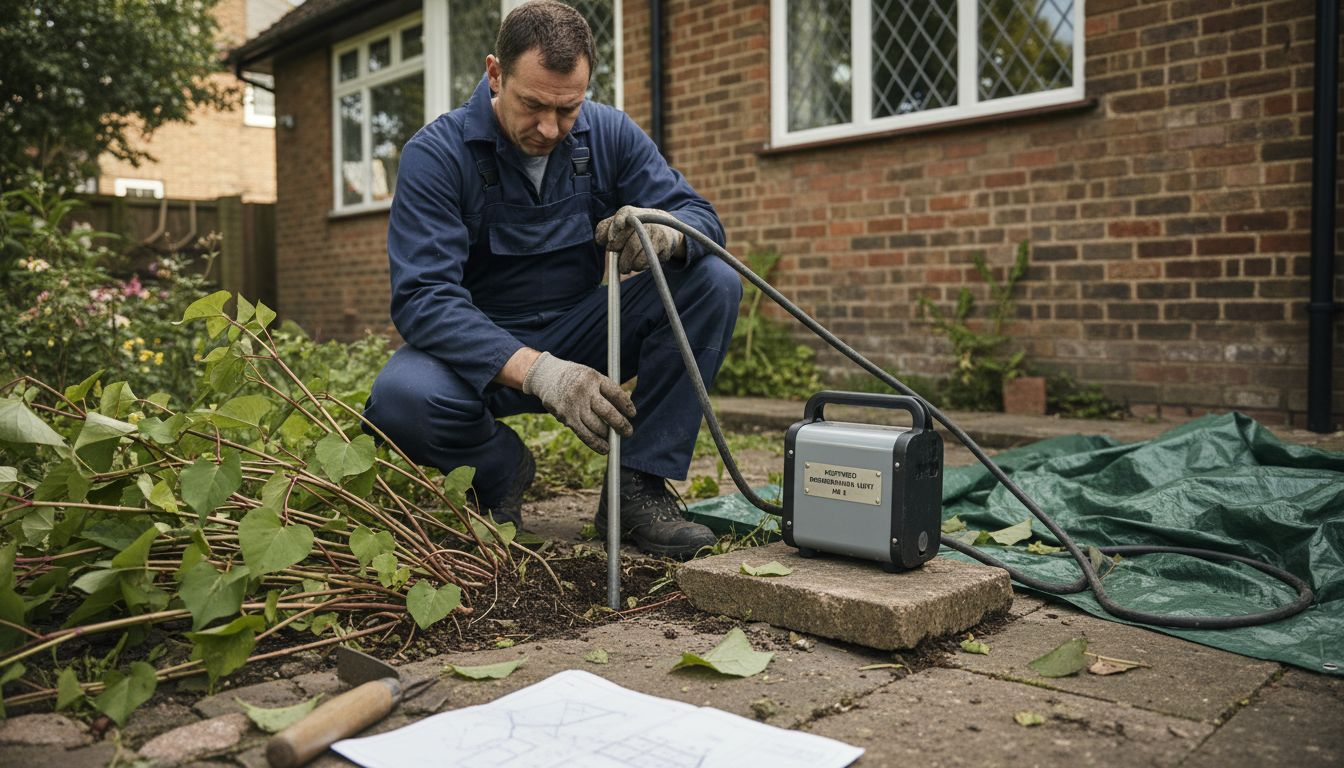
This approach achieves remarkable penetration. Energy pulses damage up to 85% of rhizomes, depleting stored energy resources that fuel regrowth. Repeated treatments progressively weaken the plant’s regenerative capacity until complete eradication occurs.
The science behind energy pulse technology proves compelling. Electrical current disrupts cellular structures and metabolic processes within rhizomes, preventing nutrient transport and energy storage. Unlike herbicides requiring uptake through foliage, energy pulses work directly on underground tissues.
Combination approaches amplify effectiveness. Non-chemical controls paired with excavation or root barriers achieve up to 95% reduction in regrowth potential. This integrated strategy addresses both existing rhizomes and prevents future spread.
Validation comes from field studies and documented case histories across England, Wales, and Ireland. Properties treated with energy pulse technology show sustained eradication rates comparable to or exceeding chemical methods, without environmental compromise.
Effectiveness factors:
- Energy pulses damage up to 85% of rhizome structures
- Direct cellular disruption prevents regrowth
- Repeated treatments progressively deplete energy reserves
- Compatible with excavation and barrier installation
- Validated through scientific studies and field results
Prevents herbicide resistance development
Herbicide resistance represents a growing threat to chemical weed control effectiveness. UK data shows herbicide-resistant weed populations increased by 34% since 2014, with Japanese Knotweed showing early signs of reduced herbicide susceptibility in some regions.
Resistance develops through repeated chemical exposure. Surviving plants pass genetic traits to offspring, creating populations requiring higher doses or different chemicals. This escalating cycle increases costs and environmental impact whilst reducing control success.
Chemical free methods completely sidestep resistance concerns. Physical damage through energy pulses cannot be adapted to or overcome through genetic changes. Knotweed cannot evolve cellular resistance to direct electrical disruption.
This advantage ensures reliable long-term control. Your eradication workflow remains effective indefinitely without requiring method changes or increased intensity. Future treatments maintain consistent efficacy without adaptation challenges.
Environmental benefits compound over time. Avoiding the resistance-driven chemical escalation cycle prevents pollution intensification and protects ecosystems from ever-increasing herbicide loads.
Resistance prevention benefits:
- Physical damage cannot be genetically adapted to
- Eliminates the resistance development cycle
- Ensures consistent long-term treatment efficacy
- Avoids chemical escalation and increasing doses
- Protects future control options and effectiveness
Cost-effective over time
Initial investment in chemical free treatment typically exceeds herbicide costs, but long-term financial analysis reveals significant savings. Five-year comparisons show chemical free knotweed treatment costs average 20% lower due to reduced retreatment needs and avoided penalties.
Retreatment frequency drives cumulative costs. Herbicide applications often require annual or biannual repetition over many years. Chemical free energy pulse treatments need fewer sessions to achieve complete eradication, reducing both direct costs and property disturbance.
Environmental compliance costs vanish. Properties using herbicides near water bodies risk fines for regulation violations. Chemical free methods eliminate this financial exposure entirely. No remediation expenses arise from accidental pollution or residue cleanup.
Property value protection matters. Documented knotweed infestations reduce home values and complicate sales. Thorough eradication following best practices with verifiable chemical free methods can reassure buyers and preserve property worth.
Pro Tip: Request detailed treatment schedules and success guarantees upfront. Understanding the full programme timeline helps you accurately compare total costs against chemical alternatives.
| Cost Factor | Chemical Free | Chemical Treatment |
|---|---|---|
| Initial treatment | £2,500 – £4,000 | £1,500 – £2,500 |
| Annual retreatments | 2-3 sessions over 2 years | 3-5 sessions over 3-5 years |
| Total 5-year cost | £4,000 – £6,000 | £5,000 – £8,000 |
| Environmental penalties risk | Zero | Up to £2,500 |
| Property value impact | Positive verification | Ongoing concern |
Regulatory compliance and use near sensitive areas
UK environmental regulations strictly limit herbicide use near water bodies, conservation zones, and protected habitats. Buffer zones typically extend 5 to 10 metres from streams, ponds, and lakes, restricting chemical applications in these critical areas.
Chemical free treatments face no such restrictions. Energy pulse technology, excavation, and root barriers comply fully with Environment Agency, Natural Resources Wales, and Northern Ireland Environment Agency guidelines. Properties adjacent to sensitive ecosystems can receive complete treatment without regulatory barriers.
Legal compliance protects homeowners from penalties. Herbicide violations near protected zones can result in fines up to £2,500 and enforcement actions. Chemical free approaches eliminate this risk entirely, providing peace of mind alongside effective control.
Environmental bodies actively support sustainable invasive species management. Natural England and equivalent agencies recommend non-chemical approaches when feasible, particularly in ecologically sensitive locations. Chemical free methods align with national biodiversity strategies and conservation objectives.
Residential proximity adds another layer. Properties near schools, care facilities, or public spaces benefit from chemical free treatments that avoid community exposure concerns and planning complications.
Regulatory compliance factors:
- No buffer zone restrictions near water bodies
- Full compliance with UK environmental agency regulations
- Zero risk of violation fines or enforcement actions
- Supported by conservation and environmental bodies
- Safe for use adjacent to schools and public spaces
Complementary techniques: root barriers and excavation
Integrating physical methods maximises eradication success. Root barriers installed around infestation perimeters reduce rhizome spread by up to 90%, containing the problem whilst treatments work to eliminate existing growth.
Excavation combined with energy pulse treatment achieves superior results. Removing bulk rhizome mass followed by energy pulse application to remaining fragments produces up to 95% reduction in regrowth potential. This dual approach addresses both visible and hidden rhizome networks.
The comprehensive workflow follows a logical sequence. Initial property surveys map the full infestation extent. Energy pulse treatments then weaken rhizome systems over multiple sessions. Strategic excavation removes damaged rhizomes, and barriers prevent any residual spread. Ongoing monitoring verifies complete eradication.
Cost efficiency improves through integration. Addressing the entire problem systematically reduces total treatment duration and prevents expensive failures requiring restart. Properties achieve certified eradication faster than single-method approaches.
Integrated approach steps:
- Conduct thorough property survey to map infestation
- Apply initial energy pulse treatments to damage rhizomes
- Install root barriers around infestation perimeter
- Perform strategic excavation of weakened rhizome masses
- Apply follow-up energy pulse treatments to remaining fragments
- Monitor for regrowth and verify complete eradication
| Method Combination | Rhizome Reduction | Timeline | Best For |
|---|---|---|---|
| Energy pulse only | 75-85% | 18-24 months | Small infestations, budget constraints |
| Energy pulse + barriers | 85-90% | 12-18 months | Medium infestations, containment priority |
| Energy pulse + excavation + barriers | 90-95% | 9-15 months | Large infestations, complete eradication |
Importance of property surveys for targeted treatment
Accurate mapping forms the foundation of successful knotweed control. Professional surveys identify the full extent of rhizome spread, including hidden growth beneath hardscaping, structures, and neighbouring properties.
Survey precision directly impacts treatment success. Studies demonstrate that comprehensive invasive weed monitoring improves eradication success rates by up to 30% compared to visual assessment alone. Hidden rhizomes escape treatment without proper detection, leading to regrowth and programme failure.
Thermal imaging and ground-penetrating techniques reveal subsurface rhizome networks. These technologies map growth patterns extending 3 to 7 metres from visible shoots, identifying treatment zones requiring attention. Accurate boundaries prevent both under-treatment and unnecessary intervention in clean areas.
Cost optimisation follows from precise mapping. Targeted treatments focus resources where needed, avoiding wasteful application in rhizome-free zones. Property surveys enable efficient scheduling and resource allocation throughout multi-session programmes.
Ongoing monitoring verifies treatment effectiveness. Follow-up surveys document rhizome damage progression and confirm complete eradication. This verification provides essential documentation for property transactions and insurance purposes.
Survey benefits:
- Identifies full extent of hidden rhizome networks
- Improves eradication success rates by 30%
- Enables cost-effective, targeted treatment planning
- Provides verification documentation for property sales
- Supports ongoing monitoring and control validation
Summary comparison and situational recommendations
Comprehensive evaluation reveals distinct advantages for chemical free approaches across most property scenarios. Understanding your specific situation guides the optimal choice.
| Criterion | Chemical Free | Chemical Treatment |
|---|---|---|
| Eradication efficacy | 85-95% with integrated approach | 70-85% with resistance concerns |
| Family safety | Excellent, no exposure risks | Moderate, requires precautions |
| Environmental impact | Minimal, no residues | Significant pollution potential |
| 5-year cost | £4,000 – £6,000 | £5,000 – £8,000+ |
| Regulatory compliance | Universal, no restrictions | Limited near water and protected zones |
| Resistance concerns | None, physical damage | Growing resistance development |
| Treatment timeline | 9-24 months | 12-60 months |
Chemical free methods excel for properties near water bodies, conservation areas, or residential zones with children and pets. The safety and environmental benefits justify any modest initial cost premium, particularly given superior long-term economics.
Chemical approaches remain viable only for remote properties with no sensitive area proximity and no family exposure concerns. Even then, resistance risks and retreatment frequency diminish long-term value.
For most homeowners, Japanese Knotweed removal best practices clearly favour chemical free solutions. The combination of safety, environmental protection, regulatory compliance, and cost efficiency creates compelling advantages across England, Wales, and Ireland.
Discover professional chemical free knotweed solutions for your home
Professional expertise transforms knotweed challenges into solved problems. Our specialists combine advanced energy pulse technology with comprehensive property surveys to deliver safe, effective eradication across England, Wales, and Ireland.
Every programme begins with detailed site assessment, mapping hidden rhizome networks and designing targeted treatment schedules. Our chemical free treatment process delivers up to 5000 volts directly to rhizomes, systematically depleting their regenerative capacity over multiple sessions.

Integrated solutions incorporate root barrier installation and strategic excavation when needed. Our property survey checklist ensures nothing escapes detection. Explore our comprehensive chemical free invasive plant solutions designed specifically for homeowners prioritising safety and environmental responsibility. Contact our team for personalised assessment and transparent programme proposals tailored to your property’s unique needs.
Frequently asked questions
What does chemical free weed control mean?
Chemical free weed control eliminates Japanese Knotweed using physical and biological methods instead of synthetic herbicides. Techniques include energy pulse treatments that damage rhizomes internally, root barrier installation to contain spread, and strategic excavation to remove compromised plant material.
Is chemical free treatment safe for children and pets?
Yes, chemical free treatments completely avoid toxic herbicides, eliminating health exposure risks for children and pets. Families can use garden spaces immediately after treatment sessions without waiting periods or precautionary restrictions.
How long does chemical free knotweed control take?
Chemical free eradication typically requires multiple treatment sessions over 9 to 24 months, depending on infestation severity. Repeated energy pulse applications progressively damage rhizomes, depleting their energy reserves until complete eradication occurs. Integrated approaches combining excavation and barriers can reduce timelines to 9 to 15 months.
Why are property surveys important for knotweed control?
Property surveys identify the full extent of rhizome spread, including hidden growth beneath structures and hardscaping. Accurate mapping improves treatment success rates by up to 30% by ensuring all rhizome zones receive appropriate attention and preventing regrowth from undetected areas.
Can chemical free methods be used near water bodies and protected habitats?
Yes, chemical free treatments fully comply with UK environmental regulations governing protected zones and sensitive areas. Unlike herbicides facing buffer zone restrictions near streams, lakes, and conservation sites, energy pulse technology and physical methods can be applied safely adjacent to any ecosystem without pollution concerns or regulatory limitations.
Recommended
- Knotweed Eradication Workflow: Effective Chemical-Free Solutions
- Step-by-Step Process for Chemical Free Knotweed Treatment
- How to Protect Property from Knotweed Naturally
- Nutrient Depletion in Knotweed – Impact on Eradication
- Sweet Peppers | Natural Farming – Pesticide Free (Narkanda) – naturessoulshop