顶级侵入性植物根系隔离工具推荐 2026

花园里总是有些顽固的植物悄悄蔓延地下根系让人头疼 想要轻松控制这些不速之客 很多人会寻找好用的根系隔离工具 好的工具不仅能保护其他植物还省下不少力气 它们的设计和材质各有不同 功能和使用感也各具特色 是否真的有效果让人十分好奇 什么样的工具适合自家花园 怎样才能快速见效 这些答案都值得期待

目录

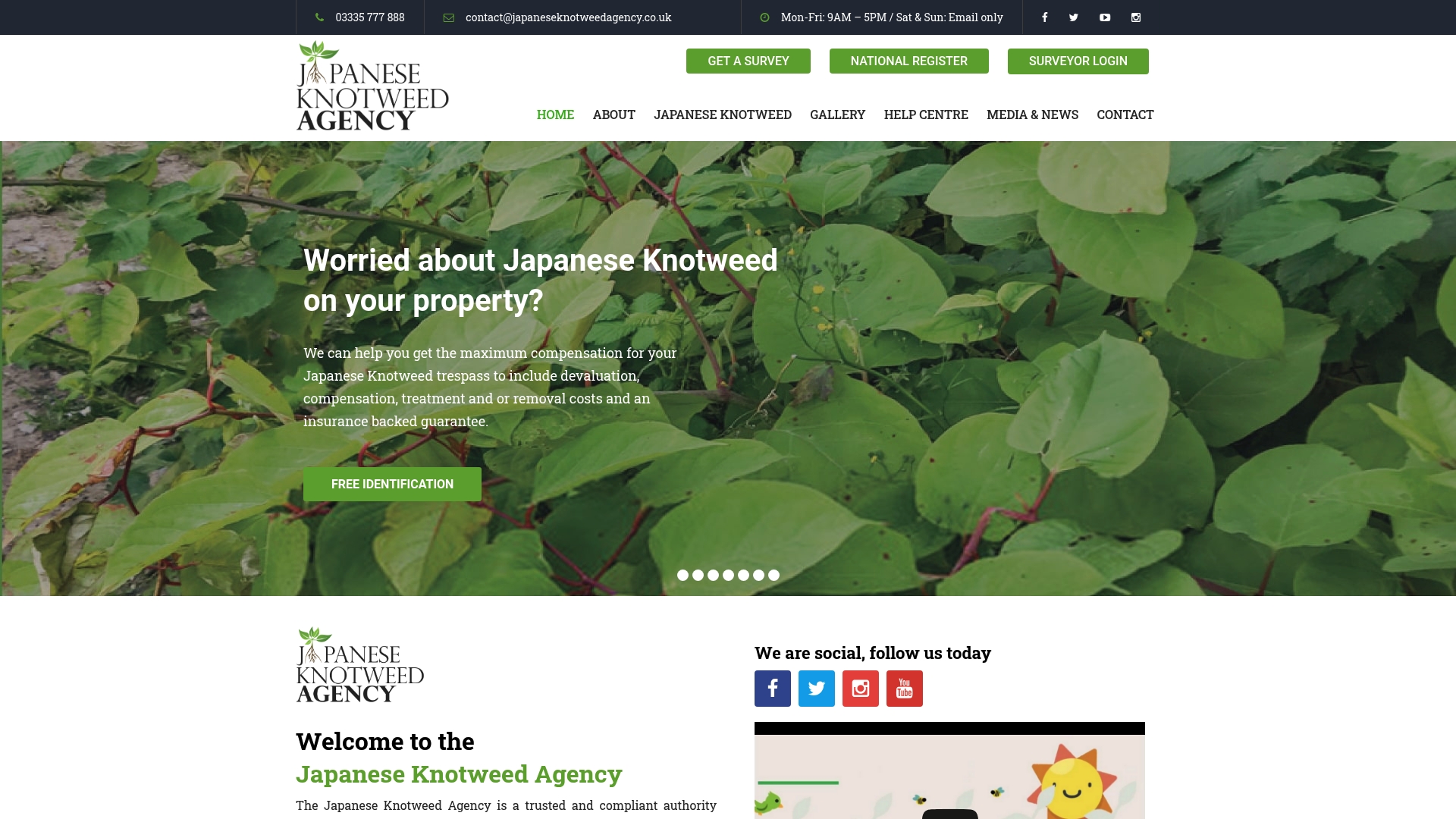
Japanese Knotweed Agency

Product Screenshot

概览

Japanese Knotweed Agency 在英国处理日本结缕草方面处于领先地位。它以化学无害的热电处理和全面的法律与调查支持闻名,是房主和购房方的首选解决方案。

核心功能

该机构提供识别与评估日本结缕草的服务。现场使用高达5000伏的直接能量输送,对根茎细胞造成内部损伤并逐步耗尽其能量。额外服务包括根系隔离安装与挖掘作业,以及为房产交易提供专业的调查报告与文件。

优点

  • 专业专注日本结缕草:长期聚焦单一入侵物种,经验丰富,处理方法更有针对性并符合监管要求。
  • 环境友好热电处理:不使用化学药剂,适合关注花园生态和邻里法规的房主。
  • 法律与保险支持:提供与房产贬值和损害相关的法律协助,帮助解决贷款或买卖障碍。
  • 维护全国登记:在 England 与 Wales 维护国家级感染登记,便于风险评估与长期跟踪。
  • 免费识别和调查:提供免费初步识别与现场调查,降低首次介入门槛。

适用对象

这项服务面向在 United Kingdom 拥有或交易受日本结缕草影响房产的房主、地产经纪人与开发商。若你正为房屋估值、贷款批准或出售交易遇到结缕草问题,这家公司能提供从识别到法律支持的端到端服务。

独特价值主张

Japanese Knotweed Agency 将化学无害的热电技术与法律支持结合,这是其最大差异化优势。通过现场输送高达5000伏的能量直接作用于根茎网络,他们能对地下根系造成持续性的能量耗损,从而减少反复生长的风险。机构同时维护 England 与 Wales 的国家登记,这为买卖双方提供可核实的历史记录与风险透明度。对讲究合规与长期安全的买家而言,这种技术加法律双轨策略比单纯机械挖除或化学喷洒更可靠、更能保护房产价值。

实际使用案例

一个 Homeowner 在后院发现大片结缕草后联系了该机构。团队先行免费调查并出具报告以便用于房产交易披露。随后现场实施热电处理并安装根系隔离板,同时提供挖掘选项与法律文件,最终帮助房主顺利完成房屋出售并减少估值损失。

价格

网站未公开具体价格信息。服务范围覆盖 England、Wales 与 Ireland,报价通常基于现场评估后确定。对价格敏感的房主建议先申请免费识别与调查以获得定制报价。

网站: https://japaneseknotweedagency.co.uk

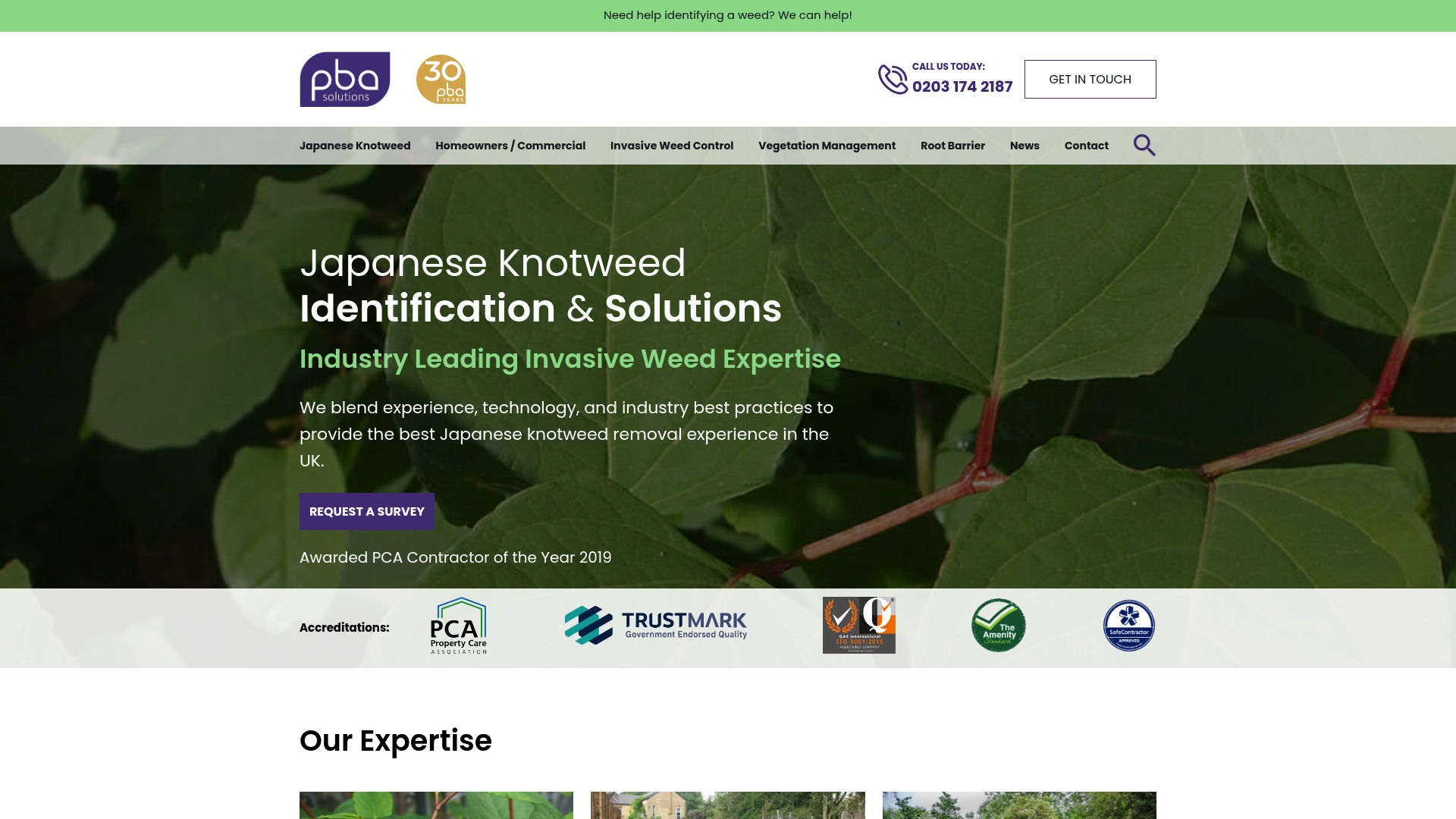
PBA Solutions

Product Screenshot

快速概览

PBA Solutions 在侵入性植物管理领域拥有超过30年的实战经验,适合在英国、Wales 和 Ireland 寻求合规治理的房主与开发商。它以专业调查、根系隔离安装和10年保险支持保证构成可靠的解决方案。

核心功能

PBA Solutions 提供入侵性杂草调查与管理计划、日本结缕草治疗、根系隔离的销售与安装,并支持法律合规及抵押贷款流程,所有服务由行业认证和保险保障背书,覆盖住宅到公共部门客户。

优点

  • 丰富经验可依赖。 公司拥有三十多年侵入性植物治理经验,说明他们在复杂现场处理和长期监测上更为成熟。

  • 多项行业认证。 持有 PCA、TrustMark、Safe Contractor 与 ISO 9001 认证,为合同质量和流程管理提供第三方证明。

  • 服务范围全面。 从现场调查到根系隔离安装再到后期管理计划,客户可以通过单一供应商完成多阶段流程,减少协调成本。

  • 保险支持保证提升信心。 提供10年 Insurance Backed Guarantees,对受日本结缕草影响的物业买卖和抵押批准具有明显帮助。

  • 面向多类客户。 同时服务房主、开发商和公共部门,经验覆盖住宅改造与大型工地清理两类场景。

缺点

  • 网站未公布价格信息,客户在成本评估阶段需要额外联系公司获取报价,这增加了前期决策时间。

  • 细节信息通常通过咨询或现场评估才会提供,导致对比不同供应商时难以直接在线比价。

  • 专注于日本结缕草和其他入侵性植物,若你需要一站式园艺或景观服务,PBA Solutions 的专业聚焦可能不完全匹配。

适用对象

PBA Solutions 最适合发现日本结缕草或需符合抵押贷款要求的英国、Wales 与 Ireland 房主、物业经理和开发商,以及需要合规治理的公共部门单位。

独特价值主张

PBA Solutions 的独特性在于将长期行业经验保险背书结合,既能进行技术上可验证的根系隔离施工,又能在法律和抵押流程上为物业交易提供支持,这对有出售或再融资需求的房主尤其重要。

实际使用案例

一位房主在花园发现日本结缕草后联系 PBA Solutions 进行调查与治理计划,团队提供现场评估、推荐根系隔离施工并出具可供抵押银行参考的报告,从而降低物业贬值风险并满足贷款机构要求。

价格

PBA Solutions 未在网站上公布固定价格,服务通常通过现场评估后出具报价。若你需要预算估算,请联系公司安排调查以获取书面报价。

网站: https://www.pba-solutions.com

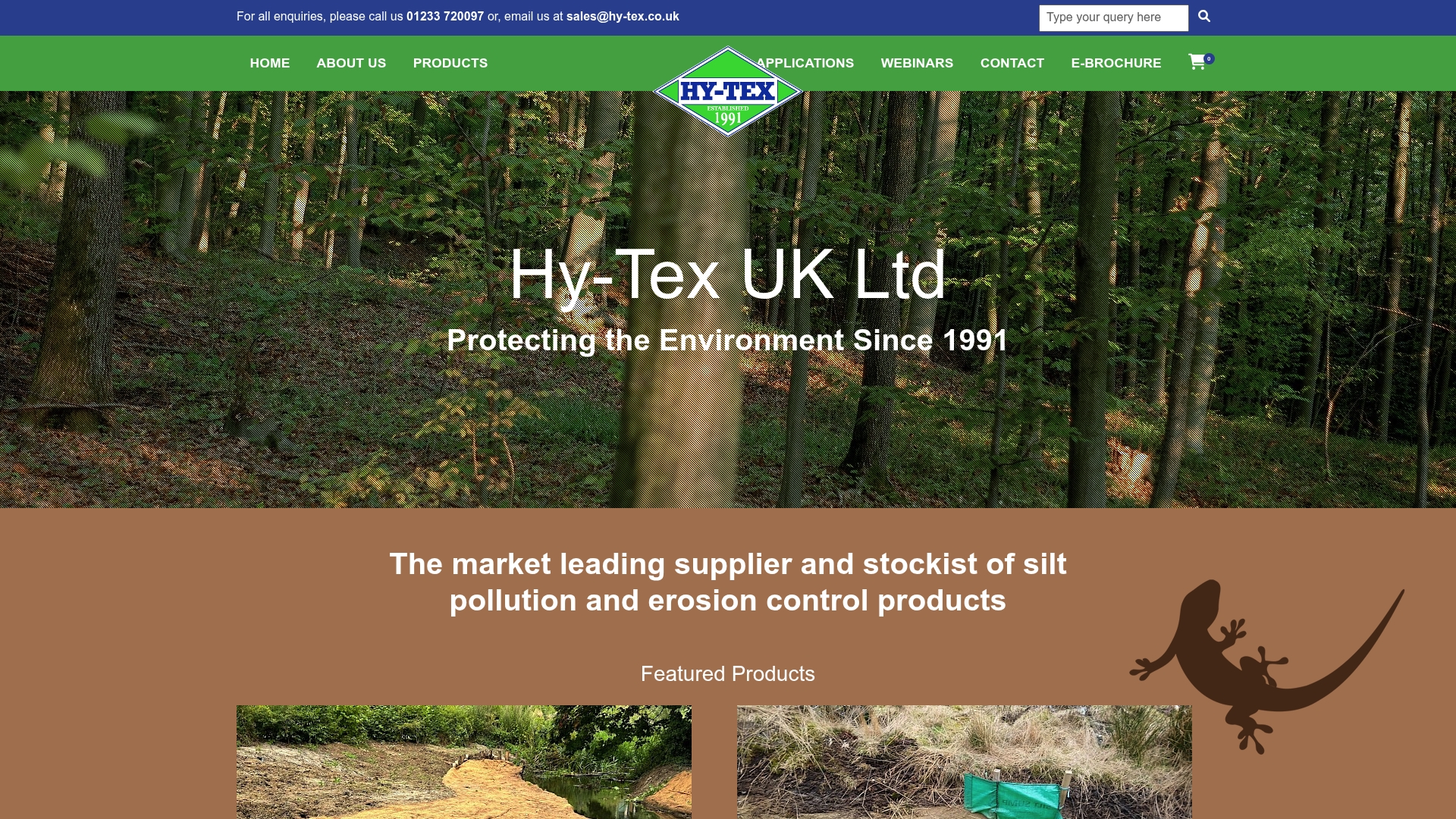
Hy-Tex UK Ltd

Product Screenshot

速览

Hy-Tex UK Ltd 是一家提供工程级侵蚀与沉积控制材料的供应商,定位于环保与可持续解决方案。总体来看,它适合需要专业土工产品和快速全国交付的项目负责人和工程团队。

核心功能

Hy-Tex 提供广泛的产品线,覆盖沉积物管理、侵蚀控制和动物保护等多个领域。公司强调 生物可降解地工织物 方案,支持长期的环境保护目标。

  • 广泛的侵蚀控制与水管理产品目录,适配不同工地需求。
  • 专注于 生物可降解 纤维与 地工织物,便于减少长期环境负担。
  • 提供模块化绿色墙体系统,用于城市绿化和景观工程。
  • 支持树木与野生动物保护的专业用品,适合园林和生态恢复项目。
  • 提供个性化客户服务与快速全国交付,方便施工进度管理。

优点

  • 产品线丰富,覆盖沉积物控制、侵蚀防治和水管理等多个场景,能满足大多数施工需求。

  • 拥有超过 34年经验,表现出长期行业积累与技术沉淀。

  • 强调环保与可持续制造,适合需要减少环境影响的公共与私人工程项目。

  • 客户服务专注且响应快速,能配合工期要求进行供应与技术支持。

  • 被多家大型企业信任,说明其产品在行业内具备一定的可靠性和可用性。

缺点

  • 网站主要展示产品与公司信息,缺乏明确的价格与规格细节,这会增加采购前的沟通成本。

  • 产品重点放在环境与侵蚀控制领域,对于非专业建筑或园艺市场的买家吸引力较低。

  • 定价未公开,需要通过联系获取报价,这对于预算紧张的中小承包商来说不够透明。

适用对象

Hy-Tex 最适合环境工程师、土木工程师、景观设计师和施工承包商,以及需要合规沉积物管理与绿化系统的政府机构。它也适用于需要环保材料的园林与基础设施项目负责人。

独特价值主张

Hy-Tex 的价值在于把 可降解材料 与工程级地工布结合,提供从侵蚀控制到绿色墙体的整套解决方案。配合长期行业经验与快速供应,它优于单一产品供应商的综合服务能力。

实际使用案例

一家土木工程公司在大型基础设施项目中使用 Hy-Tex 的拦泥栅和生物可降解垫,控制了施工期的泥沙外流,并满足了环境监管要求,同时简化了现场维护工作。

定价

网站未列明具体价格,报价为 联系获取。项目采购前请准备工程量清单与使用场景以便快速获得准确报价。

Website: https://www.hy-tex.co.uk

日本结缕草治理机构与产品比较

以下表格汇总了文章中提到的三家对抗日本结缕草的服务与产品提供商的核心特点与适用性,帮助读者快速了解与比较。请根据实际需求选择合适的服务。

公司名称 核心功能 优点 适用场景 独特价值
Japanese Knotweed Agency 提供化学无害的热电处理技术、根系隔离安装、专业调查报告 专注日本结缕草,提供免费初步调查,环保技术,法律支持 英国房主,特别是房产交易中受结缕草影响的买家和卖家 高压热能技术结合根系隔离与法律支持,提高治理效果并减小房产贬值风险
PBA Solutions 提供侵入性植物管理、根系隔离安装、行业认证支持、10年保险保障 行业经验丰富,认证齐全,服务覆盖全面,长效保险保障 需要合规支持的房主、开发商与公共部门单位 结合行业经验与法律流程支持,保障房产交易顺利进行,提供可靠的保险赔偿
Hy-Tex UK Ltd 专为工地提供环保侵蚀与沉积控制材料,涵盖绿化系统与水管理方案 丰富产品线,环保材料应用,长期制造经验,快速交付满足施工需求 工程师、景观设计师、需要抗侵蚀和环保绿化的工程单位与政府机构 可降解工程材料提供环境友好的侵蚀控制与绿化解决方案,适配多种施工场景特别需求

解决侵入性植物根系隔离的终极选择

在《顶级侵入性植物根系隔离工具推荐 2026》中,您或许已经意识到日本结缕草等入侵性植物根系问题的复杂和顽固。根系扩散广泛且生命力强,单纯机械挖除往往无效,房产价值和贷款过程都可能面临威胁。针对这些痛点,Japanese Knotweed Agency 提供业内领先且无化学污染的5000伏高能热电处理技术,直接破坏根系细胞,彻底遏制再生可能。

https://japaneseknotweedagency.co.uk

立即访问我们的官网了解详细方案和服务,体验结合法律支持与专业调查的全方位治理服务。保护您的房产免受日本结缕草侵害,从免费现场调查开始。抓住机会,保障未来房产安全,行动请点击Japanese Knotweed Agency官网

常见问题解答

什么是根系隔离工具,它的作用是什么?

根系隔离工具用于有效控制侵入性植物的根系生长,防止其蔓延。这些工具创建物理屏障,确保植物根系不影响周边植物或基础设施。选择合适的根系隔离工具可以在工程项目中降低后期维护成本。

如何选择合适的根系隔离工具?

选择根系隔离工具时,可以考虑植物的种类、根系生长的深度和广度。最好使用专业公司的指导,进行现场评估,以确保选用的工具适应特定的环境需求。

根系隔离工具的安装需要多长时间?

根系隔离工具的安装时间通常取决于项目的规模和复杂性,一般情况下,在30到60天内能够完成所有必要的安装步骤。先进行现场评估,再制定详细的施工计划,可以有效缩短安装时间。

根系隔离能否与其他园艺管理方法一起使用?

根系隔离可以与其他园艺管理方法共同使用,例如定期修剪和生态治理。结合多种方法能够产生协同效果,从而更好地控制侵入性植物的影响。

安装根系隔离工具后,我需要做什么维护?

安装后需要定期检查隔离屏障的完整性,同时监测周围植物的生长情况。保持定期维护可以预防问题的严重化,推荐每三个月进行一次检查。

使用根系隔离工具的成本是多少?

根系隔离工具的成本因材料、安装复杂性和项目规模而异。通常,进行详细现场评估后会提供个性化的报价,确保预算合理并符合实际需求。

推荐

Read more

英国家庭应对日本结缕草:2026植物防控趋势全解读


TL;DR:

  • 2026年英国禁止化学除草剂,推行无化学防控策略。
  • 热电处理和根障联合应用效果最稳定,成功率高达95%。
  • 需持续监测和规范废弃物处置,以防复发和扩散。

2026年,随着英国监管机构对草甘膦等传统除草剂实施更严格的使用限制,英国家庭和地方政府在处理日本结缕草(Japanese Knotweed)时面临前所未有的挑战。这种入侵植物生长速度极快,根系可穿透混凝土和建筑基础,对房产价值和土壤生态构成严重威胁。无化学防控已成为2026年的主流趋势,本文将系统梳理选择标准、主要技术方案、对比分析及实际操作建议,帮助您做出最适合的防控决策。

目录

关键要点

要点 详情
2026主流为无化学防控 法规严格促使95%以上家庭和地方选择无化学方案,保障土壤安全。
热电处理效率出众 1-2年见效、适用家庭,结合综合方法可实现95%持久治理。
监控与合规处置最关键 持续监测、合理处理废弃物和执行社区规范是长期成功的保障。

确定2026防控日本结缕草的选择标准

面对多种防控方案,家庭和地方政府需要建立清晰的评估框架,才能在合规、效果和成本之间找到最佳平衡点。2026年新规明确要求优先采用无化学药剂方案,这一政策导向直接影响了所有防控决策的起点。

核心选择标准包括以下四个维度:

  • 合法合规性:方案必须符合2026年最新法规,草甘膦等化学除草剂的使用受到严格限制,无化学药剂防控已成为监管部门推荐的首选方向,同时重视土壤保护和生态健康。
  • 土壤保护效果:优质方案应避免土壤污染,减少受控废弃物产生量,尤其在靠近水体或农业用地的区域,土壤安全性是不可妥协的底线。
  • 操作成本与治理周期:不同方法的初始投入差异显著,热电处理通常需要1至2年的持续治理周期,而物理挖除虽然一次性成本较高,但可在短期内快速清除地表植株。
  • 长期成功率与复发监控:选择方案时必须参考有数据支持的长期效果记录,单纯的地上部分清除无法根治根茎网络,复发监控机制同样不可或缺。

统计数据:根据行业数据,未经专业处理的日本结缕草在初次治理后的两年内复发率超过60%,这一数字充分说明了选择正确方案和建立长期监控机制的重要性。

家庭住宅入侵植物排查阶段,准确评估侵染面积和根系深度是制定防控策略的基础。面积小于10平方米的轻度侵染与大面积扩散的处理方式截然不同,切勿以同一标准衡量。此外,房产交易背景下的防控需求还涉及抵押贷款机构的合规要求,这进一步提高了方案选择的专业门槛。

无化学防控方法清单与核心原理

目前,英国市场上主流的无化学防控技术可分为四大类别,每种方法都有其适用场景和操作要点。热电处理、物理挖除、根障安装和机械清除与综合虫害管理共同构成了非化学防控的主要手段,为家庭和政府提供了多元化的选择路径。

四大无化学防控方法详解:

  1. 热电处理法(Thermo-Electric Treatment):这是目前技术最为先进的无化学防控方式。通过向植株根系直接输送高达5000伏特的电能,造成细胞内部损伤并持续消耗根茎网络的能量储备,从而实现根系层面的彻底杀灭。该方法精准度高,对周边土壤和植被影响极小,特别适用于住宅花园、靠近水体的区域以及基础设施周边环境。参考日本结缕草防控策略可了解更多适用场景细节。

  2. 物理挖除法:通过机械或人工方式将植株连同根茎系统完整挖出,是最直观的清除方式。操作过程需严格遵守废弃物处置法规,所有挖出的根茎和受染土壤均属于受控废弃物,必须由持牌服务商合规处理。该方法适合面积较小、根系尚未深度扩散的场地。

  3. 根障安装(Root Barrier):通过在地下安装高密度聚乙烯屏障,从结构层面阻断根茎的横向扩散路径。根障通常需要埋入地下至少1至2米深度,并在安装后定期检查接缝完整性。这种方法更多用于防止扩散而非根除,常与热电处理联合使用以获得最佳效果。

  4. 机械清除与综合虫害管理(IPM):定期割除地上部分可持续消耗根系能量储备,但需长期坚持方能见效。综合虫害管理则结合多种非化学手段,根据侵染程度动态调整处理策略,是实用无化学方法中适合大面积公共用地的选择。

专业提示:在选择热电处理前,务必确认服务提供商具备专业设备和认证资质,电压输出不足会导致处理效果大打折扣,甚至刺激根系产生应激性扩散。

热电处理与传统挖除的优劣对比

在无化学防控方案中,热电处理和物理挖除是最受关注的两大主流选择。热电处理可达95%成功率,1至2年内见效,特别适合住宅、靠近水体及基础设施环境;而物理挖除则会产生需要合规处置的受控废弃物,两者各有其适用场景和局限性。

对比维度 热电处理 物理挖除
成功率 最高95% 取决于清除彻底程度
治理周期 1至2年 数周至数月
土壤扰动 极低 高度扰动
废弃物产生 极少 大量受控废弃物
适用场景 住宅、水体旁、基础设施周边 小面积、根系浅层
初始成本 中等 较高
长期维护 需定期回访处理 后期监测为主

无化学处理方法指南的实践经验来看,热电处理在精准性和环境友好性方面具有明显优势,尤其是在不允许大规模土方作业的城市住宅区。物理挖除虽然能快速清除地表植株,但日本结缕草的根系可深达3米,任何残留根茎碎片都可能引发再生。

“2026年行业趋势表明,热电结合根障的综合方案在实际应用中效果最为稳定,尤其适合需要保护土壤完整性的住宅和公共用地场景。”

根障实施流程的数据显示,根障安装与热电处理联合使用时,成功率可进一步提升,同时有效降低了后期复发风险。对于预算有限的家庭,可以考虑分阶段实施:先进行热电处理压制根系活性,再在关键扩散路径上安装根障,形成双重防护体系。

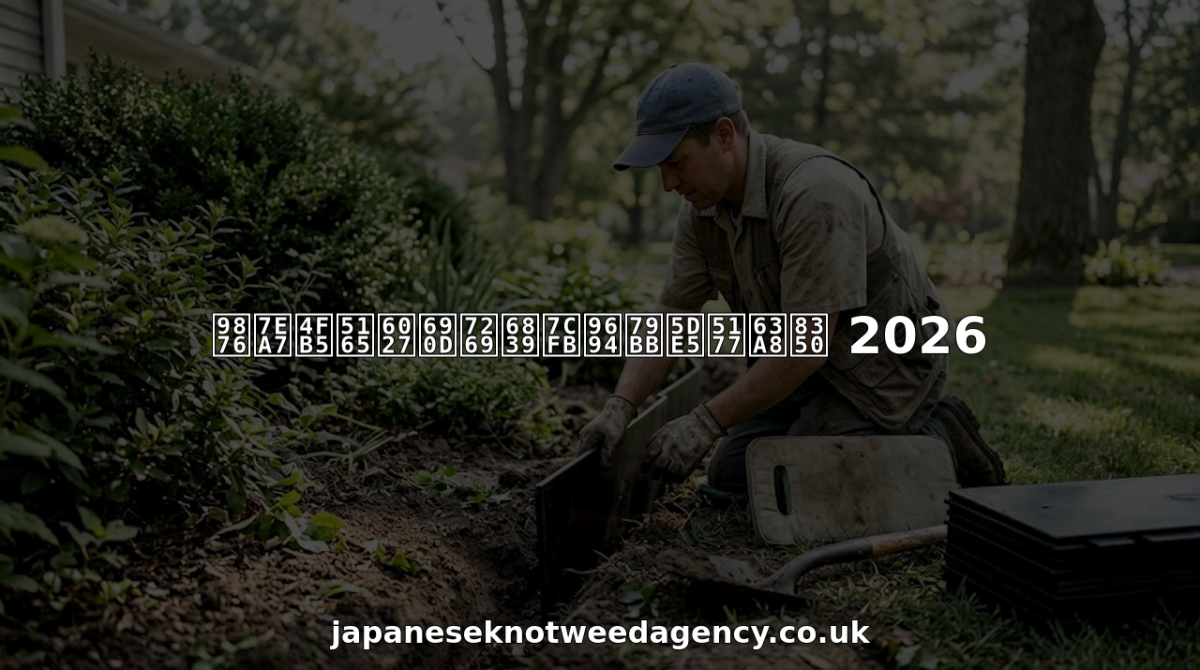
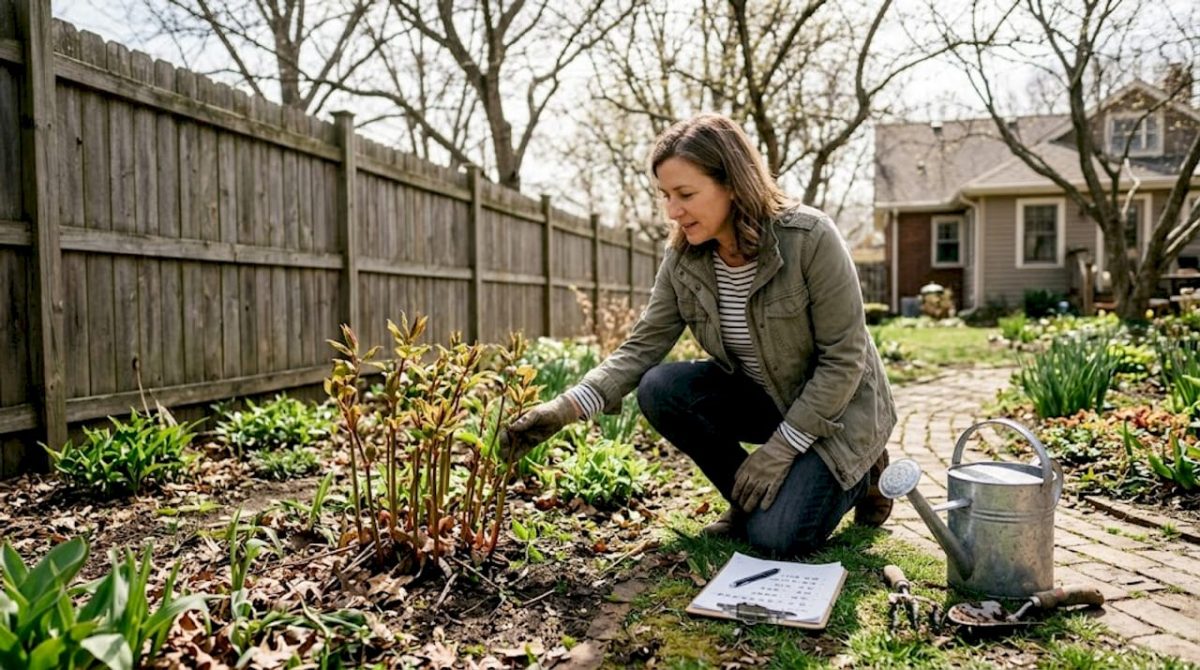
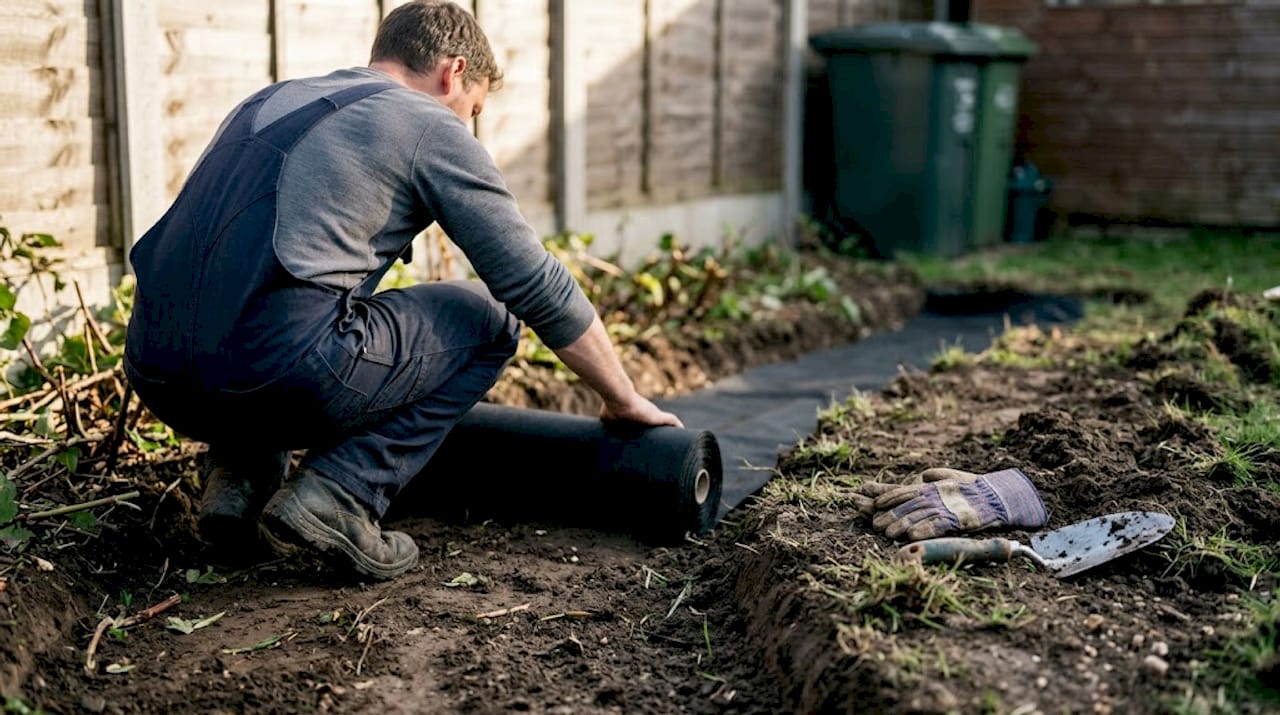
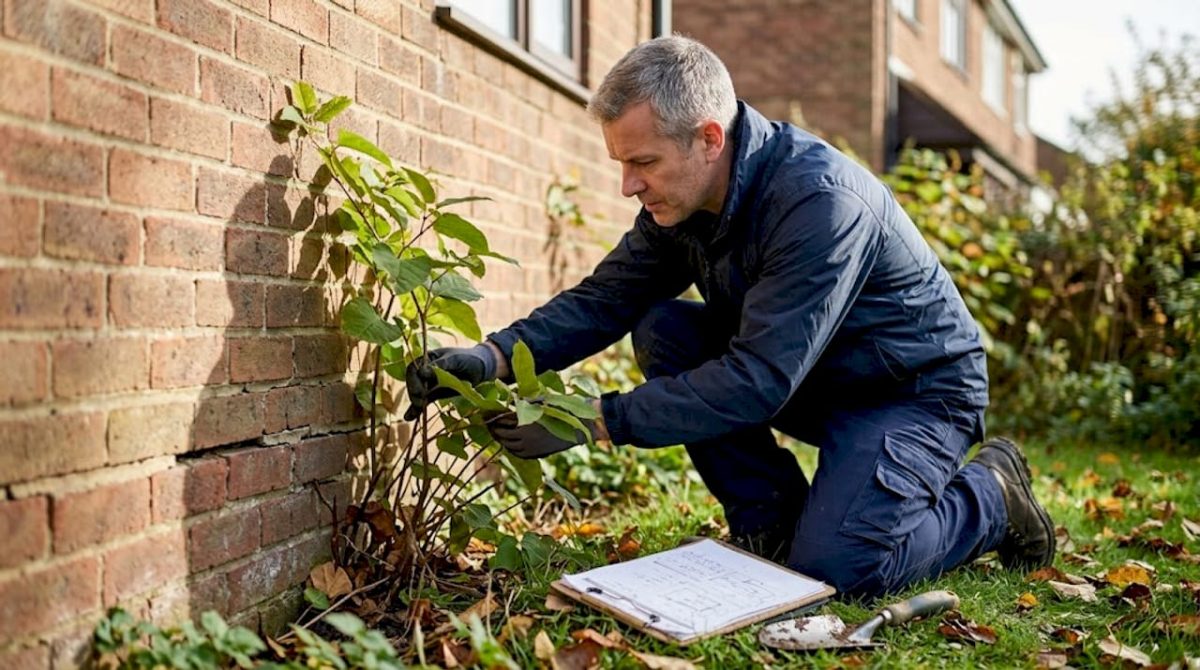
园艺师正在院子里安装防根隔板,防止植物根系蔓延。

地方政府与英国家庭的实际防控建议

无论是地方政府管理的公共绿地,还是私人住宅花园,日本结缕草的防控都需要结合实际场景制定针对性策略。地方政府优先采用机械和IPM方案,而家庭则可根据侵染程度在DIY和专业服务之间灵活选择。

场景类型 推荐方案 治理周期 注意事项
住宅小花园(10平方米以下) DIY机械清除加监测 2至3年 需长期坚持,建议专业评估
住宅中大型花园 热电处理加根障 1至2年 联系认证专业服务商
公共绿地 IPM综合方案 持续管理 政府负责公共用地
靠近水体或建筑基础 热电处理优先 1至2年 避免化学药剂污染水源

杂草清除流程的核心在于系统性和持续性。治理完成后,建议每季度进行一次现场检查,重点关注原侵染区域边缘是否出现新芽。春季是复发高峰期,此时根系活性最强,任何遗漏的根茎碎片都可能在数周内重新萌发。

废弃物处置是家庭防控中最容易忽视的环节。挖除产生的废弃物需受控运输和合规处理,非化学方法产生的废弃物量少且不含污染物,而物理挖除则需要严格遵守废弃物转移法规。将结缕草根茎随意丢弃在垃圾桶或堆肥堆中是违法行为,可能导致侵染扩散并面临法律处罚。

专业提示:在进行任何挖除作业前,务必通过识别入侵植物确认植物种类,避免将其他植物误认为结缕草而进行不必要的处理,同时也防止真正的结缕草被漏判。根系切断治理方法在某些场景下可作为辅助手段,但不应作为独立的主要治理方案。

专家视角:2026英国家庭与地方的植物防控战略误区

在实际防控工作中,我们观察到一个反复出现的误区:许多家庭和地方政府将初次治理的结束视为问题的终结,却忽略了后续1至2年的持续监测阶段。日本结缕草的根茎网络可在地下休眠数年,一旦外部压力解除便迅速复苏,这正是复发率居高不下的根本原因。

另一个常见误判是过度依赖DIY方案。10平方米以下的轻度侵染确实可以尝试自主处理,但一旦根系深度超过50厘米或侵染面积扩大,DIY的局限性会迅速显现。错误的操作不仅无法根治,还可能将根茎碎片扩散至更大范围,导致治理难度成倍增加。

热电处理结合根障的综合方案是2026年最稳定的选择,而新兴的土壤太阳能处理法虽受到一定关注,但实际应用尚不成熟,缺乏足够的长期数据支撑。在2026年入侵植物实例中,我们看到综合方案的持续优势。专业建议是:选择经过验证的技术,而非追求新颖但尚未成熟的方法,稳定性和可预期性在房产相关的防控决策中至关重要。

获取专业日本结缕草防控服务与咨询

Japanese Knotweed Agency 作为英国无化学防控领域的先驱,拥有完整的热电处理、根障安装和物理挖除服务体系,覆盖英格兰、威尔士和爱尔兰全境。如果您正在为购房、再抵押或现有房产的结缕草问题寻求解决方案,我们的专业团队可以为您提供现场勘查和定制化治理建议。

https://japaneseknotweedagency.co.uk

我们的95%成功无化学控制方案已帮助数百个英国家庭成功解决结缕草问题,同时保护了土壤生态和房产价值。您可以参考家庭防治全流程指南了解完整治理流程,或访问日本结缕草常见疑问解答获取更多实用信息。立即联系我们,获取专属治理方案。

常见问题解答

热电处理日本结缕草的成功率和适用场景是什么?

热电处理适合住宅及水体、基础设施旁的结缕草治理,1至2年内最高95%见效,是目前无化学防控方案中数据最为可靠的技术选择,特别适合不允许大规模土方作业的城市住宅环境。

地方政府会帮忙清除我家院子的日本结缕草吗?

地方政府只负责公共用地的结缕草治理,私人用地的问题需业主自行处理,但当结缕草有向公共用地扩散的风险时,政府可能会向业主发出正式的监管通知。

物理挖除后如何处置结缕草根茎和土壤?

结缕草根茎和受染土壤属于受控废弃物,必须合规处理,需转交持有废弃物运输许可证的服务商处理,严禁随意倾倒或放入普通垃圾桶,否则将面临法律处罚。

家庭可否DIY日本结缕草治理?

10平方米以下的小范围侵染可以尝试DIY机械清除,但建议专业介入与长期监测,因为错误操作可能导致根茎碎片扩散,反而加重侵染程度。

推荐

Read more

揭示日本葛根根茎与新芽关系及处理方法:房主实用攻略


TL;DR:

  • 日本葛根具有强大的地下根茎储能体系,难以彻底根除。
  • 仅割除地上藤蔓无法解决根茎引发的反复萌发问题。
  • 无化学治理需结合割除、遮光、挖掘和放牧等多方法,持续数年。

日本葛根的地下根茎重量可达200千克,即使你将地面藤蔓全部割除,根冠依然储存着巨大能量,能在数月内重新萌发出大量新芽。这一特性让葛根成为英国、威尔士和爱尔兰房产交易中最棘手的生态风险之一。许多房主在购房调查时低估了这种植物的再生能力,结果在入住后才发现问题反复出现、治理成本持续攀升。本文将从科学原理、常见误区、无化学处理方法和全球生态对比等角度,为正在购房或再融资的房主提供切实可行的指引。

目录

关键要点

要点 详情
根茎能量储备决定新芽再生 日本葛根地下根冠储存大量淀粉,即使割除地上部分也能快速发芽。
无化学治理需多方式结合 反复割除、厚覆盖、放牧与深挖结合,能有效耗尽根茎能量彻底治理。
房主需避开浅挖误区 浅挖只能清除表面藤蔓,根茎深处仍可继续生新芽,需碎片管理与深挖。
资源化利用降低治理成本 房主可探索药用开发、收购等资源化方案,兼顾治理与经济价值。
雨季操作风险需格外警惕 雨季新芽爆发快,治理难度倍增,建议科学避开雨季实施治理方案。

日本葛根根茎与新芽关系的科学原理

理解日本葛根为何如此难以根除,首先必须了解其根茎系统的工作机制。根茎并非普通的植物根系,而是一套高度复杂的地下储能网络,内含大量淀粉和碳水化合物,为植物在地面部分受损后的快速恢复提供能量支持。

根冠是新芽的唯一来源。 无论地面上的藤蔓被割除多少次,新芽始终从地下根冠重新萌发,而非从残留的茎段生长。根冠可一次萌发多达30条新藤,储能能力极为强大,这正是单纯割除地上部分始终无法彻底根除葛根的根本原因。

根茎网络的主要特征如下:

  • 根茎深入地下可达3米,普通挖掘工具难以触及核心部位
  • 单株葛根根茎重量常超过100千克,大型植株甚至超过200千克
  • 根茎碎片只要长度超过5厘米,即可独立存活并发育成新植株
  • 生长速度可达每天约30厘米,地面藤蔓扩张极为迅速
  • 根冠在冬季休眠后,春季温度回升时可立即恢复活跃生长
根茎特性 数据参考
最大根重 超过200千克
最大根深 约3米
单次萌芽数 最多30条
碎片存活最短长度 约5厘米
地面生长速度 约30厘米/天

专业提示: 在进行任何形式的挖掘操作前,务必先评估根茎的分布深度与横向范围。盲目浅挖不仅无效,还会将根茎碎片扩散至更大范围,使问题更难控制。

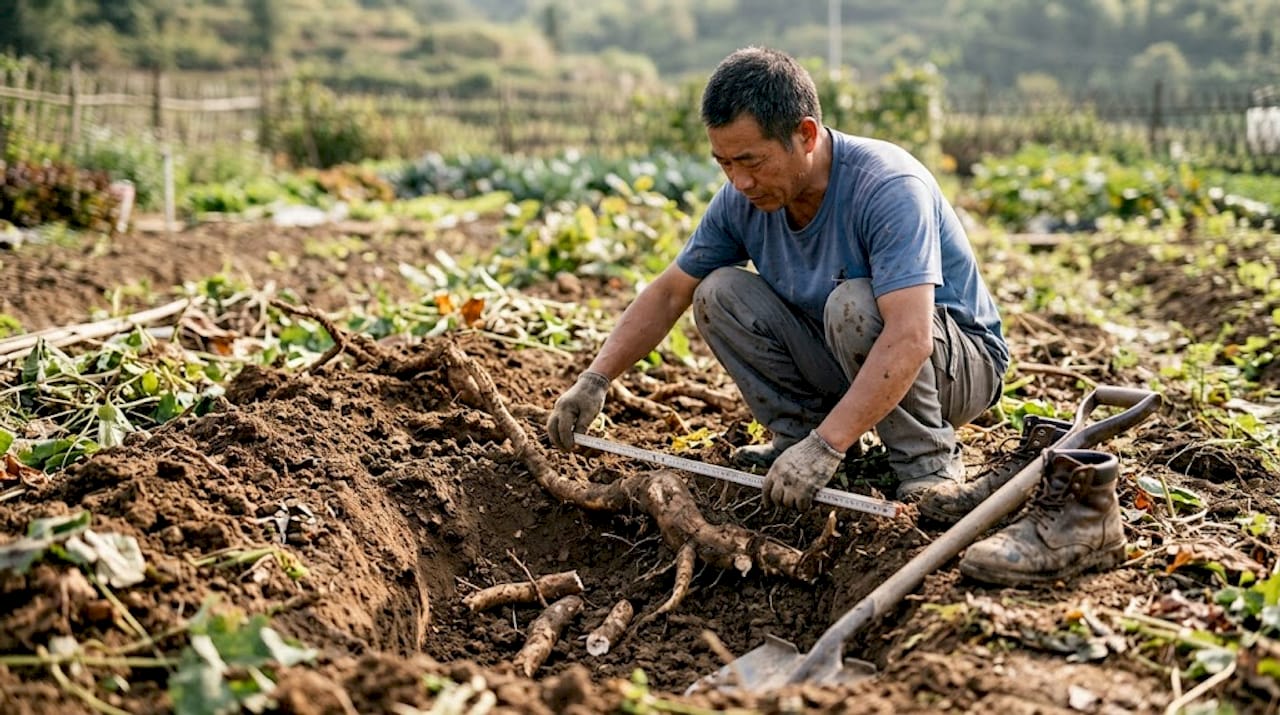
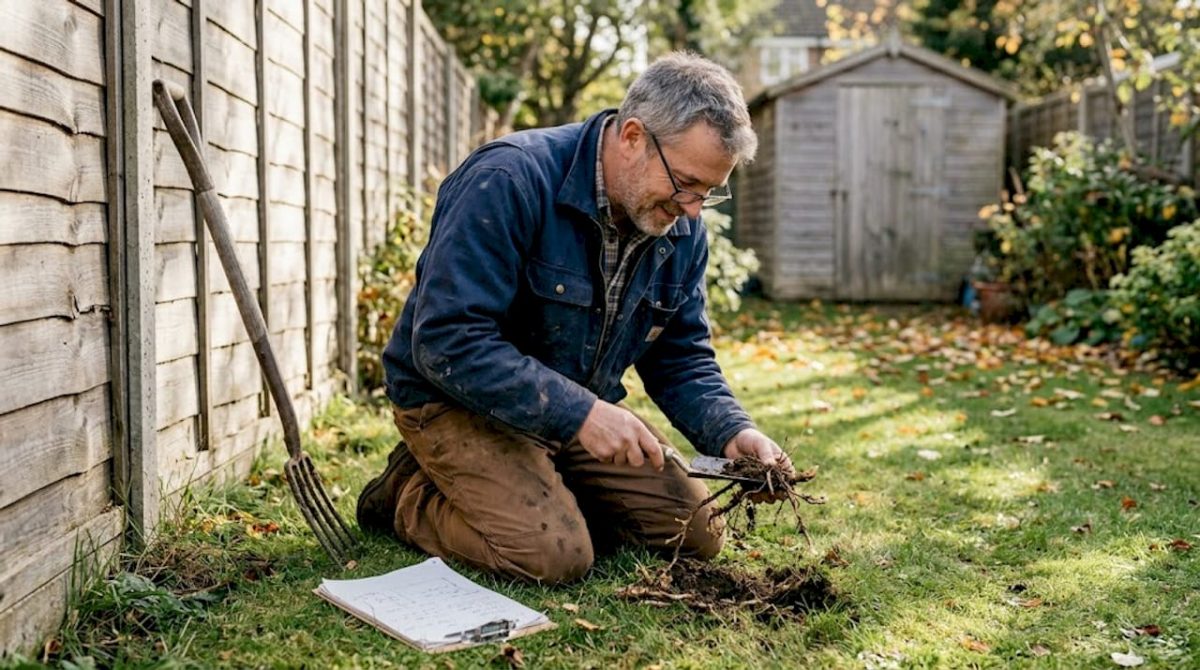
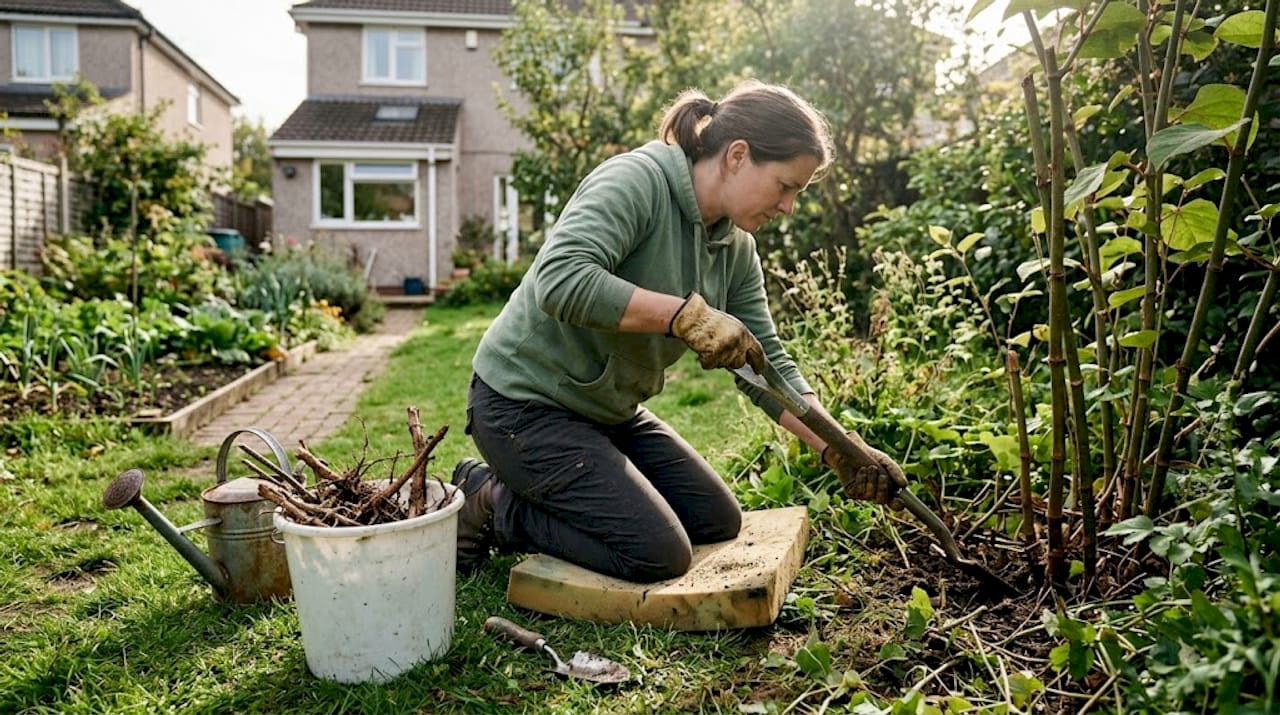
园艺师正在土壤中检查日本葛根的根茎生长情况。

根茎网络治理策略的角度来看,有效的治理必须针对地下储能系统,而非地面可见部分。任何只处理地上茎叶的方案,都只是暂时性的视觉改善,无法从根本上解决问题。雨季期间土壤湿润松软,根茎碎片更易随水流或工具扩散,操作时需格外谨慎。

日本葛根再生机制下房主处理的常见误区

许多房主在初次面对日本葛根时,往往依赖直觉做出处理决策,结果陷入一系列代价高昂的误区。了解这些错误操作,是制定有效治理方案的前提。

误区一:浅挖即可解决问题。 大多数人看到葛根后的第一反应是拿起铲子挖掉根部,但浅挖只能去除表层土壤中的茎段,深层根冠完全不受影响。几周后,根冠便会再次萌发新芽,房主误以为治理成功,实际上问题仍在持续积累。

误区二:割除一次就够了。 反复割除需要持续2至5年才能有效耗尽根茎能量,而且必须在新芽刚萌发时及时操作,不能等到藤蔓充分展开后再割。一次割除只能短暂减少地面生物量,对根冠储能几乎没有实质性影响。

常见误区汇总:

  • 只处理地上藤蔓,忽视根冠位置与深度
  • 雨季进行挖掘,导致根茎碎片随水扩散
  • 随意处置挖出的土壤与碎片,违反相关法规
  • 使用覆盖物厚度不足(少于15厘米),遮光效果有限
  • 误将葛根列为普通杂草处理,未做专项评估

“房主最常犯的错误,是将治理成效与视觉改观混为一谈。地面藤蔓消失并不代表根茎已被清除,真正的治理标志是根冠活性的持续下降。”

关于葛藤影响购房的专项指南明确指出,在购房调查阶段未能识别葛根,可能导致贷款审批受阻,甚至影响房产交易的顺利完成。治理误区中最需要警惕的,是碎片管理不当引发的次生扩散问题,这在实际案例中极为普遍。

专业提示: 挖掘葛根后,所有土壤和碎片必须按照受控废弃物进行处置,不可随意堆放或填埋于庭院其他区域,否则将造成新的侵染点。

无化学处理日本葛根的有效方法与应用场景

在不使用任何化学药剂的前提下,结合反复割除、厚覆盖遮光、放牧、根冠挖掘等多种手段,可以系统性地耗尽根茎储能,最终实现彻底根除。以下是经过验证的操作步骤与适用场景。

分阶段操作流程:

  1. 评估阶段: 委托专业人员测绘根茎分布范围与深度,确定治理优先区域
  2. 首轮割除: 在春季新芽刚展开时进行首次割除,使根冠被迫再次消耗储能萌发
  3. 厚覆盖遮光: 铺设厚度不低于15厘米的遮光覆盖物,切断光合作用来源
  4. 放牧辅助: 引入山羊持续啃食新芽,进一步消耗根冠能量储备
  5. 根冠挖掘: 在根茎能量显著下降后,进行深层根冠挖掘与碎片清理
  6. 后期监测: 每季度检查萌芽情况,及时处理残余活性区域
方法 适用场景 预计周期 注意事项
反复割除 大面积开阔地带 3至5年 需在干燥季节操作
厚覆盖遮光 庭院与边界区域 2至4年 覆盖厚度须超过15厘米
山羊放牧 农村或大型地产 3至4年 需配合割除效果更佳
根冠深挖 小型集中侵染区 1至2年 碎片必须合规处置

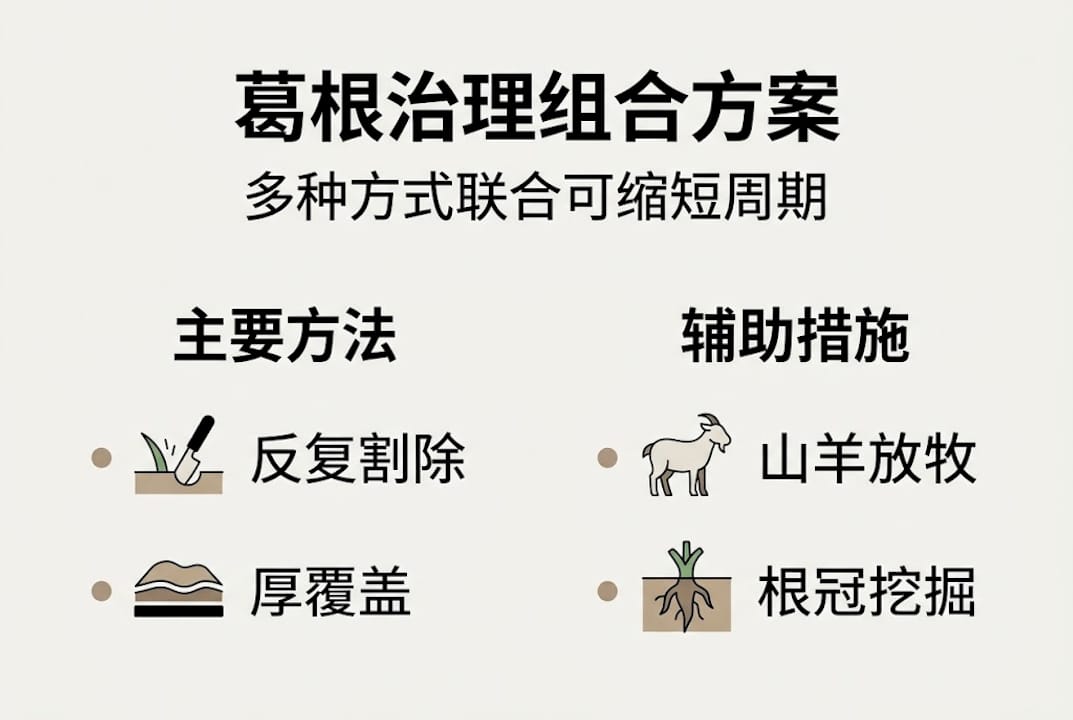
关键数据: 单独使用割除方法的成功率远低于多种方法组合使用,治理周期也会显著延长。综合方案通常可将治理时间缩短30%至50%。

日本葛根防治方案对比一览图

无化学处理方案在实际应用中还需考虑庭院土壤深度、季节性气候和周边生态环境。环保彻底根除的核心在于持续性与系统性,而非单次大规模操作。家庭除侵入植物方案应根据房产实际情况定制,避免套用通用模板造成资源浪费。

葛根生态影响与资源化利用:对比全球治理与房主新机遇

日本葛根在不同国家和地区的管理态度存在根本性差异,这一对比为房主提供了超越传统根除思维的新视角。

日本视葛根为药用资源,其根部富含异黄酮等活性成分,长期用于传统医学领域。葛根节点生根率高达62%,这一特性在日本被用于植物繁殖研究,而在美国则被视为其快速入侵和扩散的危险证据。这种截然不同的认知框架,反映了生态治理政策背后的文化与经济考量。

全球治理态度对比:

  • 日本: 将葛根纳入药用植物体系,提取异黄酮用于保健品和食品工业
  • 美国: 列为恶性入侵物种,投入大量公共资源进行系统性根除
  • 英国/威尔士: 依据法规严格管控,房产交易中须进行专项调查
  • 爱尔兰: 逐步加强对侵入植物的立法监管,购房风险评估日趋重要
国家/地区 管理定位 主要手段
日本 药用资源 异黄酮提取、食品开发
美国 入侵危害物种 大规模化学与物理根除
英国/威尔士 受控侵入植物 专项调查与无化学治理
爱尔兰 新兴管控对象 立法监管与房产评估

“资源化利用并非放弃治理,而是在有效控制侵染的同时,探索降低治理成本的可行路径。”

对于英国和爱尔兰的房主而言,日本葛防治是法律合规与房产价值保护的双重要求。了解杂草清除工作流程有助于房主在治理过程中避免法律风险。同时,英国葛根治理风险分析显示,未经处理的葛根侵染可导致房产估值下降,甚至影响按揭贷款的正常审批流程。

我们对房主管理根茎与新芽关系的深度见解

在我们多年处理葛根侵染案例的实践中,有一个规律始终成立:治理失败的根本原因往往不是方法选择错误,而是碎片管理和操作时机的忽视。碎片管理和雨季操作是两个被严重低估的治理难点,一旦操作不当,前期所有努力都可能付诸东流。

我们见过太多房主在完成大规模挖掘后,因随意处置土壤碎片而在庭院其他角落引发新的侵染。雨季操作同样危险,湿润土壤中的根茎碎片扩散速度是干燥季节的数倍,新芽在高湿度条件下萌发更加迅速。

资源化利用是我们认为值得更多关注的方向。将葛根的生物质用于饲料或联系专业机构收购,不仅可以部分抵消治理成本,也为房主提供了一种更积极的应对思路。自然风险与损失指南建议,房主应定期检测根冠活性,结合热电处理等创新技术,制定分阶段的科学治理计划,而非依赖单一的传统割除模式。

专业无化学房产调查与根茎治理服务推荐

Japanese Knotweed Agency 为正在购房或再融资的房主提供专项侵入植物调查服务,覆盖英格兰、威尔士和爱尔兰全境。我们采用高达5000伏特的直接热电能量,精准破坏根茎细胞内部结构,持续消耗根冠储能,实现无化学彻底根除。

https://japaneseknotweedagency.co.uk

无论你的房产面临轻微侵染还是大规模根茎网络,我们均可提供定制化的安全购房调查服务,以及完整的无化学葛根治理方案,包括根障安装、挖掘工程和生态评估全流程支持,从专业角度保障你的家庭安全与房产长期价值。

常见问题解答

为什么割除日本葛根藤蔓后还会长出新芽?

新芽全部由地下根冠产生,根茎储存大量能量,即使地上部分被完全清除,根冠仍可萌发多达30条新藤,数月内便可完全恢复。

哪些无化学处理方式效果最好?

反复割除结合厚覆盖遮光、山羊放牧与根冠挖掘配合使用效果最佳,单一操作周期长且成效有限,综合方案可显著缩短治理时间。

日本葛根除了治理还有哪些资源化利用方式?

异黄酮提取是日本最成熟的资源化方向,房主也可将生物质用于饲料或联系专业收购机构,以部分抵消治理成本。

雨季操作葛根治理有哪些风险?

雨季土壤湿润导致根茎碎片扩散更快,新芽在高湿度环境下萌发速度显著加快,治理失败风险大幅上升,建议优先选择干燥季节进行操作。

推荐

Read more

Energetic weed treatment: Chemical-free knotweed solutions


TL;DR:

  • Energetic weed treatment uses chemical-free heat or electricity to destroy Japanese Knotweed.
  • It offers faster, eco-friendly eradication with up to 100% success in one to two years.
  • Professional survey, treatment, and documentation are essential for effective and lender-accepted results.

Japanese Knotweed is one of the most legally and financially disruptive plants a UK or Irish homeowner can encounter. It can push through tarmac, destabilise foundations, and trigger mortgage refusals before you’ve even listed your property. With growing restrictions on herbicide use and increasing demand for eco-responsible solutions, more homeowners are turning to energetic weed treatment as a safe, effective alternative. This guide walks you through the entire process, from understanding the technology to preparing your site, executing treatment, and documenting results for insurers and lenders.

Table of Contents

Key Takeaways

Point Details
Chemical-free control Energetic weed treatment uses heat or electricity instead of herbicides for Japanese Knotweed.
Faster eradication Thermo-electric and steam methods can work in 1–2 years, outperforming traditional herbicides.
Safer for sensitive areas These methods avoid chemicals, making them suitable near water, gardens, and for eco-conscious homeowners.
Professional involvement Certified experts are essential due to equipment, legal, and documentation requirements.

Understanding energetic weed treatment: The chemical-free approach

With the problem defined, let’s clarify why energetic weed treatment is revolutionising Japanese Knotweed control.

Energetic weed treatment refers to chemical-free methods using thermal or electrical energy to eradicate Japanese Knotweed, targeting the plant’s cellular structure rather than relying on herbicides. Two primary techniques are used in professional practice: thermo-electric treatment and superheated steam. Both work by disrupting the plant’s biology at a fundamental level, making regrowth increasingly difficult with each application.

Thermo-electric treatment delivers controlled electrical current directly into the plant’s stems and rhizomes via specialist probes. The electrical energy generates intense internal heat, causing irreversible cellular damage and progressively depleting the energy reserves stored deep within the rhizome network. Superheated steam treatment applies pressurised steam at temperatures exceeding 100°C to foliage and soil, penetrating the root system and denaturing proteins that sustain growth.

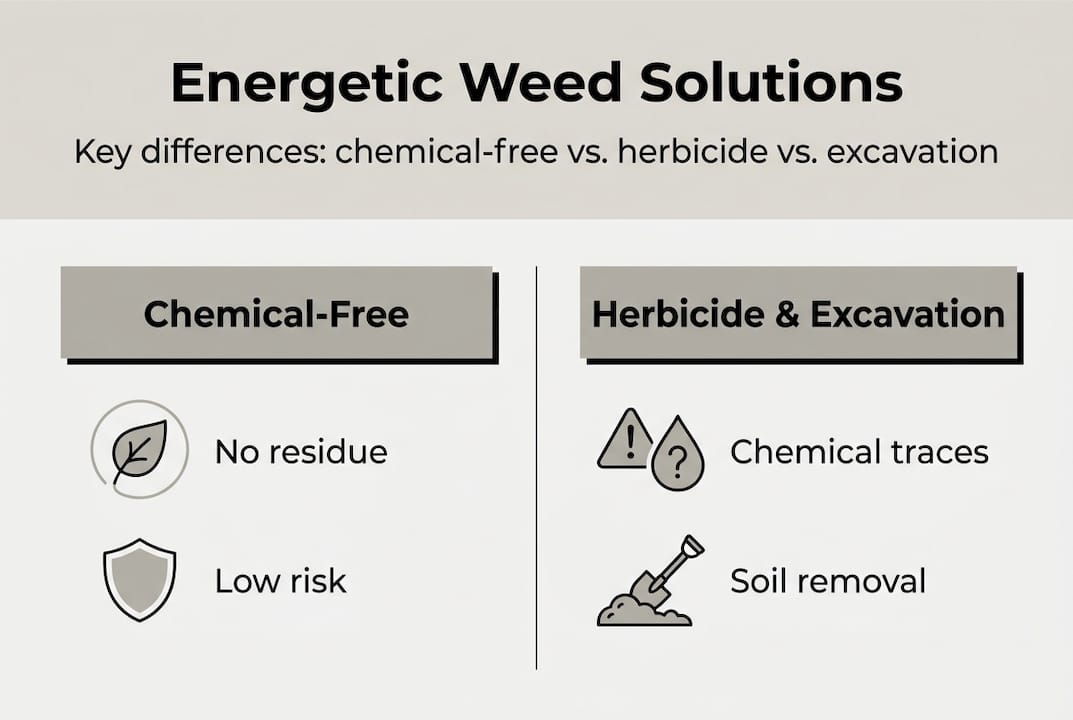
Both methods contrast sharply with conventional herbicide programmes, which introduce glyphosate or other chemicals into the soil over multiple seasons. Excavation, while immediate, is highly disruptive and expensive, often requiring specialist disposal of contaminated soil. Energetic methods sit between these extremes: less invasive than excavation, faster-acting than herbicides, and entirely free of chemical residues.

The energy-based weed control benefits are particularly significant on sensitive sites. Near watercourses, in organic gardens, or on land with biodiversity value, chemical-free approaches eliminate the risk of drift, runoff, and soil contamination. Regulatory pressure on herbicide use is increasing across England, Wales, and Ireland, making these techniques increasingly relevant for landowners who want to stay ahead of compliance requirements.

Key advantages of energetic weed treatment at a glance:

  • No chemical residues left in soil or water
  • Suitable for use near watercourses, gardens, and ecologically sensitive areas
  • Aligns with emerging environmental regulations restricting herbicide use
  • Causes progressive depletion of rhizome energy reserves with each treatment
  • Produces no contaminated soil requiring specialist disposal
  • Supports biodiversity by avoiding harm to surrounding plant and animal life
Feature Energetic treatment Herbicide programme Excavation
Chemical residues None Yes None
Suitable near water Yes Restricted Yes
Soil disruption Minimal Minimal High
Treatment duration 1–2 years 3–5 years Immediate
Eco-credentials High Low Medium

For homeowners seeking a chemical-free weed treatment guide, understanding these distinctions is the essential first step before committing to any programme.

Preparation and requirements before starting treatment

Now that you know what energetic treatment involves, here’s how to prepare and what’s required before taking action.

Surveyor prepares for knotweed treatment at home

Professional preparation is not optional. The chemical-free knotweed process follows a structured sequence: site survey and mapping, initial treatment during active growth (typically May to June), follow-up treatments in July and August, repeat cycles over one to two years, and thorough documentation for insurers and mortgage lenders. Skipping any stage risks incomplete eradication and potential legal complications.

The site survey is where everything begins. A qualified specialist will map the full extent of the infestation, including underground rhizome spread, which can extend up to three metres beyond visible growth. Without this mapping, treatment zones cannot be accurately defined, and you risk missing significant root mass.

What preparation involves for homeowners:

  • Engaging a certified invasive species specialist for a formal site survey
  • Providing access to all affected areas, including boundaries and outbuildings
  • Clearing surface debris to allow equipment access
  • Notifying neighbours if the infestation crosses boundaries (a legal obligation in many cases)
  • Retaining all survey reports and treatment records for insurance and conveyancing purposes

Documentation is arguably as important as the treatment itself, particularly if you intend to sell your property. Mortgage lenders and insurers require evidence of a formal management plan, and without it, a sale can stall or collapse entirely.

Preparation step DIY approach Professional approach
Site survey Incomplete, no mapping Full rhizome mapping included
Equipment Unavailable to public Specialist high-voltage units
Documentation Not accepted by lenders Lender-compliant reports produced
Legal compliance High risk Fully managed
Safety Significant hazard Controlled and insured

Pro Tip: Request that your specialist produces documentation in a format accepted by major mortgage lenders from the outset. Retrofitting paperwork after treatment is completed is time-consuming and sometimes impossible.

Personal protective equipment, including insulated gloves, face shields, and appropriate footwear, is mandatory during thermo-electric treatment due to high-voltage operation. This is one of several reasons why DIY attempts are strongly discouraged. The equipment involved is not commercially available to the public, and improper use risks serious injury as well as worsening the spread of knotweed through disturbed rhizome fragments.

Step-by-step: The energetic weed treatment process in action

Preparation complete — it’s time to walk through the energetic weed treatment process, step by step.

  1. Site survey and rhizome mapping. A specialist visits the property, identifies all knotweed growth, and maps the rhizome network. This defines the treatment zone and informs the management plan.
  2. Initial treatment (May to June). The first energetic treatment is delivered during active growth, when the plant is directing energy upward and the rhizomes are most vulnerable. Thermo-electric treatment delivers controlled current of up to 5,000 volts via probes inserted into stems and rhizomes, generating fatal internal heat.
  3. Follow-up treatments (July to August). Subsequent sessions target regrowth and any rhizome sections that survived the initial treatment. Each delivery further depletes the plant’s energy reserves.
  4. Second-year monitoring and treatment. For most infestations, a second year of treatment is required. The specialist revisits, assesses regrowth, and delivers additional sessions as needed.
  5. Final inspection and documentation. Once eradication is confirmed, a formal completion report is produced. This document is essential for property transactions and insurance claims.

“The steam method penetrates rhizomes, denatures proteins, neutralises pathogens, and remediates soil, offering a biologically thorough approach to knotweed eradication.” UK steam treatment research

The choice between thermo-electric and steam methods depends on site conditions. Thermo-electric treatment is highly precise and well-suited to confined spaces, boundaries, and areas where ground disturbance must be minimised. Steam treatment covers larger surface areas and offers particularly strong results in open ground.

Pro Tip: Timing your initial treatment to coincide with peak growth in May or June significantly improves outcomes. The plant’s upward energy transfer during this period makes the rhizomes more susceptible to energetic disruption.

Safety during treatment is non-negotiable. High-voltage equipment requires trained operators and a cleared exclusion zone. The knotweed eradication workflow must be managed entirely by certified professionals, both for safety and to ensure the resulting documentation carries weight with lenders and insurers.

Comparing outcomes, challenges, and what to expect

Now you’ve seen how the process unfolds, let’s examine what results to expect and how energetic treatment stacks up.

Infographic comparing weed removal methods

The performance data for energetic methods is compelling. Thermo-electric treatment achieves 80 to 95% success rates within one to two years, while steam treatment has recorded 100% eradication in UK trials. By comparison, herbicide programmes typically achieve 85 to 90% success but require three to five years to complete. For homeowners with a property transaction on the horizon, that timeline difference is significant.

Treatment method Success rate Typical duration Chemical use
Thermo-electric 80–95% 1–2 years None
Superheated steam Up to 100% 1–2 years None
Herbicide programme 85–90% 3–5 years Yes
Excavation Near 100% Immediate None

Energetic treatment performs particularly well near watercourses, in organic gardens, and on sites where chemical use is restricted. The chemical-free weed control benefits extend beyond ecology: no contaminated soil to dispose of, no waiting periods before replanting, and no risk of chemical harm to neighbouring land.

There are known limitations. Dense infestations with extensive rhizome networks may require additional treatment cycles. Boundary disputes can complicate access, particularly when knotweed has spread from a neighbouring property. In these cases, root barrier installation may be recommended alongside energetic treatment to prevent reinfestation.

Common challenges and how to address them:

  • Incomplete rhizome mapping: Always insist on a full survey before treatment begins
  • Boundary infestations: Engage a specialist who can advise on legal obligations and neighbour communication
  • Lender acceptance: Confirm your chosen specialist produces documentation recognised by major lenders
  • Reinfestation risk: Ongoing monitoring after treatment completion is essential

The impact on property transactions is well documented, and lenders are increasingly scrutinising knotweed disclosures. While energetic treatment is gaining recognition, PCA white papers on herbicides confirm that herbicide and excavation methods currently hold broader acceptance among lenders. This is changing, but documentation quality remains critical regardless of which method you choose. The energy-based weed control advantages are clear, provided the treatment is professionally delivered and properly evidenced.

Our take: Why energetic weed treatment is changing the game

With the main guidance covered, here is an honest perspective from those working at the forefront of chemical-free knotweed management.

Most guides stop at explaining how energetic treatment works. What they rarely address is the regulatory landscape shifting beneath the industry. Glyphosate restrictions and eco-regulations are tightening across the UK and Ireland, and energetic methods are directly aligned with where legislation is heading. Homeowners who adopt chemical-free solutions now are not simply making an ethical choice; they are future-proofing their approach.

The honest challenge is lender adoption. Energetic treatment does not yet carry the same universal acceptance as established herbicide programmes in the eyes of all mortgage lenders. This is not a reflection of efficacy; it is a reflection of familiarity. The solution is rigorous documentation from the outset, produced by certified specialists whose reports carry professional weight.

Our view is straightforward: the knotweed removal best practices of tomorrow will be chemical-free. Homeowners who invest in energetic treatment today, backed by thorough evidence trails, will be better positioned for property transactions, regulatory compliance, and long-term land management than those who default to herbicide programmes simply because they are more familiar.

Next steps and where to get help

Armed with this insight, here’s where to go next for expert help and official planning.

If Japanese Knotweed is affecting your property, the most important step is securing a professional survey from a certified specialist. Japanese Knotweed Agency delivers thermo-electric treatment directly on site, applying up to 5,000 volts to cause internal cell damage and progressively deplete the rhizome network with every session. We cover England, Wales, and Ireland.

https://japaneseknotweedagency.co.uk

For homeowners seeking a formal eradication plan, our chemical-free solutions page provides detailed information on treatment options and next steps. If you need a structured approach for a property transaction or insurance requirement, our invasive species eradication planning resource walks you through the full planning process. Contact us to arrange a survey and receive documentation that meets lender and insurer requirements.

Frequently asked questions

What is energetic weed treatment and how does it work?

Energetic weed treatment uses controlled heat or electricity to destroy Japanese Knotweed cells and rhizomes without any chemical application. Thermo-electric methods deliver up to 5,000 volts directly into the plant’s root system, while steam methods apply pressurised heat above 100°C to achieve the same result.

Is energetic treatment safer for pets, gardens, or near water than herbicides?

Yes. Because energetic methods avoid chemical drift and leave no residues in soil or water, they are particularly well-suited to sensitive sites including gardens, watercourses, and areas with protected wildlife. There is no waiting period before people or animals can re-enter treated areas.

How long does energetic weed treatment take to eradicate Japanese Knotweed?

Thermo-electric treatment typically achieves 80 to 95% success within one to two years, and steam treatment has recorded 100% eradication in UK trials. Both methods are significantly faster than herbicide programmes, which commonly require three to five years to complete.

Can I do energetic Japanese Knotweed treatment myself?

DIY is not advised. The equipment involved is not available to the public, and improper treatment risks spreading the infestation through disturbed rhizome fragments, as well as serious personal injury from high-voltage operation. Professional involvement is also required to produce documentation accepted by lenders and insurers.

Read more

Why invasive weeds return: mastering property risk


TL;DR:

  • Even small fragments of Japanese Knotweed can regenerate and cause long-term property damage.
  • Manual removal often spreads the plant’s roots and makes the infestation worse.
  • Professional treatment with guaranteed eradication is essential for property transaction security.

A single fragment of Japanese Knotweed, as small as 1cm, can silently regenerate beneath your garden, undermining years of control efforts and threatening both your mortgage application and property value. For homebuyers and investors in England, Wales, and Ireland, this is not a minor inconvenience. It is a legal, financial, and structural risk that demands a clear-eyed understanding of how invasive weeds survive, why they return, and what genuinely effective eradication looks like. The following sections address each of these questions in turn, equipping you with the knowledge to protect your investment and make sound decisions before signing on any dotted line.

Table of Contents

Key Takeaways

Point Details
Rhizomes drive regrowth Invasive weeds return because underground rhizomes regenerate from tiny fragments, often years after apparent removal.
Manual removal risks Digging and cutting can worsen invasions by spreading fragments, requiring expert disposal practices.
Monitoring ensures success Long-term monitoring and 10-year guarantees from certified professionals safeguard property value and compliance.
Chemical-free options Electro-thermal and root barrier solutions offer effective, environmentally friendly alternatives for lasting control.

How invasive weeds survive: the anatomy of rhizomes

To understand why invasive weeds return so persistently, you first need to understand what is happening underground. Japanese Knotweed does not rely solely on what you can see above the surface. The visible canes and leaves are only a fraction of the plant’s total biomass. The real engine of its survival is the rhizome network, a dense, branching system of root-like structures that store energy and drive regrowth season after season.

These rhizomes are formidable. Rhizomes extend up to 3m deep and 7m laterally from the parent plant, and fragments as small as 1cm or 0.5g are capable of regenerating an entirely new infestation. This means that even a single missed piece of root material left in disturbed soil can restart the cycle of growth within months.

What makes this especially challenging for property buyers is the plant’s capacity for dormancy. Rhizomes remain viable for many years underground without any visible growth above the surface. A site that appears clear for one or two seasons may simply be in a period of dormancy, not genuinely eradicated. Buyers who rely on visual inspections alone are therefore working with incomplete information.

Rhizome characteristic Detail
Maximum lateral spread Up to 7 metres from parent plant
Maximum depth Up to 3 metres
Minimum regenerative fragment 1cm or 0.5g
Dormancy potential Several years with no visible growth

The knotweed rhizome guidance from Natural Resources Wales reinforces the scale of this challenge, noting that even professionally managed sites require sustained monitoring.

Key behaviours of the rhizome network:

  • Acts as an underground energy reserve, fuelling regrowth after cutting or chemical treatment
  • Produces new shoots from any viable fragment left in disturbed soil
  • Enters dormancy during adverse conditions, resuming growth when conditions improve
  • Extends beneath paths, driveways, and foundations, causing property damage caused by knotweed that is often invisible until serious

The impact on property value becomes significant the moment a survey identifies active or dormant knotweed on or adjacent to a site. Understanding rhizome biology is not an academic exercise. It is the foundation of every effective management decision.

Pro Tip: Never assess a knotweed site by appearance alone. Absence of visible canes does not indicate eradication. Commission a specialist survey that includes soil assessment and rhizome mapping before proceeding with any property transaction.

Next, we explore why even digging and manual removal often worsen the problem.

Why manual removal often spreads invasive weeds further

One of the most counterproductive responses to discovering Japanese Knotweed on a property is to reach for a spade. Intuition suggests that if you dig the plant out, you remove the problem. In practice, the opposite is frequently true. Manual methods like digging or cutting spread fragments through the soil, creating multiple new growth points where previously there was one.
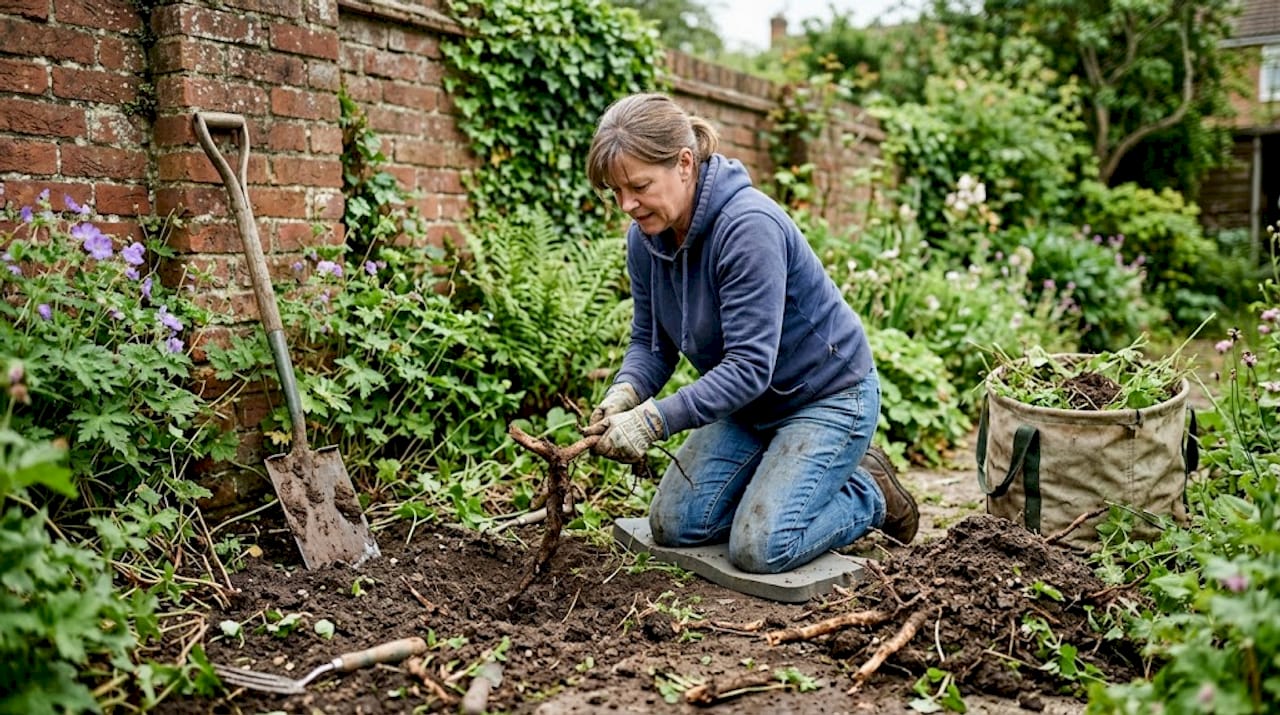
Homeowner manually digs out invasive weeds

When a rhizome is severed by a spade or fork, each fragment becomes a potential new plant. If those fragments are scattered across the site during digging, or transported elsewhere on tools, boots, or in excavated soil, the infestation multiplies rather than diminishes. This is one of the most common reasons buyers inherit worse infestations than sellers originally disclosed.

Disposal compounds the problem further. Japanese Knotweed waste is classified as controlled waste under the Environmental Protection Act 1990, and its movement and disposal are legally regulated. Placing cut material in general waste, composting it, or fly-tipping it are all offences that carry significant penalties. Refer to the guidance for disposal from Natural Resources Wales for compliant approaches.

Risks of unmanaged manual removal:

  1. Rhizome fragments spread to previously unaffected areas of the site
  2. Contaminated soil transported off-site via footwear, machinery, or vehicles
  3. Illegal disposal resulting in enforcement action against the landowner
  4. Incomplete removal leaving viable rhizome material to regenerate
  5. Escalating remediation costs when a worsened infestation requires professional intervention

“Excavation is only effective as an eradication method when every fragment of rhizome material is removed from the soil. Even small amounts of residual material will result in regrowth.”

Method Effectiveness Risk of spread Legal compliance required
Hand digging Low High Yes (disposal)
Mechanical excavation Moderate to high Moderate Yes (soil movement)
Cutting alone Very low High No
Professional removal High Low Yes (fully managed)

For those considering excavation as part of a managed programme, reviewing the safe steps for manual removal is essential before any ground works begin. Understanding your obligations around reporting knotweed is equally important when a neighbouring property is involved.

Pro Tip: If you discover knotweed during a pre-purchase survey, do not instruct the seller to “just dig it out.” Insist on a professionally managed eradication programme with documentation, as this protects your legal position and your lender’s requirements.

To build on this, let us see how professional programmes and legal compliance impact property transactions.

Professional eradication and why guarantees matter for property buyers

For most lenders operating in England, Wales, and Ireland, the presence of Japanese Knotweed on a property triggers specific requirements before a mortgage offer will be confirmed. Undocumented or amateur attempts at removal are insufficient. Lenders require a professionally prepared eradication plan, often accompanied by an insurance-backed guarantee, before they will proceed.

Professional eradication achieves 80-95% success, whereas DIY approaches consistently fail due to fragment spread and poor timing. The difference is not merely technical. It is contractual. A certified treatment programme with a 10-year monitoring guarantee provides the documentation that lenders, solicitors, and future buyers will require.

The TA6 property information form, which sellers in England and Wales must complete, includes a mandatory question about Japanese Knotweed. Failure to disclose known knotweed accurately exposes sellers to claims of misrepresentation. Buyers who discover undisclosed knotweed post-completion have grounds for legal action, making honest disclosure and certified treatment in every party’s interest.

What buyers should look for in a professional programme:

  • A site-specific management plan prepared by a qualified specialist
  • Insurance-backed guarantee of at least 10 years with annual monitoring visits
  • Compliance documentation suitable for submission to mortgage lenders
  • Written confirmation of legal disposal for all excavated material
  • Clear record of treatment dates, methods, and observed regrowth

“An untreated or poorly treated knotweed site is not simply an aesthetic problem. It is a financial liability that follows the property through every future transaction.”

Incomplete treatment reduces property value by 5 to 20% and directly affects mortgage eligibility, making a certified programme a sound financial investment rather than an optional extra. The impact on property values is well documented, and mortgage issues with knotweed can delay or prevent completion entirely.

Understanding the full scope of risks of untreated knotweed on a property is the starting point for any informed buyer or investor. Now, let us look at advanced and chemical-free control strategies gaining favour among experts.

Advanced control: chemical-free methods and edge case successes

Chemical herbicides have long been the standard response to Japanese Knotweed, but their effectiveness is increasingly questioned as resistance patterns develop. Herbicide resistance develops over repeated exposures, making chemical-free methods such as electro-thermal treatment particularly valuable, with up to 95% success achievable within 12 to 24 months.

Electro-thermal treatment works by delivering direct electrical energy, in some systems up to 5,000 volts, into the plant tissue. This causes internal cell damage and depletes the energy reserves stored within the rhizome network with each successive treatment. Unlike herbicides, which require the plant to absorb and translocate the chemical through its vascular system, electro-thermal methods act immediately and physically, reducing the risk of incomplete uptake and resistant regrowth.

Root barriers offer a complementary approach, particularly where rhizome spread into adjacent properties or infrastructure is the primary concern. Installed correctly, they prevent lateral spread without disturbing existing rhizome material, making them especially useful in urban settings or where excavation is impractical.
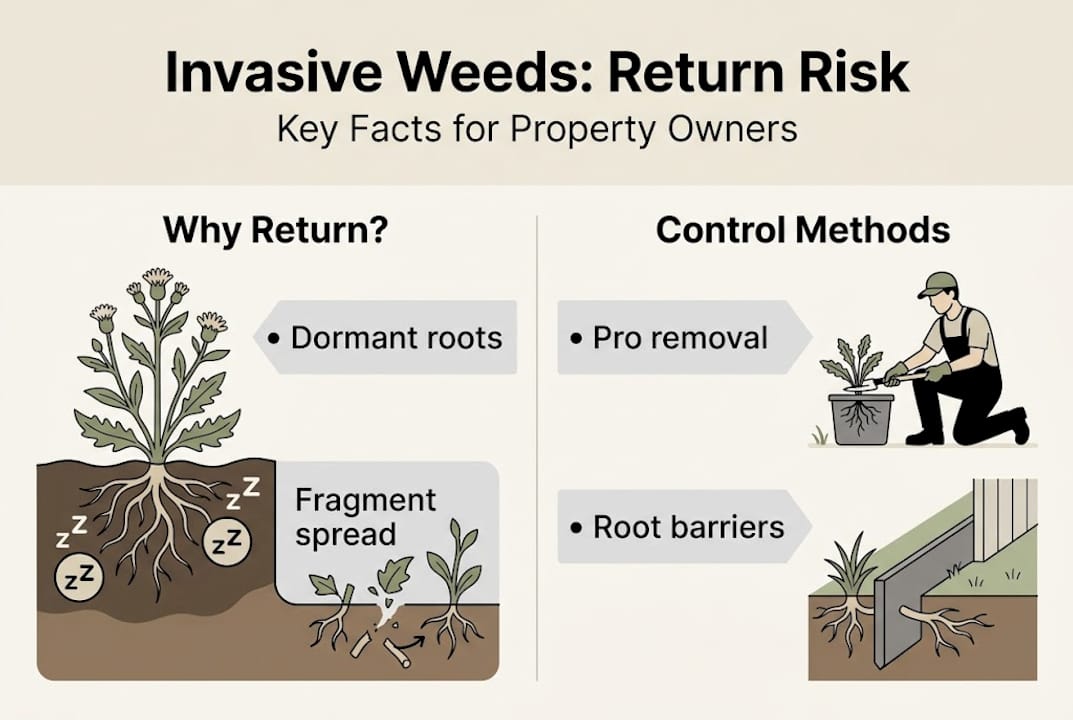
Infographic showing invasive weeds risk overview

Method Efficacy Timeline Suitable near water
Glyphosate herbicide 60-80% 3-5 years No
Electro-thermal treatment Up to 95% 12-24 months Yes
Root barriers Containment Indefinite maintenance Yes
Full excavation High Immediate Site-dependent

Post-treatment regrowth in the form of small-leaved shoots is normal during year one and two and should not be interpreted as treatment failure. It is an expected response as the weakened rhizome network makes further attempts at recovery. Monitoring over three to five or more years is required to confirm genuine eradication, and this monitoring period must be factored into any professional guarantee.

Advantages of chemical-free electro-thermal treatment:

  • No risk of chemical run-off into watercourses or surrounding soil
  • Effective in environmentally sensitive areas where herbicide use is restricted
  • Immediate physical action on rhizome cells, reducing reliance on plant uptake
  • Compatible with lender documentation requirements for compliant treatment records

For guidance on integrating manual removal: safe steps alongside advanced treatments, refer to specialist advice before combining approaches. The RHS knotweed guidance provides a useful reference for understanding what constitutes a complete treatment programme.

Pro Tip: If your property is near a watercourse, stream, or flood plain, electro-thermal treatment is not only preferable from an ecological standpoint but may be legally required, as herbicide application near water is tightly regulated under UK environmental law.

To round off, let us share practical editorial insights that help avoid common buyer misconceptions.

Editorial perspective: the truth most property buyers miss about invasive weeds

In our experience, the single most costly mistake buyers make is trusting what they can see. A clear garden in late autumn tells you very little about what lies beneath. Dormancy deceives buyers with false assurances of success, and monitoring for three to five or more years is the only reliable indicator of genuine eradication.

The property market tends to move faster than the biology of invasive weeds. Sellers under pressure to complete will sometimes point to a season without visible growth as evidence that the problem is resolved. It is not. A rhizome network that has entered dormancy is not a dead rhizome network. It is a waiting one.

The effects on property value are measurable and well evidenced, yet buyers continue to accept verbal assurances where they should demand certified documentation. The pitfalls of manual removal are equally overlooked, particularly by sellers who have made genuine but uninformed attempts to address the problem.

Our position is clear: only 10-year guaranteed, professionally monitored treatment programmes with full compliance documentation should satisfy a buyer’s due diligence. Anything less is a risk carried forward into your ownership.

Expert resources and solutions for invasive weed risk

Understanding the biology of invasive weeds is only part of the answer. Acting on that understanding requires access to the right expertise, certified treatment methods, and ongoing monitoring that lenders and solicitors will accept without question.
https://japaneseknotweedagency.co.uk

At Japanese Knotweed Agency, we provide property surveys across England, Wales, and Ireland, identifying both active and dormant Japanese Knotweed before it becomes a transactional problem. Our chemical-free knotweed treatment uses electro-thermal technology to target rhizome networks without herbicides, making it suitable for sensitive sites and environmentally protected areas. For further guidance on the most common concerns raised by buyers and investors, our knotweed FAQs provide clear, expert-led answers to help you proceed with confidence.

Frequently asked questions

Why does Japanese Knotweed return after apparent eradication?

Rhizomes remain viable and regenerate years after treatment, meaning dormant fragments below the surface can resume active growth long after a site appears clear. A visual inspection is never a reliable substitute for professional monitoring over multiple growing seasons.

How does invasive weed impact property value and mortgages?

Incomplete treatment reduces value by 5 to 20% and directly affects mortgage eligibility, as most lenders require a certified eradication plan before approving any offer. Buyers should request full compliance documentation as a condition of any purchase where knotweed has been identified.

Are manual removal methods effective against invasive weeds?

Manual methods can spread fragments and worsen infestations, making professional removal with properly controlled disposal the only genuinely reliable approach. Digging without specialist oversight typically creates more growth points rather than fewer.

Do professional eradication guarantees actually protect buyers?

Professional programmes achieve 80-95% eradication, and 10-year guarantees backed by insurance provide the documentation lenders and solicitors require to proceed with property transactions. Without this, buyers carry the full remediation risk into their ownership.

What are the best chemical-free strategies for invasive weed control?

Electro-thermal control achieves up to 95% success within 12 to 24 months and is particularly suited to environmentally sensitive locations where herbicide use is restricted or prohibited. Root barriers provide effective containment where excavation or treatment is not immediately practical.

Read more

有效防护自有房产:日本葛防治与无化学安全方案全解


TL;DR:

  • 日本葛根系强大,会造成房屋结构破坏和房产价值下降。
  • 无化学防治包括物理机械、生态恢复和热电处理,需多方法结合。
  • 早期专业干预可节省成本,避免土壤扰动和法律风险。

许多房主起初以为日本葛不过是花园里长势旺盛的杂草,殊不知它的危害远超想象。快速生长的根系可穿透地基、排水管道乃至墙体,直接影响房产结构稳定性,进而导致估价下降,甚至令抵押贷款审批受阻。面对这一威胁,越来越多的房主和物业买家正在寻求安全、无化学品的防护方案。本文将系统介绍日本葛的危害机制,以及科学高效的无化学防护与治理策略,帮助你从容保护房产安全与长期价值。

目录

关键要点

要点 详情
日本葛危害严重 该植物可致房屋结构损伤、贬值及贷款风险,须高度警惕。
无化学防护可行 机械切割、厚覆盖、生态放牧等组合方法2-4年内能有效控制日本葛。
持续管理最关键 整合多项方法并坚持监测,才能实现长期清除与防护。
特殊情况需专业方案 靠近水体或涉及交易的物业建议寻求专业评估与全面治理。

日本葛风险全面解析与房产影响

日本葛(Japanese Knotweed,学名 Fallopia japonica)原产于东亚,19世纪作为观赏植物引入英国后迅速失控蔓延。它的地下根茎(rhizome,即根状茎)网络极为庞大,可延伸至地表以下3米,横向扩展7米以上。即便是一小块根茎碎片,也足以在新地点萌发出全新植株。

根系的强大破坏力体现在多个层面:它能沿着混凝土裂缝、砖墙接缝和排水管道生长,逐渐扩大缝隙,最终造成结构性损坏。房产估价师和抵押贷款机构对此高度警惕,许多贷款方会直接拒绝为受日本葛侵扰的房产提供贷款,或要求业主提交专业治理计划方可审批。

房产估价与治理影响来看,受侵扰房产的市场价值可能下降5%至15%,在严重情况下跌幅更大。与此同时,根除对房产价值保护的意义不可忽视,及时有效的治理可显著恢复并稳固房产价值。

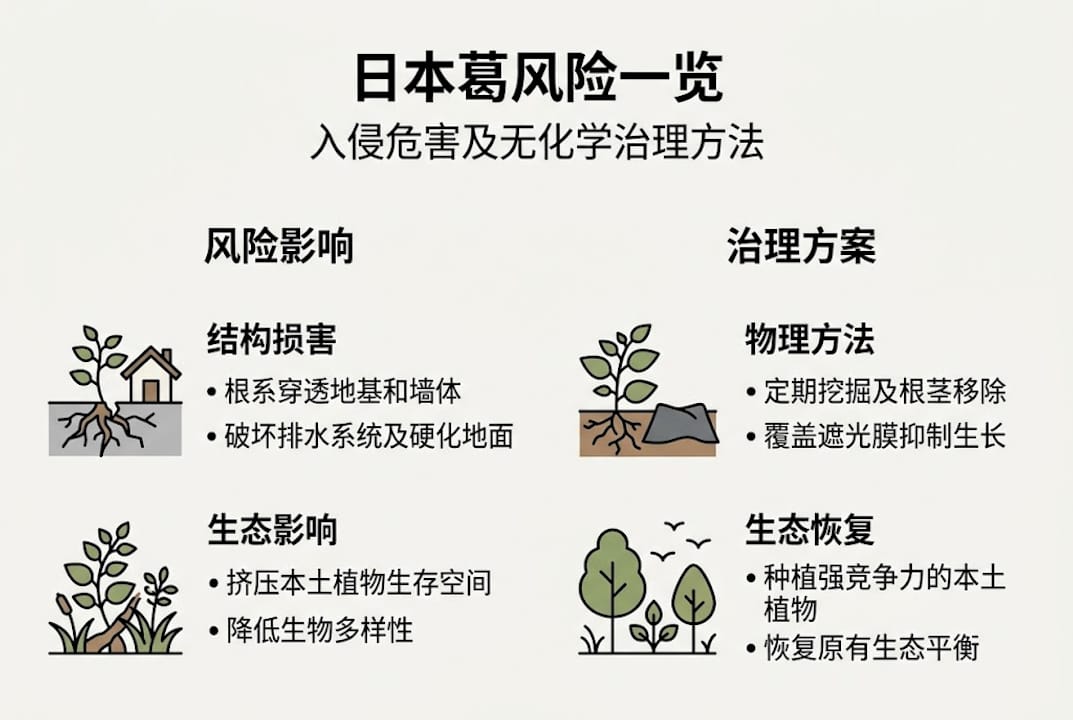
日本葛的危害与防治对策一览图

在健康与生态层面,生境改变带来的风险包括虫害增加和局部空气质量变化。日本葛密集的茎叶遮蔽阳光,导致本土植物无法生存,生物多样性大幅降低,进而影响整个区域的生态平衡。

与其他常见入侵植物相比,日本葛的危害尤为突出:

入侵植物 根系深度 结构破坏风险 影响贷款审批
日本葛 可达3米 极高
虎杖(Giant Hogweed) 约1米 中等 偶尔
喜马拉雅凤仙花 浅层
常春藤 中等 中等 偶尔

关于英国相关政策解读,英国法律明确规定,将日本葛废弃物随意丢弃属于违法行为,业主有责任防止其蔓延至邻近地块。

核心风险一览:

  • 地基、排水管道及墙体结构损坏
  • 房产估价下降,影响买卖与贷款
  • 本土植物受压制,生物多样性降低
  • 法律责任风险(若扩散至邻地)

无化学安全防护核心原理及机制

无化学防治日本葛的方法主要分为三大类:物理机械法、生态恢复法,以及新兴的热电处理技术。理解每种方法的原理,才能根据房产具体情况选择最适合的策略组合。

物理机械法是最基础的无化学手段。机械切割、手工挖掘与厚层覆盖通过物理阻断植株的光合作用和营养传输,逐步消耗根茎储存的能量。切割需在生长季节每隔4至6周进行一次,持续剥夺植株再生所需的碳水化合物储备。厚层覆盖(通常使用不透光防草布或多层有机物料)则通过遮光彻底抑制新芽萌发。

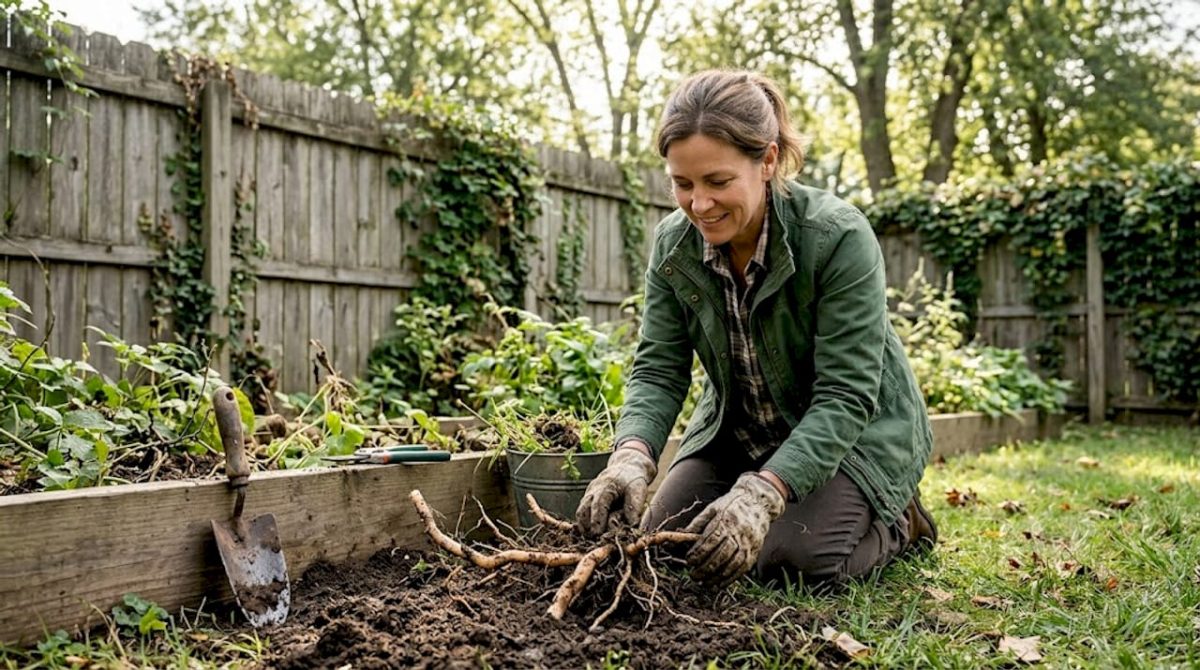
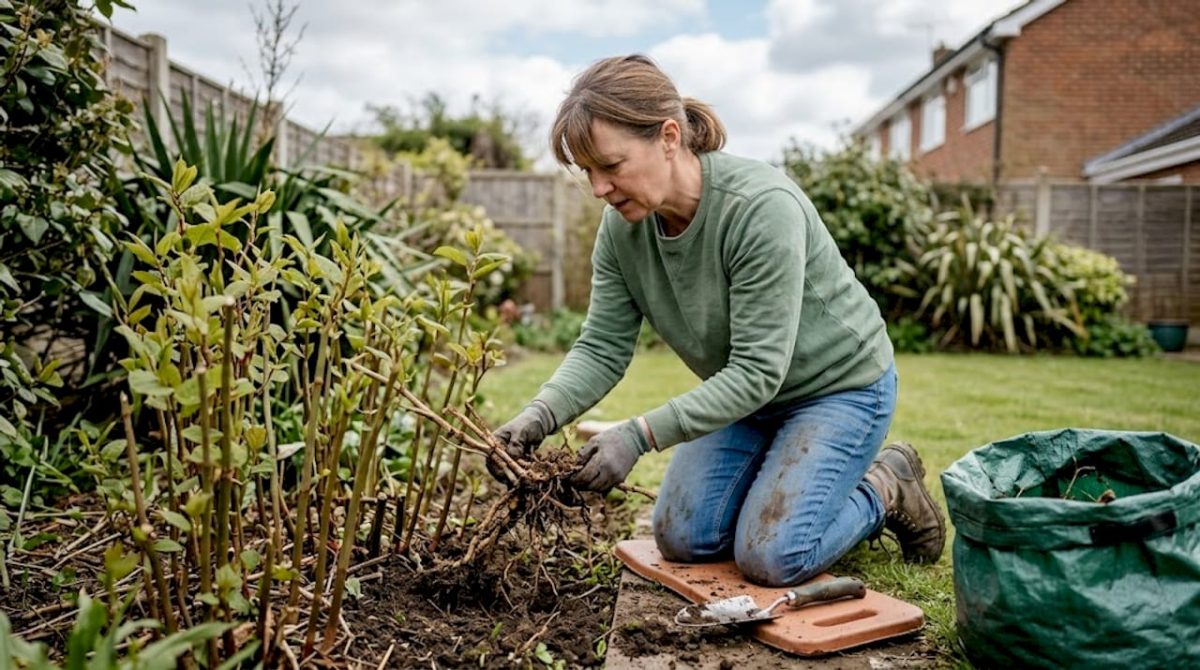
一位女士正在自家后院挖野生的虎杖

生态恢复法适用于面积较大的侵扰区域。在部分地区,引入山羊或绵羊定期啃食日本葛地上部分,可有效减少植株生物量,同时避免土壤扰动。配合种植竞争性强的本土植物,可逐步恢复生态位,压缩日本葛的生存空间。

热电处理技术是目前最具技术含量的无化学方案。通过向根茎网络直接输送高压电能,造成细胞内部损伤,持续消耗根系储存的能量资源,从而实现深层根除,且不对周围土壤和生态系统造成化学污染。

无化学防治实操指南强调,单一方法效果有限,多方法组合才是科学路径。以下是推荐的整合方案步骤:

  1. 首先进行专业现场评估,确定侵扰范围和根系深度
  2. 在生长季节开始前安装不透光覆盖层
  3. 每4至6周进行一次机械切割,清除地上部分
  4. 结合热电处理针对根茎网络进行深层干预
  5. 引入本土植物辅助生态恢复
  6. 每季度进行监测,记录再生情况

关键数据: 持续2至4年的组合管理可将日本葛再生率控制在20%以下,而单一切割或单一覆盖的效果远不及此。

七大无化学防治方案区域性防治成功经验均表明,坚持多途径整合管理的房主,最终实现完全根除的成功率显著高于依赖单一手段者。

专业提示: 覆盖材料的选择至关重要。使用至少300克每平方米(300gsm)的不透光防草布,边缘重叠不少于30厘米,并用地钉牢固固定,防止风力掀起造成缝隙。

实操方案与房主常见误区详解

了解原理之后,正确的操作细节决定防治成败。以下是经过实践验证的分步操作指南,以及房主最容易犯下的错误。

分步操作流程:

  1. 标记侵扰边界: 在春季新芽萌发时,用标记旗或喷漆清晰标出日本葛分布范围,包括地下根茎可能延伸的区域。
  2. 安装覆盖层: 在标记区域铺设不透光防草布,确保完全覆盖,边缘压实固定。
  3. 定期机械切割: 每4至6周切割一次地上茎秆,切割高度尽量贴近地面。切割后的植株残体须装袋密封,按照受控废弃物处理,切勿随意堆放或堆肥。
  4. 热电处理介入: 在专业团队指导下,对根茎网络实施热电处理,直接破坏细胞结构,消耗根系能量储备。
  5. 监测根系残留: 每季度检查覆盖层边缘及周边土壤,留意新芽萌发迹象,及时处理根茎碎片。

完全根除需3至4年的持续管理,中途停止往往导致根系反弹,前功尽弃。

专业提示: 靠近水体或排水沟渠时,切割和挖掘操作须格外谨慎。根茎碎片一旦随水流扩散,可在下游数十米处萌发新植株,大幅增加防治难度和法律风险。

房主最常见的三大误区:

  • 误区一:切断后不清理根块。 遗留在土壤中的根茎碎片,哪怕只有1厘米长,也能萌发新植株。每次切割后必须彻底清理地面残留物。
  • 误区二:过度挖掘扰动土壤。 大范围挖掘会将深层根茎带至地表,反而加速扩散。挖掘须在专业评估后进行,并严格控制范围。
  • 误区三:误施化学药物后放弃无化学路线。 部分房主在无化学方法见效较慢时转而使用除草剂,不仅破坏土壤生态,还可能引发法律责任,尤其是靠近水体的区域。

入侵植物管理实用技巧更多无化学防护案例提供了大量真实场景参考,帮助房主避开操作陷阱。常见治理建议也对各类情境下的应对策略做出了详细说明。

特殊情境与长效防护策略(如近水体、贷款买卖场景)

并非所有房产的日本葛防治都能套用标准流程。靠近水体、湿地或计划进行物业交易的房主,面临更为复杂的管理挑战,需要针对性的策略。

靠近水体的房产:

靠近水体须防扩散,避免任何形式的土壤扰动是首要原则。水流可将根茎碎片迅速传播至下游,一旦在新地点定植,防治成本将成倍增加。建议采取以下措施:

  • 优先使用覆盖和物理屏障,避免挖掘和大范围切割
  • 在水体边缘安装根系屏障(root barrier),阻止根茎向水边延伸
  • 每季度检查水岸线附近是否出现新芽,及时处理
  • 与当地环境保护机构沟通,确认操作符合水体保护法规

近水体房产防护策略提供了专项指导,帮助业主在保护水体生态的同时有效控制侵扰。

物业买卖与贷款场景:

主动披露日本葛侵扰情况,是保障交易顺利进行的关键。隐瞒侵扰情况不仅可能导致交易破裂,还可能引发法律纠纷。相反,提供专业治理计划和进度报告,往往能够有效消除买家和贷款机构的顾虑,促进交易成功。

专业提示: 在挂牌出售前委托专业机构进行入侵植物调查,获取正式报告,不仅能提升买家信心,还可为贷款审批提供有力支持,避免因信息不透明导致的估价折扣。

长效监测与生态恢复:

完成初步治理后,长效监测是防止复发的关键。建议每年春季和秋季各进行一次全面检查,记录侵扰状态变化。同时,在原侵扰区域种植竞争性强的本土植物,可有效填补生态位,降低日本葛再次入侵的可能性,并逐步恢复区域生物多样性。

专家视角与房产保护实践反思

在多年的专业防治实践中,我们观察到一个反复出现的规律:大多数房主在日本葛已经造成明显结构损坏或影响贷款审批之后,才意识到问题的严重性。此时的治理成本和时间投入,往往是早期干预的数倍。早期检测可节省60%成本,这一数据在我们的实际案例中得到了反复印证。

市面上存在一种误解,认为只要坚持切割就能解决问题。事实上,单一的机械切割只能控制地上部分,无法消耗根茎网络储存的庞大能量。只有将物理手段、生态恢复与热电处理技术有机结合,才能实现真正意义上的根除,而非周而复始的抑制。

我们的核心建议是:将日本葛防治纳入房产日常维护计划,而不是等到问题爆发后再被动应对。避免不必要的土壤扰动,优先选择无化学安全治理方案,不仅保护房产价值,也是对周边生态环境负责任的选择。

管理技巧实操反思进一步说明,整合多途径管理的房主在3至4年内实现完全根除的比例,远高于依赖单一手段者。

获取专业支持,守护房产安全和价值

Japanese Knotweed Agency 作为无化学防治领域的先行者,为英格兰、威尔士及爱尔兰的房主提供全流程专业服务。我们的热电处理技术可向根茎网络直接输送高达5000伏的电能,实现深层根除,且不对周围生态系统造成任何化学污染。

https://japaneseknotweedagency.co.uk

无论你正在计划物业交易、申请抵押贷款,还是希望从根本上消除日本葛威胁,我们都能提供因地制宜的全流程无化学防治方案。我们的专业团队还可协助你完成入侵情况披露、长期监测及生态修复工作。立即查阅入侵物种防除指南,或了解我们完整的化学品免费解决方案,迈出保护房产的第一步。

常见问题解答

日本葛会不会对人体或宠物有毒危害?

日本葛本身无毒,对人类与宠物安全,但旺盛生长可能带来虫害等环境风险。对人畜安全已有明确记录,但其引发的生态变化仍须持续关注。

无化学手段防护日本葛多久能见效?

一般需要2至4年,每年持续切割、覆盖等综合治理成效显著。组合管理2至4年可将再生率控制在可管理范围内,中途停止则容易前功尽弃。

房产靠水体或湿地如何安全管理日本葛?

需避免扰动土壤和根系,建议以覆盖和物理屏障为主,并长期监测扩散情况。靠水体须防扩散是专业防治的核心原则,任何挖掘操作都须在专业评估后谨慎进行。

物业买卖或贷款时怎么披露日本葛情况?

建议业主主动披露入侵情况,提供治理计划或专业调查报告,以保障交易顺利推进和贷款成功审批。披露与专业治理能有效恢复房产价值,并消除买家和贷款机构的顾虑。

推荐

Read more

Chemical-free Japanese Knotweed solutions: 95% success


TL;DR:

  • Chemical-free methods like Roots Reset achieve over 95% eradication in a single treatment.
  • Proper eradication requires a formal plan with long-term guarantees from accredited specialists.
  • DIY removal poses legal and environmental risks, making professional, documented treatment essential.

The belief that Japanese Knotweed cannot be controlled without herbicides has persisted for decades, shaping the advice given to homeowners across England, Wales, and Ireland. That assumption is now being overturned. Trials conducted in Wales in 2025 demonstrated over 95% eradication using a fully chemical-free method, and Irish pilot projects are producing comparable results through organic compost approaches. If you are facing a knotweed infestation and want a solution that protects your property, your health, and your legal standing, the landscape of available options has changed significantly.

Table of Contents

Key Takeaways

Point Details
Knotweed can be eradicated New chemical-free methods now reliably control Japanese Knotweed in the UK and Ireland.
Formal plans are essential Accredited surveys and guarantees are critical for property sales and legal compliance.
DIY risks are high Attempting unaccredited DIY removal can worsen the problem and may lead to legal issues.
Rapid replanting possible Some advanced chemical-free treatments allow you to replant as soon as five days later.

What makes Japanese Knotweed so resistant?

Now that we have challenged the biggest myth, let us uncover why Japanese Knotweed is so persistent in the first place. Understanding its biology is essential before selecting any treatment method, chemical-free or otherwise.

Japanese Knotweed (Fallopia japonica) produces an extensive underground network of rhizomes, the root-like stems that store energy and drive regrowth. These rhizomes can extend up to three metres deep and seven metres horizontally from the visible plant. A fragment as small as one centimetre is capable of generating an entirely new plant. This is not a weed that responds to surface-level intervention.

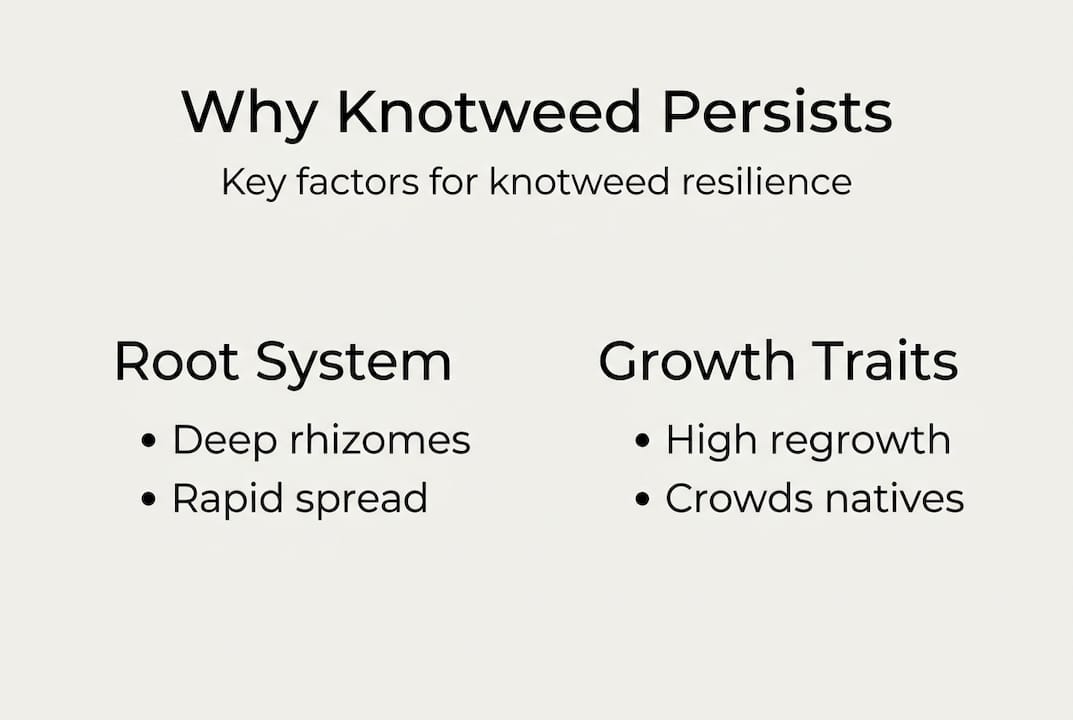
Infographic explains knotweed resistance mechanisms

The plant’s above-ground canes can push through tarmac, crack foundations, and breach drainage systems. Below ground, the rhizome network acts as a biological reserve, drawing on stored energy to regenerate even after the visible growth has been removed. This is precisely why incomplete removal attempts so often make the problem worse.

Common homeowner struggles include:

  • Legal obligations: In the UK, allowing knotweed to spread to neighbouring land is a civil and potentially criminal matter
  • Long treatment timelines: Most approaches require multiple seasons before any guarantee can be issued
  • Garden disruption: Excavation works can be extensive, affecting landscaping, structures, and soil integrity
  • Property sale complications: Mortgage lenders and insurers require formal eradication plans before proceeding

“Herbicide methods take over 3 seasons and are often incomplete since Knotweed regenerates from fragments.”

This is why understanding why use non-chemical methods matters so much. Herbicide programmes are slow, require repeated applications, and carry environmental risks to surrounding soil and waterways. The case for a better approach is well established, and the evidence now supports it.

Breakthroughs in chemical-free treatment: Welsh and Irish success stories

Understanding resistance is only half the battle. What are the game-changing solutions now available to homeowners in England, Wales, and Ireland?

Two significant developments deserve close attention. The first is the Roots Reset method, trialled in Wales in 2025. This technique uses an anaerobic soil process, depriving the rhizome network of the oxygen it needs to sustain cell function, causing cellular breakdown without any herbicide input. The results were striking: the Roots Reset method achieves 95% or greater eradication in a single treatment cycle, with replanting possible just five days after completion.

The second development comes from Ireland, where the KNOT project introduced a bespoke organic compost treatment. This approach works by boosting beneficial soil fungi, improving the microbial environment, and using targeted shading to suppress knotweed regrowth. The Irish pilot compost method increases beneficial fungi and measurably reduces knotweed regrowth across treated sites.

Method Treatment time Replanting Chemical use Eradication rate
Herbicide programme 3 or more seasons Delayed Yes Variable
Excavation (dig out) Days to weeks Immediate No Risk of spread
Roots Reset (anaerobic) Single treatment 5 days No 95%+
Organic compost (KNOT) Multiple seasons Gradual No Improving

Statistic to note: A 95% eradication rate in a single treatment cycle represents a significant advance over traditional herbicide programmes, which frequently require three to five years and still carry risk of incomplete clearance.

Pro Tip: When reviewing any chemical-free option, ask the contractor to share documented trial data, not just testimonials. Methods like Roots Reset have published results you can verify independently.

For homeowners wanting to understand the full chemical-free eradication workflow, the process is structured and methodical. Reviewing non-chemical knotweed controls alongside these trial results gives a clear picture of what modern, responsible eradication looks like.

What formal eradication looks like: Homeowner obligations and legalities

With new solutions available, let us clarify what eradication means in a legal and practical sense, and why the formal process matters as much as the method itself.

Specialist inspecting Japanese Knotweed in urban yard

Eradication is not simply the removal of visible canes. In the context of property law, insurance, and mortgage lending, eradication means a documented, professionally managed programme with a long-term guarantee, typically between five and ten years. Without this, a property sale can stall, a mortgage application can be declined, and insurance claims related to knotweed damage may be rejected.

Key legal and procedural considerations for homeowners include:

  • Accreditation matters: Contractors should hold PCA (Property Care Association) or INNSA (Invasive Non-Native Specialists Association) accreditation
  • Formal management plans: These documents outline the treatment method, timelines, monitoring schedule, and guarantee terms
  • Waste disposal compliance: Knotweed is classified as controlled waste in the UK; improper disposal is a criminal offence
  • Neighbour liability: Allowing spread to adjacent land can result in legal action under the Anti-Social Behaviour, Crime and Policing Act 2014

“Homeowners should start with a PCA or INNSA-accredited survey for a formal plan with a 5 to 10 year guarantee; DIY risks spread and legal issues.”

Understanding the knotweed specialists’ role is essential here. A specialist does not simply treat the plant; they produce documentation that satisfies lenders, insurers, and solicitors. The survey guide for knotweed explains what a professional assessment covers and why it forms the foundation of any credible eradication plan.

Requirement Why it matters
PCA or INNSA accreditation Recognised by lenders and insurers
Written management plan Required for property transactions
5 to 10 year guarantee Provides long-term legal protection
Controlled waste disposal Legal compliance, avoids prosecution

DIY attempts carry serious risks. Beyond the practical challenge of incomplete removal, homeowners who disturb knotweed without a plan risk spreading the plant, creating additional legal liability, and voiding any future guarantee from a professional contractor.

Choosing and applying a chemical-free solution: Step-by-step for homeowners

Knowing the standards, homeowners need actionable steps to implement the right chemical-free remedy with confidence.

Official guidance prioritises non-chemical approaches where possible, but always recommends starting with a professional survey. Here is a practical framework:

  1. Assess the infestation: Note the extent of visible growth, proximity to structures, and whether the plant has spread beyond your boundary
  2. Commission a professional survey: An accredited specialist will map the rhizome extent and identify the most appropriate treatment method
  3. Select the right method: Based on survey findings, choose between approaches such as Roots Reset, organic compost treatment, thermo-electric treatment, root barrier installation, or excavation
  4. Agree a formal management plan: Ensure the plan is written, includes a guarantee period, and specifies monitoring intervals
  5. Follow up as scheduled: Chemical-free methods often require follow-up visits to confirm eradication and address any regrowth
  6. Obtain written confirmation of clearance: This document is what solicitors and lenders will request during any future property transaction

Common pitfalls to avoid:

  • Cross-contamination during removal, which can spread viable rhizome fragments to unaffected areas
  • Disposing of knotweed material in standard garden waste, which is illegal
  • Accepting verbal assurances instead of written guarantees
  • Choosing a contractor without verifiable accreditation

Pro Tip: Ask specifically for evidence of completed formal eradications using non-chemical methods. A reputable contractor will have documented case studies and be able to demonstrate the process for chemical-free treatment clearly. Understanding the benefits of chemical-free weed control will also help you ask the right questions during any initial consultation.

A fresh perspective: Why most advice about knotweed control is out of date

Stepping back, it is worth asking why so many authorities and online forums still emphasise herbicides or offer ambiguous answers when the science has moved on.

The honest answer is institutional inertia. Guidance documents take years to update, and herbicide programmes have a long commercial history that shapes what contractors default to recommending. Meanwhile, trials like Roots Reset in Wales and the KNOT composting project in Ireland are producing results that render much of the standard advice obsolete.

The uncomfortable truth for homeowners is this: DIY attempts, however well-intentioned, still carry a disproportionate legal and logistical risk. A single mishandled removal can spread the plant further, create liability with neighbours, and invalidate future professional guarantees. The financial cost of that mistake consistently exceeds the cost of engaging a specialist from the outset.

Only well-documented, professionally delivered, chemical-free programmes resolve knotweed issues in a way that satisfies lenders, insurers, and the law. For homeowners serious about protecting their property, reviewing sustainable eradication advice is a logical and necessary first step.

How we help: Get the right formal plan for knotweed eradication

If you are ready to move beyond confusion and secure a professional, chemical-free solution that is recognised for legal and resale purposes, Japanese Knotweed Agency is here to help.

https://japaneseknotweedagency.co.uk

We are pioneers of chemical-free treatment and eradication of Japanese Knotweed across England, Wales, and Ireland. Our thermo-electric treatment delivers up to 5,000 volts directly to the rhizome network, causing internal cell damage and depleting the plant’s energy reserves without a single drop of herbicide. We also carry out root barrier installations, excavation works, and accredited property surveys. Our eradication plan guide explains exactly what a formal plan involves, and our chemical-free eradication step-by-step gives you a clear pathway from survey to guarantee.

Frequently asked questions

Can Japanese Knotweed really be eradicated without chemicals?

Yes. The Roots Reset method achieves over 95% eradication in a single treatment cycle, and the Irish organic compost pilot demonstrates measurable suppression of regrowth, both without herbicides.

What guarantee do I need for formal eradication?

You should insist on a written guarantee of five to ten years from a PCA or INNSA-accredited contractor, as this is the standard recognised by mortgage lenders and insurers.

Is it illegal to dig and dispose of Knotweed without a professional plan?

It carries serious legal risk. Knotweed waste is classified as controlled waste in the UK, and improper disposal can result in prosecution, as well as spreading the plant further.

How quickly can I replant after a chemical-free treatment?

With the Roots Reset method, replanting is possible just five days after treatment is completed, making it significantly faster than herbicide-based programmes.

Read more

Garden protection checklist: 95% chemical-free knotweed fix


TL;DR:

  • Japanese Knotweed must be legally disclosed during property transactions to avoid legal penalties.
  • Thermo-electric treatment offers a chemical-free, rapid, and effective method with a 95% success rate.
  • Ongoing monitoring and proper waste disposal are essential for long-term eradication and legal compliance.

Japanese Knotweed is one of the most legally and financially consequential plants a homeowner in England, Wales, or Ireland can encounter. Classified as invasive under the Wildlife and Countryside Act 1981, it must be disclosed during property transactions and managed responsibly to avoid criminal liability. Whether you are preparing for a sale, planning a renovation, or simply trying to reclaim your garden, knowing the right eradication methods, legal obligations, and documentation requirements is essential. This checklist-driven guide covers everything from survey standards and thermo-electric treatment to physical excavation, root barriers, and compliant waste disposal, giving you a clear, actionable path forward.

Table of Contents

Key Takeaways

Point Details
Legal survey essentials Professional surveys and clear disclosure protect against legal issues and ensure property value.
Thermo-electric innovation Thermo-electric treatments offer high success, low waste, and are ideal for complex gardens.
Physical vs root barriers Excavation clears quickly but root barriers prevent re-infestation with minimal disruption.
Monitoring and compliance Annual checks and strict waste disposal are vital to prevent spread and retain compliance.
Professional support Expert help reduces risks, ensures chemical-free eradication and unlocks insurance guarantees.

Before any eradication work begins, understanding your legal standing is non-negotiable. Japanese Knotweed must be disclosed on the TA6 property information form when selling, and mortgage lenders routinely reject applications where infestations are unmanaged or undocumented. The consequences of non-disclosure can include legal action from buyers, so getting a professional survey in place early protects you on every front.

The Royal Institution of Chartered Surveyors (RICS) uses a four-category grading system to assess proximity and risk:

  1. Category 1: Knotweed present on neighbouring land more than 7 metres from the boundary, with no visible impact on the property.
  2. Category 2: Knotweed within 7 metres of the property boundary or within the garden but not causing structural damage.
  3. Category 3: Knotweed within 7 metres of habitable spaces or outbuildings, with evidence of damage or encroachment.
  4. Category 4: Knotweed within or causing direct damage to structures, foundations, or drainage systems.

Higher categories demand more urgent and documented professional intervention. A knotweed survey checklist provides a clear framework for what needs to be recorded, mapped, and verified before any treatment begins.

Pro Tip: Always request an insurance-backed guarantee from your treatment provider. Mortgage lenders and solicitors increasingly require this documentation, and it significantly improves your position when selling property with knotweed present.

Sites adjacent to water courses, or large infestations exceeding 10 square metres, require specialist survey methodology. The RHS knotweed guidance recommends professional involvement for any situation involving sensitive ecological boundaries.

Mapping the rhizome network is as important as the visual survey. Rhizomes can extend far beyond the visible shoot growth, and incomplete mapping leads to incomplete treatment. Accurate records also strengthen your legal compliance position and directly support knotweed’s impact on property values by demonstrating a proactive management programme to prospective buyers and lenders.

With legal compliance established, the next step is evaluating eradication methods that avoid chemicals entirely.

Thermo-electric treatment: Innovative, low-waste solution

Thermo-electric treatment is the most technically advanced chemical-free option currently available, and it is the method at the core of what we do at Japanese Knotweed Agency. The process involves delivering direct electrical energy of up to 5,000 volts into the plant tissue and root network, causing irreversible internal cell damage and progressively depleting the energy reserves stored within the rhizome system. Each treatment visit compounds the effect, weakening the plant further with every application.

The practical advantages for homeowners are significant:

  • No chemicals introduced into the soil, water table, or surrounding ecology.
  • Minimal surface disruption, making it ideal for gardens near walls, patios, or foundations.
  • Suitable for use near water courses, where herbicide treatments are prohibited or restricted.
  • Faster results than many traditional approaches, typically delivering measurable progress within one to two treatment seasons.
  • Low waste generation, reducing licensed disposal requirements compared to full excavation.

A 95% eradication success rate makes thermo-electric treatment particularly well-suited to situations where time is critical, such as an imminent property sale or a planned construction project. Speed of resolution matters enormously when mortgage approvals and exchange dates depend on documented progress.

Technician using thermo-electric machine on knotweed

Pro Tip: If your garden has complex boundaries adjoining neighbouring properties or public land, thermo-electric treatment allows precise targeting without the collateral disruption that excavation causes. This precision matters for maintaining positive relations with neighbours and avoiding accidental spread during treatment.

The RHS professional treatment preference for expert-led management is well-established, particularly for sites with ecological sensitivity. Our thermo-electric solutions have been deployed across diverse sites, from urban rear gardens to rural riverside properties, with consistent results. For large-scale or particularly deep infestations, combining thermo-electric treatment with other physical strategies delivers the most thorough outcome, and the future of weed control increasingly points towards layered, non-chemical programmes exactly like this.

Whilst thermo-electric treatment is arguably the most innovative approach, traditional physical methods still play a meaningful role where urgency or scale dictates a different strategy.

Physical excavation and root barriers: Comparison and checklist

For some garden situations, physical removal or containment is the most practical route. Understanding the differences between these two approaches helps you make an informed decision based on your site conditions, budget, and timeline.

Method Speed of effect Disruption level Waste generated Best suited for
Physical excavation Immediate High Significant Isolated, small infestations
Root barrier installation Gradual (2 to 4 years) Low to moderate Minimal Boundary containment, renovations

Physical excavation provides immediate clearance of visible growth and accessible rhizomes, making it attractive when speed is the priority. However, it generates substantial volumes of contaminated soil that must be removed via licensed waste contractors, which adds cost and logistical complexity. Excavation works best for clearly isolated, smaller infestations where the full rhizome extent can be confidently traced and removed.

Root barriers, by contrast, offer a containment and redirection strategy. Installing a high-density polyethylene barrier beneath the soil line prevents rhizome spread into adjacent areas while the plant is managed above ground. Our root barrier tips highlight the importance of correct depth and overlap to prevent rhizome bypass. Done properly, barriers provide long-term knotweed protection without major soil disturbance.

Practical checklist for either approach:

  • Assess the full extent of the infestation before committing to a method.
  • Confirm soil conditions and proximity to structures, utilities, or water.
  • For infestations exceeding 10 square metres, instruct a professional rather than attempting DIY clearance.
  • When installing root barriers, ensure minimum 600mm depth and proper sealing at joins.
  • Monitor treated areas at regular intervals and document each inspection.

Attempting excavation without professional guidance on larger sites risks fragmenting the rhizome network, which can accelerate spread rather than reduce it. Refer to our invasive species eradication plan guide for site-specific decision frameworks.

After selecting and combining your preferred method, follow-up and documentation ensure both success and ongoing legal compliance.

Monitoring, waste disposal, and documentation for lasting protection

Eradication does not end with a single treatment visit. Japanese Knotweed rhizomes reach up to 7 metres horizontally and 3 metres deep, meaning dormant fragments can regenerate months or even years after initial treatment. Sustained monitoring is what separates a managed situation from a recurring legal and financial liability.

Follow this step-by-step monitoring and compliance process:

  1. Schedule post-treatment visits at three-month intervals during the growing season (April to October).
  2. Photograph all monitored zones at each visit, logging date, location, and any visible regrowth.
  3. Test soil in excavated areas annually to confirm rhizome absence before any landscaping or construction begins.
  4. Update your site map after each visit to reflect current conditions and treatment progress.
  5. Retain all documentation including survey reports, treatment records, and waste transfer notes for at least ten years.

Waste disposal is a critical and often overlooked compliance point. It is a criminal offence to spread Japanese Knotweed material, whether intentionally or through careless handling. All excavated material must travel via a licensed waste carrier to an approved facility. Never compost knotweed on site or include it in domestic green waste collections.

Documentation type Purpose Retention period
Survey reports Legal compliance and mortgage support Minimum 10 years
Treatment logs Proof of ongoing management Duration of programme
Waste transfer notes Criminal liability protection Minimum 2 years (legal minimum)
Site maps and photographs Evidence of extent and progress Minimum 10 years

For ongoing assurance, use our property survey workflow to align your documentation with what lenders and solicitors expect. And for a complete eradication step-by-step reference, our resource library covers every stage from initial identification through to final sign-off.

With the full checklist covered, here are some overlooked lessons from hands-on eradication and garden protection work.

Beyond checklists: What experts wish homeowners knew

Checklists make eradication manageable, but persistence is what actually wins the battle. In our experience across hundreds of sites in England, Wales, and Ireland, the homeowners who achieve lasting results are those who treat knotweed management as an ongoing commitment rather than a one-off project. No single treatment suffices; repeat visits and combined methods are what produce reliable, documented eradication.

Thermo-electric treatment shines particularly well for gardens with complex or constrained boundaries, but large infestations near structures or in clay-heavy soils still benefit from a layered strategy that may include barriers or targeted excavation alongside electrical treatment.

The paperwork is not just administrative. Survey records and treatment logs are what protect your property value and your peace of mind when a buyer’s solicitor asks difficult questions. Every year without an inspection is a year of potential liability accumulating silently. The property industry impact of undisclosed or poorly managed knotweed is well-documented, and prevention through annual documentation consistently costs far less than reactive legal defence. The RHS reinforces the case for professional-led management, and we would encourage every homeowner to treat that advice seriously.

Discover professional help for garden protection

Managing Japanese Knotweed effectively requires the right combination of expertise, technology, and legal awareness. At Japanese Knotweed Agency, we pioneer chemical-free solutions that deliver real, documented results without introducing harmful substances to your garden or the wider environment.

https://japaneseknotweedagency.co.uk

Our step-by-step treatment process walks you through exactly what to expect from your first survey to final sign-off, with insurance-backed guarantees included. If you have questions about your specific situation, our Japanese Knotweed FAQs cover the most common concerns from homeowners across England, Wales, and Ireland. For a broader look at what we offer, explore our full range of invasive plant solutions and find the right programme for your property.

Frequently asked questions

Do I need to disclose Japanese Knotweed during property sales?

Yes, UK law requires disclosure of Japanese Knotweed infestations on the TA6 property information form when selling. Failure to disclose can result in legal action from buyers after completion.

Are thermo-electric treatments effective and safe for gardens?

Thermo-electric treatments deliver a 95% eradication success rate and are safe for use near structures and water courses, making them one of the most reliable chemical-free options available to homeowners.

What are the best practices for disposing of Japanese Knotweed waste?

Always use a licensed waste carrier and an approved disposal facility, as spreading knotweed is a criminal offence under UK law. Never compost it on site or include it in domestic green waste collections.

How often should gardens be monitored for Japanese Knotweed?

Annual inspections are the minimum recommended standard, with repeat monitoring visits during the growing season essential in the years immediately following active treatment to prevent re-emergence.

Can DIY eradication increase the risk of spreading Knotweed?

Yes. Disturbing rhizomes without professional knowledge frequently fragments them, and even a small fragment can regenerate into a new plant. DIY attempts risk both accidental spread and criminal liability, which is why professional intervention is strongly advised for any site beyond the most minor surface growth.

Read more

日常花园保养六大要点,提升房产价值与美观


TL;DR:

  • 花园状况直接影响房产价值和买家决策。
  • 科学浇水、排水和土壤维护是确保花园健康的关键。
  • 定期精细养护预防问题,提升整体房产吸引力。

花园状况与房产价值之间的关联远比多数业主意识到的更为直接。61%的买家在做出购房决策时会受到花园状况的影响,而维护不善的花园则可能直接拉低转售价格。无论您是刚刚购置新房,还是正在考虑再融资以优化资产配置,花园的日常保养都是守住房产价值、提升居住舒适度不可忽视的环节。本文将系统梳理六大核心日常保养要点,帮助您建立科学、高效的花园管理习惯,真正实现以小投入换取长期保值效果。

目录

关键要点

要点 详情
科学浇水预防烂根 坚持清晨适量浇水并检查排水,有效防止根部腐烂和积水。
选择本土低维护植物 优先本地品种并结合滴灌,降低后期养护难度,提升花园观感。
季节化养护提升抗逆 根据春夏秋冬调整修剪、施肥和浇灌策略,有效减少病虫害发生。
定期修剪与除草守住美观 坚持修剪与及时拔除杂草,预防花园杂乱,维护房产形象与价值。
改善土壤根基更牢 定期翻耕并补充堆肥,提高排水性和肥力,为植物打造健康基底。

科学浇水与排水管理

首先,从最基础的保养环节——水分管理说起,这是所有花园健康的前提。浇水看似简单,但错误的方式会导致根部腐烂、病害蔓延,甚至加速土壤退化,最终让花园外观大打折扣。

浇水宜清晨进行,此时气温较低,水分蒸发量最小,植物能充分吸收水分,同时叶片在白天有足够时间干燥,有效降低真菌病害风险。每次浇水需湿透根系,但切忌积水。以下是科学浇水的核心原则:

  • 一般植物每周浇水4至5次,干旱季节适当增加频率
  • 每次浇水量以湿透根系土层为准,避免浅层浇灌
  • 避免傍晚浇水,以防夜间叶片潮湿引发病害
  • 定期检查土壤排水性,排水缓慢需及时改良

在排水管理方面,土壤排水性直接影响植物根系健康。建议每年至少进行一次排水测试:向土壤挖一个约30厘米深的坑,注满水后观察渗透时间,若超过1小时仍未渗透,则需改良土壤结构。常见改良方法包括混入粗沙或珍珠岩,以增加孔隙率,改善透气性。

对于新房业主,滴灌系统搭配本土低维护植物是减少日常工作量的最佳组合。滴灌系统可精准控制水量,减少浪费,同时降低叶片受病害感染的概率。本土植物对当地气候和土壤条件已有天然适应性,耗水量更低,维护难度显著降低。

良好的排水管理不仅保护植物根系,也能有效防止土壤侵蚀,维持花园整体结构稳定,是长期保值的基础工程。

专业提示: 如果您的花园存在局部积水问题,可在低洼处铺设碎石排水沟,引导多余水分流向花园边缘,避免根系长期浸泡。同时参考花园保养误区,避免常见操作失误。

合理施肥与土壤维护

有了科学的浇灌和排水基础,下一步就是为花园提供充足营养和更佳土壤结构。土壤是植物生长的根本,其健康程度直接决定花园的长期美观与生命力。

一位女士正在花园里翻拌堆肥土壤,为植物生长做好准备。

在施肥之前,建议先进行土壤pH测试。大多数观赏植物和草坪适合pH值在6.0至7.0之间的微酸性至中性土壤。pH偏低可加入石灰调节,偏高则可加入硫磺粉或有机酸性堆肥。土壤翻耕也是改善结构的重要步骤,每年春季翻耕15至20厘米深,有助于打破板结层,促进根系伸展。

有机肥料每月施用1至2次,配合约3厘米厚的堆肥覆盖层,能同时改善排水性和保持土壤肥力。以下是常见肥料类型的优劣对比:

  • 堆肥: 改善土壤结构效果显著,释放缓慢,适合长期维护,成本低廉
  • 液体有机肥: 吸收速度快,适合植物生长旺季快速补充营养,但效果持续时间较短
  • 颗粒缓释肥: 使用方便,效果持续3至6个月,适合忙碌业主减少施肥频率
  • 化学合成肥: 见效快但易造成土壤板结,长期使用会降低土壤生物活性,不建议作为主要选择

堆肥覆盖不仅能补充营养,还能有效抑制杂草生长,减少浇水频率,一举多得。建议每年春秋两季各铺设一次,厚度保持在3至5厘米之间,避免覆盖植物茎基部,以防腐烂。

专业提示: 施肥后立即浇水,帮助肥料渗入根系区域,提升吸收效率。同时了解有机与天然肥料建议,为您的花园选择最适合的养护方案。

草坪与花坛的精细养护

施肥和改良土壤后,各类植物的日常精细管理就成了重点。草坪和花坛是花园颜值的核心,也是买家和访客第一眼关注的焦点。

草坪需定期修剪,留茬高度保持在6至8厘米,全年修剪次数约30至35次。留茬过低会削弱草坪抗旱和抗病能力,留茬过高则影响美观。花坛方面,缺苗率应控制在15%以下,以保持整体丰满效果。

以下是草坪与花坛养护的优先顺序建议:

  1. 每周检查草坪高度,生长季节每5至7天修剪一次
  2. 修剪后及时清理草屑,避免覆盖草坪影响透气
  3. 每两周检查花坛浇水情况,确保排水畅通无积水
  4. 每月清理枯花和黄叶,促进新花萌发
  5. 春季补苗,填补花坛空缺,维持视觉饱满度
养护项目 频率 关键标准
草坪修剪 每5至7天一次 留茬6至8厘米
花坛浇水 每2至3天一次 避免积水,湿透根系
枯花清理 每月一次 残花率低于15%
补苗 春季为主 缺苗率低于15%

专业提示: 修剪草坪时,刀片保持锋利至关重要。钝刀会撕裂草叶而非切断,造成草坪发黄,增加病害风险。了解更多草坪与花坛美观秘诀,帮助您的花园全年保持最佳状态。

修剪、除草与病虫害防控

提升整体植物生长状态后,还需通过日常维护保持整洁和健康环境。修剪和除草是花园日常管理中最耗时但也最直接影响外观的工作。

定期修剪灌木和乔木不仅能维持株形美观,还能改善植株内部通风,降低病害发生率。残花量应控制在15至20%以下,病虫害优先采用物理和天然方法处理,预防远比事后治理更高效、更经济。

在除草方面,手动除草是最安全、最环保的选择,尤其对于靠近观赏植物的区域,避免化学除草剂伤及根系。以下是常见工具对比:

工具类型 适用场景 优势 局限性
手动除草钳 小面积精细除草 精准,不伤周边植物 耗时较长
锄头 大面积裸土区域 效率高 不适合密植区
覆盖物抑草 花坛长期防草 持续效果好 初期成本较高
印楝油喷雾 有机虫害防治 无毒,对益虫友好 需定期重复施用

病虫害防控方面,印楝油(Neem Oil)是目前公认效果最佳的天然杀虫剂之一,对蚜虫、红蜘蛛等常见害虫有显著抑制效果,同时不伤害蜜蜂等益虫。了解更多无化学防控技巧天然除草与安全修剪方法,可帮助您在不依赖化学药剂的前提下有效管理花园健康。

季节性变化与特别注意事项

在充分掌握日常关键措施后,请务必关注季节变化带来的新挑战。四季气候差异显著,养护策略需要随之灵活调整,才能确保花园全年保持最佳状态。

春季施氮肥促进生长,秋季则以钾肥为主增强植物越冬抗性。夏季高温时应采用多频次小量浇水的策略,避免一次性大量浇水导致水分快速蒸发或根系受热冲击。冬季则应减少干预,让植物自然进入休眠状态。

以下是四季养护的核心调整建议:

  1. 春季: 施氮肥,翻耕土壤,补苗,春旱期每1至2天浇水一次
  2. 夏季: 草坪留茬适当提高至8至10厘米以减少水分蒸发,为敏感植物提供遮阴
  3. 秋季: 施钾肥,清理落叶,减少浇水频率,为越冬做准备
  4. 冬季: 停止施肥,减少修剪,保护根系免受霜冻损害

数据参考: 高温季节草坪留茬提高2至3厘米,可使土壤水分保留率提升约20%,显著降低夏季补水需求。

特殊土壤类型也需要针对性调整。黏土排水较慢,夏季需特别注意避免积水;沙质土保水性差,需增加浇水频率并加强有机质补充。识别外来病虫害也是季节性管理的重要组成部分,尤其在春夏植物生长旺盛期,外来入侵植物和害虫扩散速度最快,需保持高度警惕。

专业提示: 每季度拍摄一次花园全景照片,建立视觉档案,有助于快速发现植物健康变化趋势,及时采取干预措施。

我们的专业见解:房主如何避免花园保养误区

上述内容为标准流程,但现实中还需警惕因疏忽带来的麻烦。在我们多年的实地调查和物业评估经验中,发现绝大多数业主面临的问题并非源于不知道该做什么,而是源于对早期细微问题的忽视。一片逐渐扩散的杂草、一处持续积水的角落、几株悄然蔓延的入侵植物,这些看似微小的信号,往往在数月后演变为需要大规模整改的棘手问题。

预防性维护可减少病虫害发生率高达50%,频繁的小规模修剪和定期观测,其长期效益远超偶尔的集中补救。我们强烈建议业主在选择植物时优先考虑本土低维护品种,这类植物天然适应当地气候,抗病性强,所需干预最少,却能提供持续稳定的视觉效果。

日常观测与快速反应才是真正的保值之道。每周花15分钟巡视花园,远比每半年一次的大规模整改更省时、省钱,也更能维持房产的持续吸引力。参考花园保养误区案例,了解哪些常见操作正在悄悄损害您的花园和房产价值。

延伸阅读与科学花园管理解决方案

结合我们专业建议,以下内容可助力您持续优化花园和房产价值。Japanese Knotweed Agency 作为无化学处理和入侵植物根除领域的先行者,不仅提供专业的热电处理技术,更致力于帮助业主建立系统化的花园管理体系。

https://japaneseknotweedagency.co.uk

无论您面临的是日常养护疑问,还是入侵植物带来的复杂挑战,我们的专业团队均可提供针对性支持。访问英国花园养护常见问题获取更多实用解答,或了解我们的无化学杂草管理流程,以科学、环保的方式守护您的花园健康与房产价值。

常见问题解答

花园什么时候最适合浇水?

清晨浇水能最大限度减少水分蒸发,并让叶片在白天充分干燥,是预防病害、提升浇水效率的最佳时间选择。

杂草必须用化学药剂处理吗?

杂草优先天然方法处理,包括手动拔除、覆盖物抑草和印楝油喷雾,既安全有效,又避免化学药剂对土壤微生物和家庭健康的潜在危害。

房主如何判断土壤需要改良?

若浇水后1小时内土壤仍未完全渗透,或植物出现黄叶、生长迟缓等症状,土壤需改良,可加入堆肥、粗沙或珍珠岩提升排水性和营养供给。

定期修剪对房产价值有多大影响?

61%的买家在购房决策中会考量花园状况,缺乏修剪的杂乱花园会直接影响第一印象,进而拉低房产吸引力和转售价格。

推荐

Read more

Chemical-free weed treatment: safe knotweed guide 2026


TL;DR:

  • Japanese Knotweed’s underground rhizome network can cause severe property damage and legal issues.
  • Chemical-free removal involves physical excavation, barriers, and soil solarisation for safe, effective eradication.
  • Ongoing monitoring and professional support are essential to prevent regrowth and ensure full removal.

Japanese Knotweed is one of the most destructive invasive plants affecting properties across England, Wales, and Ireland. It can push through tarmac, crack foundations, and trigger serious legal obligations for homeowners who fail to manage it responsibly. Many people instinctively reach for chemical herbicides, yet growing concerns about health risks, environmental damage, and the safety of children and pets are driving a clear shift. This guide sets out a practical, step-by-step approach to chemical-free treatment that is both effective and environmentally responsible, giving you the confidence to act decisively.

Table of Contents

Key Takeaways

Point Details
Chemical-free methods work You can tackle Japanese Knotweed safely, sustainably, and effectively without harsh chemicals.
Preparation is key Having the right tools and understanding legal obligations ensures your efforts pay off.
Document everything Keep records of treatment steps and monitoring for peace of mind and property sales.
Persistence prevents regrowth Regular checks and rapid response to new shoots give the best long-term results.

Understanding Japanese Knotweed and the dangers of chemicals

To act confidently, you first need to understand the threat and why chemical-free approaches matter. Japanese Knotweed (Fallopia japonica) is a non-native invasive plant introduced to Britain in the 19th century. Its rhizome network, the underground root system, can extend up to three metres deep and seven metres laterally from the visible stem. Left unchecked, knotweed can undermine property foundations and lead to costly repairs, with remediation bills running into tens of thousands of pounds.

In England and Wales, the Wildlife and Countryside Act 1981 makes it an offence to cause Japanese Knotweed to spread in the wild. In Ireland, the European Communities (Birds and Natural Habitats) Regulations 2011 impose similar obligations. Mortgage lenders increasingly require formal eradication plans before approving loans on affected properties, so the legal and financial stakes are real.

Risk category Potential impact
Structural damage Foundation cracking, drainage disruption
Legal liability Fines for allowing spread to neighbouring land
Property value Reduced sale price or mortgage refusal
Environmental harm Loss of native biodiversity

Chemical herbicides such as glyphosate are widely used, yet they carry documented risks to soil health, waterways, and non-target plant species. The Royal Horticultural Society guidance acknowledges that repeated herbicide application over several growing seasons is typically required, and even then, regrowth is common. There is also a persistent myth that a single treatment, chemical or otherwise, can eradicate Knotweed permanently. It cannot. Effective eradication demands a sustained, structured programme regardless of the method chosen.

“The most dangerous assumption a homeowner can make is that Japanese Knotweed has gone simply because the visible stems have died back. The rhizome network below ground can remain viable for years.”

Understanding the reasons for non-chemical removal is therefore not just about personal preference. It reflects a responsible, evidence-based approach to protecting your property, your neighbours, and the wider environment.

What you need: tools, materials, and preparation

Now you know what you are up against, it is time to get everything in place for a safe and effective start. Proper preparation ensures the effectiveness of any chemical-free weed removal strategy, and cutting corners at this stage invariably leads to regrowth and wasted effort.

Here is what you will need before you begin:

  • Spades and forks with long handles for deep digging
  • Heavy-duty root barriers (minimum 3mm thickness) for boundary protection
  • Thick polythene sheeting or tarps for solarisation and covering cut material
  • Puncture-resistant gloves and protective clothing covering all skin
  • Sealed heavy-duty bags for waste material
  • Site markers to define the treatment zone clearly
Item Essential Useful but optional
Root barrier (3mm+) Yes
Heavy-duty gloves Yes
Sealed waste bags Yes
Polythene sheeting Yes
Soil moisture metre Yes
GPS site markers Yes

Preparation also means isolating the affected area. Clearly mark the perimeter of the infestation and avoid walking through it unnecessarily, as even small fragments of rhizome carried on boots or tools can establish new colonies elsewhere. The government guidance on preparation is explicit: all equipment must be thoroughly cleaned before leaving the site.

Hands marking knotweed-infected area with flags

Never place cut Knotweed material in your general garden waste or compost. It must be treated as controlled waste. Check with your local authority for approved disposal routes, or arrange licensed collection.

Pro Tip: Photograph the infestation before you start and at each stage of treatment. This documentation is invaluable if you later need to demonstrate an eradication programme to a mortgage lender or solicitor.

If your infestation is near a boundary, speak with your neighbour before starting. Knotweed does not respect property lines, and a coordinated approach between adjoining landowners significantly improves outcomes. Understanding how non-chemical treatments protect homes from long-term structural risk is a strong argument to share with any reluctant neighbours.

Step-by-step chemical-free Japanese Knotweed removal

With your tools ready, follow this process from site preparation to effective, lasting Knotweed elimination. Physical methods such as digging can remove above-ground and underground Knotweed structures, but success depends on thoroughness and consistency across multiple seasons.

Statistic: Japanese Knotweed rhizomes have been recorded at depths exceeding three metres, meaning surface-level removal alone is rarely sufficient for full eradication.

  1. Cut and remove all above-ground growth. In late spring or early summer, cut stems as close to the ground as possible. Bag all material immediately and seal it.
  2. Excavate the rhizome network. Dig methodically to a minimum depth of one metre, removing all visible root material. Even a fragment as small as 0.7g can regenerate a new plant.
  3. Screen excavated soil. Pass all removed soil through a fine-mesh screen to retrieve rhizome fragments before disposal or reuse.
  4. Install root barriers. For boundary or high-risk areas, install heavy-duty root barriers to prevent lateral spread. This is particularly important near drains, walls, and neighbouring land. Review detailed step-by-step instructions for correct barrier depth and overlap specifications.
  5. Apply solarisation. Cover the treated area with thick black polythene sheeting, secured at the edges. This raises soil temperature and deprives any remaining rhizome material of light and moisture over several months.
  6. Monitor and repeat. Check the site every four to six weeks throughout the growing season. Any regrowth must be cut immediately and the area retreated.
  7. Document every action. Record dates, methods, and observations at each visit. This eradication workflow record supports any future property transaction or legal compliance requirement.

Pro Tip: The most commonly missed step is failing to treat the soil at the edges of the excavation zone. Rhizomes extend well beyond the visible plant, so always treat at least one metre beyond the outermost stem.

For further guidance on species-specific behaviour, invasive species advice provides useful context on rhizome viability and seasonal growth patterns.

Verifying results and preventing regrowth

Completing removal is not the final step; successful eradication means ongoing vigilance. Many homeowners make the mistake of assuming that once visible growth has stopped, the problem is resolved. The rhizome network can remain dormant for extended periods before re-emerging, particularly after soil disturbance.

Signs that treatment is working include:

  • No new stem emergence during the spring growing season
  • Reduced rhizome density on follow-up excavation checks
  • Neighbouring soil showing no signs of lateral spread
  • Consistent absence of growth across two full growing seasons

Signs that regrowth is occurring include:

  • Small, red-tinged shoots appearing at or near the original site
  • New growth emerging from adjacent soil or through barriers
  • Unusual soil movement near previously treated areas

Continual monitoring is vital to prevent Japanese Knotweed from re-establishing, particularly in the first two years following initial treatment.”

Annual professional surveys are strongly advisable, even after apparent success. A certified surveyor can identify early-stage regrowth that is easy to miss during routine checks. This is especially important if you are planning to sell your property, as property transaction implications can be significant without documented evidence of an ongoing management plan.

If you encounter persistent regrowth despite thorough physical removal, or if the infestation is near structures, drainage systems, or a shared boundary, seek professional assessment without delay. Reviewing removal best practices with a qualified specialist can save considerable time and expense in the long run.

Why chemical-free methods are the future of weed management

Looking at the broader picture, it is clear that attitudes towards Knotweed management are changing in a meaningful and lasting way. UK councils, mortgage lenders, and environmental regulators are increasingly aligning their requirements with sustainable, non-toxic approaches. Non-chemical interventions align with the latest environmental standards, and this is no longer a niche preference but an emerging baseline expectation.

The older assumption that herbicides are the only reliable solution is being challenged by the evidence. Thermo-electric treatment, physical excavation, and root barrier installation are demonstrating consistent results without the collateral damage to soil ecology, waterways, and biodiversity that chemical programmes can cause. The benefits of chemical-free weed control extend well beyond the individual property, contributing to healthier local ecosystems and reduced chemical load in the wider environment.

Infographic showing main chemical-free knotweed solutions

For homeowners, the practical advantages are equally compelling. Chemical-free methods generate documentation that satisfies lenders and solicitors, carry no risk of chemical trespass onto neighbouring land, and are safe for children, pets, and wildlife from day one. This is not simply an environmental statement. It is sound, future-proof property management.

Get expert help with your chemical-free treatment plan

For those seeking guaranteed results or formal eradication proof, professional support is available. Japanese Knotweed Agency specialises in precisely this: delivering innovative, chemical-free eradication using thermo-electric treatment that delivers up to 5,000 volts directly into the rhizome network, causing internal cell damage and depleting energy reserves with each application.

https://japaneseknotweedagency.co.uk

Whether you need a formal management plan for a mortgage application, a property survey, root barrier installation, or full excavation, the agency provides a step-by-step treatment process tailored to your site. Explore chemical-free plant solutions designed specifically for homeowners, or visit the expert FAQs for immediate guidance. Contact the team today to discuss your situation with a specialist.

Frequently asked questions

How long does chemical-free Japanese Knotweed treatment take?

Most chemical-free methods take at least one full growing season and may require repeated action for complete success. Treatment timelines vary depending on infestation size and the methods applied.

Yes, but strict disposal and site management regulations apply; always check government guidelines before starting to ensure full legal compliance.

What is the safest way to dispose of Knotweed without chemicals?

Never compost Knotweed; bag all material and use approved landfill facilities or, where relevant, burn with permission. The RHS advice recommends using licensed disposal facilities at all times.

Can root barriers really prevent regrowth?

Yes, root barriers are proven to block rhizomes and are widely recommended in chemical-free strategies. Root barrier installation is particularly effective for boundary infestations and areas adjacent to structures.

When should I call in a professional?

If you see regrowth, face mortgage delays, or struggle with full removal, a certified expert is highly advised. Professional assessment is vital for difficult or repeated infestations where DIY methods have reached their limits.

Read more